European School Frankfurt by NKBAK
Frankfurt, Germany
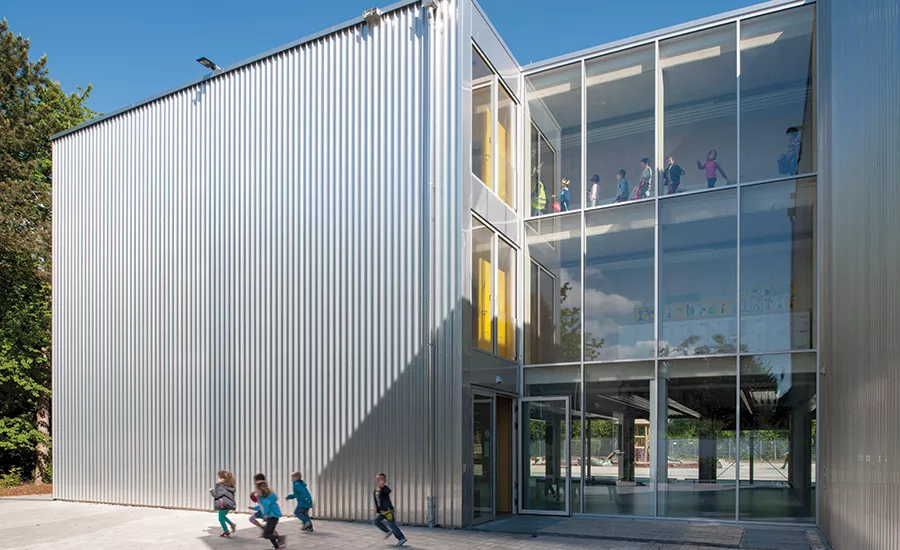
Corrugated, perforated, and matte aluminum cladding make up much of the school’s exterior. But generous triple-glazed windows allow views to the surroundings and make the wood construction visible, even from the outside, so children can see and understand the building’s structure.
Photo © Thomas Mayer
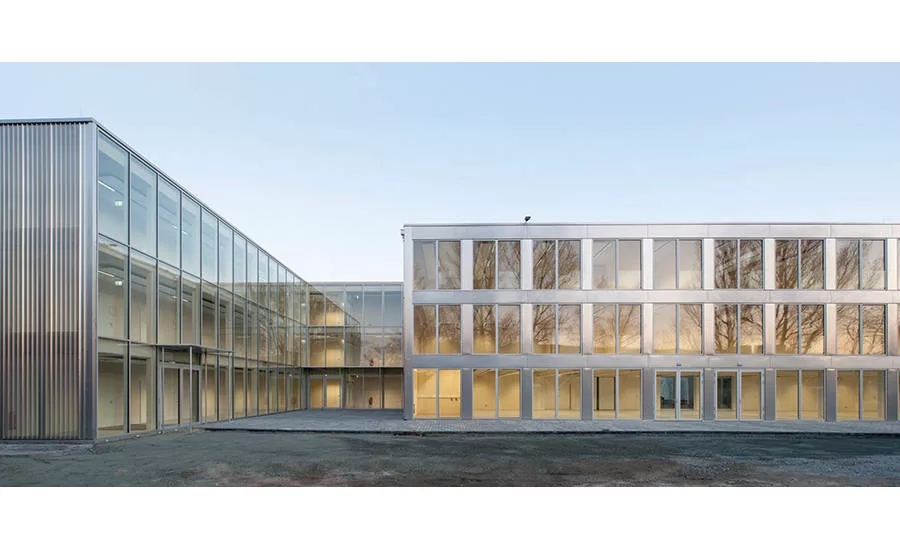
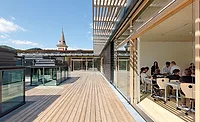
Floor-to-ceiling windows flood the school’s interior with daylight. This expansive fenestration required sunshades on the south and east facades to prevent overheating in summer.
Photo © Thomas Mayer
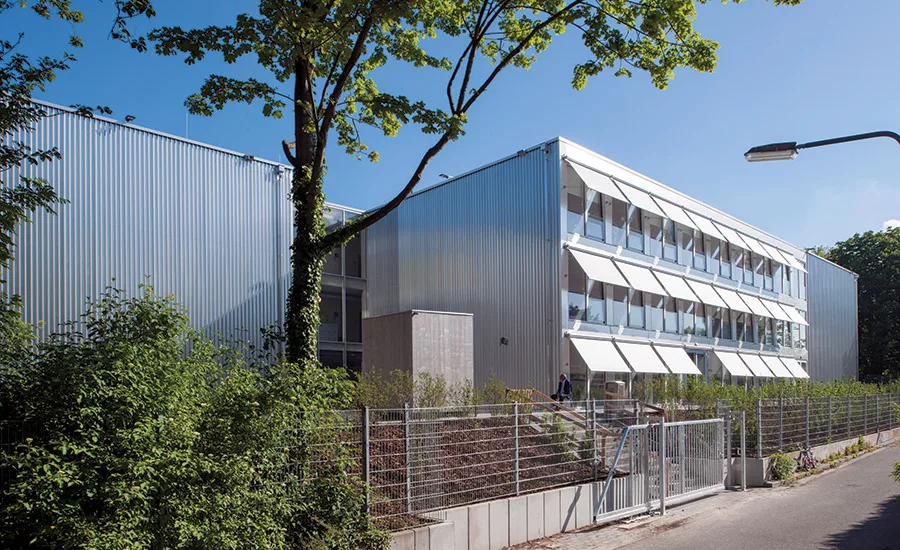
The expansive fenestration required sunshades on the south and east facades to prevent overheating in summer.
Photo © Thomas Mayer
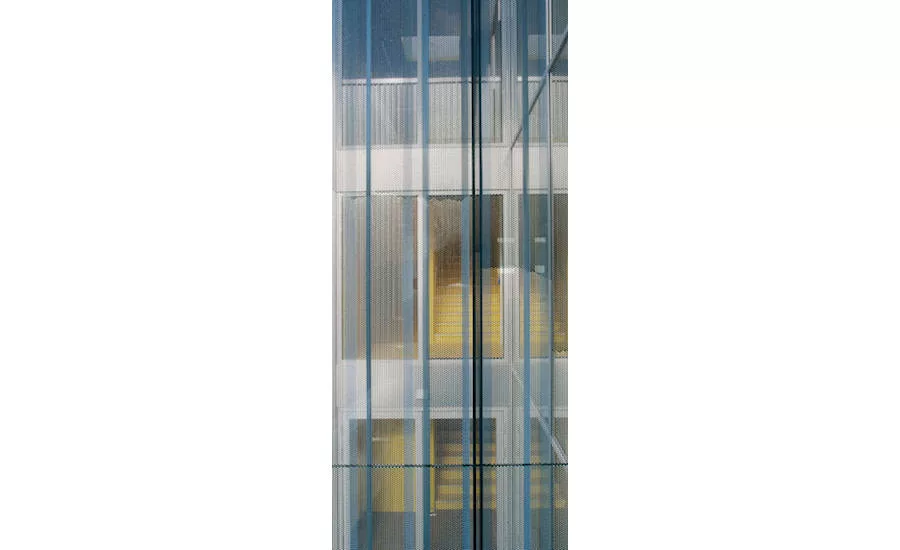
Perforated metal screens cover much of the glazing.
Photo © Thomas Mayer
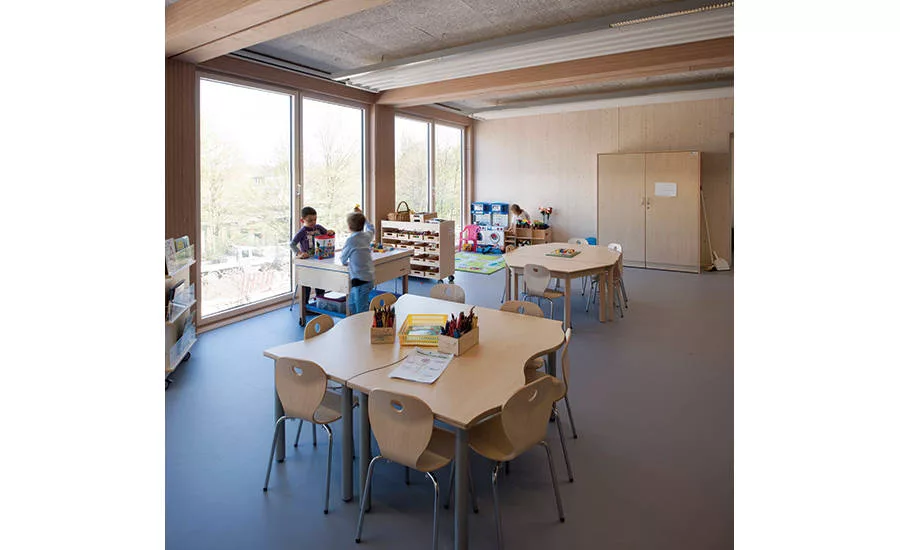
Each classroom is 870 square feet and is made up of three prefabricated wood modules.
Photo © Thomas Mayer
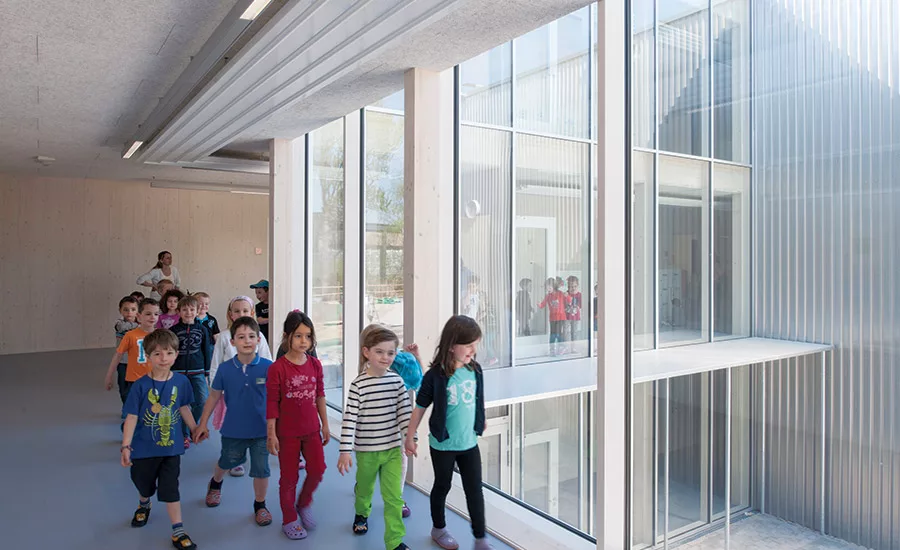
The classrooms are clustered along an L-shaped corridor, which is enclosed by extensive glazing when single-loaded and widens where double-loaded to become a communication zone.
Photo © Thomas Mayer
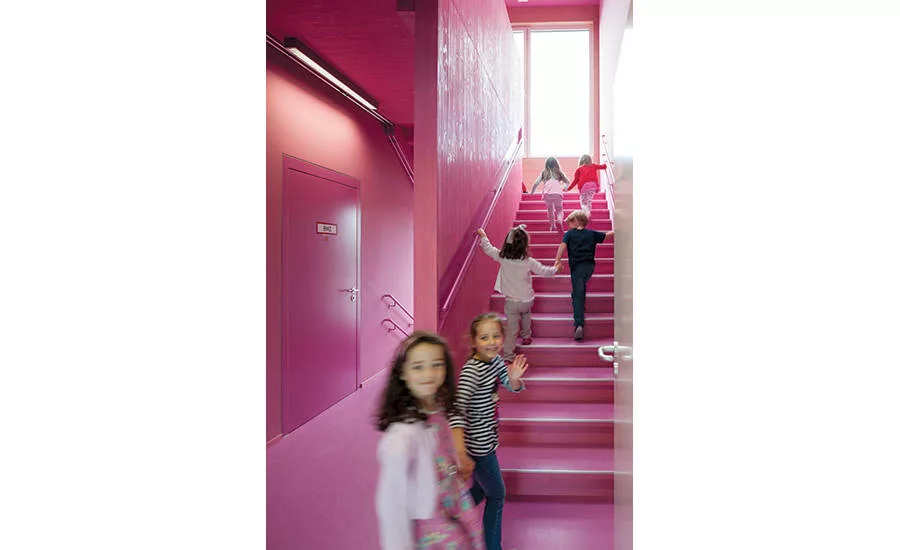
Each stairwell is painted a vibrant color—magenta, lemon yellow, or lime green—providing a contrast to the whitewashed wood surfaces in the classrooms and corridors.
Photo © Thomas Mayer
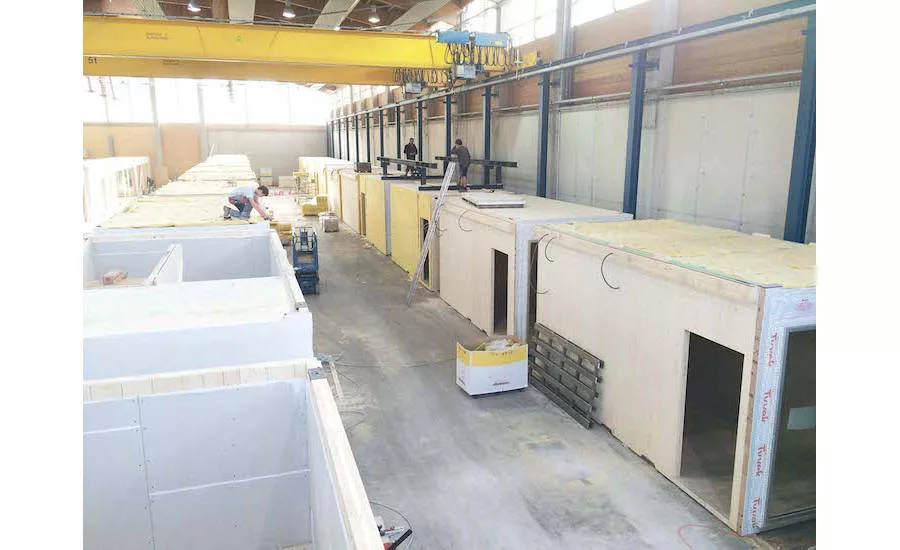
The wood modules, as well as almost all other building parts, including the stairwells, were factory-produced in Austria.
Photo courtesy NKBAK
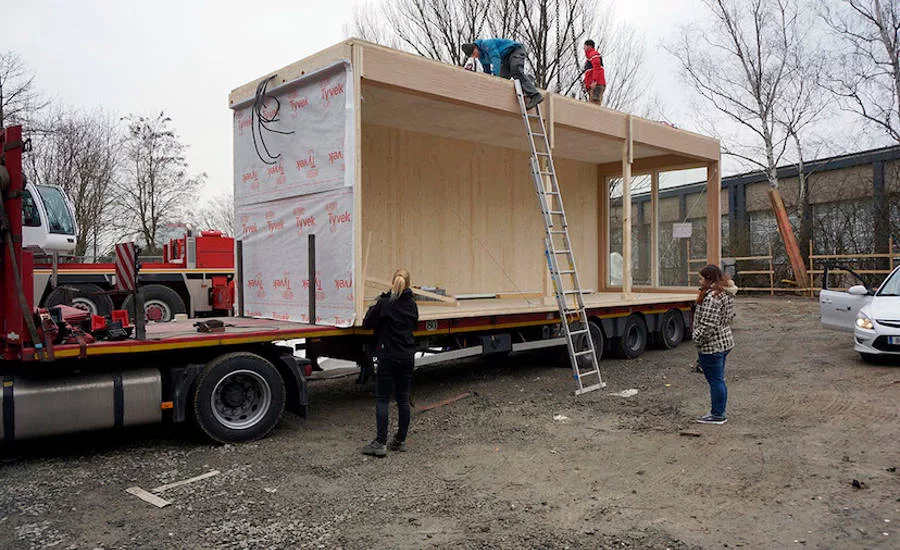
Flatbed trucks transported the prefabricated elements 290 miles to the site, arriving every half hour over a three-and-a-half-week period.
Photo © Thomas Mayer
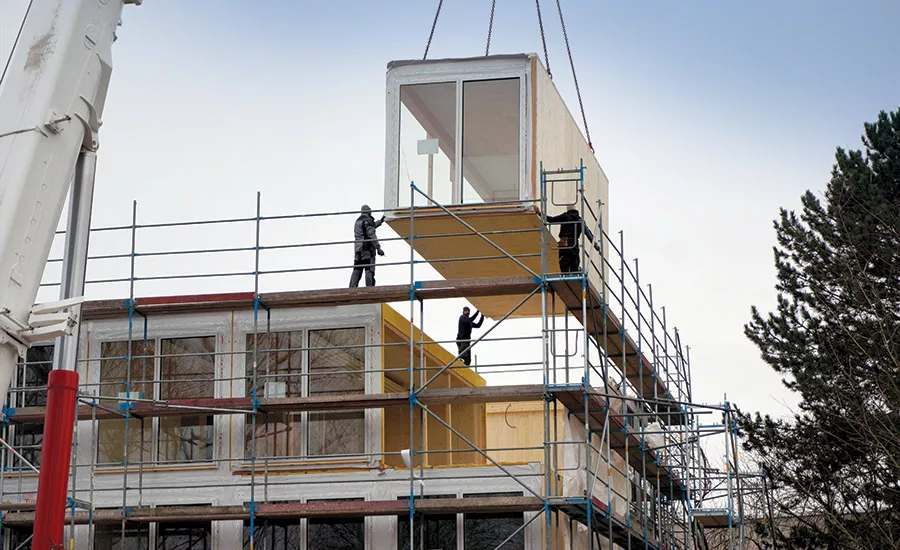
The modules were stacked on a slab and fastened to create a three-dimensional frame stiffened by the stairwell walls.
Photo © Thomas Mayer
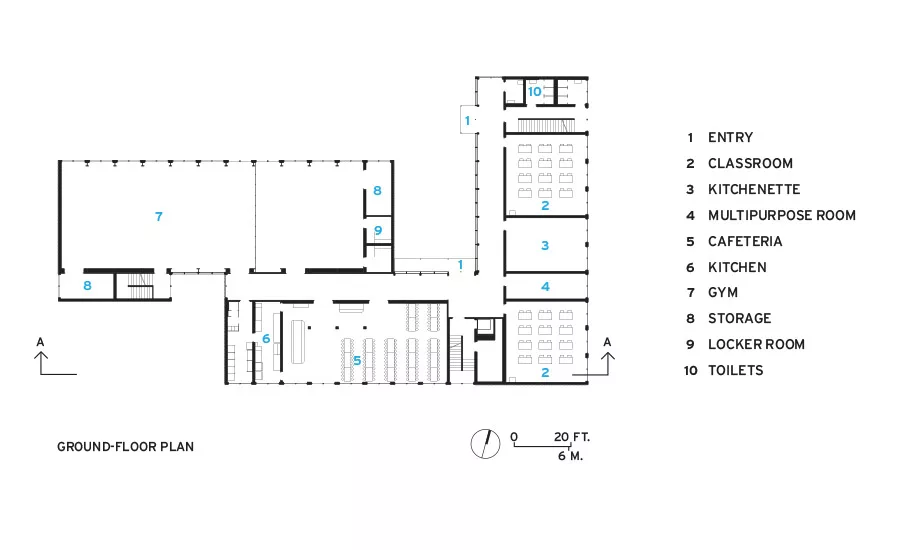
Image courtesy NKBAK
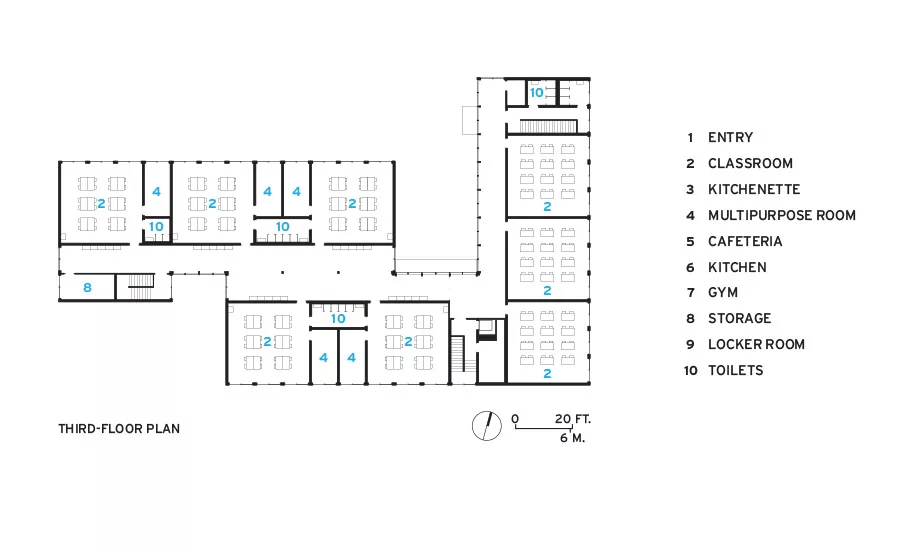
Image courtesy NKBAK
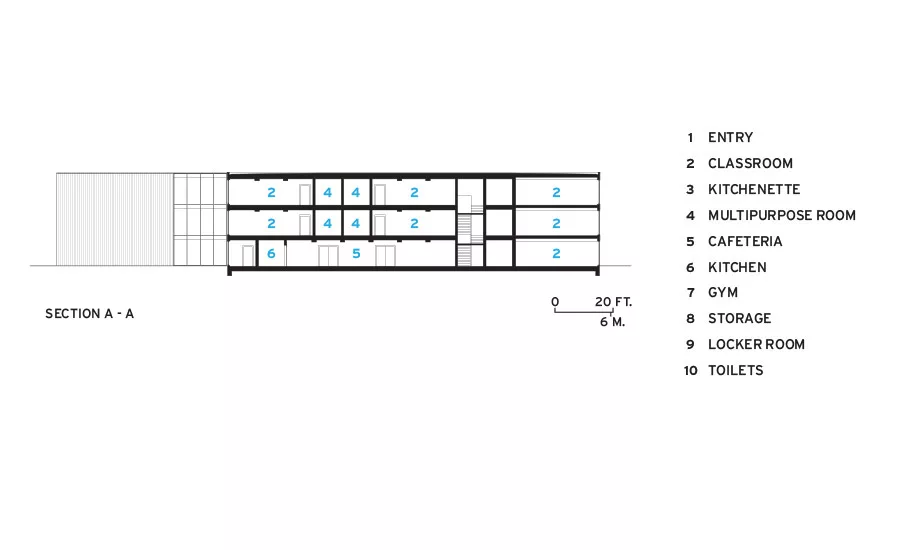
Image courtesy NKBAK
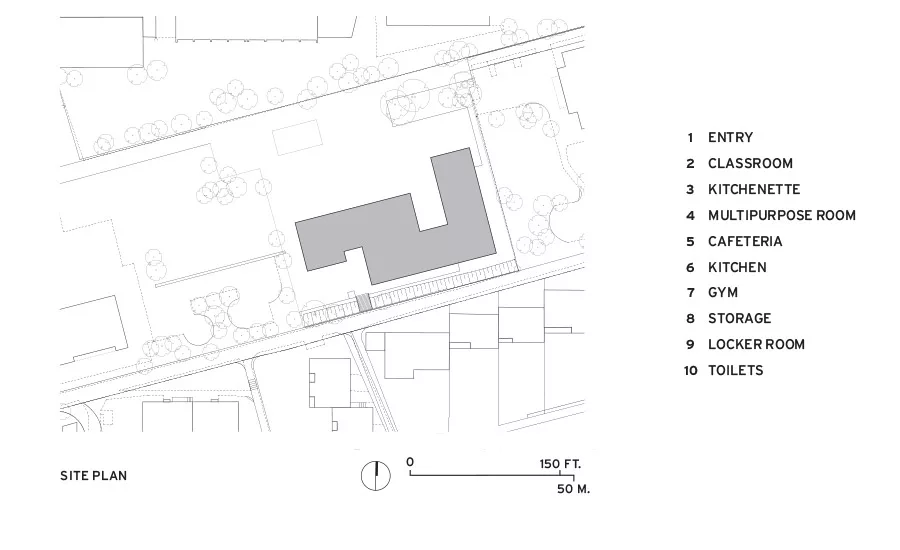
Image courtesy NKBAK
Architects & Firms
Frankfurt
When city officials approached architects NKBAK in late 2013 to design a temporary building for the campus of the European School Frankfurt (ESF), they were more concerned with speed than “an interesting architectural solution,” says firm principal Andreas Krawczyk. A large contingent of European Central Bank employees and their families were poised to move to the German city in the next year, threatening to overcrowd the already at-capacity ESF, which offers pre-K-through-12 instruction for the children of staff at European Union institutions. In such situations, Frankfurt often builds schools out of shipping containers, but Krawczyk and his partner, Nicole Kerstin Berganski, hoped to provide a more innovative alternative, convincing the client to consider other modular systems.
Located on the city’s northwestern periphery, the ESF required the new building to house a cafeteria, a gym, and 17 classrooms for 500 students in preschool, kindergarten, and first grade. Because the school offers children daily lessons in their mother tongue, which can be any one of the 24 official EU languages, each classroom needed a generous 870 square feet, to allow several instructors to teach small groups simultaneously.
Due to a tight schedule, with only 15 months for design and construction, the architects elected to create a modular building using wood. Keeping the classroom dimensions in mind, they laid out the three-story structure on a 9-foot 10-inch grid. Then they designed three types of modules, each measuring 9 feet 10 inches by 29 feet 6 inches: a standard shoebox-like unit, with two long plywood walls; a second type with one long wall and one glue-laminated beam; and a third, with only beams. Single modules function as individual rooms or are combined to create larger spaces. For example, a classroom consists of a beam-only module flanked by two more modules, each with one wall and one beam.
The architects clustered modules along an L-shaped corridor, which is enclosed by extensive glazing when single-loaded and widens when double-loaded to become a communication zone. Common spaces take up most of the ground floor, and classrooms occupy the two upper levels. Floor-to-ceiling windows, all triple-glazed, flood the interiors with daylight. Because the city required that the windows be aluminum-framed for maintenance reasons, the architects chose this material for the flat and corrugated panels and the perforated screens that cover much of the exterior. “A wood facade on a wood building is banal,” says Krawczyk.
The 100 spruce modules were fabricated in Austria with insulation, electrical cables, plumbing and sanitary fixtures, acoustic panels, glazing, and heating units installed at the factory. The fabricator also produced the non-modular wood components—the corridors and stairwells—as well as metal elements such as the facade panels and screens, and the structural steel used to achieve an almost 40-foot-long span over the gym. Flatbed trucks transported the prefabricated elements 290 miles to the site, arriving every half hour over a three-and-a-half-week period.
The modules were stacked on a slab and fastened to create a three-dimensional frame stiffened by the stairwell walls. To avoid damage, some finishes and fixtures, including the varnish of matte whitewash on the interior walls, the vibrant stairwell colors, the dove-gray linoleum floor, and the ceiling luminaires, were added on-site, at the end of the construction process.
In many respects, the project has exceeded expectations: it met the tight schedule, cost 25 percent less than a school built with traditional methods, and is even a game-changer: the city is now planning permanent modular wood schools. The ESF building was initially given a five-year occupancy permit. When it expires, either an extension will be granted or the school could be dismantled and rebuilt elsewhere.
The building does have some problems. The wood structure’s lack of thermal mass and the extensive glazing caused overheating in warm weather, which proved troublesome because the facility houses activities during summer vacation. Additional sunshading and ventilators were recently added to reduce heat gain and improve air circulation.
The school may look tough, but the seemingly weightless cladding and generous fenestration provide glimpses of classroom activity and create a surprisingly welcoming impression. The solution feels thoroughly appropriate for young children.
Inside, the wood construction dominates. The air smells lightly of spruce and, as Kalle Endres, a parent, observes, “The building feels cozy and permanent,” in contrast to classrooms in shipping containers. Nevertheless, the unembellished corridors look slightly unfinished, as if awaiting the users’ touch. Step into the classrooms, however, and the artwork, furnishings, and child-size belongings complete the spaces. “We did not aim to be pedagogical,” says Krawczyk. “We wanted to make a light-filled and spacious school so children can feel free and creative.” He and Berganski have accomplished this without resorting to the cloyingly sweet aesthetic that is often applied to architecture for children. Instead, their building challenges and satisfies with its poetic clarity.
People
Architect NKBAK Interior designer NKBAK Engineers Structure Planning: Bollinger + Grohmann, D - Frankfurt (design engineering); Merz Kley & Partner, A - Dornbirn (detailed engineering) Mechanical Engineer: Hochbauamt Frankfurt, D- Frankfurt Fire protection: Wagner Zeitter Engineers, D - Wiesbaden Consultant Landscape: Dipl.-Ing. Michael Gattinger General contractor Kaufmann Bausysteme, Vorderreuthe 57, A 6870 Reuthe Client Stadtschulamt Frankfurt Size40,000 square feet Cost$6.1 million
Completion dateApril 2015 |
ProductsStructural system Wood modules (the whole structure is made of wood) Structural beams and columns: Pollmeier Massivholz Exterior cladding Metal panels: Profiled sheeting by Aluform Ltd. Metal/glass curtain wall: RAICO Wood: Kaufmann Bausysteme, Ploomeier Massivholz Curtain wall: Becker 360 (executive company) Roofing Built-up roofing: executive company: Gernor Berner Ltd. D - Frankfurt Windows Wood/Aluminum-frame: ALCO Ltd. D - Muenster Glazing Glass: Neutralux Doors Entrances: RAICO Wood doors: Kaufmann Bausysteme Hardware Closers: Dorma Pulls: FSB Interior finishes Acoustical ceilings: Heradesign superfine Cabinetwork and custom woodwork: Kaufmann Bausysteme Wall coverings: Acoustic panels: Topakustik (rear walls in the classrooms) Floor and wall tile, restrooms: Villeroy & Boch, Pro Architectura Carpet, rooms and floors: Linoleum, Forbo Carpet, colored staircases: Linoleum Armstrong DLW Furnishings Chairs and tables, classrooms: Dusyma Lighting Interior ambient lighting: Trilux Conveyance Elevators/escalators: Vestner Ltd. Plumbing Kaufmann Bausysteme Other unique products that contribute to sustainability Ceiling Heating: Zehnder Deutschland Ltd. Sunscreens: clauss markisen Sanitary accessories: Laufen Bathrooms |
Looking for a reprint of this article?
From high-res PDFs to custom plaques, order your copy today!