Isabella Stewart Gardner Museum Extension
Green Machine: An extension to a revered museum is never easy, as Renzo Piano found out in a first foray into Boston.
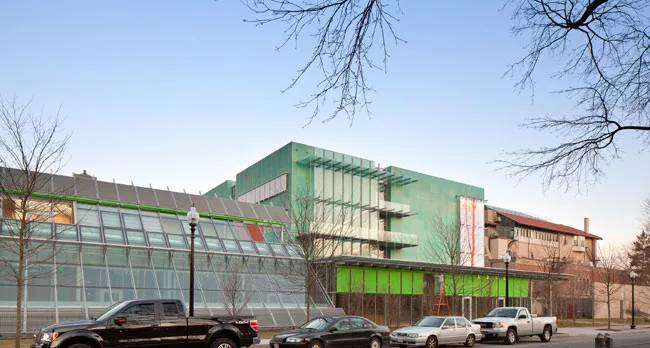
Prepatinated copper, green shades, and a red and white hanging mark the new main entrance facing Evans Way Park.
Photo © Bruce T. Martin
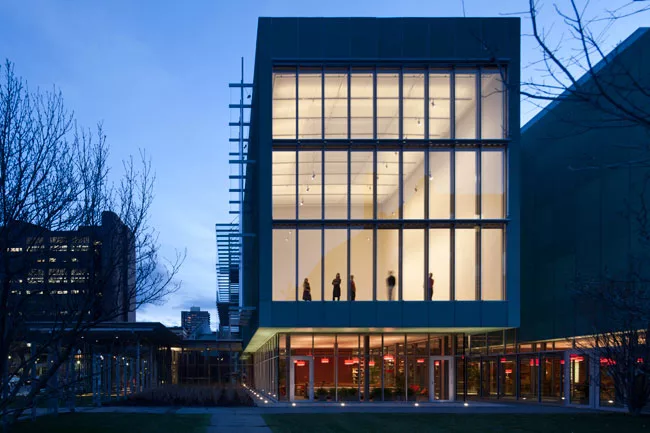
In a 36-foot cubic volume, the Special Exhibition Gallery hovers over the Living Room on the main level.
Photo © Nic Lehoux
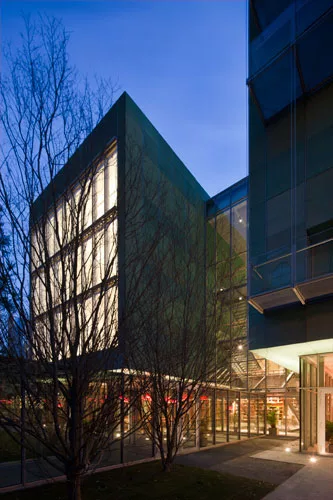
A glass connector links the stair in the new wing to the back (south) side of the old museum.
Photo © Nic Lehoux
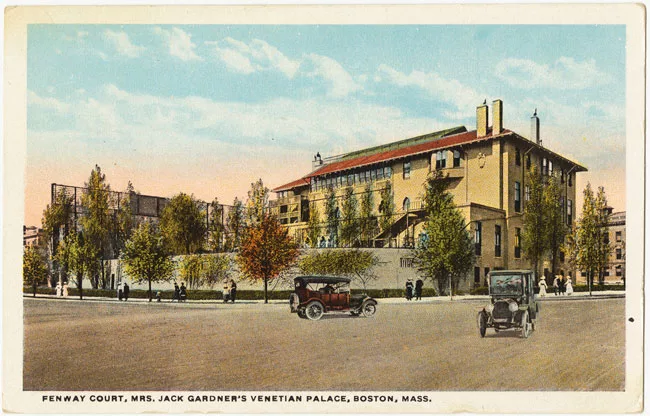
Willard T. Sears designed the Gardner in 1903 to face the Fenway.
Postcard courtesy Boston Public Library
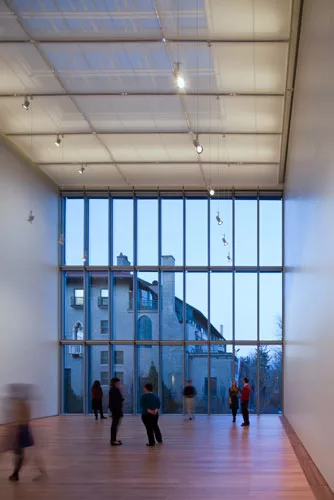
The glass-walled Special Exhibition Gallery overlooks a garden and the back of the Gardner.
Photo © Nic Lehoux
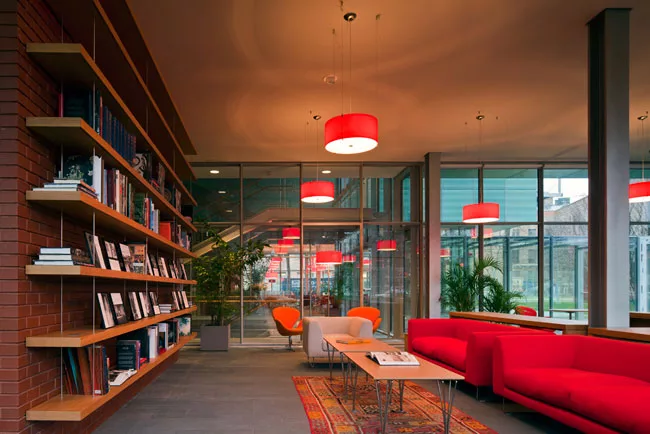
The Living Room on the main floor is enclosed on three sides in glass window walls.
Photo © Nic Lehoux
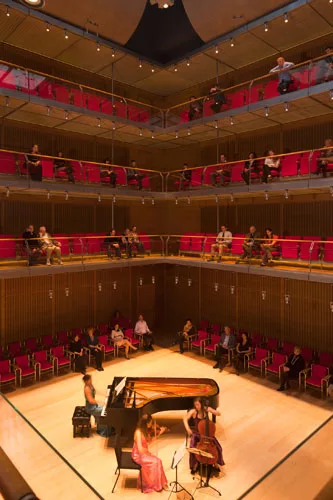
The 42-foot cubic space of Calderwood Hall is topped by a skylight. Beside movable seats on the floor, the concert space is edged with three balconies with single-row seating.
Photo © Nic Lehoux
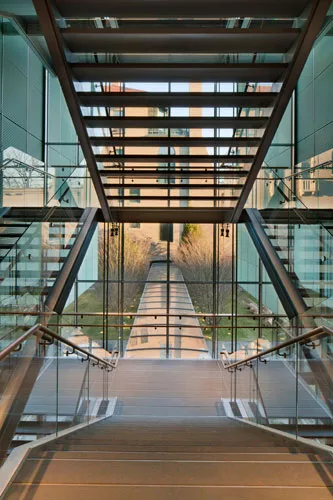
The grand stair in the new wing frames the glass connector taking visitors to the back of the Gardner. Its glass balustrades and open risers heighten the sense of transparency.
Photo © Bruce T. Martin
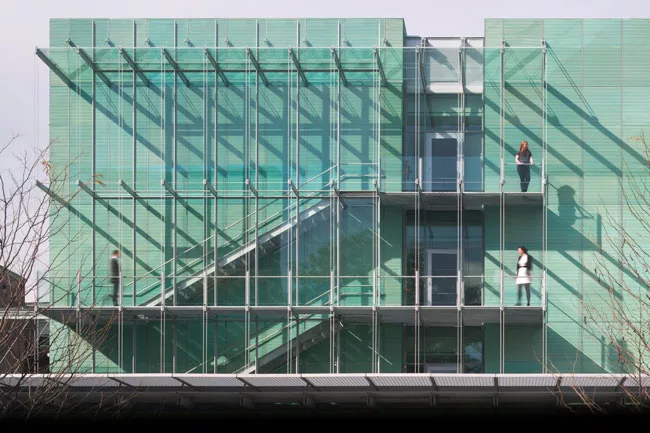
Photo © Nic Lehoux
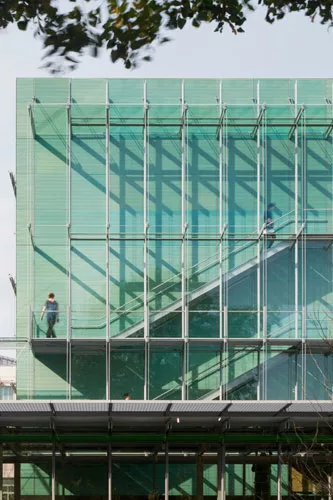
Photo © Nic Lehoux
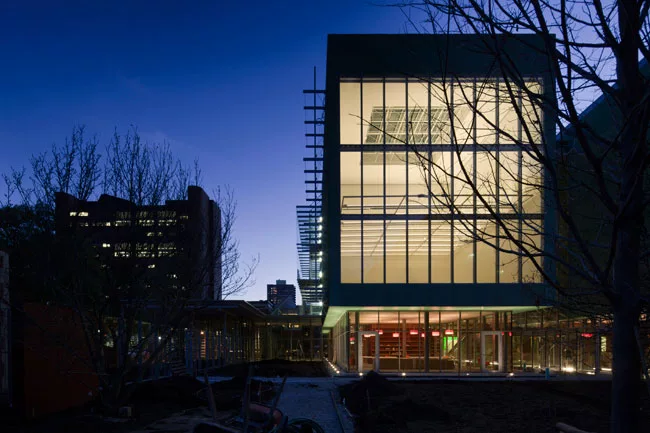
Photo © Nic Lehoux
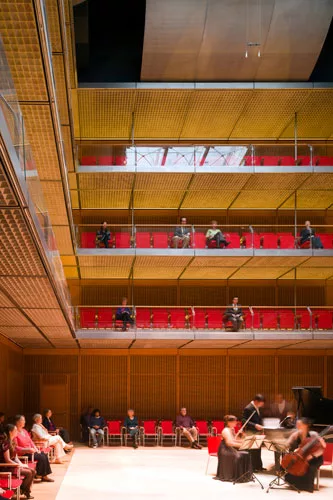
Photo © Nic Lehoux
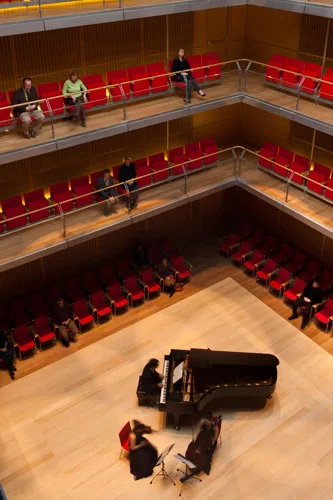
Photo © Nic Lehoux
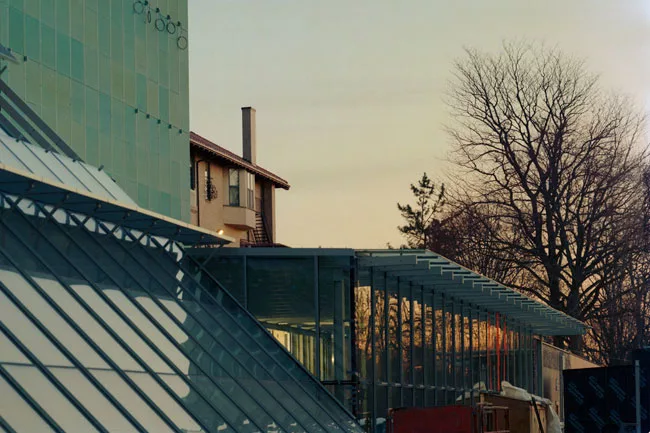
Photo © George Bouret
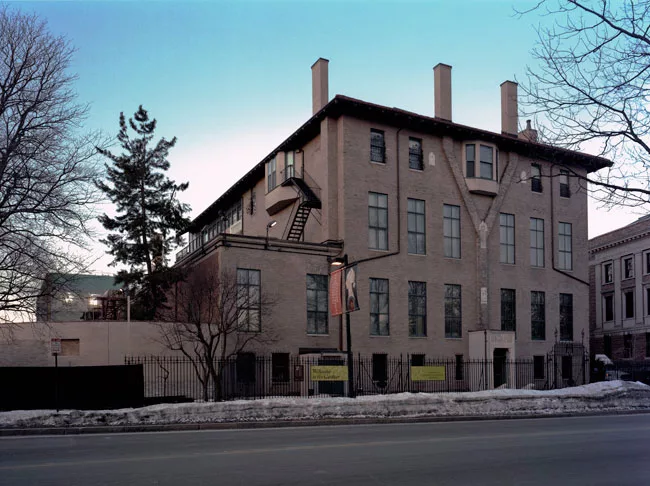
The former main entrance to the Gardner from the Fenway.
Photo © George Bouret
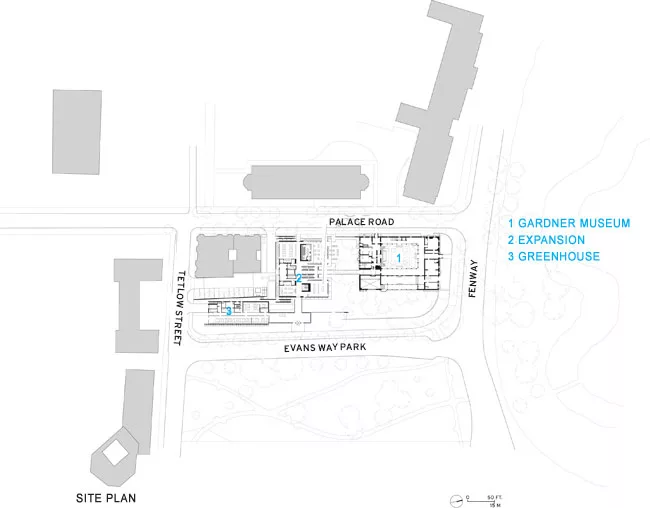
Image courtesy Renzo Piano Building Workshop
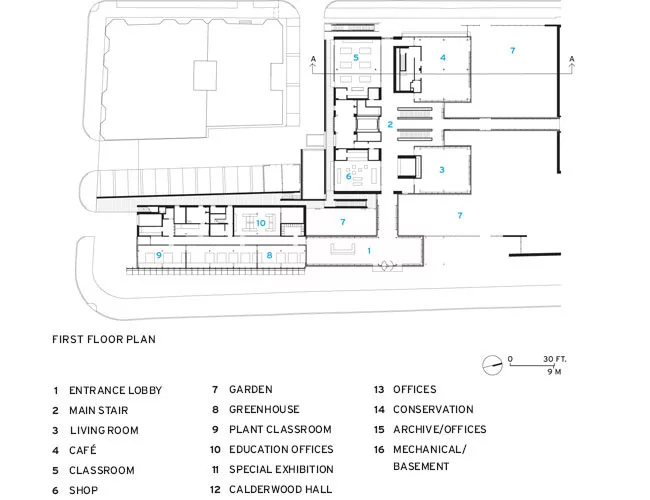
Image courtesy Renzo Piano Building Workshop
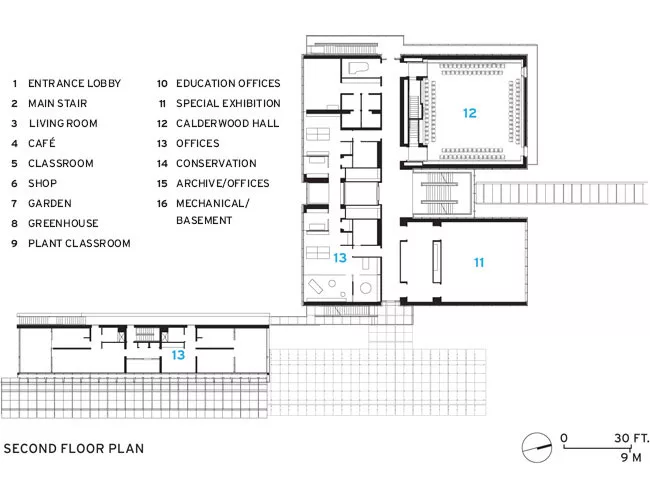
Image courtesy Renzo Piano Building Workshop
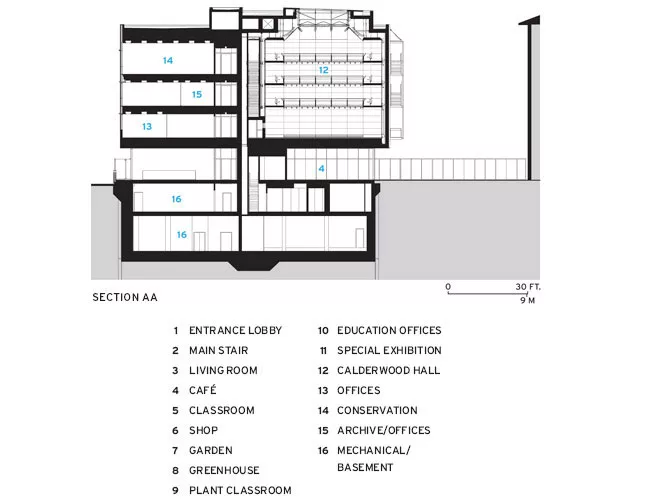
Image courtesy Renzo Piano Building Workshop
Architects & Firms
Boston, Massachusetts
Once you get past the eye-popping turquoise green prepatinated copper of Renzo Piano's new 70,000-square-foot addition to the Isabella Stewart Gardner Museum in Boston, you discover that the new wing echoes the older museum in its proportions, sleek lines, and taut planes. Piano's glass, brick (and copper) cladding for the $114 million steel-frame and poured-concrete structure retains, too, the austerity of the beige brick pile designed in 1903 by architect Willard T. Sears facing the Fenway. While Sears's palazzo for his indomitable dowager-client shows an affinity to 15th century Venetian predecessors, its brick expanses and small, plainly rendered windows evoke as easily early Modernist industrial buildings such as Hans Poelzig's Chemical Factory in Luban, Poland (1912). The factory motif shows up in Piano's scheme as well'not surprising for a Modernist vocabulary.
But now we must return to the copper'the elephant in the backyard. Although naturally patinated copper appears in traditional structures nearby, Piano's decision to prepatinate an expansive skin was dead wrong. The corrugated green screen lacks the subtlety, depth, and faded tone of naturally oxidized copper. And there is so much prepatinated green copper (even if a number of panels bear a yellowish tinge) that it appears flat and homogenous, especially on gray days. In an informal conversation last October, Piano defended the copper covering's 'fragility and lightness.' But he then mused that the prepatination 'does need a little help.' The other major exterior material, a fire-engine-red brick, at least approximates the color of surrounding brick buildings and echoes the smooth texture and scale of the horizontal, almost Roman-size brick, with tightly mortared joints, of the Gardner's beige walls. In addition, Piano's glass-sided fire escapes and balconies do bounce light and articulate the new flat facades.
The old museum's coup de th''tre has always been its interior, where the Italian Renaissance skylit courtyard is surrounded by three floors of galleries that are encrusted with centuries-old architectural fragments; filled out with sturdy, stately furniture; and adorned with grandly scaled tapestries amassed by Gardner. And then, of course, there is the acclaimed trove of art, including works by Rembrandt, Vermeer, Degas, Manet, and Sargent. The varied and rich ensemble comes as a stunning surprise for those first entering this unprepossessing structure.
The museum's decision to expand to accommodate crowds and provide a 6,000-square-foot hall for its musical programs, as well as a 1,650-square-foot greenhouse for plantings, plus two artists-in-residence apartments, posed no physical threat to the actual museum itself. Over the years the Gardner had assembled enough property that Piano's L-shaped wing could be inserted 50 feet away from the back of the older building, next to an existing brick apartment house on the southwest. Unfortunately it meant Gardner's 1908 carriage house had to be torn down, which created a severe dispute with the preservation-minded. Only now is the museum applying for city landmark status. In addition, the team, led by director Anne Hawley since 1989, is striving for LEED Gold certification (eight geothermal wells, rainwater for plants, 28 percent reduction in energy use), which might mend some fences.
Despite the distinct separation of new from old, it should be said that the plan underscores an unsettling trend in museum expansions: when high-roller architects add onto a venerable museum, often you find the main entrance is reoriented to the new (architect-designed) wing. As happened with the Piano-designed addition to the Morgan Library and Museum in New York City (2006), the public rarely sees the original entrance elevation, except by accident. True, the Gardner sorely needed more space for ticketing, a coat check, caf', shop, and orientation'items de rigueur in today's museums. (It also includes advanced security, still a sensitive subject after the yet-unsolved theft of 13 works of art in 1990.) Because the Gardner hopes to increase visitors by 15 percent, to 230,000 a year, Piano's decision to move the main entrance from the Fenway on the north to the east side facing Evans Way Park seemed logical. And, true, the former entrance was hardly grand. Nevertheless, to reach the stunning Gardner interior now takes a wee bit longer.
The new Gardner entrance opens onto a glass and steel shed attached to a greenhouse, with Piano's square main building straight ahead. Here you first encounter a comfortable 'Living Room' (for orientation and relaxing), and beyond that the caf', both occupying pavilion-like glazed enclosures overlooking the back of the old museum. Above, separated by a large stair, are two cubic volumes. One, the Special Exhibition Gallery, 36 feet in three dimensions, has an adjustable-height ceiling for differing display needs, with a glazed wall on the north. The other, Calderwood Hall, is a 42-foot-cubic concert space, topped by a skylight. Both offer crisply majestic ambiences, albeit more understated than the sumptuous galleries and Tapestry Room (where concerts were formerly held) in the palazzo next door.
A cube-shaped space is considered excellent for small concerts (Yasuhisa Toyota of Nagata Acoustics was the consultant): here, three single-row balconies, backed by oak-clad, poured-concrete walls, provide most of the auditorium seating. Of the 296 seats, only 116 occupy the main-floor performance area. One functional observation nags: Seated patrons in the balconies must rise for new arrivals, since space is very tight between the chairs and the wood handrails on which spectators lean to survey the musical offerings below.
One of the most fortunate benefits of the new hall is that the Gardner gets its old Tapestry Room back, which has been restored by the staff to its former magnificence. Also, the (longish) entrance reorientation does create an ultra-dramatic sequence from new architecture to old. The addition's main stair'with glass balustrades and open risers'frames a light-filled, glazed connecting link, which leads in an enfilade fashion to a dark, barrel-vaulted brick antechamber in the old Gardner, before releasing visitors into the east cloister of the resplendent mottled-pink stuccoed courtyard. You have arrived at the heart of the museum, and all else is forgotten. Once the landscaping is fully in place, perhaps the extension will appear more settled and grown-in. If the prepatinated copper does remain disturbing, let's hope climbing ivy can be added to the planting program.
Location: 280 The Fenway, Boston, Massachusetts
Completion Date: January 2012
Gross square footage:
Building area: 70,000 square feet
Cost: $114 million (construction)
PeopleOwner: Isabella Stewart Gardner Museum
Architect:
Personnel in architect's firm who should receive special credit:
Engineer(s):
Consultant(s): Landscape: StossLU Lighting: ARUP Other: Nagata Acoustics (acoustician); Allied Consulting Engineering Services, Inc. (geothermal design); ARUP (security design); Front Inc. (exterior wall system design); Harvey Marshall Berling Associates (audio visual design); Hughes Associates, Inc. (code engineer); McPhail Associates, Inc. (geotechnical consultant); Stuart-Lynn Company (cost consultant); 2x4 Inc. (graphic design). Construction Manager: Shawmut Design and Construction)
Photographer(s): |
Products
Exterior cladding Copper/glass curtain wall: Gartner
Glazing Glass Balustrade: Oldcastle BuildingEnvelope
Interior finishes Bluestone floor, public areas: Kenneth Castellucci & Associates
Lighting |
Looking for a reprint of this article?
From high-res PDFs to custom plaques, order your copy today!
