Architectural Record
search
cart
facebook twitter linkedin youtube
  • Sign In
  • Subscribe
  • Sign Out
  • My Account
Architectural Record
  • NEWS
    • Latest News
    • Awards
    • Interviews
    • Obituaries
    • Podcasts
      • Design:Ed Podcast
      • Sponsored Podcasts
  • OPINION
    • Book Reviews / Excerpts
    • Exhibition Reviews
    • Forum
  • EXCLUSIVES
    • Videos
    • Design Vanguard
    • Top 300 Firms
    • Sponsored Content
    • Sponsored eBooks
    • From the Archives
  • CONTINUING ED
    • Editorial Continuing Ed
    • CE Center
    • CE Academies
  • PROJECTS
    • Buildings By Type
    • Reuse & Renovation
    • Museums & Arts Centers
    • Colleges & Universities
    • Multifamily Housing
    • Interiors
    • Lighting
    • Kitchen & Bath
  • HOUSES
    • Record Houses
    • House of the Month
    • Featured Houses
  • PRODUCTS
    • Products by Category
    • Record Products of the Year
    • Latest Products
  • EVENTS
    • Dates & Events
    • Record on the Road
    • Innovation Conference
    • Sustainability in Practice
    • Women In Architecture
    • Webinars
    • Ad Excellence Awards
    • Submit an Event
  • CONNECT
    • Ask RECORD AI
    • Newsletters
    • Contact
    • Advertise
    • Editorial Calendar
    • Store
    • Customer Service
  • SUBMIT
    • Submission Guidelines
    • RECORD Competitions
  • MAGAZINE
    • Subscribe
    • My Account
    • Digital Edition
    • Current Issue
    • Firm Pass
    • Historic Archive
Residential ArchitectureRecord Houses

18.36.54 House

By Suzanne Stephens
18.36.54 House
18.36.54 House
The house's inhabitants can look through a glazed opening on the south to the pastoral surroundings.
 
Photo © Todd Eberle
18.36.54 House
18.36.54 House
On the west side of the house a patio extends from the living area and kitchen.
 
Photo © Todd Eberle
18.36.54 House
18.36.54 House
From the exterior, the stainless steel panels appear reflective or opaque depending on the position of the observer and the time of day.
 
Photo © Todd Eberle
18.36.54 House
18.36.54 House
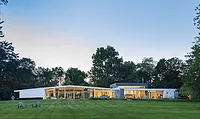
At night interior illumination brings out the pattern of the cladding.
 
Photo © Todd Eberle
18.36.54 House
18.36.54 House
The fluidity of the interior spaces can be seen in the connection between the bathtub (foreground) and the bedroom beyond (which can be closed off).
 
Photo © Todd Eberle
18.36.54 House
18.36.54 House
A ramp from the entrance edges the dining area and gradually descends to the sitting room.
 
Photo © Todd Eberle
18.36.54 House
18.36.54 House
Inside, the angular oak planes and a change in floor level define the cooking area.
 
Photo © Todd Eberle
18.36.54 House
18.36.54 House
 
Image courtesy Studio Daniel Libeskind
18.36.54 House
18.36.54 House
 
Image courtesy Studio Daniel Libeskind
18.36.54 House
18.36.54 House
 
Image courtesy Studio Daniel Libeskind
18.36.54 House
18.36.54 House
 
Image courtesy Studio Daniel Libeskind
18.36.54 House
18.36.54 House
18.36.54 House
18.36.54 House
18.36.54 House
18.36.54 House
18.36.54 House
18.36.54 House
18.36.54 House
18.36.54 House
18.36.54 House
April 16, 2011

Architects & Firms

Studio Libeskind

Connecticut

People/Products

A house is not a museum. And the clients for a 3,000-square-foot weekend retreat in Connecticut clearly knew that. While they are involved in the art world, they did not want their country home to be a gallery-like setting for art. Yet it was the Jewish Museum in Berlin, completed in 1998 by Daniel Libeskind, that spurred them to turn to the architect with this residential commission. Like many visitors to the museum, they had observed that its tilting walls, the angular ceilings, and slanted floors heightened the kinesthetic as well as the visual experience of walking through its spaces.

The clients wanted a house that would have these experiential qualities, as well as provide a place where they could relax, read, cook, and take in the landscape. Libeskind, who is not known for creating cozy cabins in the woods, wondered if the latter meant gem'tlich. One of the owners recalls challenging him: 'Whatever you design, we'll ask you to make it more extreme.' Libeskind said yes, and did not even ask for a contract.

The couple had found a rolling 54-acre site in Connecticut dotted with large oak trees and crumbling fieldstone walls left from the 18th century.The architect's radical interpretation of a weekend getaway turned out to be a stainless steel'paneled house that perches on a grassy knoll like a Russian Constructivist bird: its 18 folds yield 36 knifelike points and 54 lines (both folds and edges) following a mathematical series that guided Libeskind and gave the house its name.

As you approach the front door concealed within burnished steel angles, you could be entering a cottage in the 1920 German Expressionist film The Cabinet of Dr. Caligari, whose convoluted sets were designed by Hermann Warm. But this is for real. The soign' elegance imparted by its materials and design make your next reaction all the more surprising: It is cozy. 'You need that in a house,' says Libeskind.

The underneath surface of the stainless steel roof is clad in oak ' dark, warm, comforting oak. Once inside, a ramp gradually draws you down to the living area and the fireplace around which a built-in sofa zigzags. Libeskind designed all built-in furniture, which includes a dining table, banquettes, and numerous fittings, although the clients salted in a few items, such as George III side chairs and traditional lamps, for a bit of contrast.

Owing to the manipulation of the section and plan, private corners and recesses commingle with the open spaces, and glazed openings give on to expansive, but framed and sheltered, views of the landscape. No curtains or shades block your vision. This 'interstitial glass,' in Libeskind's words, was inserted between the folds of the roof. Only one perpendicular wall ' behind the kitchen area ' stands as an offering to a Euclidean pragmatism. Even the fireplace was tucked into the slanted wall, a remarkable event considering that the clients had forgotten to mention it in the program. (The basement level is more straightforward, and includes a yoga room, storage, and a guest bedroom with a fold-down bed.)

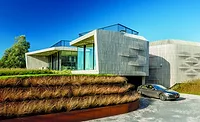
The bronze, stainless steel panels cladding the exterior change in the tones and hues from dark copper to purple to dark brown depending on the position of the observer and the time of day, as do the panels' alternation from a shimmering reflectiveness to a matte opacity.

The stainless steel elements are mounted on plywood structural insulated panels (SIPs), with the entirety supported on a steel frame consisting of four angular arches. On the inside, the oak panels are attached to metal studs mounted on the steel frame. Where they extend outdoors, a different finish compensates for the climatic conditions. (The few interior walls not clad in oak are surfaced in Swedish putty.)

In order to keep the rainwater from discoloring the steel panels, gutters follow the low edges of the roof, and downspouts are embedded within the walls. A radiant system in the concrete floor heats and cools the house, although supplementary forced air can be turned on when desired.

All the technical spaces of the house create a handcrafted object that astonishes with its presence, which Libeskind wanted to be 'aggressive and soothing.' While the custom artifact needs cleaning ' much like a boat ' the clients have got a radically experimental cozy cottage in which to live and entertain. They also got one of Libeskind's best works.


People

Owner: Private

Architect
Studio Daniel Libeskind
2 Rector Street, 19th Floor
New York, NY 10006 USA

Daniel Libeskind, FAIA

Arne Emerson, principal

David Stockwell – Associate, Design
Jerry Figurski, Job Captain, Design
Roy Oei, Design

Interior designer 
Studio Daniel Libeskind

Engineer(s)       
Structural Engineer:
Hage Engineering, NYC
Mark Hage
William Doll

M/E/P:
P A Collins, NYC
Andrew Collins
Marius Blanaru
Kevin Kendall

Consultant(s)
Landscape:   
Kent Greenhouse, Connecticut

Lighting:    
ARUP Lighting, NYC
Matt Franks

Other:   
Building Envelope - Simposon, Gumpertz & Heger, San Francisco and NYC

General contractor
CNR Group, NJ
Jesse Krzywon, President
Mark Sosik
Wojtek Lusinski

Photographer
Todd Eberle

Renderer(s) 
Renderings by Studio Daniel Libeskind

Gross square footage:

 3,027 sq.ft.  Ground Floor and Basement (unfinished)

Completion date:

July 2010


Products

Structural system 
Steel Frame: HyWay Erectors, NJ

Structural Insulated Panels (SIP):
PanelWrights, West Virginia

Exterior cladding
Metal:   
Stainless steel cladding with mirror finish:
Rimex Metals, UK, and by Zahner Metals, KC

Wood:    
Exterior and Interior Stained Oak Paneling:
CNR Group, NJ

Windows
Steel: Crittall Windows, UK

Doors
Entrances: Crittall Windows, UK

Hardware
Closers: ER Butler, NYC

Security devices: Supplied by ESCC, NYC

Cabinet hardware: ER Butler, NYC

Interior finishes
Cabinetwork and custom woodwork: 
Designed Studio Daniel Libeskind and provided by CNR Group.

Paneling: Oak Paneling, walls and ceilings, provided by CNR Group.

Special surfacing: Concrete floor finish,Vermont Eco-Floors, VT

Carpet: Rush Matting provided by Rush Matters, UK

Furnishings
Fixed seating:
All millwork (living dining seating, kitchen island, bedroom furnishing, and stairwell millwork designed by Studio Daniel Libeskind, and fabricated by CNR Group.

Tables:      
Dining table design by Studio Daniel Libeskind and fabricated by CNR Group.

Upholstery: Houston Upholstery, NYC

Lighting
Interior ambient lighting: iO Lighting

Downlights: RSA Architectural Lighting

Task lighting: RSA Architectural Lighting

Exterior: Hydrel – An Acuity Brands Co.

Controls: Lutron Radio RA 2

Plumbing
Custom hardware fixtures was provided in all ground floor areas - designed by Studio Daniel Libeskind and fabricated by CNR Group.

Dornbracht hardware and fixings were used in the basement wet areas.
 
KEYWORDS: Connecticut

Share This Story

Looking for a reprint of this article?
From high-res PDFs to custom plaques, order your copy today!

Stephens

Suzanne Stephens, a former deputy editor of Architectural Record, has been a writer, editor, and critic in the field of architecture for several decades. She has a Ph.D. in architectural history from Cornell University, and teaches a seminar in the history of architectural criticism in the architecture program of Barnard and Columbia colleges.

Post a comment to this article

Report Abusive Comment

Subscription Center
  • Create an Account
  • Start a Subscription
  • Manage My Account
  • Sign Up for Newsletters
  • Visit Customer Service
  • Update Preferences

More Videos

Sponsored Content

Sponsored Content is a special paid section where industry companies provide high quality, objective, non-commercial content around topics of interest to the Architectural Record audience. All Sponsored Content is supplied by the advertising company and any opinions expressed in this article are those of the author and not necessarily reflect the views of Architectural Record or its parent company, BNP Media. Interested in participating in our Sponsored Content section? Contact your local rep!

close
  • TAMLYN XtremeTrim Exterior Trim
    Sponsored byTamlyn

    Designing Cleaner Panel Facades: Why Exterior Trim Details Matter

  • Building with Vapor Barriers
    Sponsored byReef Industries, Inc.

    Vapor Barriers Help Control Moisture in Tighter Building Designs

  • Duct Interior with Prodeq System
    Sponsored byHenry, a Carlisle Company

    Designing Resilient Water Containment Systems

DESIGN:ED Podcast
Listen to Architectural Record’s DESIGN:ED Podcast

Events

June 16, 2026

Focus on the Façade: Exploring Steel, Timber & Fire-Rated Curtain Walls and Channel Glass Systems

Credits: 1 AIA LU/HSW; 1 AIBD P-CE; 0.1 ICC CEU

Explore modern façade and glazing systems that enhance daylighting, fire safety, and thermal performance while expanding architectural design possibilities.

June 18, 2026

Rebooting the Aging Office Building

Credits: 1 AIA LU/HSW; 1 AIBD P-CE; 0.1 ICC CEU; 1 PDH

Explore façade retrofit strategies and award-winning design concepts that can transform aging office buildings into healthier, higher-performing workplaces for today’s hybrid workforce.

View All Submit An Event

Products

2026 Architect's Square Foot Costbook

2026 Architect's Square Foot Costbook

See More Products

Popular Stories

SanDiegoAirport

Top 300 Architecture Firms of 2026

Coronado Bridge

The Architect’s Guide to San Diego

Crane Cove, ONO

Design Vanguard 2026 Winners

House on a Hill

Design Vanguard 2026: Forma

House A on a Hill

Design Vanguard 2026: Santiago Valdivieso

Focus on the Facade - Free Webinar - June 16, 2026

Related Articles

  • New Canaan House

    New Canaan House by Joel Sanders

    See More
  • BrillhartHouse_FT

    Brillhart House

    See More
  • Stony Hill House.

    Stony Hill House by Bates + Masi Architects

    See More

Related Products

See More Products
  • biogenic.jpg

    Manual of Biogenic House Sections

  • iconic house.jpg

    The Iconic House

See More Products
×

The latest news and information

#1 Source for Architectural Design, News and Products

SUBSCRIBE
  • RESOURCES
    • Advertise
    • Contact Us
    • Submit
    • Store
  • ACCOUNT CENTER
    • Create an Account
    • Start a Subscription
    • Manage My Account
    • Sign Up for Newsletters
    • Visit Customer Service
    • Update Preferences
  • PRIVACY
    • PRIVACY POLICY
    • TERMS & CONDITIONS
    • DO NOT SELL MY PERSONAL INFORMATION
    • PRIVACY REQUEST
    • ACCESSIBILITY
  • SERVICES
    • Marketing Services
    • Reprints
    • Market Research
    • List Rental
    • Survey/Respondent Access
  • STAY CONNECTED
    • Linkedin
    • Facebook
    • Instagram
    • YouTube
    • X (Twitter)

Copyright ©2026. All Rights Reserved BNP Media, Inc. and BNP Media II, LLC.

Design, CMS, Hosting & Web Development :: ePublishing