Architectural Record
search
cart
facebook twitter linkedin youtube
  • Sign In
  • Subscribe
  • Sign Out
  • My Account
Architectural Record
  • NEWS
    • Latest News
    • Awards
    • Interviews
    • Obituaries
    • Podcasts
      • Design:Ed Podcast
      • Sponsored Podcasts
  • OPINION
    • Book Reviews / Excerpts
    • Exhibition Reviews
    • Forum
  • EXCLUSIVES
    • Videos
    • Design Vanguard
    • Top 300 Firms
    • Sponsored Content
    • Sponsored eBooks
    • From the Archives
  • CONTINUING ED
    • Editorial Continuing Ed
    • CE Center
    • CE Academies
  • PROJECTS
    • Buildings By Type
    • Reuse & Renovation
    • Museums & Arts Centers
    • Colleges & Universities
    • Multifamily Housing
    • Interiors
    • Lighting
    • Kitchen & Bath
  • HOUSES
    • Record Houses
    • House of the Month
    • Featured Houses
  • PRODUCTS
    • Products by Category
    • Record Products of the Year
    • Latest Products
  • EVENTS
    • Dates & Events
    • Record on the Road
    • Innovation Conference
    • Sustainability in Practice
    • Women In Architecture
    • Webinars
    • Ad Excellence Awards
    • Submit an Event
  • CONNECT
    • Ask RECORD AI
    • Newsletters
    • Contact
    • Advertise
    • Editorial Calendar
    • Store
    • Customer Service
  • SUBMIT
    • Submission Guidelines
    • RECORD Competitions
  • MAGAZINE
    • Subscribe
    • My Account
    • Digital Edition
    • Current Issue
    • Firm Pass
    • Historic Archive
ProjectsBuildings by TypeAdaptive Reuse and Renovation

M/S Maritime Museum of Denmark

Ghost Ship: In the shadow of a 16th-century UNESCO-listed castle, a museum steps into the footprint of Denmark’s maritime industry.

By Philip Tidwell
M/S Maritime Museum of Denmark
The architect left the walls of the 60-year-old dry dock mostly untouched, placing galleries in the underground perimeter, as well as in crisscrossing bridges.
 
Photo © Luca Santiago Mora
M/S Maritime Museum of Denmark
To build the museum, all the soil around the flooded dock needed to be excavated, which would have caused groundwater to push up the dock’s concrete floor.
 
Photo © Dragor Luft
M/S Maritime Museum of Denmark
Anchors were drilled through the slab to a depth of about 148 feet and tied off at the top to keep it pinned in place. Then workers built a slurry wall around the perimeter. Once this was done, the site was drained and excavated. The museum takes an iconic form because the dry dock is conveniently shaped like a boat.
 
Photo © Luca Santiago Mora
M/S Maritime Museum of Denmark
By burying the museum underground, views of Kronberg Castle and other monuments were left undisturbed.
 
Photo © Rasmus Hjortsh
M/S Maritime Museum of Denmark
Three two-level aluminum-clad bridges span the dock’s void. They contain auditoriums and gallery space. A café overlooks the floor of the dock.
 
Photo © Rasmus Hjortsh
M/S Maritime Museum of Denmark
Careful cuts into the old concrete walls bring light into the perimeter galleries.
 
Photo © Luca Santiago Mora
M/S Maritime Museum of Denmark
The museum’s neighbor, Kronberg Castle (the inspiration for Elsinore in Shakespeare’s Hamlet), can be seen from the promenades created by the bridges that zigzag across the dry dock.
 
Photo © Rasmus Hjortsh
M/S Maritime Museum of Denmark
Iceberg-like display cases, by exhibition designer Kossmann.dejong, show off the museum’s collection.
 
Photo © Thijs Wolzak
M/S Maritime Museum of Denmark
An angled stair guides visitors back up to the galleries from the dock floor.
 
Photo © Rasmus Hjortsh
M/S Maritime Museum of Denmark
Photo © Ole Thomsen (before)
Photo © Luca Santiago Mora (after)
M/S Maritime Museum of Denmark
Photo © Rasmus Hjortsh (before)
Photo © Luca Santiago Mora (after)
M/S Maritime Museum of Denmark
Photo © Luca Santiago Mora
M/S Maritime Museum of Denmark
Photo © Rasmus Hjortsh
M/S Maritime Museum of Denmark
Photo © Rasmus Hjortsh
M/S Maritime Museum of Denmark
Photo © Rasmus Hjortsh
M/S Maritime Museum of Denmark
Photo © Rasmus Hjortsh
M/S Maritime Museum of Denmark
Image courtesy BIG
M/S Maritime Museum of Denmark
Image courtesy BIG
M/S Maritime Museum of Denmark
Image courtesy BIG
M/S Maritime Museum of Denmark
Image courtesy BIG
M/S Maritime Museum of Denmark
Image courtesy BIG
M/S Maritime Museum of Denmark
February 15, 2014

Architects & Firms

BIG

Helsingør, Denmark

People/Products

Over the past decade, Bjarke Ingels’s firm BIG has made its reputation primarily by designing some of the most ambitious residential buildings anywhere today. First in Copenhagen and now in New York, Beijing, and other cities, the office has gained international attention by finding opportunities for architectural invention within the tight practical demands of speculative residential development. Over the last six years, as many of those projects have risen, the office has been working to realize an earlier big win: a 2006 competition for the M/S Maritime Museum on the coast of Ingels’s native Denmark. With the project now complete, BIG adds to its burgeoning portfolio an impressive public building that negotiates formal and technical constraints to create a public landmark in a footprint of the nation’s historic shipbuilding industry.

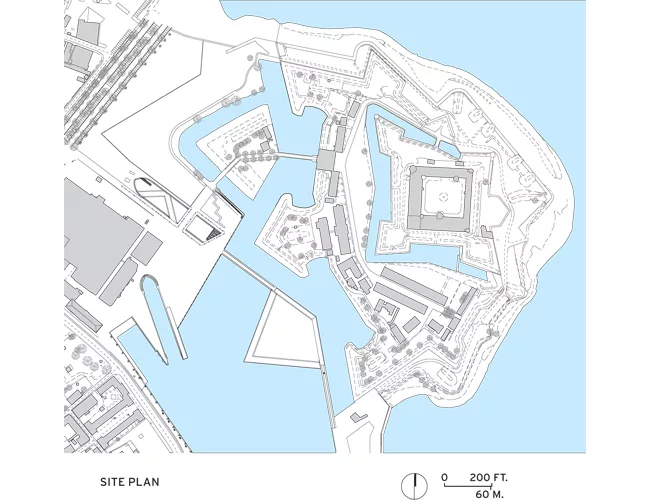
Since it was founded in 1915, the M/S Maritime Museum has been located in the coastal city of Helsingør, at the northern end of the Øresund Strait, at the entrance to the Baltic Sea. Until 2003, the museum was housed in the Kronborg Castle (1574–1585), known to most visitors as Elsinore from Shakespeare’s Hamlet, but equally important for its role in Danish maritime history. With its prominent position along a narrow commercial thoroughfare, the castle served for centuries as a point to collect tolls from passing ships. In 2000, the designation of the castle and its surroundings as a UNESCO World Heritage site forced the museum to relocate. To remain close to the castle and waterfront, the museum decided to move to a nearby 32,000-square-foot dry dock, which once served the city’s shipbuilding industry but had been abandoned and flooded for over two decades. By placing the new facility below grade, the museum would not obstruct views of the castle or disturb the historic ramparts. And by repurposing an industrial relic, it would preserve part of the city’s maritime heritage. The massive concrete structure could not only be saved, but also put to new use presenting the impressive history of which it was part.

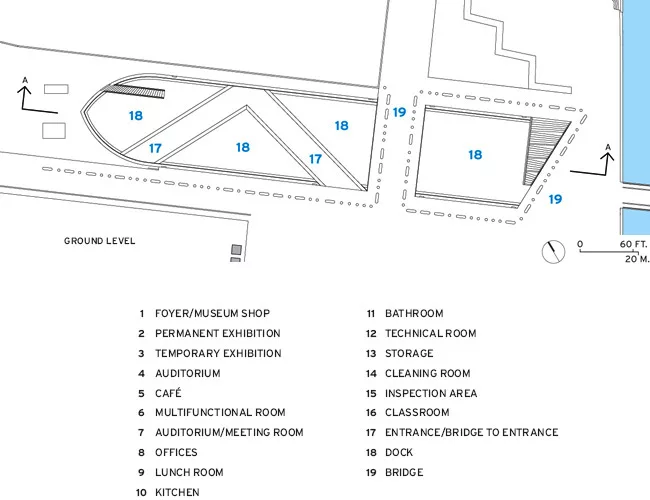
While the solution was mostly effective, the practical demands imposed by such a unique site were not easy to resolve. Galleries and exhibition spaces could be placed in the dock and lit from above, but working spaces and staff offices would require light, views, and circulation that could not be accommodated in the narrow footprint of the sunken space. Recognizing these constraints, the competition brief for the new museum called for over 60,000 square feet of exhibition halls, offices, and conservation facilities to be located partly in the dock and partly in existing structures nearby, effectively dividing the museum into separate buildings. BIG’s winning entry radically reconfigured that program by embedding the building around the perimeter of the void rather than within it. This arrangement allowed the dock to be used as an entry and circulation space as well as a sunken courtyard that would provide light to the surrounding galleries, café, and offices 26 feet below grade. More important, it increased the available program area so that all public and administrative functions could remain together in a single structure.

After nearly six years of extensive design and engineering, the building that has emerged from that winning proposal is a subtle yet surprising addition to the historic waterfront. Walking north from the train station, the silhouette of the castle dominates the horizon, and the only visible portion of the museum is a handrail floating above the surrounding wharf. As visitors near the edge of the low glass perimeter wall, they confront the immense boat-shaped void that serves as the public facade. The museum appears not as a monument so much as an inhabited ruin, an archaeological site undergoing excavation beneath the public promenade. A series of cuts in the walls of the dock allow light and access to the spaces below while providing a hint of the extensive facilities. The battered concrete has been cut with the careful precision of a Gordon Matta-Clark operation to sharpen the contrast between old and new and to reveal the raw beauty of the 5-foot-thick structure. The sharp lines of the aluminum-clad bridges, which guide visitors into and across the sunken pit, heighten the drama of the negative space and provide additional room for exhibitions and events.

In a move characteristic of BIG’s design approach, the entire program is organized around a unifying gesture—an elongated ramp–that extends throughout the length of the building. Halfway along the southern edge of the site, the ramp begins its descent into the dock and turns before proceeding through the concrete wall and entry doors. Continuing past the ticket counter, the ramp moves gradually down through the exhibition galleries and around the perimeter of the void until it reaches the dock floor. The return journey is completed via a less elaborate, though slightly dizzying, ascent up an angled staircase.

This continuously flowing route is a familiar motif for museums. Many architects have experimented with sloping exhibition spaces, but here the gesture is executed with remarkable restraint. The gentle descent is at times barely noticeable as it lulls visitors through the continuous exhibition hall. Along the way, the width of the ramp slowly shifts in accordance with the oblique geometries of the plan, altering the scale and proportions of this elongated room. It alternately compresses and expands, creating moments of intensity and providing a variety of spaces for the museum’s diverse collection of paintings, posters, artifacts, and scale models of ships from a wide range of historical periods.

The impressive feats of engineering, requiring Danish firm Rambøll to bury a museum deep underground on the shores of the Baltic Sea, have inspired a book documenting the project that will be published later this year. However, most visitors will happily overlook the technical achievements of the project as they become absorbed in the gently shifting rhythm of the galleries and the captivating views from within the sunken void. As in sailing across the open sea, planning is important, but most of us just enjoy the ride.


People

Client:
THE DANISH MERCANTILE AND MARITIME MUSEUM

Owner:
THE DANISH MERCANTILE AND MARITIME MUSEUM

Architect:
BIG CPH
Kl'verbladsgade 56
2500 Valby, Copenhagen
Denmark

BIG NYC
601 W. 26th St. Suite 1255
New York, NY 10001
USA

Personnel in architect's firm who should receive special credit:
BIG Credit List
Partner-in-Charge: Bjarke Ingels, David Zahle
Team:
Annette Jensen, Jeppe Ecklon, Karsten Hammer Hansen, Rasmus Rodam, Rune Hansen, John Pries Jensen, Henrik Kania, Ariel Joy Norback Wallner, Rasmus Pedersen, Dennis Rasmussen, Jan Magasanik Alina Tamosiunaite, Alysen Hiller, Ana Merino, Andy Yu , Christian Alvarez, Claudio Moretti, Felicia Guldberg, G'l Ertekin, Johan Cool, Jonas Pattern, Kirstine Ragnhild, Malte Chloe, Marc Jay, Maria Mavriku, Masatoshi Oka, Oana Simionescu, Pablo Labra, Peter Rieff, Qianyi Lim, Sara Sosio, Sebastian Latz, Tina Lund H'jgaard, Tina Troster, Todd Bennet, Xi Chen, Xing Xiong, Xu Li

Engineers:
Ramb'll Denmark A/S, Copenhagen, Denmark

Consultant(s):
Landscape:
Landscape Architect Jens Ravnholt, Stenstrup, Denmark

Lighting:
Delux Denmark ApS, Vallensb'k, Denmark _ Louis Poulsen Lighting A/S, Copenhagen Denmark _X-light I/S, Greve, Denmark

Fire consultant:
Freddy Madsen Engineers, Snekkersten, Denmark

Client Consultant:
Alectia, Virum, Denmark

Exhibition Design:
Kossmann.dejong, Amsterdam, Netherlands

General contractor:
E. Pihl & Son A/S, Kongens Lyngby, Denmark

Photographer(s):
Luca Santiago Mora
Rasmus Hjortsh'j

Size:

77,500 square feet

Cost:

$54 million

Completion date:

October 2013


Products

Glazing
Glass facades:
Scandinavian Glass Systems AB, G'teborg, Sweden

Flooring
Wooden flooring:
Jakon A/S _ Junckers Industries A/S, Denmark

Concrete flooring:
Lodbyg ApS, Holb'k

Interior Finishes
Aluminium Sheating:
Jakon A/S _ Jernkunsten ApS, Taastrup, Denmark

Aluminium Ceilings:
Jakon A/S _ Mogens Rasmussen A/S

Interior glass walls:
Lafuco A/S, Ish'j, Denmark

Stairs:
HB Stairs & Steel A/S, Gentofte, Denmark _ PL Concrete A/S, R'nne, Denmark _ Jakon A/S

Wall painting:
C. M'llmann & Co A/S, R'dovre, Denmark

Granite:
S.A. GRANITE A/S, Randers, Denmark

Resurfacing of the dock bottom:
CC-Tiles Aps, Eskildstrup, Denmark

Linoleum:
JJ-Montage, Gr'sted, Denmark

Ventilation:
Airteam A/S, Roskilde, Denmark

Inventory:
Br'nnum A/S, Herlev, Denmark, Randers inventory carpentry, Dino Steel A/S, Viby J, Denmark

Doors
Doors:
SWEDOOR JELD WEN, Denmark

Fire doors:
Viruma Doors, Karlsminde_ Multi-Tek A/S, Randers, Denmark

Furnishings
Furniture:
Paustian A/S, Copenhagen ', Denmark

Curtains:
Priebe Scene Teknik A/S, Fredericia, Denmark

Lighting
Lamps:
Delux Denmark ApS, Vallensb'k, Denmark _ Louis Poulsen Lighting A/S, Copenhagen Denmark _X-light I/S, Greve, Denmark

Conveyance
Elevators:
O.H. Teknik A/S, H'rning, Denmark _ ThyssenKrupp, Glostrup, Denmark

Plumbing
Lavatories:
Vola A/S, Copenhagen ', Denmark _ Wagner Ewar

Plumbing:
Fredensborg Plumbing Teknik, Fredensborg, Denmark

Sprinkler System:
Danish Sprinkler Teknik A/S, Odense, Denmark

 
KEYWORDS: Denmark

Share This Story

Looking for a reprint of this article?
From high-res PDFs to custom plaques, order your copy today!
Post a comment to this article

Report Abusive Comment

Subscription Center
  • Create an Account
  • Start a Subscription
  • Manage My Account
  • Sign Up for Newsletters
  • Visit Customer Service
  • Update Preferences

More Videos

Sponsored Content

Sponsored Content is a special paid section where industry companies provide high quality, objective, non-commercial content around topics of interest to the Architectural Record audience. All Sponsored Content is supplied by the advertising company and any opinions expressed in this article are those of the author and not necessarily reflect the views of Architectural Record or its parent company, BNP Media. Interested in participating in our Sponsored Content section? Contact your local rep!

close
  • TAMLYN XtremeTrim Exterior Trim
    Sponsored byTamlyn

    Designing Cleaner Panel Facades: Why Exterior Trim Details Matter

  • Building with Vapor Barriers
    Sponsored byReef Industries, Inc.

    Vapor Barriers Help Control Moisture in Tighter Building Designs

  • Duct Interior with Prodeq System
    Sponsored byHenry, a Carlisle Company

    Designing Resilient Water Containment Systems

DESIGN:ED Podcast
Listen to Architectural Record’s DESIGN:ED Podcast

Events

June 16, 2026

Focus on the Façade: Exploring Steel, Timber & Fire-Rated Curtain Walls and Channel Glass Systems

Credits: 1 AIA LU/HSW; 1 AIBD P-CE; 0.1 ICC CEU

Explore modern façade and glazing systems that enhance daylighting, fire safety, and thermal performance while expanding architectural design possibilities.

June 18, 2026

Rebooting the Aging Office Building

Credits: 1 AIA LU/HSW; 1 AIBD P-CE; 0.1 ICC CEU; 1 PDH

Explore façade retrofit strategies and award-winning design concepts that can transform aging office buildings into healthier, higher-performing workplaces for today’s hybrid workforce.

View All Submit An Event

Products

2026 Architect's Square Foot Costbook

2026 Architect's Square Foot Costbook

See More Products

Popular Stories

SanDiegoAirport

Top 300 Architecture Firms of 2026

Coronado Bridge

The Architect’s Guide to San Diego

House A on a Hill

Design Vanguard 2026: Santiago Valdivieso

Dusk House

Design Vanguard 2026: ONO

Crystal Bridges Museum of American Art expansion

Safdie Architects Returns to the Crystal Bridges Museum of American Art for Major Expansion

Focus on the Facade - Free Webinar - June 16, 2026

Related Articles

  • Paris Maritime Museum

    Paris’s Maritime Museum Reopens after a Belowdecks Overhaul by h2o and Snøhetta

    See More
  • Paul S. Russell, MD Museum of Medical History and Innovation

    See More
  • 01.jpg

    Museum of Islamic Art by I. M. Pei

    See More

Related Products

See More Products
  • reuse.jpg

    Resource Salvation: The Architecture of Reuse

See More Products
×

The latest news and information

#1 Source for Architectural Design, News and Products

SUBSCRIBE
  • RESOURCES
    • Advertise
    • Contact Us
    • Submit
    • Store
  • ACCOUNT CENTER
    • Create an Account
    • Start a Subscription
    • Manage My Account
    • Sign Up for Newsletters
    • Visit Customer Service
    • Update Preferences
  • PRIVACY
    • PRIVACY POLICY
    • TERMS & CONDITIONS
    • DO NOT SELL MY PERSONAL INFORMATION
    • PRIVACY REQUEST
    • ACCESSIBILITY
  • SERVICES
    • Marketing Services
    • Reprints
    • Market Research
    • List Rental
    • Survey/Respondent Access
  • STAY CONNECTED
    • Linkedin
    • Facebook
    • Instagram
    • YouTube
    • X (Twitter)

Copyright ©2026. All Rights Reserved BNP Media, Inc. and BNP Media II, LLC.

Design, CMS, Hosting & Web Development :: ePublishing