Architectural Record
search
cart
facebook twitter linkedin youtube
  • Sign In
  • Subscribe
  • Sign Out
  • My Account
Architectural Record
  • NEWS
    • Latest News
    • Awards
    • Interviews
    • Obituaries
    • Podcasts
      • Design:Ed Podcast
      • Sponsored Podcasts
  • OPINION
    • Book Reviews / Excerpts
    • Exhibition Reviews
    • Forum
  • EXCLUSIVES
    • Videos
    • Design Vanguard
    • Top 300 Firms
    • Sponsored Content
    • Sponsored eBooks
    • From the Archives
  • CONTINUING ED
    • Editorial Continuing Ed
    • CE Center
    • CE Academies
  • PROJECTS
    • Buildings By Type
    • Reuse & Renovation
    • Museums & Arts Centers
    • Colleges & Universities
    • Multifamily Housing
    • Interiors
    • Lighting
    • Kitchen & Bath
  • HOUSES
    • Record Houses
    • House of the Month
    • Featured Houses
  • PRODUCTS
    • Products by Category
    • Record Products of the Year
    • Latest Products
  • EVENTS
    • Dates & Events
    • Record on the Road
    • Innovation Conference
    • Sustainability in Practice
    • Women In Architecture
    • Webinars
    • Ad Excellence Awards
    • Submit an Event
  • CONNECT
    • Ask RECORD AI
    • Newsletters
    • Contact
    • Advertise
    • Editorial Calendar
    • Store
    • Customer Service
  • SUBMIT
    • Submission Guidelines
    • RECORD Competitions
  • MAGAZINE
    • Subscribe
    • My Account
    • Digital Edition
    • Current Issue
    • Firm Pass
    • Historic Archive
ProjectsBuildings by TypeAdaptive Reuse and Renovation

Boa Nova Restaurant and Teahouse

Time Machine: A Pritzker Prize winner turns back the clock, restoring one of his first works of architecture after it had fallen into disrepair.

By David Cohn
Boa Nova Restaurant and Teahouse
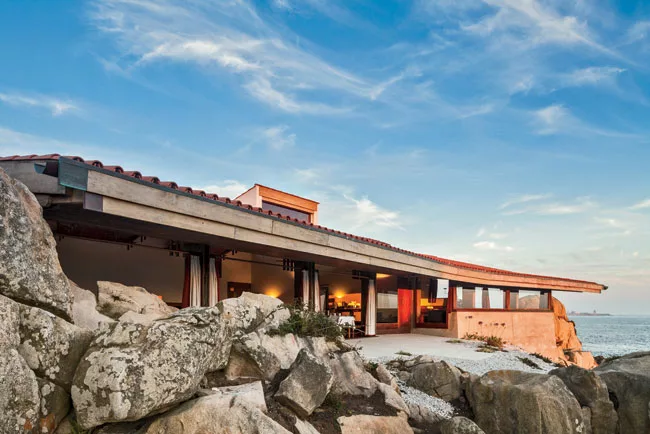
A series of steps and landings leads visitors from a parking lot (not shown) to the restaurant, creating a winding procession that alternates views of the sea with close-ups of the architecture. The building nestles into its rocky, sloped site, so people enter from the upper level. New roof tiles were made to match the originals, but do not yet have the weathered look of those on neighboring buildings.
 
Photo © Joao Morgado
Boa Nova Restaurant and Teahouse
The dining room once again glows with the reddish embrace of floors and ceilings made of afzelia, a tropical hardwood from Africa.
 
Photo © Joao Morgado
Boa Nova Restaurant and Teahouse
New copies of the original tables, chairs, trolleys, and lamps were made with old wood. A two-story atrium leads to a small bar and the tearoom on one side and the dining room on the other.
 
Photo © Joao Morgado
Boa Nova Restaurant and Teahouse
The dining room faces the ocean, to the west. In good weather, floor-to-ceiling windows can retract into the floor to open the room to a terrace and views.
 
Photo © Joao Morgado
Boa Nova Restaurant and Teahouse
The restaurant and teahouse when the project opened in 1963.
 
Photo courtesy 'lavaro Siza
Boa Nova Restaurant and Teahouse
The site before the restaurant was built.
 
Photo courtesy 'lavaro Siza
Boa Nova Restaurant and Teahouse
The dining room shortly after it first opened.
 
Photo courtesy 'lavaro Siza
Boa Nova Restaurant and Teahouse
The building right before restoration work began.
 
Photo courtesy 'lavaro Siza
Boa Nova Restaurant and Teahouse
Image courtesy 'lvaro Siza Vieira
Boa Nova Restaurant and Teahouse
Image courtesy 'lvaro Siza Vieira
Boa Nova Restaurant and Teahouse
Image courtesy 'lvaro Siza Vieira
Boa Nova Restaurant and Teahouse
February 15, 2015

Architects & Firms

Álvaro Siza Vieira

Leça da Palmeira, Portugal

People/Products

'lvaro Siza's restoration of his first building, the Boa Nova Restaurant and Teahouse, five decades after it opened in 1963, is the happy ending to what could have been an architectural tragedy. The casual pavilion, snuggled into a rocky promontory on Portugal's Atlantic coast, in the town of Le'a da Palmeira, 6 miles north of Porto, was left empty by its municipal owners in 2011 and vandalized by thieves, who ripped out copper gutters and wiring for salvage, destroyed the roof and interiors, and left the structure open to the elements.

Fortunately, the building had important defenders, led by the Casa da Arquitectura, a local civic association dedicated to documenting and promoting Portugal's contemporary architecture. Despite the country's deep economic crisis, the organization persuaded the town to restore the structure, after the central government declared it a National Monument, together with Siza's nearby seaside swimming pools of 1962, which did not require restoration. The town brought in Rui Paula, a celebrated chef from Porto, to launch an ambitious restaurant in the space. Siza and his team updated the kitchens to Paula's specifications, and immaculately restored the building, its interiors, and grounds to their original state, including the custom-designed furniture and woodwork.

Boa Nova marked a turning point in the rebirth of Portuguese modernism during the waning years of the Salazar dictatorship (1932'74), which had isolated the country for decades. With its low tiled roofs and deep eaves hovering over the rocks, counterbalanced by irregular, whitewashed vertical volumes rising to form a chimney and a light scoop, the building mixes elements from Portuguese vernacular architecture with influences from Scandinavia, Frank Lloyd Wright, and Japan. Siza was just a student at the time and under the supervision of Fernando T'vora, his teacher at the University of Porto, who exposed the young architect to such international references. Siza began the project with four fellow students, but his scheme won out over the others.

As young architects do, Siza put everything he could find from this new world of references into the design. He recalls, for example, buying a magazine featuring Alvar Aalto's work. 'I didn't have the least idea who he was, but I thought it was marvelous. In Boa Nova, the influence of his Maison Carr' is very clear,' says Siza.

Now 81, Siza brought to the restoration an authenticity and continuity with the original project that would be difficult for anyone else to achieve. He restored the original wood windows, for example, including their single-pane glazing, something a contemporary firm might not have contemplated. Equipped with new motors, the floor-to-ceiling windows in the dining room can once again retract into the floor, merging the space with the adjacent terrace, a detail he picked up from Mies van der Rohe's 1930 Tugendhat House in what was then Czechoslovakia.

The original woodwork and furniture was made with afzelia, a reddish tropical hardwood from Angola (then a Portuguese colony) that was cheap and abundant at the time, but is expensive and difficult to find now. Siza considered the original tables, chairs, and serving carts to be beyond repair, but he found a carpenter with a stock of old wood to remake them, as well as the table lamps with shades made from translucent wood veneer. To treat water stains on the ceilings, he explains, 'an old furniture restorer treated the wood with something, and it doesn't look too bad.' He removed varnish applied in an earlier restoration to the exterior carpentry and treated the wood with oils, giving it a weathered look. As a result, though the building has been thoroughly restored, equipped with modern mechanical services, and brought up to code, one can still sense its time and age. The only elements that are jarring are the new roof tiles, which had to be specially made to match the originals, but lack the patina of seaside exposure.

The project's conversion into a luxury, reservations-only restaurant is a sore point for Siza, as local residents can no longer come simply to drink a coffee or a glass of wine, and architecture students and aficionados find it more difficult to drop by. Visits can be arranged through the Casa da Arquitectura, which is negotiating with Paula for greater access. Siza complains, 'Only rich people can go there. It wasn't a luxury restaurant before. It was built using good materials, but it was very popular. The other day, they even turned away Rafael Moneo!'

Indeed, the accessible, small-scale gentility of the building belongs to a different age, when a concessionaire could make a living serving tea and snacks on a rocky shoreline beside the ocean, in a country suspended in time. Today, a visit to that once-isolated world is reserved for only a few, it seems. As Siza points out, 'The building's use has changed more than its form.'


People

Architect:

'Ivaro Siza Vieira Designer

Client:
Municipal Government of Matosinhos

Owner:
Shorenstein / SRI Nine Boa Nova Restaurant and Teahouse LLC

Architect
Designer:  Álvaro Siza Vieira
             
Collaborators: 
Alberto Neves
António Menéres
Botelho Dias
Joaquim Sampaio

Restoration (in 1991):
Carlos Castanheira
Cristina Ferreirinha
Jane Considine

Restoration (2012-2014):
Carlos Leite Pereira

Consultants (2012-2014)
Structural Engineers:
Jorge Silva
Filipa Abreu

Plumbing:
Raquel Fernandes

Electrical:
Alexandre Martins

Mechanical Engineers:
Raul Bessa
André Tiza
           
Contractor:
Soares da Costa

Lúcios (2013-2014)

Size:

5,250 square feet

Completion date:

July 2014


Products

Furniture:
SPSS – Serafim Pereira Simões
www.spss.pt

Roof Tiles:
SILMAR
www.ceramicasilmar.com

Kitchen equipment:
CIMAGOM
www.cimagom.com

 
KEYWORDS: Portugal

Share This Story

Looking for a reprint of this article?
From high-res PDFs to custom plaques, order your copy today!


David Cohn is a Madrid-based architecture critic and international correspondent for Architectural Record. His latest book, Spain: Modern Architectures in History, was released in 2025.

Post a comment to this article

Report Abusive Comment

Subscription Center
  • Create an Account
  • Start a Subscription
  • Manage My Account
  • Sign Up for Newsletters
  • Visit Customer Service
  • Update Preferences

More Videos

Sponsored Content

Sponsored Content is a special paid section where industry companies provide high quality, objective, non-commercial content around topics of interest to the Architectural Record audience. All Sponsored Content is supplied by the advertising company and any opinions expressed in this article are those of the author and not necessarily reflect the views of Architectural Record or its parent company, BNP Media. Interested in participating in our Sponsored Content section? Contact your local rep!

close
  • TAMLYN XtremeTrim Exterior Trim
    Sponsored byTamlyn

    Designing Cleaner Panel Facades: Why Exterior Trim Details Matter

  • Building with Vapor Barriers
    Sponsored byReef Industries, Inc.

    Vapor Barriers Help Control Moisture in Tighter Building Designs

  • Duct Interior with Prodeq System
    Sponsored byHenry, a Carlisle Company

    Designing Resilient Water Containment Systems

DESIGN:ED Podcast
Listen to Architectural Record’s DESIGN:ED Podcast

Events

June 11, 2026

Very Early Warning Fire Detection for Mission-Critical Facilities

Credits: 1 AIA LU/HSW; 1 AIBD P-CE; 0.1 ICC CEU

Examine advanced fire detection strategies that support uptime and enhance safety in data centers and other mission-critical facilities.

June 16, 2026

Focus on the Façade: Exploring Steel, Timber & Fire-Rated Curtain Walls and Channel Glass Systems

Credits: 1 AIA LU/HSW; 1 AIBD P-CE; 0.1 ICC CEU

Explore modern façade and glazing systems that enhance daylighting, fire safety, and thermal performance while expanding architectural design possibilities.

View All Submit An Event

Products

2026 Architect's Square Foot Costbook

2026 Architect's Square Foot Costbook

See More Products

Popular Stories

Practice Matters illustration

What’s in a (Firm’s) Name? Thinking About Succession and Legacy

Coronado Bridge

The Architect’s Guide to San Diego

Practice Matters illustration

By the Numbers: Counting America's Architects

Crane Cove, ONO

Design Vanguard 2026 Winners

House on a Hill

Design Vanguard 2026: Forma

Broader Sustainability of CMU - Free Webinar - May 21, 2026

Related Articles

  • Le Monde Media Plaza.

    Le Monde Media Plaza by Snøhetta and SRA Architects with BOA Light Studio

    See More
  • Lawrencetown House

    Bishop McDowell Extends Nova Scotia’s Vernacular with a Contemporary Oceanside House

    See More

Related Products

See More Products
  • Architectural Record - July 2025

    Architectural Record July 2025 Issue

See More Products

Events

View AllSubmit An Event
  • June 2, 2026

    Adaptive Reuse for Multi-Family Residential: Transforming Historic Structures into Sustainable Housing

    NOW ON DEMANDCredits: 1 AIA LU/HSW; 1 AIBD P-CE; 0.1 ICC CEUExplore real-world adaptive reuse case studies that show how to transform historic buildings into high-performing, sustainable multi-family housing while preserving architectural character.
View AllSubmit An Event
×

The latest news and information

#1 Source for Architectural Design, News and Products

SUBSCRIBE
  • RESOURCES
    • Advertise
    • Contact Us
    • Submit
    • Store
  • ACCOUNT CENTER
    • Create an Account
    • Start a Subscription
    • Manage My Account
    • Sign Up for Newsletters
    • Visit Customer Service
    • Update Preferences
  • PRIVACY
    • PRIVACY POLICY
    • TERMS & CONDITIONS
    • DO NOT SELL MY PERSONAL INFORMATION
    • PRIVACY REQUEST
    • ACCESSIBILITY
  • SERVICES
    • Marketing Services
    • Reprints
    • Market Research
    • List Rental
    • Survey/Respondent Access
  • STAY CONNECTED
    • Linkedin
    • Facebook
    • Instagram
    • YouTube
    • X (Twitter)

Copyright ©2026. All Rights Reserved BNP Media, Inc. and BNP Media II, LLC.

Design, CMS, Hosting & Web Development :: ePublishing