Architectural Record
search
cart
facebook twitter linkedin youtube
  • Sign In
  • Subscribe
  • Sign Out
  • My Account
Architectural Record
  • NEWS
    • Latest News
    • Awards
    • Interviews
    • Obituaries
    • Podcasts
      • Design:Ed Podcast
      • Sponsored Podcasts
  • OPINION
    • Book Reviews / Excerpts
    • Exhibition Reviews
    • Forum
  • EXCLUSIVES
    • Videos
    • Design Vanguard
    • Top 300 Firms
    • Sponsored Content
    • Sponsored eBooks
    • From the Archives
  • CONTINUING ED
    • Editorial Continuing Ed
    • CE Center
    • CE Academies
  • PROJECTS
    • Buildings By Type
    • Reuse & Renovation
    • Museums & Arts Centers
    • Colleges & Universities
    • Multifamily Housing
    • Interiors
    • Lighting
    • Kitchen & Bath
  • HOUSES
    • Record Houses
    • House of the Month
    • Featured Houses
  • PRODUCTS
    • Products by Category
    • Record Products of the Year
    • Latest Products
  • EVENTS
    • Dates & Events
    • Record on the Road
    • Innovation Conference
    • Sustainability in Practice
    • Women In Architecture
    • Webinars
    • Ad Excellence Awards
    • Submit an Event
  • CONNECT
    • Ask RECORD AI
    • Newsletters
    • Contact
    • Advertise
    • Editorial Calendar
    • Store
    • Customer Service
  • SUBMIT
    • Submission Guidelines
    • RECORD Competitions
  • MAGAZINE
    • Subscribe
    • My Account
    • Digital Edition
    • Current Issue
    • Firm Pass
    • Historic Archive
ProjectsBuildings by TypeHealth Care Design

UCLA Outpatient Surgery and Medical Building

Light Touch: The Corbusian pavilions of the UCLA Outpatient Surgery and Medical Building, by Michael W. Folonis Architects, bring daylight to the patient experience.
By Laura Raskin
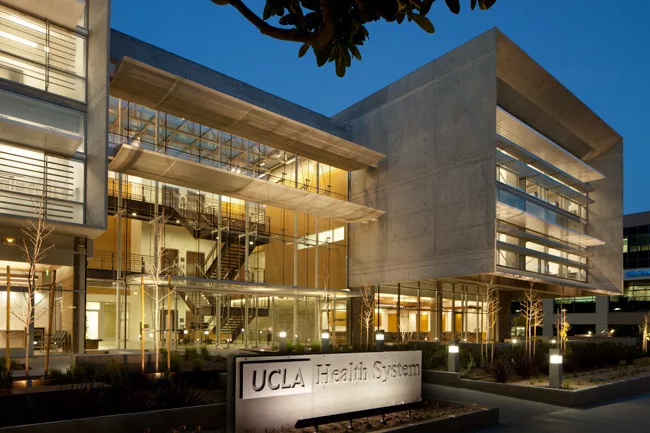
The architect divided the center’s massing between two concrete pavilions; the southern volume cantilevers 25 feet over a first-floor waiting room. A central glass lobby glows at night.
UCLA Outpatient Surgery and Medical Building
Michael W. Folonis Architects
Santa Monica, California
The architect divided the center’s massing between two concrete pavilions; the southern volume cantilevers 25 feet over a first-floor waiting room. A central glass lobby glows at night.
Photo © Tom Bonner
The center stands alone on the site, allowing each elevation to receive direct sunlight. Staff lounges and offices along the southern facade have views from windows framed by red metal boxes.
UCLA Outpatient Surgery and Medical Building
Michael W. Folonis Architects
Santa Monica, California
The center stands alone on the site, allowing each elevation to receive direct sunlight. Staff lounges and offices along the southern facade have views from windows framed by red metal boxes.
Photo © Tom Bonner
A steel stair in the lobby leads to second- and third-floor bridges that direct visitors to the north or south pavilion.
UCLA Outpatient Surgery and Medical Building
Michael W. Folonis Architects
Santa Monica, California
A steel stair in the lobby leads to second- and third-floor bridges that direct visitors to the north or south pavilion.
Photo © Tom Bonner
Prep and recovery rooms on the second floor benefit from northwestern sun that filters through horizontal louvers.
UCLA Outpatient Surgery and Medical Building
Michael W. Folonis Architects
Santa Monica, California
Prep and recovery rooms on the second floor benefit from northwestern sun that filters through horizontal louvers.
Photo © Tom Bonner
The architect carries the material palette—bamboo panels and concrete—throughout the public spaces, including the third-floor clinic waiting room.
UCLA Outpatient Surgery and Medical Building
Michael W. Folonis Architects
Santa Monica, California
The architect carries the material palette—bamboo panels and concrete—throughout the public spaces, including the third-floor clinic waiting room.
Photo © Tom Bonner
The ground-floor waiting room has views through the central lobby.
UCLA Outpatient Surgery and Medical Building
Michael W. Folonis Architects
Santa Monica, California
The ground-floor waiting room has views through the central lobby.
Photo © Tom Bonner
UCLA Outpatient Surgery and Medical Building
Michael W. Folonis Architects
Santa Monica, California
Image courtesy Michael W. Folonis Archit
UCLA Outpatient Surgery and Medical Building
Michael W. Folonis Architects
Santa Monica, California
Image courtesy Michael W. Folonis Archit
UCLA Outpatient Surgery and Medical Building
Michael W. Folonis Architects
Santa Monica, California
Image courtesy Michael W. Folonis Archit
UCLA Outpatient Surgery and Medical Building
Michael W. Folonis Architects
Santa Monica, California
Image courtesy Michael W. Folonis Archit
The architect divided the center’s massing between two concrete pavilions; the southern volume cantilevers 25 feet over a first-floor waiting room. A central glass lobby glows at night.
The center stands alone on the site, allowing each elevation to receive direct sunlight. Staff lounges and offices along the southern facade have views from windows framed by red metal boxes.
A steel stair in the lobby leads to second- and third-floor bridges that direct visitors to the north or south pavilion.
Prep and recovery rooms on the second floor benefit from northwestern sun that filters through horizontal louvers.
The architect carries the material palette—bamboo panels and concrete—throughout the public spaces, including the third-floor clinic waiting room.
The ground-floor waiting room has views through the central lobby.
UCLA Outpatient Surgery and Medical Building
August 16, 2012

Architects & Firms

Michael W. Folonis Architects

Santa Monica, California

Michael Folonis reacted with baffled delight when he was chosen to design the 50,000-square-foot, three-story UCLA Outpatient Surgery and Medical Building in Santa Monica. He had no background in health care. But his client, Randall Miller, an owner-developer who was constructing the building with the intention of leasing it to UCLA, simply told him that a good architect should be able to design anything.


Educated at SCI-Arc and UCLA, Santa Monica–based Folonis worked for Frank Gehry and Ray Kappe before starting his own firm in 1983. His residential, mixed-use, and preservation work of the last three decades expresses his loyalty to the legacy of California Modernists—buildings that use daylight as a material and strive to connect the interior with the outdoors. Perhaps because his portfolio does not include other medical buildings, the architect was able to bring an unencumbered approach and elegance to the UCLA center. “I needed to think about what this building means to people,” says Folonis. “What it means to me is: This is a very scary place. How can I change this experience?”

Two smooth, poured-in-place concrete pavilions frame the three floors and rest on a base of board-formed concrete. A central glass-walled atrium topped with a fritted glass roof separates the two volumes. (A rooftop photovoltaic array supplies 15 percent of the facility's energy. The building is slated for LEED Gold certification.)

To make the lobby as transparent as possible, the architect decided on a point-fixed curtain wall: Suspended sheets of glass are joined with spider fittings, which in turn connect to shiplike steel masts. This system delicately holds the glass in place and eliminates the need for heavy mullions. Three perforated metal sunshades on the exterior shield the western facade from the sun. In addition, the atrium acts as a chimney, funneling warm air up and out when the entry doors are open and a fan is on.

“Wayfinding in most of these places is unbelievably difficult” and an unnecessary stress for visitors, says Folonis. A central, cantilevered steel stair with bamboo treads in the lobby organizes the space, connecting the second- and third-floor bridges that link to services, such as the clinics that span both pavilions on the third floor. Because concrete can be rough and cold, the architect clad many of the interior walls in the public spaces with bamboo panels, to “soften the edge.”

Since the service aspects of the program—such as oncology, prep, and recovery—take up more room than the support spaces, the architect housed them in the larger, north pavilion. It was important to Folonis to push prep and recovery rooms to the glazed northern and western perimeters, rather than the dark cores where they are typically relegated. Even the sterile corridor behind the operating rooms gets daylight from clerestory windows along the eastern facade. On the ground floor, the linear accelerator, the device that uses X-rays to destroy cancer cells, is enclosed in the building's concrete base to prevent radiation leaks.

The smaller, south pavilion contains staff lounges, amenities, and offices. The architect also set this smaller volume apart by cantilevering the second and third floors 25 feet over the first, shading the main waiting room where patients' friends and family members may spend hours. From here they can wander out to a garden designed by Paula Burton.

With no room to grow in UCLA's inpatient hospital across the street, designed by Robert A.M. Stern (with its Italianate flair, it could be seen as the architectural opposite of Folonis's almost Corbusian center), the university needed to shift outpatient services but keep them close, says Richard Azar, director of real estate and design and construction for UCLA's health system. When owner-developer Miller purchased the site in late 2007, it came with the stipulation that he had to build a medical center and give first dibs to UCLA (which had previously owned two of the four combined parcels). It proved to be perfect timing for the university.

UCLA knew it wanted an ambulatory-surgery clinic with eight operating rooms, a radiation-oncology clinic, a blood lab, general clinics, and parking; it worked with Miller, Folonis, and the late health-care planner George Pressler to refine the program room by room.

Over a six-month period, building users, including operating-room nurses, prep/recovery nurses, and sterile-processing technicians, voiced their needs for the center in a series of focus groups. “We weren't building to the typical University of California spec, where everything is 300 percent oversized and gold-plated. We designed a delivery system to avoid that,” says Miller. He also conceived an innovative automated parking system below the center (see sidebar, right).

Collaborating with UCLA, Pressler, and the user groups helped Folonis to focus on his thesis: that there was no reason a medical building couldn't achieve a connection to the outdoors and be filled with daylight. The result is an advanced outpatient center that respects its patients and staff: a great model for the future, since signs point to all but the most acute care taking place outside of large, unwieldy hospitals in years to come.

“It's one of these things that as a young architect, which I'm not, you try to tell potential clients: that you can design lots of different building types,” says Folonis, who is still moved by the opportunity he was given. “It's really about having somebody who will believe in you.”

The waiting area in the garage extends architect Michael Folonis's material theme, with bamboo panels on the ceiling and concrete benches (top). The automated system (bottom) reduces parking volume by 50 percent compared with conventional garages, and saves at least 10,000 miles annually because drivers aren't circling multilevel garages as they look for parking spaces, according to owner-developer Randall Miller.

Park and Go

Speedy automated parking below the UCLA Outpatient Surgery and Medical Building reduces stress and energy use.

“It's not uncommon in Los Angeles to see parking structures that are bigger than buildings,” says Randall Miller, the owner-developer of the UCLA Outpatient Surgery and Medical Building. To avoid that ratio and relieve patients and their caregivers of the stress of parking and searching for their cars, Miller paired a software company with a manufacturer to create a 380-space system to his specifications: Visitors wait only two or three minutes for their cars to be retrieved and rotated so that they face out of the garage, ready to drive away.

“I wanted a people-friendly system,” says Miller. “The public area needed to be wide open. I didn't want anything coming at you from the floor, or grates where you get your high heels stuck.”

At the center, drivers park in one of six drop-off bays, as directed by LED signs, then swipe their UCLA identification card or a credit card at a kiosk. The automated system takes over, directing one of two cranes to align its lift platform with the bay where the car is parked. A roll-up garage door opens, allowing a load-handling device, called the satellite, to slide underneath the car. The satellite lifts the car about an inch off the ground by cradling the tires and carries it onto the crane's lift platform. The crane takes the car to its storage location by moving vertically and horizontally. Valets, watch out! L.R.

Size: 50,000 square feet

Construction cost: $28 million

Completion date: February 2012

Architect:
Michael W. Folonis Architects
1424 Fourth Street, 3rd floor
Santa Monica, California 90401
Phone: 310-899-3920
Fax: 310-899-3930

People

Owner: Sixteenth Street Medical Center LP

Architect:
Michael W. Folonis Architects
1424 Fourth Street, 3rd floor
Santa Monica, California 90401
Phone: 310-899-3920
Fax: 310-899-3930

Personnel in architect's firm who should receive special credit:
-Michael W. Folonis, FAIA Principal
-Rudy Gonzalez, Project Architect
-James Kersten, Design Team
-Tommy Johnson, Design Team

Design Professional of record:
Randy Miller, PE

Interior designer: Michael W. Folonis Architects

Engineer(s):
Mechanical Engineer: Vision Mechanical.
Plumbing/Electrical Engineer: Levine Seegel Associates.
Structural Engineer: Nautilus Group

Consultant(s):
Landscape: Pamela Burton & Company
Lighting: Kaplan Gehring McCarroll Architectural Lighting
Acoustical: Arup
Other: Medical Planner: Planning Decision Resources/George Pressler, AIA
LEED Consultant: Arup

General contractor: Nautilus Group

Photographer: Tom Bonner, 310.396.7125

Renderer: Michael W. Folonis Architects


Products

Structural system
List type, e.g. concrete or steel frame, wood, etc.: concrete
Manufacturer of any structural components unique to this project: Novum curtainwall

Exterior cladding

Metal Panels: Azurelite
Metal/glass curtain wall: Oldcastle Glass
Curtain wall: Avic Sanxin; Novum

Glazing

Glass: Oldcastle Glass; Avic Sanxin
Skylights: Aluminex

Doors

Metal doors: Seeley Brothers
Wood doors: Seeley Brothers
Sliding doors: Horton Automatic
Fire-control doors, security grilles: The Cookson Company
Special doors (sound control, X-ray, etc.): J&S Metco (radiation door)

Hardware

Other special hardware: Cabinet Hinges: Blum

Interior finishes

Acoustical ceilings: USG
Cabinetwork and custom woodwork: Artcrafters Cabinets; SierraPine Composite Solutions
Paints and stains: Dunn-Edwards Paints
Paneling: Marlite; McNichols
Plastic laminate: Wilsonart International
Solid surfacing: DuPont Corian; Cesarstone
Resilient flooring: Lonseal (“Lonfloor Flecks” and “Loneco Topseal”); Johnsonite; Capri Cork
Special interior finishes unique to this project: Smith & Fong (“Plyboo”)

Furnishings

Office furniture: Humanscale (“Liberty” designed by Niels Diffrient); Herman Miller (“Canvas Office Landscape” designed by Consultants for Design Strategy, Douglass Ball, and JRuiter + Studio)
Reception furniture: Vitra (“Airline” designed by Norman Foster); Herman Miller (“Setu” designed by Studio 7.5); Coalesse (“Switch” designed by EOOS)
Chairs: Humanscale (“Liberty” designed by Niels Diffrient); Steelcase (“Move”); Herman Miller (“Setu” designed by Studio 7.5); Coalesse (“Switch” designed by EOOS)
Tables: Coalesse (“Calm” designed by Pamela Light); Herman Miller (“Eames Table” designed by Charles and Ray Eames); Herman Miller (“Canvas Office Landscape” designed by Consultants for Design Strategy, Douglass Ball, and JRuiter + Studio)
Upholstery: Vitra (“Vinyl Valencia”); Pallas Textiles (“Holy Cow”); Momentum Textiles (“Rein”); DesignTex
Other furniture (use additional sheet if necessary):
Lockers: Ideal Products (“1000 Series”)
Cubicle Curtain Fabric: Knoll Textiles (“Divine” designed by Dorothy Cosonas)

Lighting

Interior ambient lighting: Axis Lighting (“Beam”); Oracle Lighting
Downlights: Maxilume Architectural Lighting
Task lighting: New Star Lighting (“StarSurgical”)
Pendant lights: Sistemalux (“Modem”)
Exterior: Lumenton Lighting
Dimming System or other lighting controls: Lutron; Lighting Control & Design

Conveyance

Elevators: ThyssenKrupp Elevators

Plumbing

Chicago Faucets; Just Manufacturing

Energy
Energy management or building automation system: Siemens
Photovoltaic system: Martifer Solar

Other unique products that contribute to sustainability:
Automated Garage System: Criterion Manufacturing Solutions

 
KEYWORDS: California

Share This Story

Looking for a reprint of this article?
From high-res PDFs to custom plaques, order your copy today!


Lr
Laura Raskin, a former RECORD editor, writes about architecture. She recently moved with her family from Brooklyn, New York, to the Green Mountains of Vermont.

Post a comment to this article

Report Abusive Comment

Subscription Center
  • Create an Account
  • Start a Subscription
  • Manage My Account
  • Sign Up for Newsletters
  • Visit Customer Service
  • Update Preferences

More Videos

Sponsored Content

Sponsored Content is a special paid section where industry companies provide high quality, objective, non-commercial content around topics of interest to the Architectural Record audience. All Sponsored Content is supplied by the advertising company and any opinions expressed in this article are those of the author and not necessarily reflect the views of Architectural Record or its parent company, BNP Media. Interested in participating in our Sponsored Content section? Contact your local rep!

close
  • TAMLYN XtremeTrim Exterior Trim
    Sponsored byTamlyn

    Designing Cleaner Panel Facades: Why Exterior Trim Details Matter

  • Building with Vapor Barriers
    Sponsored byReef Industries, Inc.

    Vapor Barriers Help Control Moisture in Tighter Building Designs

  • Duct Interior with Prodeq System
    Sponsored byHenry, a Carlisle Company

    Designing Resilient Water Containment Systems

DESIGN:ED Podcast
Listen to Architectural Record’s DESIGN:ED Podcast

Events

June 16, 2026

Focus on the Façade: Exploring Steel, Timber & Fire-Rated Curtain Walls and Channel Glass Systems

Credits: 1 AIA LU/HSW; 1 AIBD P-CE; 0.1 ICC CEU

Explore modern façade and glazing systems that enhance daylighting, fire safety, and thermal performance while expanding architectural design possibilities.

June 18, 2026

Rebooting the Aging Office Building

Credits: 1 AIA LU/HSW; 1 AIBD P-CE; 0.1 ICC CEU; 1 PDH

Explore façade retrofit strategies and award-winning design concepts that can transform aging office buildings into healthier, higher-performing workplaces for today’s hybrid workforce.

View All Submit An Event

Products

2026 Architect's Square Foot Costbook

2026 Architect's Square Foot Costbook

See More Products

Popular Stories

Coronado Bridge

The Architect’s Guide to San Diego

SanDiegoAirport

Top 300 Architecture Firms of 2026

Crane Cove, ONO

Design Vanguard 2026 Winners

House on a Hill

Design Vanguard 2026: Forma

House A on a Hill

Design Vanguard 2026: Santiago Valdivieso

Focus on the Facade - Free Webinar - June 16, 2026

Related Articles

  • University of California, San Francisco Osher Center Medical Office Building

    See More
  • Seton Medical Center, Surgery/Emergency Department

    See More
  • Ronald Reagan UCLA Medical Center

    See More

Related Products

See More Products
  • facade.jpg

    Sustainable Facades: Design Methods for High-Performance Building Envelopes

  • manual

    2026 National Building Cost Manual

See More Products
×

The latest news and information

#1 Source for Architectural Design, News and Products

SUBSCRIBE
  • RESOURCES
    • Advertise
    • Contact Us
    • Submit
    • Store
  • ACCOUNT CENTER
    • Create an Account
    • Start a Subscription
    • Manage My Account
    • Sign Up for Newsletters
    • Visit Customer Service
    • Update Preferences
  • PRIVACY
    • PRIVACY POLICY
    • TERMS & CONDITIONS
    • DO NOT SELL MY PERSONAL INFORMATION
    • PRIVACY REQUEST
    • ACCESSIBILITY
  • SERVICES
    • Marketing Services
    • Reprints
    • Market Research
    • List Rental
    • Survey/Respondent Access
  • STAY CONNECTED
    • Linkedin
    • Facebook
    • Instagram
    • YouTube
    • X (Twitter)

Copyright ©2026. All Rights Reserved BNP Media, Inc. and BNP Media II, LLC.

Design, CMS, Hosting & Web Development :: ePublishing