Architectural Record
search
cart
facebook twitter linkedin youtube
  • Sign In
  • Subscribe
  • Sign Out
  • My Account
Architectural Record
  • NEWS
    • Latest News
    • Awards
    • Interviews
    • Obituaries
    • Podcasts
      • Design:Ed Podcast
      • Sponsored Podcasts
  • OPINION
    • Book Reviews / Excerpts
    • Exhibition Reviews
    • Forum
  • EXCLUSIVES
    • Videos
    • Design Vanguard
    • Top 300 Firms
    • Sponsored Content
    • Sponsored eBooks
    • From the Archives
  • CONTINUING ED
    • Editorial Continuing Ed
    • CE Center
    • CE Academies
  • PROJECTS
    • Buildings By Type
    • Reuse & Renovation
    • Museums & Arts Centers
    • Colleges & Universities
    • Multifamily Housing
    • Interiors
    • Lighting
    • Kitchen & Bath
  • HOUSES
    • Record Houses
    • House of the Month
    • Featured Houses
  • PRODUCTS
    • Products by Category
    • Record Products of the Year
    • Latest Products
  • EVENTS
    • Dates & Events
    • Record on the Road
    • Innovation Conference
    • Sustainability in Practice
    • Women In Architecture
    • Webinars
    • Ad Excellence Awards
    • Submit an Event
  • CONNECT
    • Ask RECORD AI
    • Newsletters
    • Contact
    • Advertise
    • Editorial Calendar
    • Store
    • Customer Service
  • SUBMIT
    • Submission Guidelines
    • RECORD Competitions
  • MAGAZINE
    • Subscribe
    • My Account
    • Digital Edition
    • Current Issue
    • Firm Pass
    • Historic Archive
ProjectsBuildings by TypeHealth Care Design

Rey Juan Carlos Hospital

The Royal Treatment: Rafael de La-Hoz Arquitectos crafts a serenely restorative environment for Madrid's Rey Juan Carlos Hospital.

By David Cohn
Rey Juan Carlos Hospital
Six circular skylights punctuate the bright-red canopy of the emergency entry.
 
Photo © Duccio Malagamba
Rey Juan Carlos Hospital
Patients and their families enter through an airy, daylit hall that leads off to diagnostic and treatment areas.
 
Photo © Duccio Malagamba
Rey Juan Carlos Hospital
A motif of circles'appearing as windows, skylights, and roof planters throughout 'extends beyond the hospital to its grounds and a heliport.
 
Photo © Duccio Malagamba
Rey Juan Carlos Hospital
The ovoid patient-room modules atop the main medical-services plinth are centered on two planted atria.
 
Photo © Duccio Malagamba
Rey Juan Carlos Hospital
Porthole-like windows in each private room look out onto the hospital's suburban surroundings.
 
Photo © Duccio Malagamba
Rey Juan Carlos Hospital
Image courtesy Rafael De La-Hoz Arquitectos
Rey Juan Carlos Hospital
Image courtesy Rafael De La-Hoz Arquitectos
Rey Juan Carlos Hospital
Image courtesy Rafael De La-Hoz Arquitectos
Rey Juan Carlos Hospital
Image courtesy Rafael De La-Hoz Arquitectos
Rey Juan Carlos Hospital
March 16, 2013

Architects & Firms

Rafael de La-Hoz Arquitectos

Madrid, Spain

People/Products

Behind the eye-catching design of the 969,000-square-foot Rey Juan Carlos Hospital in the Madrid suburb of M'stoles, Spanish architect Rafael de La-Hoz has created a therapeutic atmosphere, organizing the building around accessible atria that help orient patients and immerse them in a protective, inward-looking environment. These spaces also ensure that all patient areas have direct access to natural light.

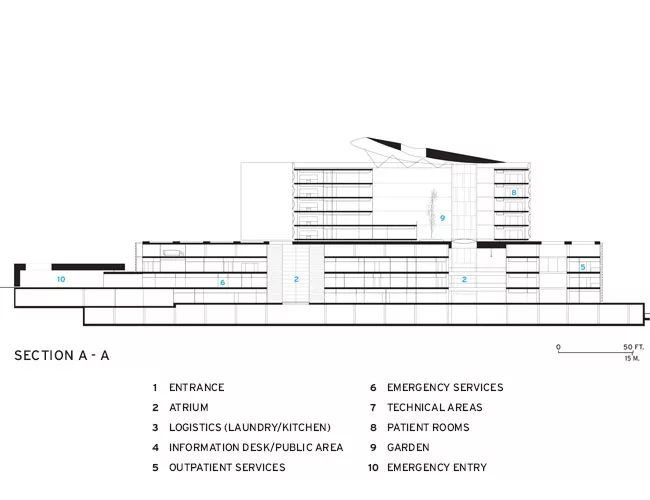
Working with a tight site and leaving room for a future addition, De La-Hoz organized the program into a dense, compact building divided vertically into two distinct realms. A rectangular podium contains technical and outpatient services, while two ovoid glass drums on top house patient rooms. De La-Hoz resolves the different geometries of the two zones by adding an intermediary floor between them that efficiently delivers mechanical services to both. 'Each section responds to its necessities, unlike so many hospitals where the structural requirements of one area condition the other,' he explains. The arrangement gives the facility an abstract identity when seen from an adjacent highway.

De La-Hoz won a competition for the project in 2010, and it was designed and built in only 18 months for $140 per square foot, a low cost even for Spain. De La-Hoz cites the country's financial crisis and a lack of work in the construction industry as major reasons these goals were met.

The three-story base of the building is organized into a trio of parallel horizontal bands separated by two atria that run across its full width. One band, containing outpatient services, faces the street and features a line of eight light wells that bring daylight into corridors and waiting areas. Examining rooms look outside, where windows are shielded by a screen of continuous metal slats. Emergency services occupy a second band on the opposite side of the building and one level up, with ramped access for ambulances and dropoffs. Diagnostic equipment, operating rooms, and other technical areas are in the central band, for easy access from all areas, including the patient rooms above them.

Entries to the building from parking areas on both sides and from the street bring visitors into the main atrium. Despite its clean finishes and clear organization, the space is Piranesian in impact, crossed by bridges and with natural light sifting down from lofty circular skylights. The second atrium, lined on both sides with corridors for technical areas, is quieter and more isolated.

De La-Hoz and his team organized the curving drums above this base around accessible gardens, which are surrounded by glazed corridors and patient rooms. Each of the five floors contains a single nursing station, comprising a total of 260 beds. Within these drums, patients and visitors find themselves in a luminous, womblike space that includes them in a larger community of patients. The elevated ground plane of the gardens feels almost celestial. Sunlight filters through tilted roof canopies to create'together with the wood-plank floors, planters, and seating'an intimate and habitable space. In spirit these gardens are cloisters, places of repose, tranquility, and protection.

Patient rooms have expansive windows that overlook a suburban landscape. Even bathrooms have exterior windows. 'Usually the hotel-room type is extrapolated to the hospital,' says De La-Hoz. 'But you only sleep in a hotel; hospital rooms are lived in. And the bathroom is basic to this.' Outward-facing bathrooms give nurses greater visibility and access into the room.

Working with Spanish suppliers, the design team developed the curved glass sheath of the two drums as construction began. The resulting ventilated facade, supported by stainless-steel arms, is textured with a diamond pattern of dimpled glass panels'each configured with a surface of white ceramic frits that enable clear views from inside. Resting above the horizontal banding of the plinth, this milky glazing punctuated by hundreds of abstract 'eyes' glitters in the sun, a beacon of rescue for all those in the community seeking care.


People

Owner: Madrilenian Public Health Service. Department of Health, Autonomous Community of Madrid

Architect:
Rafael de La-Hoz
Paseo de la Castellana 82 2º 28046 Madrid
Phone: [+34] 91 745 35 00
Fax number:  [+34] 91 561 78 03
estudio@rafaeldelahoz.com
www.rafaeldelahoz.com

Personnel in architect's firm who should receive special credit:
Interior designer: Rafael de La-Hoz

Engineer(s): GHESA Ingeniería y Tecnología, S.A.

Consultant(s):
Landscape: HABITUM

Other:  Permasteelisa, Cricursa

General contractor: O.H.L. (Obrascón Huarte Laín), S.A.

Photographer(s):
Duccio Malagamba
Duccio Malagamba Fotografía de Arquitectura SL
www.ducciomalagamba.com

Contact details:

Duccio Malagamba
Duccio Malagamba Fotografía de Arquitectura S.L.
Consell de Cent, 282 3º 1ª
08007 BARCELONA (Spain)
Tel.  +34 93 215 75 60
Fax. +34 93 215 95 28
www.ducciomalagamba.com

Renderer(s): Rafael De La-Hoz Arquitectos

Size:

969,000 square feet

Total Construction Cost:

$126 million

Completion Date:

March 2012


Products

Tile: Porcelanosa, Discesur

Glass: Cricursa, Control Glass

Cladding: Permasteelisa, Cricursa, FERGA, Doval Building

Furnishings: Actiú

Flooring: Armstrong DLW Ibérica, Tarkett

 
KEYWORDS: Madrid Spain

Share This Story

Looking for a reprint of this article?
From high-res PDFs to custom plaques, order your copy today!
David Cohn is a Madrid-based architecture critic and international correspondent for Architectural Record. His latest book, Spain: Modern Architectures in History, was released in 2025.

Post a comment to this article

Report Abusive Comment

Subscription Center
  • Create an Account
  • Start a Subscription
  • Manage My Account
  • Sign Up for Newsletters
  • Visit Customer Service
  • Update Preferences

More Videos

Sponsored Content

Sponsored Content is a special paid section where industry companies provide high quality, objective, non-commercial content around topics of interest to the Architectural Record audience. All Sponsored Content is supplied by the advertising company and any opinions expressed in this article are those of the author and not necessarily reflect the views of Architectural Record or its parent company, BNP Media. Interested in participating in our Sponsored Content section? Contact your local rep!

close
  • TAMLYN XtremeTrim Exterior Trim
    Sponsored byTamlyn

    Designing Cleaner Panel Facades: Why Exterior Trim Details Matter

  • Building with Vapor Barriers
    Sponsored byReef Industries, Inc.

    Vapor Barriers Help Control Moisture in Tighter Building Designs

  • Duct Interior with Prodeq System
    Sponsored byHenry, a Carlisle Company

    Designing Resilient Water Containment Systems

DESIGN:ED Podcast
Listen to Architectural Record’s DESIGN:ED Podcast

Events

June 10, 2026

Rethinking Stormwater – The Power of Porous Paving

Credits: 1 AIA LU/HSW; 1 AIBD P-CE; 0.1 ICC CEU

Learn how porous paving systems support stormwater management, reduce heat island effects, and enhance sustainable site design performance.

June 11, 2026

Very Early Warning Fire Detection for Mission-Critical Facilities

Credits: 1 AIA LU/HSW; 1 AIBD P-CE; 0.1 ICC CEU

Examine advanced fire detection strategies that support uptime and enhance safety in data centers and other mission-critical facilities.

View All Submit An Event

Products

2026 Architect's Square Foot Costbook

2026 Architect's Square Foot Costbook

See More Products

Popular Stories

Practice Matters illustration

What’s in a (Firm’s) Name? Thinking About Succession and Legacy

Coronado Bridge

The Architect’s Guide to San Diego

Practice Matters illustration

By the Numbers: Counting America's Architects

Riverdale House by Studio Lau

Riverdale House by Studio Lau

KRESA by DLR

In Kalamazoo, DLR Group Completes a Mass-Timber Hub for Career and Technical Education Programs

Broader Sustainability of CMU - Free Webinar - May 21, 2026

Related Articles

  • Children's Hospital, Ambulatory Care Building

    See More
  • Community Production Center Las Tejedoras5.jpg

    A Community Weaving Center in Rural Ecuador Wins Fifth MCHAP. emerge Award

    See More
  • Maternity and Pediatric Hospital

    See More
×

The latest news and information

#1 Source for Architectural Design, News and Products

SUBSCRIBE
  • RESOURCES
    • Advertise
    • Contact Us
    • Submit
    • Store
  • ACCOUNT CENTER
    • Create an Account
    • Start a Subscription
    • Manage My Account
    • Sign Up for Newsletters
    • Visit Customer Service
    • Update Preferences
  • PRIVACY
    • PRIVACY POLICY
    • TERMS & CONDITIONS
    • DO NOT SELL MY PERSONAL INFORMATION
    • PRIVACY REQUEST
    • ACCESSIBILITY
  • SERVICES
    • Marketing Services
    • Reprints
    • Market Research
    • List Rental
    • Survey/Respondent Access
  • STAY CONNECTED
    • Linkedin
    • Facebook
    • Instagram
    • YouTube
    • X (Twitter)

Copyright ©2026. All Rights Reserved BNP Media, Inc. and BNP Media II, LLC.

Design, CMS, Hosting & Web Development :: ePublishing