Beauty and the Book
Libraries in the digital age raise questions about the place of books.


Didn’t the 1957 movie Desk Set first raise the question about whether or not librarians and, by extension, libraries, are still needed in a world of computers? Although it begins on a note of suspense, this romantic comedy starring Katharine Hepburn and Spencer Tracy showed that computers and librarians could work together.
And yet, more than a half-century later, apprehension lingers about what technology is doing to reading, research, and libraries. This shouldn’t be the case. After the number of people in the United States who spend their leisure time reading dropped for decades, from 2002 to 2008 their ranks rebounded astonishingly, rising 7 percent among adults and 9 percent, the biggest growth, among teens, according to the National Endowment for the Arts. Moreover, public libraries in the United States have seen record usage, up 23 percent between 2006 and 2009, according to the American Library Association (ALA), partly due to the job-seeking resources they offer. So the future of libraries in a computerized world is potentially bright — if they can survive a slow economic recovery where state and local municipalities keep cutting services.
The brutal economic climate poses an obvious challenge for architects. It also creates an opportunity for them to help libraries make a transition to an increasingly digital world. Computers affect architecture differently than they did just a few years ago, let alone during the days of Desk Set. EMERAC, the fictional machine custom-built to assist Hepburn and her busy reference staff, occupied the better part of an entire room. The integrated circuit board was invented a year after the movie came out and, with its development, computers began doubling in speed every two years with a corresponding shrinkage in size. Instead of taking up space, computers now liberate it. Google has undertaken an effort to digitize practically every book ever published — an endeavor not without its critics — while academic journals and other periodicals are increasingly available only in electronic form.
Just what to do with the shelf space created by digitization is another matter entirely. At one extreme is Cushing Academy, a prep school in Ashburnham, Massachusetts, whose library got rid of nearly all its 20,000 books in 2009 and replaced them with Kindles. This choice might have been prescient. E-book sales led a resurgence in overall book purchases during 2010, according to the Association of American Publishers, with an astonishing 165.6 percent growth over 2009.
But of course it’s not just e-books that transformed Cushing’s library from one of its least used spaces to among the campus’s most popular — it was the installation of new couches, a café, and the social environment they nurture. To similar acclaim, these features are appearing in libraries of all sizes and types. Librarians at California Polytechnic State University, San Luis Obispo, weeded so much of their reference and periodicals collections that they opened two entire floors of their five-story building, replacing stacks with a café and comfortable seating, as well as whiteboards and other tools to facilitate group study sessions. “Creating community space for students meant they had the physical space to come together as people,” observes Michael Miller, dean of library services.
Public library users have the same need. Although digitization means that anyone, anywhere can access pretty much anything from home, people still tote their laptops and smartphones into a library to do work. The modern library has always been something of a community center — a place where people gather to learn, whether in a story hour or a craft workshop, in the presence of others. Many observers contend that this role, often referred to as an “information commons,” must now take center stage.
The contemporary librarian, as Linda Braun, a lecturer at Simmons College Graduate School of Library and Information Science, points out, is part reference specialist, part social worker, and part community organizer. Accordingly, cutting-edge libraries are providing users with the tools to create their own stories — content creation in the form of videos, theater, and self-published books.
How should architecture address this change? It’s more than providing meeting rooms, or installing raised floors to accommodate abundant electrical outlets, although these features offer a good starting point. Addressing the library’s future involves overcoming a mind-set entrenched since the Renaissance, when books emerged from underneath monks’ desks to become symbols of power and the most prominent design element.
The prototype for modern libraries has been Michelangelo’s Laurentian Library, in Florence. Rows of desks dominate a navelike reading room whose construction became a political statement that the merchant Medici family — who commissioned it in 1523 — had ascended into the ruling and religious classes. Johann Bernhard Fischer von Erlach’s Hofbibliothek, now the Austrian National Library at the Hofburg Palace in Vienna, underscored the relationship of books and power in a more lavish, baroque style. Charles VI, Holy Roman Emperor, commissioned this opulent space in 1721 to house spoils that the Hapsburg empire had acquired over centuries. About the same time, Thomas Burgh created a stunning library for Trinity College in Dublin, a testament to the increasing significance of academic institutions.
Although the Enlightenment introduced the notion that libraries could be a vital organ of democracy, their design changed only to reflect new construction materials and techniques. In Paris, Henri Labrouste’s iconic Bibliothèque Nationale (1854–75) and Bibliothèque Sainte-Geneviève (1838–50) celebrated ferro-vitreous architecture with impossibly thin iron columns supporting vaulted ceilings. And in the United States, McKim, Mead & White gave Labrouste’s scheme a neoclassical twist in its Beaux-Arts masterpiece Boston Public Library, completed in 1895. Books line the walls of these buildings’ vast reading rooms, while tables and carrels occupy most of the floor space. Edward Tilton and other disciples copied the formula in smaller, Carnegie-funded neighborhood libraries nationwide, each representing a temple to learning that encouraged immigrants and the working classes to better themselves.
It was at this moment, often considered a golden age of library design, that dissention emerged. William Poole, a cofounder of the ALA, complained in 1881 that library design was “yoked to ecclesiastical architecture.” Navelike reading rooms, with their vaulted ceilings, wasted space that could be better used for extra floors of book storage. Their lofty heights trapped heat, an enemy of paper. Worse, Poole wrote in a government report, these showy cathedrals rendered quiet study impossible amid a promenade of “tramps and sightseers... asking each other in audible tones if they suppose the librarians have read all these books.” With his love of books, Poole would have appreciated one contemporary design trend: a celebration of books that borders on fetishization. Gordon Bunshaft, of Skidmore, Owings & Merrill, may have established the Modern version of the precedent in 1963 with his Beinecke Rare Book and Manuscript Library at Yale University. Its marble exterior walls shelter an internal glass tower that showcases 180,000 volumes like treasured museum pieces. This same celebration is apparent in Sou Fujimoto’s Musashino Art University Library — and Alberto Kalach’s Biblioteca José Vasconcelos, in Mexico City, which features a central atrium in which steel girders dizzyingly suspend multiple levels of book stacks above the heads of readers.
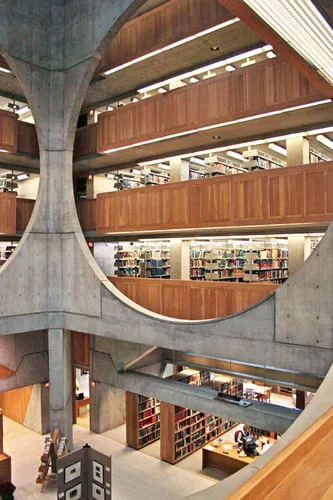
A new trend in contemporary library design is sustainability. Like other clients, libraries are pursuing green designs to lower their operating expenses and provide better spaces for users. They’re also going green to promote environmental literacy: to teach users, through example, about environmental stewardship. It wasn’t couched in these terms, but Louis Kahn’s library at Phillips Exeter Academy, opened in 1971, is a masterpiece of daylighting — a popular sustainable strategy for reducing electricity use that is evident in many of the libraries profiled in this section.
The noise level in libraries has only increased since Poole’s day, but this observation underscores a point vital to the institution’s survival. Libraries must satisfy as many different user needs as possible with a range of flexible spaces: some quiet, some active. In the past, a central aisle offered the only way to navigate through these buildings. In the future, users must be allowed to make their own paths. But rest assured, books will always be there in both paper and digital form. In a world where everything is digitized, there is knowledge to be gained from the simple, tactile act of holding a printed work. (Not to mention that computers crash, as in Desk Set.) The library’s future rests with its ability to be a comfortable space where people come together to tell their own stories and discover new ones.
People |
Products |
Looking for a reprint of this article?
From high-res PDFs to custom plaques, order your copy today!