Architectural Record
search
cart
facebook twitter linkedin youtube
  • Sign In
  • Subscribe
  • Sign Out
  • My Account
Architectural Record
  • NEWS
    • Latest News
    • Awards
    • Interviews
    • Obituaries
    • Podcasts
      • Design:Ed Podcast
      • Sponsored Podcasts
  • OPINION
    • Book Reviews / Excerpts
    • Exhibition Reviews
    • Forum
  • EXCLUSIVES
    • Videos
    • Design Vanguard
    • Top 300 Firms
    • Sponsored Content
    • Sponsored eBooks
    • From the Archives
  • CONTINUING ED
    • Editorial Continuing Ed
    • CE Center
    • CE Academies
  • PROJECTS
    • Buildings By Type
    • Reuse & Renovation
    • Museums & Arts Centers
    • Colleges & Universities
    • Multifamily Housing
    • Interiors
    • Lighting
    • Kitchen & Bath
  • HOUSES
    • Record Houses
    • House of the Month
    • Featured Houses
  • PRODUCTS
    • Products by Category
    • Record Products of the Year
    • Latest Products
  • EVENTS
    • Dates & Events
    • Record on the Road
    • Innovation Conference
    • Sustainability in Practice
    • Women In Architecture
    • Webinars
    • Ad Excellence Awards
    • Submit an Event
  • CONNECT
    • Ask RECORD AI
    • Newsletters
    • Contact
    • Advertise
    • Editorial Calendar
    • Store
    • Customer Service
  • SUBMIT
    • Submission Guidelines
    • RECORD Competitions
  • MAGAZINE
    • Subscribe
    • My Account
    • Digital Edition
    • Current Issue
    • Firm Pass
    • Historic Archive
ProjectsBuildings by TypeLibrary Design

Musashino Art University Museum & Library

By Naomi Pollock, FAIA
Musashino Art University Museum & Library
A glazed freestanding bookshelf wraps the perimeter of the library.
 
Photo © Iwan Baan
Musashino Art University Museum & Library
At the front of the building, a soaring picture window frames a view of the stepped shelves inside.
 
Photo © Iwan Baan
Musashino Art University Museum & Library
An oversize picture window expands the impressive periodicals area to the tree-lined walk and campus outside.
 
Photo © Iwan Baan
Musashino Art University Museum & Library
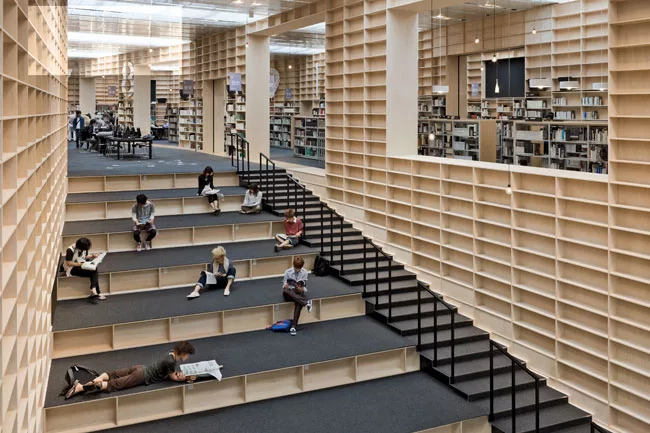
Lined with towering bookshelf walls ' whose empty shelves represent the library's potential as a place to use and house books for years to come ' an integrated cascading stair and series of stepped shelves serve as a connection between the two main levels and provide plenty of room for students to sit or recline as they read, sketch, or catch up on text messages and e-mail.
 
Photo © Iwan Baan
Musashino Art University Museum & Library
Openings in the spiraling bookshelf wall create views within views and a sense of depth. Designed by graphic designer Taku Satoh, supersize white numerals affixed to the shelves identify different subject categories and help orient library users.
 
Photo © Iwan Baan
Musashino Art University Museum & Library
Low bookcases and seating areas delineate space amid the continuum of bookshelf walls. Overhead, playful hanging lamps complement the daylight that filters down from the strips of skylights.
 
Photo © Iwan Baan
Musashino Art University Museum & Library
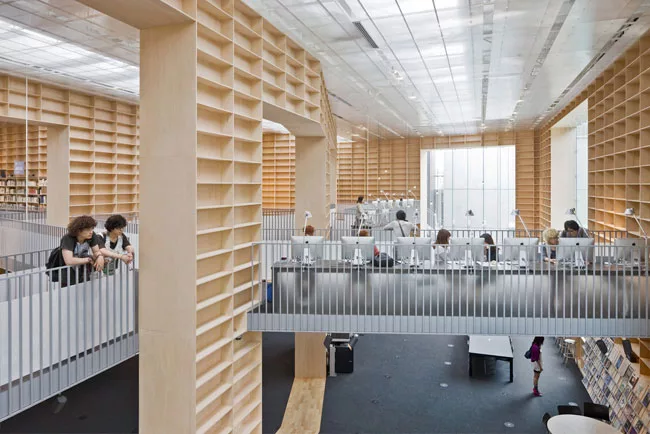
At the front of the library's second level, a web of catwalks replaces the floor. Each one is lined with counter-like workstations equipped with computers and task lights.
 
Photo © Iwan Baan
Musashino Art University Museum & Library
Designed by Taku Satoh, a gently curved reference desk receives ample daylight beneath the expansive skylight on the second floor. A cluster of pendant fixtures above it identifies the desk from across the room.
 
Photo © Iwan Baan
Musashino Art University Museum & Library
A second-level terrace connects the new library and the existing soon-to-be-museum structure. An opening in its wall provides views of the old building.
 
Photo © Iwan Baan
Musashino Art University Museum & Library
 
Image courtesy Sou Fujimoto
Musashino Art University Museum & Library
 
Image courtesy Sou Fujimoto
Musashino Art University Museum & Library
 
Image courtesy Sou Fujimoto
Musashino Art University Museum & Library
March 16, 2011

Architects & Firms

Sou Fujimoto Architects

Tokyo, Japan

People/Products

Built in 1962, Musashino Art University’s combined gallery-library is one of the school’s treasured original buildings. Designed by architect Yoshinobu Ashihara, the Modernist concrete edifice occupies a prominent position amid the school’s 27-acre campus, a checkerboard of solids and voids 25 miles west of central Tokyo. But even treasured architectural gems have a shelf life. And after 40-plus years, the building had become cramped and outdated.

Dividing the gallery-library’s program in two, the school administration decided to turn the historic building into a museum and erect a new library on the adjacent site. It then held an invited competition for the dual commission. Sou Fujimoto trumped the five other contenders and wowed the jury with a single, spiral-shaped bookshelf encased in a glass box. Evoking the atmosphere of a traditional reading room, this geometry resolved the two conflicting goals common to many libraries. While the labyrinthine paths between book-lined walls inspire the unguided exploration of the library’s sizable collection, the radial organization system cutting through the shelves enables the beeline search for a specific book.

Abutting the existing building, whose renovation will finish this spring, the new, 69,000-square-foot library fills what was one of the only open plots left on the now-congested campus. Though the site is surrounded by a variety of academic buildings and the main cafeteria, it had few constraints, since many of these older structures are slated for redevelopment in the near future. The broad pedestrian thoroughfare to the north, lined with flowering cherry trees, was the logical place to enter the building and start the spiral wall.

Composed of wooden bookshelves enclosed with glass, the spiral begins as a freestanding, 28-foot-high wall that rings the building perimeter and then curls in to define concentric layers of space inside. Visible from multiple directions on the campus, this wall immediately identifies the building’s function as a place of books. Students enter through a large opening in the wall into a small vestibule that serves as the three-story library’s primary entrance. Nestled between the new and existing buildings, exterior stairs ascend to the second floor, where an ancillary entrance connects the two structures and leads to a covered terrace at the rear of the library.

Back at grade, the tunnel-like vestibule opens onto a dramatic, double-height periodicals section followed by a circulation desk, rare book room, catalogue gallery, and offices on the ground floor. While private study carrels line one wall, rooms for meetings, research, and exhibits separate the secured book-storage area. Upstairs, a reading room and open stacks fill almost the entire upper floor. Additional shelving and storage occupy the basement. With room for 300,000 volumes, the new facility has over twice the capacity of the old library.

“The whole space is continuous but on two levels,” says Fujimoto of the library’s main floors. In the spirit of a fantastic Piranesi etching, the architect blurred the boundary between upper and lower levels with tiers of stepped shelves big enough for sitting, vast void spaces puncturing the second floor, and a web of narrow catwalks winding their way among the colossal shelves. And while a run of gentle risers graciously leads up to the reading room, elevators and enclosed staircases offer alternate routes at either end of the building. 

Though the enclosed programmatic elements partially obscure the spiral downstairs, it is clearly legible upstairs, where the floor-to-ceiling bookshelf winds repeatedly around the reference desk in the middle of the room.

Between the spiral’s 16-foot-high shelves, furniture and lighting designate functional zones. Carefully positioned for easy access, low bookcases fill the layered rings of space, while communal tables, individual desks, computer-lined counters, and select designer chairs from the school’s substantial collection clearly define seating and study areas.

The lighting scheme also helps orient library users as they navigate the mazelike space. Rows of task lights dot the balconies, and a cluster of pendant fixtures hovers above the reference desk. “It is like walking through a forest,” explains Fujimoto. “Bright lights invite you to go here or there.” During the day, sunshine boosts the installed ambient light, gently illuminating the entire room.

In addition to expansive picture windows, skylights interspersed with opaque panels stripe the roof and fill the room with muted rays. Directly beneath, a dropped ceiling made with double panels of polycarbonate honeycomb disguises the overhead ducts and beams while diffusing the daylight from above. Mirroring the shelves below, the surface of the glossy panels reflects the rows of books, making them appear to go on forever.

Cutting across the three-foot-thick bookshelf walls are sequences of rectangular openings of varying proportions and sizes, each one determined by multiple model studies. They alleviate the concentric geometry, framing views within views and creating a sense of depth in the space. At the same time, these breaks in the walls facilitate the library’s book classification system. Physically, this system is manifest with wedge-shaped
sections that radiate out from the reference desk. These sections correspond to different numbered subject categories. White, plastic supersize graphics affixed laterally to the shelves identify each section.

Made of lightly stained, laminated basswood, the double-loaded interior shelves straddle the line between architecture and furniture. Their partitions and backing boards conceal and are pinned to the library’s steel structure: a rigid frame system of beams and oblong columns supporting a fire-rated substrate. “The columns are really more like small braces,” explains Fujimoto. Due to the walls’ quirky shape and irregularly spaced openings, the columns could not stand in grid formation. But the voluminous bookcase wall provided plenty of room for alternative positioning, and extra beams ensured stability.

At the building’s exterior, the shelves are stained dark brown and have been chemically treated for fire protection. Moreover, along with concealing the insulation, these shelves hide the steel hardware that secures the exterior glazing. Though the 3-foot-square panes appear to float in front of the wood cases, square metal fasteners affix the 0.3-inch-thick glass sheets together and anchor them to the building’s structural frame.

Beyond reinvigorating Musashino Art University’s aging campus, Sou Fujimoto’s library champions books — an especially noble achievement at a time when the printed word is facing an uncertain future. “Anyone can read at McDonald’s,” says the architect. “But enjoying, concentrating, and relaxing in a library surrounded by books is a special experience.”

Yet the building is curiously longing for books. Both inside and out there is an abundance of empty shelf space. Initially Fujimoto envisioned walls of books filled up high to the ceiling. But in the end only the first seven rows are actually in use, since shelves above six feet require extra measures for earthquake protection and stepladders for access. “After completion, I found that emptiness is better,” reasons the architect. “If you fill up all the shelves, it is just a bookcase. But if you leave it part empty, it is full of potential.”

Lined with towering bookshelf walls — whose empty shelves represent the library’s potential as a place to use and house books for years to come — an integrated cascading stair and series of stepped shelves serve as a connection between the two main levels and provide plenty of room for students to sit or recline as they read, sketch, or catch up on text messages and e-mail.


People

Owner:
Musashino Art University

Architect:
Sou Fujimoto Architects
10-3,Higashienoki-cho, Ichikawa Seihon building 6F
Shinjuku-ku, Tokyo 162-0807, Japan
T:  +81(0)3-3513-5401
F:  +81(0)3-3513-5402

Personnel in architect's firm who should receive special credit:
Sou Fujimoto Architects-- principal-in-charge; Sou Fujimoto

Project Team: Koji Aoki, Naganobu Matsumura, Shintaro Homma, Tomoko Kosami, Takahiro Hata,
Yoshihiro Nakazono, Masaki Iwata

Architect of record:
Sou Fujimoto Architects (Sou Fujimoto)

Interior designer:
Sou Fujimoto Architects

Engineer(s):
Structural Engineers: Jun Sato Structural Engineers--Jun Sato, Masayuki Takada

MEP: Kankyo Engineering--Takafumi Wada, Kazunari Ohishima, Hiroshi Takayama

Consultant(s):
Adviser: Eishi Katsura

Lighting:
Sirius Lighting Office--Hirohito Totsune, Koichi Tanaka, lighting

Other:
Signage: Taku Satoh Design Office--Taku Satoh, Shingo Noma, Kuniaki Demura

Furniture: Inoue Industries--Takafumi Inoue, Azusa Jin, Yosuke Goto, Hideki Yamazaki

General contractor:
Taisei Corporation--Tsukasa Sakata

Photographer(s):
Daici Ano
ano@fwdinc.jp
080.5675.8975

Location:

Tokyo, Japan

Gross square footage:

69,095 sq ft.

Completion date:

June 2010


Products

Structural system
Steel frame, partly reinforced concrete

Exterior cladding
Major materials: timber shelf, glass, exterior; wood shelf, tile carpet, polycarbonate panel ceiling, interior

Wood:
All Timber work by ARLISS Co.,Ltd.

Curtain wall:
Curtain wall by Showa Lead Fu Co.,Ltd.

Roofing
Elastomeric:
DRY PROCESS ROOF HEAT INSULATING WATER PROOFING (SANTAC Waterproofing system IB-NB system / Hayakawa Rubber Co.,Ltd.)
(HEAT INSULATING PANEL T35
+SHEET WATERPROOFING T1.5)

Skylight:
Custom skylight Tokteck Co.,Ltd.

Windows
All Aluminium Sash byFUJISASH Co.,Ltd

Interior finishes
Raised flooring:
DRY PROCESS DOUBLE FLOOR H250 (Barrier-less Floor system / KIRII Co.,Ltd.)
(SUPPORTING LEG+PARTICLE BOARD T20)

Furnishings
Signage and Furniture Design: Taku Satoh Design Office

Signage and Furniture Fabrication: INOUE-INDUSTRIES

 
KEYWORDS: Tokyo

Share This Story

Looking for a reprint of this article?
From high-res PDFs to custom plaques, order your copy today!
Contributing Editor Naomi Pollock, FAIA, is the author of Japanese Design Since 1945: A Complete Sourcebook and the forthcoming Vanishing Japan: Modern Architecture Gone But Not Forgotten,

Post a comment to this article

Report Abusive Comment

Subscription Center
  • Create an Account
  • Start a Subscription
  • Manage My Account
  • Sign Up for Newsletters
  • Visit Customer Service
  • Update Preferences

More Videos

Sponsored Content

Sponsored Content is a special paid section where industry companies provide high quality, objective, non-commercial content around topics of interest to the Architectural Record audience. All Sponsored Content is supplied by the advertising company and any opinions expressed in this article are those of the author and not necessarily reflect the views of Architectural Record or its parent company, BNP Media. Interested in participating in our Sponsored Content section? Contact your local rep!

close
  • TAMLYN XtremeTrim Exterior Trim
    Sponsored byTamlyn

    Designing Cleaner Panel Facades: Why Exterior Trim Details Matter

  • Building with Vapor Barriers
    Sponsored byReef Industries, Inc.

    Vapor Barriers Help Control Moisture in Tighter Building Designs

  • Duct Interior with Prodeq System
    Sponsored byHenry, a Carlisle Company

    Designing Resilient Water Containment Systems

DESIGN:ED Podcast
Listen to Architectural Record’s DESIGN:ED Podcast

Events

June 16, 2026

Focus on the Façade: Exploring Steel, Timber & Fire-Rated Curtain Walls and Channel Glass Systems

Credits: 1 AIA LU/HSW; 1 AIBD P-CE; 0.1 ICC CEU

Explore modern façade and glazing systems that enhance daylighting, fire safety, and thermal performance while expanding architectural design possibilities.

June 18, 2026

Rebooting the Aging Office Building

Credits: 1 AIA LU/HSW; 1 AIBD P-CE; 0.1 ICC CEU; 1 PDH

Explore façade retrofit strategies and award-winning design concepts that can transform aging office buildings into healthier, higher-performing workplaces for today’s hybrid workforce.

View All Submit An Event

Products

2026 Architect's Square Foot Costbook

2026 Architect's Square Foot Costbook

See More Products

Popular Stories

Coronado Bridge

The Architect’s Guide to San Diego

SanDiegoAirport

Top 300 Architecture Firms of 2026

Crane Cove, ONO

Design Vanguard 2026 Winners

House on a Hill

Design Vanguard 2026: Forma

House A on a Hill

Design Vanguard 2026: Santiago Valdivieso

Focus on the Facade - Free Webinar - June 16, 2026

Related Articles

  • Princeton University Art Museum

    Adjaye Associates’ Princeton University Art Museum is an Unexpected and Praiseworthy Homage to the Past

    See More
  • Princeton Art Museum

    David Adjaye Unveils Design for Princeton University Art Museum

    See More
  • New Library, Tama Art University

    See More

Related Products

See More Products
  • Architectural Record - November 2025

    Architectural Record November 2025 Issue

  • superlux.jpg

    SuperLux: Smart Light Art, Design & Architecture for Cities

See More Products
×

The latest news and information

#1 Source for Architectural Design, News and Products

SUBSCRIBE
  • RESOURCES
    • Advertise
    • Contact Us
    • Submit
    • Store
  • ACCOUNT CENTER
    • Create an Account
    • Start a Subscription
    • Manage My Account
    • Sign Up for Newsletters
    • Visit Customer Service
    • Update Preferences
  • PRIVACY
    • PRIVACY POLICY
    • TERMS & CONDITIONS
    • DO NOT SELL MY PERSONAL INFORMATION
    • PRIVACY REQUEST
    • ACCESSIBILITY
  • SERVICES
    • Marketing Services
    • Reprints
    • Market Research
    • List Rental
    • Survey/Respondent Access
  • STAY CONNECTED
    • Linkedin
    • Facebook
    • Instagram
    • YouTube
    • X (Twitter)

Copyright ©2026. All Rights Reserved BNP Media, Inc. and BNP Media II, LLC.

Design, CMS, Hosting & Web Development :: ePublishing