Architectural Record
search
cart
facebook twitter linkedin youtube
  • Sign In
  • Subscribe
  • Sign Out
  • My Account
Architectural Record
  • NEWS
    • Latest News
    • Awards
    • Interviews
    • Obituaries
    • Podcasts
      • Design:Ed Podcast
      • Sponsored Podcasts
  • OPINION
    • Book Reviews / Excerpts
    • Exhibition Reviews
    • Forum
  • EXCLUSIVES
    • Videos
    • Design Vanguard
    • Top 300 Firms
    • Sponsored Content
    • Sponsored eBooks
    • From the Archives
  • CONTINUING ED
    • Editorial Continuing Ed
    • CE Center
    • CE Academies
  • PROJECTS
    • Buildings By Type
    • Reuse & Renovation
    • Museums & Arts Centers
    • Colleges & Universities
    • Multifamily Housing
    • Interiors
    • Lighting
    • Kitchen & Bath
  • HOUSES
    • Record Houses
    • House of the Month
    • Featured Houses
  • PRODUCTS
    • Products by Category
    • Record Products of the Year
    • Latest Products
  • EVENTS
    • Dates & Events
    • Record on the Road
    • Innovation Conference
    • Sustainability in Practice
    • Women In Architecture
    • Webinars
    • Ad Excellence Awards
    • Submit an Event
  • CONNECT
    • Ask RECORD AI
    • Newsletters
    • Contact
    • Advertise
    • Editorial Calendar
    • Store
    • Customer Service
  • SUBMIT
    • Submission Guidelines
    • RECORD Competitions
  • MAGAZINE
    • Subscribe
    • My Account
    • Digital Edition
    • Current Issue
    • Firm Pass
    • Historic Archive
ProjectsBuildings by TypeMuseums & Art Centers

Kimbell Art Museum Addition

With his expansion, Renzo Piano speaks softly to Louis Kahn's masterpiece.
By Sarah Williams Goldhagen
Kimbell Art Museum Addition
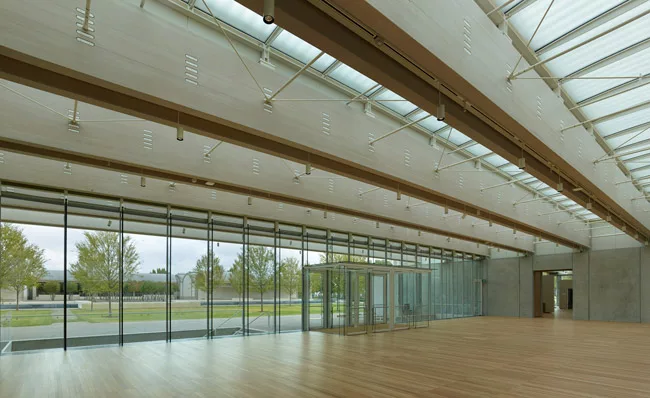
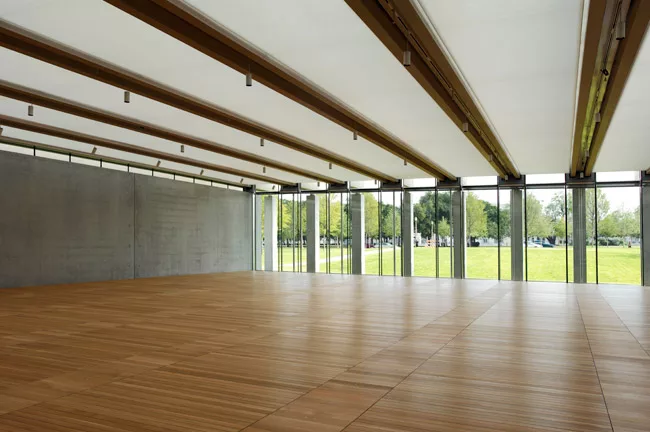
The southeast gallery is defined by the rhythmic procession of concrete columns supporting laminated Douglas fir beams 100 feet long.
 
Photo © Timothy Hursley
Kimbell Art Museum Addition
Louis Kahn’s venerated 1972 building for the Kimbell.
 
Photo © Timothy Hursley
Kimbell Art Museum Addition
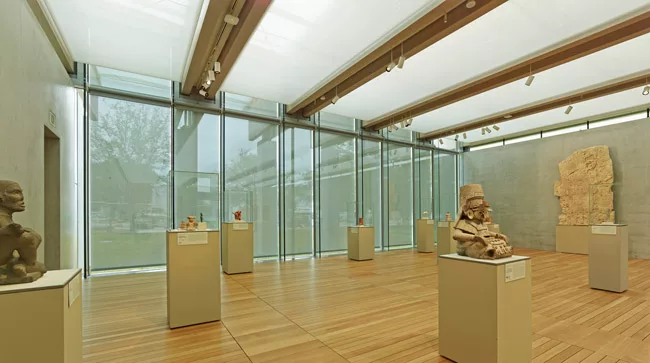
As seen in the north gallery (left) and the southeast gallery (slide 5), the oak floor “breathes” owing to 3/16-inch gaps between the boards for the under-floor air system.
 
Photo © Timothy Hursley
Kimbell Art Museum Addition
The main entrance to the Piano addition (left) opens into an expansive lobby (slide 6).
 
Photo © Timothy Hursley
Kimbell Art Museum Addition
As seen in the north gallery (slide 3) and the southeast gallery (left), the oak floor “breathes” owing to 3/16-inch gaps between the boards for the under-floor air system.
 
Photo © Timothy Hursley
Kimbell Art Museum Addition
The main entrance to the Piano addition (slide 4) opens into an expansive lobby (left).
 
Photo © Timothy Hursley
Kimbell Art Museum Addition
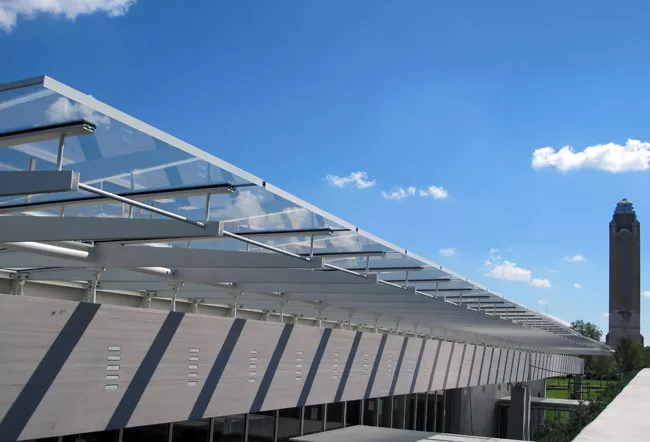
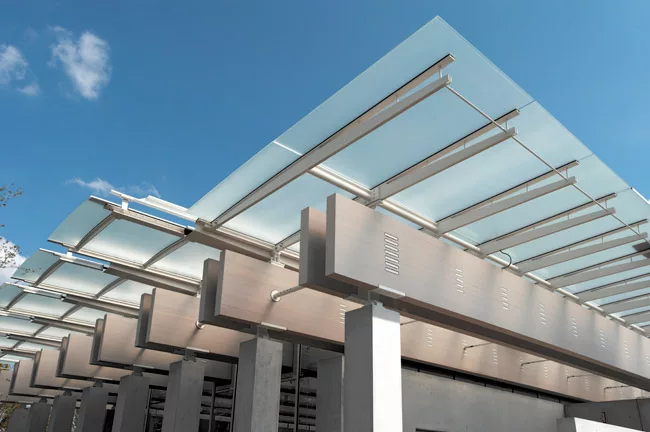
The entrance to the Kimbell addition faces a lawn and the reoriented main entrance to Kahn’s Kimbell (left). Parking, with 132 spaces, is underneath. Adjustable motorized aluminum louvers with photovoltaic panels form the top layer of Piano’s skylit roof. Beneath these, double glazing, laminated with a UV filter and ceramic frit, admits light into the galleries. Grass on the roof of the western portion continues on the stair treads to the space below. There, the auditorium’s stage (slide 8) is backed by a glazed expanse and a concrete retaining wall that form a lightwell.
 
Photo © Timothy Hursley
Kimbell Art Museum Addition
The entrance to the Kimbell addition faces a lawn and the reoriented main entrance to Kahn’s Kimbell (slide 7). Parking, with 132 spaces, is underneath. Adjustable motorized aluminum louvers with photovoltaic panels form the top layer of Piano’s skylit roof. Beneath these, double glazing, laminated with a UV filter and ceramic frit, admits light into the galleries. Grass on the roof of the western portion continues on the stair treads to the space below. There, the auditorium’s stage (left) is backed by a glazed expanse and a concrete retaining wall that form a lightwell.
 
Photo © Timothy Hursley
Kimbell Art Museum Addition
Northeast corner
 
Photo © Timothy Hursley
Kimbell Art Museum Addition
North Gallery
 
Photo © Timothy Hursley
Kimbell Art Museum Addition
North Gallery
 
Photo © Timothy Hursley
Kimbell Art Museum Addition
South side
 
Photo © Timothy Hursley
Kimbell Art Museum Addition
Lobby
 
Photo © Timothy Hursley
Kimbell Art Museum Addition
Lobby
 
Photo © Timothy Hursley
Kimbell Art Museum Addition
Stairs to Lower Level Library and Auditorium.
 
Photo © Timothy Hursley
Kimbell Art Museum Addition
View of Link to Auditorium.
 
Photo © Timothy Hursley
Kimbell Art Museum Addition
South Elevation.
 
Photo © Timothy Hursley
Kimbell Art Museum Addition
West Edge of Glass Roof.
 
Photo © Robert Polidori
Kimbell Art Museum Addition
Detail of Skylight.
 
Image courtesy RPBW
Kimbell Art Museum Addition
Detail of Skylight.
 
Image courtesy RPBW
Kimbell Art Museum Addition
Detail of Skylight.
 
Image courtesy RPBW
Kimbell Art Museum Addition
Detail of Skylight.
 
Photo © Robert Polidori
Kimbell Art Museum Addition
Detail of Roof.
 
Photo © Robert Polidori
Kimbell Art Museum Addition
Entrance Facade.
 
Photo © Robert Polidori
Kimbell Art Museum Addition
East/West Section.
 
Image courtesy RPBW
Kimbell Art Museum Addition
East/West Section.
 
Image courtesy RPBW
Kimbell Art Museum Addition
East/West Section.
 
Image courtesy RPBW
Kimbell Art Museum Addition
East/West Section.
 
Image courtesy Renzo Piano Building Workshop
Kimbell Art Museum Addition
Site Plan.
 
Image courtesy Renzo Piano Building Workshop
Kimbell Art Museum Addition
Site Plan.
 
Image courtesy Renzo Piano Building Workshop
Kimbell Art Museum Addition
Site Plan.
 
Image courtesy Renzo Piano Building Workshop
Kimbell Art Museum Addition
December 16, 2013

Architects & Firms

Renzo Piano Building Workshop

Fort Worth

People/Products

For the general public, the Kimbell Art Museum’s exalted reputation rests on the extraordinarily high quality of its small collection, with hundreds of firstrate pieces by Western painters and sculptors, and a growing cache of Asian and pre-Columbian work. For architects, the building housing that collection is its crown jewel: Louis Kahn’s cycloid-vaulted concrete and travertine oasis in silver and creamy white ranks as one of modern architecture’s greatest monuments, perhaps his most sublime building, the one he called his favorite child.

Over the last 40 years, since it opened in 1972 in Fort Worth, the Kimbell’s double blessing—magnificent building, magnificent collection—has brought with it a cursed problem: Kahn’s 120,000-square-foot structure was too small to simultaneously display any significant portion of its permanent collection and host the special exhibitions that museums use to draw crowds. It needed more space.

In 1990, 16 years after Kahn’s death, the museum announced an expansion, designed by Mitchell/Giurgola Architects. Its principal, Romaldo Giurgola, who had been close to Kahn, proposed replicating Kahn’s modular bays and appending them at both ends, thereby altering the original building’s proportions and scale. A truly nasty public outcry ensued. Kahn’s normally reticent daughter Sue Ann Kahn publicly condemned the design. Famous people, including Frank Gehry, Philip Johnson, and Phyllis Lambert, signed a petition. The Kimbell, humiliated, retracted the misguided scheme. But their space problem remained.

How to add to the sublime? Several years ago, the leaders of the Kimbell Art Foundation approached Sue Ann Kahn, hoping to avoid any hint of a reprise of the Giurgola debacle. What would she think about a separate building, connected underground, across the way from her father’s celebrated masterpiece? Kahn responded well. And whom to enlist? The Kimbell says that only one firm was ever considered: the Renzo Piano Building Workshop (RPBW).

Renzo Piano and his office have completed 21 museums and museum additions to date. Curators like the firm’s work because it “lets the art speak,” as one current client recently explained. Simple loftlike spaces acquire their refined elegance and placemaking character not through theatrical gestures that could upstage the art but through subtle moves: delicate compositions combining manufactured and natural materials, lavishly considered construction details, and abundant filtered natural light. Three of the firm’s very best projects are museums (two in Texas): the Menil Collection in Houston (1987), the Nasher Sculpture Center in Dallas (2003), and the Foundation Beyeler near Basel (1997). And RPBW’s museums are never bad; at worst, they are dignified, if somewhat tepid.

The one-story-high addition, located a civil 160 feet from the Kahn building, is about its size, adding three large new galleries as well as a 295-seat auditorium, library, classrooms, and event space, with underground parking connecting old and new. Everything about the project drips “R-E-S-P-E-C-T”—quite frankly, it looks as though Piano designed it with a straightjacket on. Hoping to start what he calls “a conversation” between old and new, Piano kept the basic organization of Kahn’s building: a 324-foot-long horizontally slung shed divided lengthwise into three equal bays with the entrance on center. Kahn’s building is concrete, travertine, and glass with oak floors; RPBW’s is concrete and glass with oak floors. (Mock-ups suggested that travertine would mimic the older building too closely.) In both, the structural conceit is the 100-foot-long-span beam landing on concrete columns. Inside both, top-lit galleries and fine detailing—from smooth concrete to shadow joints to polished metal hardware—dominate.

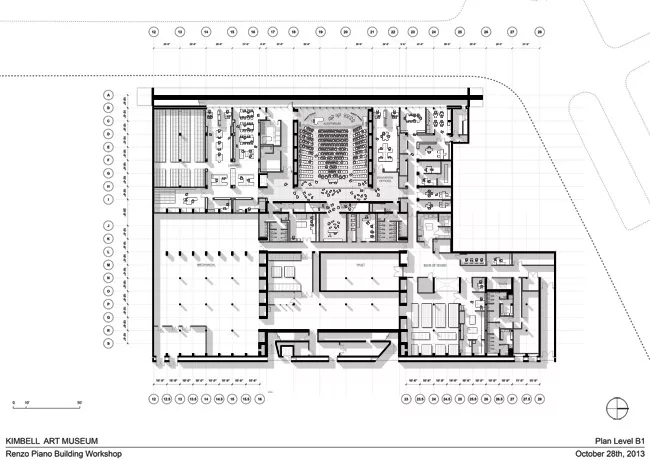
The addition’s entrance axis extends from the lobby to a glazed passageway through an outdoor courtyard, terminating in a buried, auditorium wing. A 19,200-square-foot grass roof covers this underground extension, which also includes classrooms and another gallery. Behind the auditorium’s stage—in a direct quote of the basement level of the Kahn building—a monumental glass wall faces a concrete retaining wall, where a linear troughlike lightwell edges the addition on the west. If this is a conversation, it is not between equals—Kahn sets the terms, and Piano offers polite comments about sustainability with such features as photovoltaic panels on the louvered skylights, 140 geothermal wells, and an under-floor air-distribution system.

Refinements abound. For the galleries’ concrete walls, on which art will be directly hung, RPBW poured dozens of samples before hitting upon a silvery-gray shade mixed with titanium. The tint holds its own without overpowering the visually delicate Old Master paintings that form the core of the collection. (The opening show is devoted to the permanent collection; after that, traveling exhibitions will be housed in Piano’s galleries.) The architectural team devised a construction system of birch plywood forms for a 30-foot pour without tie-holes that creates super-smooth walls resembling spun silk. The 29 pairs of 100-foot-long-by-52-inch-deep laminated Douglas fir beams are, regrettably, almost invisible inside the two top-lit galleries owing to the scrim stretched between the beams. But their exposed surfaces help infuse the interior with a soft yellow light.

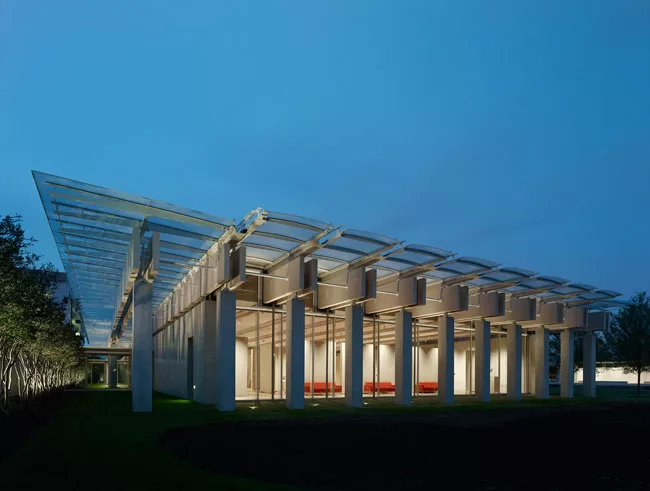
Muscularity trumps obsequiousness twice, once outside, once in. On the north and south elevations, closely spaced concrete columns support paired wood beams and a glass skylight above, creating a pounding tempo. And inside, north-south axes of paired courtyards and monumental staircases generate a strong rhythm.

More often than not, though, the docile acquiescence of the RPBW building highlights why Kahn’s architecture is so compelling. RPBW’s straightforwardness lacks the spatial nuance Kahn achieved with his more complex composition: the low-slung cycloid vaults pull the roofline closer to the user and help, along with the tartan grid plan, to disaggregate the building into smaller cells related to the scale of the human body. Galleries in both the original and the new building may be top-lit, but Kahn’s long, dramatic swaths of daylight, cast from slots running down the center of vault-like cantilevered beams, change all day long. Piano’s glazed ceilings may be a curator’s dream but add none of the temporal complexity to the experience of being indoors that Kahn’s cycloid vaults and skylights do. And although the buildings seem so similar, a sense of nature suffuses only Kahn’s, owing to the more highly textured materiality of his wood, travertine, and concrete, along with his more vigorous sculpting of natural light. The domestic feel of Kahn’s more dynamic, roomlike spaces is absent in the addition’s institutional Miesian interiors. For these reasons and more, only the Kahn portion brings about a deeply personal connection between user and building.

Kahn often said that a building is a struggle, not a miracle. It’s too bad that Piano didn’t engage in a more intense conversation with Kahn. Reportedly Piano proposed design features that would have more strongly differentiated the two buildings, such as wood siding and taller proportions, but these suggestions were rebuffed by clients wary of public outcry. That RPBW successfully solved the Kimbell Art Museum’s space crunch without ruining, or even particularly changing, the original building is an accomplishment worth applauding. In the case of beloved monuments, even this outcome is never preordained.


Architect: Renzo Piano Building Workshop—Renzo Piano, principal; Mark Carroll, partner in charge; Onur Teke, associate in charge; Shunji Ishida, partner

Executive Architect: Kendall/Heaton Associates

Engineer: Guy Nordenson & Associates (structure), Brockett/Davis/Drake (structural consultant to construction manager); Arup, Summit Consultants (m/e/p)

Client: Kimbell Art Foundation

Size: 101,130 square feet

Cost: $135 million

Completion date: November 2013

Curtainwall, skylight: Seele

Sarah Williams Goldhagen, the architecture critic for The New Republic, wrote Louis Kahn’s Situated Modernism (2001).

People


Products

 
KEYWORDS: Texas

Share This Story

Looking for a reprint of this article?
From high-res PDFs to custom plaques, order your copy today!
Post a comment to this article

Report Abusive Comment

Subscription Center
  • Create an Account
  • Start a Subscription
  • Manage My Account
  • Sign Up for Newsletters
  • Visit Customer Service
  • Update Preferences

More Videos

Sponsored Content

Sponsored Content is a special paid section where industry companies provide high quality, objective, non-commercial content around topics of interest to the Architectural Record audience. All Sponsored Content is supplied by the advertising company and any opinions expressed in this article are those of the author and not necessarily reflect the views of Architectural Record or its parent company, BNP Media. Interested in participating in our Sponsored Content section? Contact your local rep!

close
  • TAMLYN XtremeTrim Exterior Trim
    Sponsored byTamlyn

    Designing Cleaner Panel Facades: Why Exterior Trim Details Matter

  • Building with Vapor Barriers
    Sponsored byReef Industries, Inc.

    Vapor Barriers Help Control Moisture in Tighter Building Designs

  • Duct Interior with Prodeq System
    Sponsored byHenry, a Carlisle Company

    Designing Resilient Water Containment Systems

DESIGN:ED Podcast
Listen to Architectural Record’s DESIGN:ED Podcast

Events

June 18, 2026

Rebooting the Aging Office Building

Credits: 1 AIA LU/HSW; 1 AIBD P-CE; 0.1 ICC CEU; 1 PDH

Explore façade retrofit strategies and award-winning design concepts that can transform aging office buildings into healthier, higher-performing workplaces for today’s hybrid workforce.

June 23, 2026

Enhancing Fire Resistance with Advanced PVC Solutions

Credits: 1 AIA LU/HSW; 1 AIBD P-CE; 0.1 ICC CEU; 1 IIBEC CEH

Evaluate advanced PVC solutions that improve fire resistance, support WUI compliance, and enhance resilience in residential and commercial building design.

View All Submit An Event

Products

2026 Architect's Square Foot Costbook

2026 Architect's Square Foot Costbook

See More Products

Popular Stories

SanDiegoAirport

Top 300 Architecture Firms of 2026

Coronado Bridge

The Architect’s Guide to San Diego

Lorcan O' Herilhy

California Architect Lorcan O’Herlihy Has Died, Age 66

CCA, Studio Gang

The Winners of the AIA’s 2026 Architecture Award Range from Collegiate Rowing Hubs to Housing for the Homeless

Dusk House

Design Vanguard 2026: ONO

Rebooting the Aging Office Building - Free Webinar - June 18, 2026

Related Articles

  • Kimbell Art Museum

    Kimbell Art Museum and Guggenheim Bilbao Celebrate Anniversaries

    See More
  • David Chipperfield-designed Addition to St. Louis Art Museum Opens This Month

    See More
  • Denver Art Museum Gift

    Denver Art Museum Announces $150 Million Upgrade and Addition to Gio Ponti Building

    See More

Related Products

See More Products
  • Architectural Record - November 2025

    Architectural Record November 2025 Issue

See More Products
×

The latest news and information

#1 Source for Architectural Design, News and Products

SUBSCRIBE
  • RESOURCES
    • Advertise
    • Contact Us
    • Submit
    • Store
  • ACCOUNT CENTER
    • Create an Account
    • Start a Subscription
    • Manage My Account
    • Sign Up for Newsletters
    • Visit Customer Service
    • Update Preferences
  • PRIVACY
    • PRIVACY POLICY
    • TERMS & CONDITIONS
    • DO NOT SELL MY PERSONAL INFORMATION
    • PRIVACY REQUEST
    • ACCESSIBILITY
  • SERVICES
    • Marketing Services
    • Reprints
    • Market Research
    • List Rental
    • Survey/Respondent Access
  • STAY CONNECTED
    • Linkedin
    • Facebook
    • Instagram
    • YouTube
    • X (Twitter)

Copyright ©2026. All Rights Reserved BNP Media, Inc. and BNP Media II, LLC.

Design, CMS, Hosting & Web Development :: ePublishing