Architectural Record
search
cart
facebook twitter linkedin youtube
  • Sign In
  • Subscribe
  • Sign Out
  • My Account
Architectural Record
  • NEWS
    • Latest News
    • Awards
    • Interviews
    • Obituaries
    • Podcasts
      • Design:Ed Podcast
      • Sponsored Podcasts
  • OPINION
    • Book Reviews / Excerpts
    • Exhibition Reviews
    • Forum
  • EXCLUSIVES
    • Videos
    • Design Vanguard
    • Top 300 Firms
    • Sponsored Content
    • Sponsored eBooks
    • From the Archives
  • CONTINUING ED
    • Editorial Continuing Ed
    • CE Center
    • CE Academies
  • PROJECTS
    • Buildings By Type
    • Reuse & Renovation
    • Museums & Arts Centers
    • Colleges & Universities
    • Multifamily Housing
    • Interiors
    • Lighting
    • Kitchen & Bath
  • HOUSES
    • Record Houses
    • House of the Month
    • Featured Houses
  • PRODUCTS
    • Products by Category
    • Record Products of the Year
    • Latest Products
  • EVENTS
    • Dates & Events
    • Record on the Road
    • Innovation Conference
    • Sustainability in Practice
    • Women In Architecture
    • Webinars
    • Ad Excellence Awards
    • Submit an Event
  • CONNECT
    • Ask RECORD AI
    • Newsletters
    • Contact
    • Advertise
    • Editorial Calendar
    • Store
    • Customer Service
  • SUBMIT
    • Submission Guidelines
    • RECORD Competitions
  • MAGAZINE
    • Subscribe
    • My Account
    • Digital Edition
    • Current Issue
    • Firm Pass
    • Historic Archive
ProjectsBuildings by TypeMuseums & Art Centers

Garage Museum of Contemporary Art by OMA

Moscow

By Justin McGuirk
Garage Museum of Contemporary Art
OMA took a derelict 1968 building in Gorky Park and wrapped it in a shimmering envelope of glass and polycarbonate. A pair of 36-foot-wide panels slide up to reveal the new entrance.
 
Photo © Iwan Baan
Garage Museum of Contemporary Art
Transformed into the Garage Museum, it beckons to people in the evening with a facade that reflects nearby lights and offers views inside.
 
Photo © Iwan Baan
Garage Museum of Contemporary Art
The Seasons of the Year cafeteria could serve as many as 1,200 people at a time.
 
Photo © Iwan Baan
Garage Museum of Contemporary Art
The architects cut through some floor plates to create double-height spaces that help visitors orient themselves in the 58,100-square-foot building.
 
Photo © Iwan Baan
Garage Museum of Contemporary Art
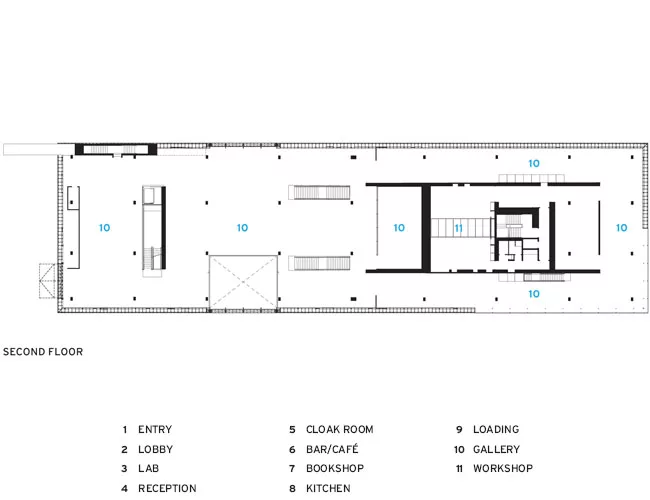
OMA tried to keep intact as much of the old building as possible, retaining the concrete frame and exposing it in places such as second-floor galleries.
 
Photo © Iwan Baan
Garage Museum of Contemporary Art
The firm also restored old mosaics and brickwork that had not been given much respect previously by architectural historians. A mosaic depicting autumn now holds pride of place in a new caf'.
 
Photo © Iwan Baan
Garage Museum of Contemporary Art
OMA tried to keep intact as much of the old building as possible, retaining the concrete frame and exposing it in places such as the shop on the ground floor.
 
Photo © Iwan Baan
Garage Museum of Contemporary Art
Garage moved from the 1926 Bakhmetevsky Bus Depot designed by Konstantin Melnikov to Gorky Park.
 
Photo © Iwan Baan
Garage Museum of Contemporary Art
Garage moved from the 1926 Bakhmetevsky Bus Depot designed by Konstantin Melnikov to Gorky Park.
 
Photo © Iwan Baan
Garage Museum of Contemporary Art
Garage moved from the 1926 Bakhmetevsky Bus Depot designed by Konstantin Melnikov to Gorky Park.
 
Photo © Iwan Baan
Garage Museum of Contemporary Art
Site plan.
 
Photo © Iwan Baan
Garage Museum of Contemporary Art
Old photograph of Gorky Park.
 
Photo © Iwan Baan
Garage Museum of Contemporary Art
View of cafeteria interior before renovation.
 
Photo © Iwan Baan
Garage Museum of Contemporary Art
View of cafeteria interior before renovation.
 
Photo © Iwan Baan
Garage Museum of Contemporary Art
Cross section showing exhibition concept.
 
Photo © Iwan Baan
Garage Museum of Contemporary Art
Model shot showing the educational platform.
 
Photo © Iwan Baan
Garage Museum of Contemporary Art
Sections showing the hinged display panels raised and lowered.
 
Photo © Iwan Baan
Garage Museum of Contemporary Art
Model shot showing hinged display panels raised.
 
Photo © Iwan Baan
Garage Museum of Contemporary Art
Model shot showing hinged display panels lowered.
 
Photo © Iwan Baan
Garage Museum of Contemporary Art
Main stair.
 
Photo ' Iwan Baan
Garage Museum of Contemporary Art
Roof terrace.
 
Photo © Iwan Baan
Garage Museum of Contemporary Art
Side stair with renovated tiles.
 
Photo © Iwan Baan
Garage Museum of Contemporary Art
Second floor with installation by Rirkrit Tiravanija.
 
Photo © Iwan Baan
Garage Museum of Contemporary Art
Stair on second floor.
 
Photo © Iwan Baan
Garage Museum of Contemporary Art
Gallery space.
 
Photo © Iwan Baan
Garage Museum of Contemporary Art
Gallery.
 
Photo © Iwan Baan
Garage Museum of Contemporary Art
Gallery with installation by Yayoi Kusama.
 
Photo © Iwan Baan
Garage Museum of Contemporary Art
July 16, 2015

Architects & Firms

OMA

People/Products

Four years ago I wandered the ruins of the Hexagon, a 1920s pavilion for exhibiting tractors in Gorky Park, which was slated to become the new home of the Garage Center for Contemporary Culture. With its temple-like colonnades, it seemed a fittingly grand setting for the art-world ambitions of Dasha Zhukova, wife of billionaire Roman Abramovich. But, shortly afterward, it was listed as a historic monument, and the project moved to another ruin nearby, a derelict cafeteria. This was not quite the demotion it may sound. The 1968 structure was once able to feed 1,200 people in a sitting'Soviet proportions can easily accommodate the 21st-century culture industry.

Today, the Seasons of the Year cafeteria is enclosed in a skin of glossy poly-carbonate. This semitranslucent box, designed by OMA, is utterly inscrutable, and yet it could only be one thing: a gallery. A raised cargo door signals the entrance to the hangar-like building'as though industrial motifs are de rigueur even when the original building was not technically industrial.

Rem Koolhaas describes this project as a work of preservation. He invokes OMA/AMO's 2010 exhibition at the Venice Biennale, Cronocaos, in which he argued with characteristically intricate contradiction that the world has gone preservation mad and yet we must preserve the socialist and social-democratic architecture of the postwar years. With Garage, he has been able to save a piece of that legacy, though this is not preservation in the standard, precious mode.

In the central atrium the remains of the restaurant are plainly displayed'the old brick walls, patchily covered with lovely green ceramic tiles, and a Socialist Realist mosaic depicting autumn. The two brick cores'one of which used to house a vast kitchen and the other the staircase'now contain an auditorium, education spaces, and a small caf'. The exhibition spaces wrap around these cores on two levels, accessed by restored terrazzo staircases with new black-steel railings. What has been preserved here is the texture of the interior and the public-minded generosity of space.

The shell, however, is uncompromisingly new. The relatively cheap polycarbonate skin was chosen because this was supposed to be a temporary home for Garage in advance of the move to the tractor temple, but it became permanent. Koolhaas has presented the modesty of materials and form as the antidote to so much 'spectacular' architecture, but it is also practical. One meter deep, the translucent double skin contains the services that provide the necessary climatic conditions for showing art. And thus'much to the bemusement of the Russian contractors'the wires, pipes, and such remain visible through the facade. The architects describe this skin as the 'machine' that enables a ruin to work as a museum.

And that is what this now is. Garage has become the Garage Museum of Contemporary Art'a shift from private gallery to the status of a public institution. Consequently, the program also has a new orientation toward research and education, with archival exhibitions exploring Soviet-era art and international cultural relations.

Whether this is a good space for showing art is not yet proven. Apart from the open central spaces'in one of which artist Rirkrit Tiravanija has installed Ping-Pong tables and old ladies serving dumplings'the galleries are slightly cramped. There is much less exhibition space here than in the 1926 Konstantin Melnikov'designed bus garage where Garage began (and got its name). And the curators are a little anxious about the lack of white-cube spaces. Hinged display panels can be raised up to the ceiling to offer a choice of white-wall or exposed-brick hanging surfaces, a nice idea that may not stand the test of time.

Still, the building feels good. The glazed ground floor is entirely open to the greenery of the surrounding park, and the expansive sense of space is inviting. Perhaps not quite a contradiction, it is certainly curious to see a relic of Soviet public-spiritedness transformed into a symbol of oligarchic patronage. But in the new Russia, it seems, it falls to billionaires to create the public institutions of contemporary culture.


People

Client: Iris Foundation/Park Development

Architect: OMA — Rem Koolhaas

Personnel who should receive special credit:
Partner in charge: OMA ' Rem Koolhaas

Project architect: Ekaterina Golovatyuk

Team: Giacomo Cantoni, Nathan Friedman, Cristian Mare, John Paul Pacelli, Cecilia del Pozo, Timur Shabaev, Chris van Duijn, Yashin Kemal, Timur Karimullin, Federico Pompignoli, Marek Chytil, Salome Nikuradze, Boris Tikvarski

Local Architects: Form Bureau (concept phase); Buromoscow (construction phase)

Engineers:
Structural, facade, and m/e/p: Werner Sobek

Consultants:
Scenography, lighting, museum devices: dUCKS and Les 'claireurs

Photographer: Iwan Baan

Size: 58,100 square feet

Cost: withheld

Completion Date: June 2015


Products

Structural system
Existing concrete structure, reinforced; façade structure in steel

Exterior cladding
Metal/glass curtain wall/ façade structure: contractor: Lumitex

Wood: façade Lumi (RU)

Other cladding unique to this project:
Polycarbonate facade panels: Manufacturer Dott.Gallina (IT), installer: Lemo-Koepels (NL)

Windows
Metal frame: ground level and L1 ribbon window (Lumitex (RU)

Interior finishess unique to this project: birch plywood (Nayada, RU), Anodized aluminum (Nayada, RU), tinted oak Parquet (Nayada, RU), Resin Floor (Pol-Beton, RU)

Furnishings
All fixed furniture by Nayada


Looking for quick answers on architecture and design topics?
Try Ask RECORD, our new smart AI search tool.
Ask RECORD →

KEYWORDS: Moscow

Share This Story

Looking for a reprint of this article?
From high-res PDFs to custom plaques, order your copy today!
Post a comment to this article

Report Abusive Comment

Subscription Center
  • Create an Account
  • Start a Subscription
  • Manage My Account
  • Sign Up for Newsletters
  • Visit Customer Service
  • Update Preferences

More Videos

Sponsored Content

Sponsored Content is a special paid section where industry companies provide high quality, objective, non-commercial content around topics of interest to the Architectural Record audience. All Sponsored Content is supplied by the advertising company and any opinions expressed in this article are those of the author and not necessarily reflect the views of Architectural Record or its parent company, BNP Media. Interested in participating in our Sponsored Content section? Contact your local rep!

close
  • TAMLYN XtremeTrim Exterior Trim
    Sponsored byTamlyn

    Designing Cleaner Panel Facades: Why Exterior Trim Details Matter

  • Building with Vapor Barriers
    Sponsored byReef Industries, Inc.

    Vapor Barriers Help Control Moisture in Tighter Building Designs

  • Duct Interior with Prodeq System
    Sponsored byHenry, a Carlisle Company

    Designing Resilient Water Containment Systems

DESIGN:ED Podcast
Listen to Architectural Record’s DESIGN:ED Podcast

Events

June 10, 2026

Rethinking Stormwater – The Power of Porous Paving

Credits: 1 AIA LU/HSW; 1 AIBD P-CE; 0.1 ICC CEU

Learn how porous paving systems support stormwater management, reduce heat island effects, and enhance sustainable site design performance.

June 11, 2026

Very Early Warning Fire Detection for Mission-Critical Facilities

Credits: 1 AIA LU/HSW; 1 AIBD P-CE; 0.1 ICC CEU

Examine advanced fire detection strategies that support uptime and enhance safety in data centers and other mission-critical facilities.

View All Submit An Event

Products

2026 Architect's Square Foot Costbook

2026 Architect's Square Foot Costbook

See More Products

Popular Stories

Practice Matters illustration

What’s in a (Firm’s) Name? Thinking About Succession and Legacy

Coronado Bridge

The Architect’s Guide to San Diego

Practice Matters illustration

By the Numbers: Counting America's Architects

Riverdale House by Studio Lau

Riverdale House by Studio Lau

KRESA by DLR

In Kalamazoo, DLR Group Completes a Mass-Timber Hub for Career and Technical Education Programs

Broader Sustainability of CMU - Free Webinar - May 21, 2026

Related Articles

  • New Museum

    New Museum of Contemporary Art by SANAA

    See More
  • Nerman Museum Contemporary Art

    Nerman Museum of Contemporary Art by Kyu Sung Woo Architects

    See More
  • Museum of Contemporary Art

    Rationalism Revisited: Alterations to the Museum of Contemporary Art, Chicago, by Johnston Marklee

    See More

Related Products

See More Products
  • Architectural Record - February 2026

    Architectural Record February 2026 Issue

  • image7.jpg

    Contemporary Architecture in China Towards A Critical Pragmatism

See More Products
×

The latest news and information

#1 Source for Architectural Design, News and Products

SUBSCRIBE
  • RESOURCES
    • Advertise
    • Contact Us
    • Submit
    • Store
  • ACCOUNT CENTER
    • Create an Account
    • Start a Subscription
    • Manage My Account
    • Sign Up for Newsletters
    • Visit Customer Service
    • Update Preferences
  • PRIVACY
    • PRIVACY POLICY
    • TERMS & CONDITIONS
    • DO NOT SELL MY PERSONAL INFORMATION
    • PRIVACY REQUEST
    • ACCESSIBILITY
  • SERVICES
    • Marketing Services
    • Reprints
    • Market Research
    • List Rental
    • Survey/Respondent Access
  • STAY CONNECTED
    • Linkedin
    • Facebook
    • Instagram
    • YouTube
    • X (Twitter)

Copyright ©2026. All Rights Reserved BNP Media, Inc. and BNP Media II, LLC.

Design, CMS, Hosting & Web Development :: ePublishing