Architectural Record
search
cart
facebook twitter linkedin youtube
  • Sign In
  • Subscribe
  • Sign Out
  • My Account
Architectural Record
  • NEWS
    • Latest News
    • Awards
    • Interviews
    • Obituaries
    • Podcasts
      • Design:Ed Podcast
      • Sponsored Podcasts
  • OPINION
    • Book Reviews / Excerpts
    • Exhibition Reviews
    • Forum
  • EXCLUSIVES
    • Videos
    • Design Vanguard
    • Top 300 Firms
    • Sponsored Content
    • Sponsored eBooks
    • From the Archives
  • CONTINUING ED
    • Editorial Continuing Ed
    • CE Center
    • CE Academies
  • PROJECTS
    • Buildings By Type
    • Reuse & Renovation
    • Museums & Arts Centers
    • Colleges & Universities
    • Multifamily Housing
    • Interiors
    • Lighting
    • Kitchen & Bath
  • HOUSES
    • Record Houses
    • House of the Month
    • Featured Houses
  • PRODUCTS
    • Products by Category
    • Record Products of the Year
    • Latest Products
  • EVENTS
    • Dates & Events
    • Record on the Road
    • Innovation Conference
    • Sustainability in Practice
    • Women In Architecture
    • Webinars
    • Ad Excellence Awards
    • Submit an Event
  • CONNECT
    • Ask RECORD AI
    • Newsletters
    • Contact
    • Advertise
    • Editorial Calendar
    • Store
    • Customer Service
  • SUBMIT
    • Submission Guidelines
    • RECORD Competitions
  • MAGAZINE
    • Subscribe
    • My Account
    • Digital Edition
    • Current Issue
    • Firm Pass
    • Historic Archive
ProjectsBuildings by TypeColleges & Universities

Boston University Law School Renovation & Expansion

Sert Re-Asserted: A renovation and expansion of a midcentury academic tower restores a master's legacy.

By Joann Gonchar, FAIA
Boston University Law School Renovation and Expansion
The most conspicuous piece of a five-building complex by Josep Lluís Sert on Boston University's campus is the 265-foot-tall Law Tower, which is especially visible from across the Charles River.
 
Photo by Richard Mandelkorn
Boston University Law School Renovation and Expansion
Bruner/Cott is now renovating the tower and has just completed a five-story limestone-clad and glass addition at its base.
 
Photo by Richard Mandelkorn
Boston University Law School Renovation and Expansion
A major aspect of the addition project was creating spaces for students to socialize and study together—an amenity that was lacking in the Sert tower. These gathering spaces, enclosed in glass, include a double-story winter garden that serves as an entry lobby for both the tower and the new building.
 
Photo by Richard Mandelkorn
Boston University Law School Renovation and Expansion
The Redstone Building's second-floor café overlooks the river.
 
Photo by Richard Mandelkorn
Boston University Law School Renovation and Expansion
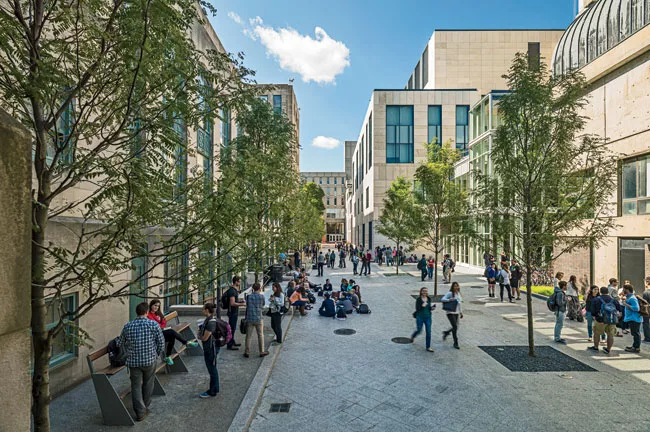
The lobby opens directly to a main pedestrian axis for this part of campus.
 
Photo by Richard Mandelkorn
Boston University Law School Renovation & Expansion
Drawing courtesy Bruner/Cott & Associates
Boston University Law School Renovation & Expansion
Drawing courtesy Bruner/Cott & Associates
Boston University Law School Renovation and Expansion
Boston University Law School Renovation & Expansion
November 15, 2014

Architects & Firms

Bruner/Cott Architects

Boston

People/Products

Preservation and Modernism might seem to have contradictory goals, but not for architects Bruner/Cott. The Cambridge, Massachusetts'based firm is renovating and restoring Boston University's Law Tower and has just completed a 93,000-square-foot addition at its base. The half-century-old 18-story tower is a key element in a collection of five 1960s buildings designed by Josep Llu's Sert, the Corbusier-influenced architect and urban designer who fled to the United States from fascist Spain in the 1939. They occupy a site on the university's central campus between busy Commonwealth Avenue and the Charles River in Boston's Fenway-Kenmore section. In addition to the tower, the Brutalist concrete grouping includes two libraries, a student union, and a central boiler plant, making up what Bruner/Cott calls “a rare grouping of significant works by a single, internationally known architect.”

The tower, which at a height of 265 feet is the most conspicuous piece of the assemblage, is noteworthy for its “sculptural presence,” says Bruner/Cott principal Henry Moss. Its elevations are composed of highly articulated cantilevered volumes that form the armature for windows, scuppers, and precast spandrel panels. The projecting compositions “are not applied; they are part of the structure of the building,” adds founding principal Leland Cott.

Although Moss and Cott—students of Sert when he was dean of Harvard's Graduate School of Design (1953 to 1969)—are ardent admirers of the tower's assertive aesthetic, its users have long criticized the building, which housed classrooms and offices, for its functional drawbacks. For instance, chronic traffic jams at its six small and slow elevators meant it would take students as much as 20 minutes to move between classes.

In addition, the building's envelope posed other challenges, primarily due to age and deferred maintenance: both its cast-in-place frame and its precast panels were spalling, exposing rebar, and its steel-framed, single-glazed windows were drafty and leak-prone. On top of that, the tower had been built without mechanical cooling (Sert's idea was that the narrow floor plate—only 60 feet wide by 120 feet long—would facilitate cross ventilation through clerestory windows and brightly colored metal panels). Although two separate air-conditioning systems were added in the 1970s and 1980s, both were outmoded and ineffective by the time Bruner/Cott was asked by the university to develop a preservation and development plan for this part of campus in 2007.

The tower was outdated in other ways—it had almost no space where students could gather to socialize or work in groups, making it out of step with the collaborative nature of 21st-century legal education.

Given all the tower's limitations, it is not surprising that the law school's leadership had long wanted to build a new facility on another site. Its dean, Maureen O'Rourke, says that the law school's relocation had been a consideration for at least the two decades that she has been a faculty member. Nevertheless, Bruner/Cott was able to convince the university and the school to move forward instead with a renovation and to build a glass and limestone-clad five-story addition, now known as the Sumner Redstone Building, over the one-story boiler plant. The scheme made compelling economic sense: the $184 million project (a sum that includes the expansion and the renovation, as well as soft costs like financing and design fees) is 40 percent less expensive than an entirely new facility, according to Gary Nicksa, the university's senior vice president for operations.

Cott says the project also makes sense for its users. He points to the project's “simple diagram,” which entails moving classrooms out of the upper reaches of the tower and placing them, along with new spaces for group study and socializing, in Redstone or on the lower levels of the Sert building. The tower's upper floors would be given over completely to administrative functions and faculty offices, where their occupants will enjoy views over Boston and Cambridge once the renovation is complete. The strategy is intended to reduce the crush at the elevators, and it locates the programmatic elements where structural logic dictates: the largest rooms are in the addition, which has a steel frame, and therefore longer spans, and the smaller spaces are within the tower's constrained waffle-slab floor plates.

One drawback to the approach is that Redstone's placement sacrifices some of the outdoor space that was part of Sert's composition. But Bruner/Cott maintains that the plazas were windswept and often in shadow, suggesting that Sert was applying a solution more appropriate to the climate of his native Barcelona than that of New England.

What the law school gets in exchange for the inhospitable outdoor spaces are indoor counterparts open to the whole university community. Expressed as glazed volumes that project from the smooth limestone skin of Redstone in a way that refers to Sert's cantilevers, the new gathering places include a caf' overlooking the river and a double-story winter garden that serves as an entry lobby. In the latter space, old and new are clearly distinguished from each other: muscular concrete stands out against a relatively delicate curtain wall. The contrast is reinforced by details such as the 10-inch-wide reveal where the winter garden's ceiling meets Sert's tower (the gap also hides an expansion joint).

As part of the tower's restoration, which is now in full swing, the single-glazed steel windows are being replaced with double-glazed versions in thermally broken aluminum. The new windows' mullions and transoms will match the profile and rhythm of the originals and re-create their shadows.

One particularly tricky aspect of the project is the repair of the spalling concrete, especially that of its cast-in-place structure, says Moss, since the appearance of the material is different in different parts of the tower. What's more, contractors must wait three to four weeks for samples to cure to see how well they match the existing surfaces. “Patching stone is a piece of cake by comparison,” he says.

The renovation also includes the removal of all partitions and the installation of completely new building systems, such as active chilled beams in perimeter offices, which will cool efficiently but work within the structure's tight floor-to-floor heights. Cott says that he hopes the project will redeem the tower in the eyes of the Law School's faculty and students. Once the restoration is completed in the fall of 2015, he says, “it will be better than it has ever been.”


People

Formal name of building:
The Sumner Redstone Building

Location:
Boston University School of Law; Boston, Massachusetts

Completion Date:
September 2014

Gross square footage:
93,000 gross square feet

Total project cost:
$184M

Total construction cost:
$75 Million: The Sumner Redstone Building (completed Sept. 2014)
$58 Million: The Sert Tower (to be completed Sept. 2015)

Client:
Boston University School of Law

Owner:
Boston University

Architect's firm name, address, phone, and fax number:
Bruner/Cott & Associates
Cambridge, MA
(tel) 617-492-8400
(f) 617 876-4002

Personnel in architect's firm who should receive special credit:
Leland Cott, Principal in Charge;
Lynne Brooks, Henry Moss, Lawrence Cheng, project principals;
Peter Ziegler, project managing architect;
Jason Jewhurst, Ken Guditz, Susan Morgan, Gretchen Neeley, Jeff Leclair, Karen Greene, Nat Crosby, Hank Scollard, Rachelle Ain, Alex Janjic, Michael Heise, Alexandra Desaulniers, Meredith Affleck, project team.

Registered:
Leland Cott, Lynne Brooks, Henry Moss, Lawrence Cheng, Peter Ziegler, Ken Guditz, Susan Morgan, Jeff Leclair, Karen Greene, Hank Scollard, Rachelle Ain, Alex Janjic

Architect of record:
Bruner/Cott & Associates

Interior designer:
Bruner/Cott & Associates

Engineers:
Weidlinger Assoc., Structural; BR+A, MEPFP

Consultant(s):
Owners Project Manager: Compass Project Management
Landscape: Richard Burck Associates
Food service: Colburn & Guyette
Civil: Nitsch Engineering
Specs: Kalin Associates
Lighting: Atelier Ten
Acoustical, AV, IT: Acentech
Curtainwall: CDC
Elevator: Syska Hennessey Group

Concrete Restoration:
Simpson, Gumpertz & Heger

Construction Manager:
Skanska USA

Photographer(s):
Richard Mandelkorn Photography (781) 259-3310

Total cost:

$75 Million (Sumner Redstone Building)
$58 Million (The Sert Tower)

Size:

93,000 gross square feet

Completion date:

September 2014 (Sumner Redstone Building)


Products

Structural system:
steel frame

Exterior cladding
Rainscreen (terra cotta, composite, etc.): limestone and granite
Curtain wall: Oldcastle BuildingEnvelope

Roofing
Built-up roofing: Sika Sarnafil

Glazing
Glass: Viracon, Guardian

Doors
Metal doors: LIF Industries
Wood doors: LIF Industries
Fire-control doors, security grilles: Raynor

Interior finishes
Acoustical ceilings: Armstrong, Owens Corning
Demountable partitions: Hufcor
Cabinetwork and custom woodwork: Sefina Industries
Carpet: Tandus, Shaw, Masland
Raised flooring: Tate

Furnishings
Fixed seating: American Seating
Chairs: Knoll, Hightower, Coalesce, Kielhaur, Davis
Tables: Neudorfer
Other furniture (use additional sheet if necessary): Lecture Hall Tables: KI

Lighting
Interior ambient lighting: Litecontrol, Axis, Gotham, Portfolio
Decorative lighting: Betacalco
Dimming System or other lighting controls: Lutron

Conveyance
Elevators/Escalators: Otis Gen2

Energy
Energy management or building automation system: Schneider Electric

 
KEYWORDS: Boston

Share This Story

Looking for a reprint of this article?
From high-res PDFs to custom plaques, order your copy today!

Joann gonchar

Joann Gonchar, FAIA, LEED AP, is deputy editor at Architectural Record. She joined RECORD in 2006, after working for eight years at its sister publication, Engineering News-Record. Before starting her career as a journalist, Joann worked for several architecture firms and spent three years in Kobe, Japan, with the firm Team Zoo, Atelier Iruka. She earned a Master of Architecture degree from the University of Pennsylvania and a Bachelor of Arts from Brown University. She is licensed to practice architecture in New York State.

Post a comment to this article

Report Abusive Comment

Subscription Center
  • Create an Account
  • Start a Subscription
  • Manage My Account
  • Sign Up for Newsletters
  • Visit Customer Service
  • Update Preferences

More Videos

Sponsored Content

Sponsored Content is a special paid section where industry companies provide high quality, objective, non-commercial content around topics of interest to the Architectural Record audience. All Sponsored Content is supplied by the advertising company and any opinions expressed in this article are those of the author and not necessarily reflect the views of Architectural Record or its parent company, BNP Media. Interested in participating in our Sponsored Content section? Contact your local rep!

close
  • TAMLYN XtremeTrim Exterior Trim
    Sponsored byTamlyn

    Designing Cleaner Panel Facades: Why Exterior Trim Details Matter

  • Building with Vapor Barriers
    Sponsored byReef Industries, Inc.

    Vapor Barriers Help Control Moisture in Tighter Building Designs

  • Duct Interior with Prodeq System
    Sponsored byHenry, a Carlisle Company

    Designing Resilient Water Containment Systems

DESIGN:ED Podcast
Listen to Architectural Record’s DESIGN:ED Podcast

Events

June 10, 2026

Rethinking Stormwater – The Power of Porous Paving

Credits: 1 AIA LU/HSW; 1 AIBD P-CE; 0.1 ICC CEU

Learn how porous paving systems support stormwater management, reduce heat island effects, and enhance sustainable site design performance.

June 11, 2026

Very Early Warning Fire Detection for Mission-Critical Facilities

Credits: 1 AIA LU/HSW; 1 AIBD P-CE; 0.1 ICC CEU

Examine advanced fire detection strategies that support uptime and enhance safety in data centers and other mission-critical facilities.

View All Submit An Event

Products

2026 Architect's Square Foot Costbook

2026 Architect's Square Foot Costbook

See More Products

Popular Stories

Practice Matters illustration

What’s in a (Firm’s) Name? Thinking About Succession and Legacy

Practice Matters illustration

By the Numbers: Counting America's Architects

Riverdale House by Studio Lau

Riverdale House by Studio Lau

House on a Hill

Design Vanguard 2026: Forma

Crane Cove, ONO

Design Vanguard 2026 Winners

Broader Sustainability of CMU - Free Webinar - May 21, 2026

Related Articles

  • Golkin Hall, Penn Law School

    See More
  • Behnisch Wins UB Law School Commission

    See More
  • Center for Integrative & Innovative Research

    A Public Research Institute at the University of Arkansas Continues the School’s Pioneering Embrace of Mass Timber

    See More

Related Products

See More Products
  • Architectural Record - February 2026

    Architectural Record February 2026 Issue

  • Web-Regenerative-school4-1920x1125.jpg

    Creating the Regenerative School

  • Architectural Record - November 2025

    Architectural Record November 2025 Issue

See More Products
×

The latest news and information

#1 Source for Architectural Design, News and Products

SUBSCRIBE
  • RESOURCES
    • Advertise
    • Contact Us
    • Submit
    • Store
  • ACCOUNT CENTER
    • Create an Account
    • Start a Subscription
    • Manage My Account
    • Sign Up for Newsletters
    • Visit Customer Service
    • Update Preferences
  • PRIVACY
    • PRIVACY POLICY
    • TERMS & CONDITIONS
    • DO NOT SELL MY PERSONAL INFORMATION
    • PRIVACY REQUEST
    • ACCESSIBILITY
  • SERVICES
    • Marketing Services
    • Reprints
    • Market Research
    • List Rental
    • Survey/Respondent Access
  • STAY CONNECTED
    • Linkedin
    • Facebook
    • Instagram
    • YouTube
    • X (Twitter)

Copyright ©2026. All Rights Reserved BNP Media, Inc. and BNP Media II, LLC.

Design, CMS, Hosting & Web Development :: ePublishing