Architectural Record
search
cart
facebook twitter linkedin youtube
  • Sign In
  • Subscribe
  • Sign Out
  • My Account
Architectural Record
  • NEWS
    • Latest News
    • Awards
    • Interviews
    • Obituaries
    • Podcasts
      • Design:Ed Podcast
      • Sponsored Podcasts
  • OPINION
    • Book Reviews / Excerpts
    • Exhibition Reviews
    • Forum
  • EXCLUSIVES
    • Videos
    • Design Vanguard
    • Top 300 Firms
    • Sponsored Content
    • Sponsored eBooks
    • From the Archives
  • CONTINUING ED
    • Editorial Continuing Ed
    • CE Center
    • CE Academies
  • PROJECTS
    • Buildings By Type
    • Reuse & Renovation
    • Museums & Arts Centers
    • Colleges & Universities
    • Multifamily Housing
    • Interiors
    • Lighting
    • Kitchen & Bath
  • HOUSES
    • Record Houses
    • House of the Month
    • Featured Houses
  • PRODUCTS
    • Products by Category
    • Record Products of the Year
    • Latest Products
  • EVENTS
    • Dates & Events
    • Record on the Road
    • Innovation Conference
    • Sustainability in Practice
    • Women In Architecture
    • Webinars
    • Ad Excellence Awards
    • Submit an Event
  • CONNECT
    • Ask RECORD AI
    • Newsletters
    • Contact
    • Advertise
    • Editorial Calendar
    • Store
    • Customer Service
  • SUBMIT
    • Submission Guidelines
    • RECORD Competitions
  • MAGAZINE
    • Subscribe
    • My Account
    • Digital Edition
    • Current Issue
    • Firm Pass
    • Historic Archive
ProjectsBuildings by TypeColleges & Universities

Princeton Neuroscience Institute & Peretsman-Scully Hall

Brain Trust: At Princeton University, an architect unites two disciplines with splashes of daylight and easy sociability.

By James S. Russell, FAIA Emeritus
Princeton Neuroscience Institute & Peretsman-Scully Hall
Technology-intensive neuroscience research occupies a low wing, connected to the psychology department in a taller, curved slab.
 
Photo © Duccio Malagamba
Princeton Neuroscience Institute & Peretsman-Scully Hall
The sloping site partially buries two levels, which are revealed from the south.
 
Photo © Duccio Malagamba
Princeton Neuroscience Institute & Peretsman-Scully Hall
The sloping site partially buries two levels, which are revealed from the south.
 
Photo © Duccio Malagamba
Princeton Neuroscience Institute & Peretsman-Scully Hall
A rainscreen of molded glass panels casts diffuse light through tall clear-glass windows, leaving desk-level views unobstructed.
 
Photo © Duccio Malagamba
Princeton Neuroscience Institute & Peretsman-Scully Hall
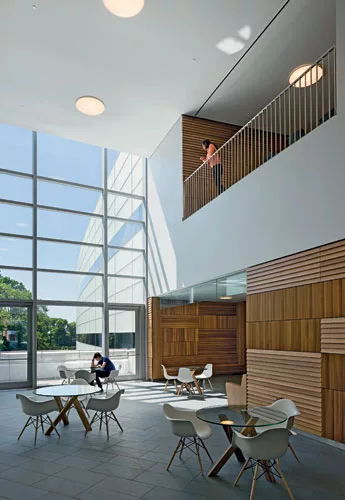
Neuroscience and psychology meet in the two-story lobby, where a lounge and wood-paneled alcoves (the pattern echoing that of the exterior molded glass) offer a variety of formal and intimate meeting spaces. The glass-topped tables were designed by Moneo.
 
Photo © Duccio Malagamba
Princeton Neuroscience Institute & Peretsman-Scully Hall
Moneo uses daylight in a variety of ways. In the Human Neuroscience area, offices borrow light from a clerestory-lit shaft that includes an inviting stair.
 
Photo © Duccio Malagamba
Princeton Neuroscience Institute & Peretsman-Scully Hall
Daylight enlivens the corridor outside the neuroscience-lab core, which is interrupted by an open stair lit by clerestories.
 
Photo © Duccio Malagamba
Princeton Neuroscience Institute & Peretsman-Scully Hall
High windows in offices capture light diffused by the exterior molded-glass panels (though the pulled shade obscures this in photo), which passes through glazed sliding doors.
 
Photo © Duccio Malagamba
Princeton Neuroscience Institute & Peretsman-Scully Hall
The Neuro Lab offers lounge spaces on three levels.
 
Photo © Duccio Malagamba
Princeton Neuroscience Institute & Peretsman-Scully Hall
Image courtesy Rafael Moneo Architects
Princeton Neuroscience Institute & Peretsman-Scully Hall
Rafael Moneo Architects
Princeton, New Jersey
Image courtesy Rafael Moneo Architects
Princeton Neuroscience Institute & Peretsman-Scully Hall
Rafael Moneo Architects
Princeton, New Jersey
Image courtesy Rafael Moneo Architects
Princeton Neuroscience Institute & Peretsman-Scully Hall
Rafael Moneo Architects
Princeton, New Jersey
Image courtesy Rafael Moneo Architects
Princeton Neuroscience Institute & Peretsman-Scully Hall
Rafael Moneo Architects
Princeton, New Jersey
Image courtesy Rafael Moneo Architects
Princeton Neuroscience Institute & Peretsman-Scully Hall
November 15, 2014

Architects & Firms

Rafael Moneo

Princeton, New Jersey

People/Products

Princeton University's new neuroscience and psychology building hunkers calmly, even hermetically, tucked into a slope amid a burgeoning science-research quarter. Across a lawn, the building faces the flamboyant sunshades and monumental gathering space of a genomics laboratory designed by Rafael Vi'oly (Record, November 2003, page 180). The neuroscience entry curves toward an elegant bridge crossing Washington Road, where Hopkins Architects built a nave of ecclesiastic grandeur within a chemistry building that puts the research on display. Such are the architectural gymnastics required to engage the quandaries of scientific investigation: How do researchers collaborate across disciplines while retaining a core professional identity? How do you unite diverse expertise and find a common analytical language to answer critical questions?

At first glance, the Madrid architect Rafael Moneo's 248,000-square-foot steel-framed design looks like a throwback to postwar lab buildings erected under the spell of Walter Gropius. A broad, low wing counterpoints a taller, curved slab, both horizontally striped in ribbed translucent glass, vision glass, and white glass spandrel panels. Landscape architect Michael Van Valkenburgh wrapped the building in a meadow dotted with trees to make a gentle transition from the edge of a small forest to the tidy lawn.

The building's massing makes programmatic sense. The four-story horizontal volume accommodates technology-intense neuroscience labs, while the five-story slab is devoted to psychology, where faculty offices and seminar rooms predominate. The two departments meet not in a grand atrium but in a modest lobby spanned by a bridge overhead. Such distinct realms for neuroscience and psychology look ambivalent, but Moneo and senior associate Valeria Mazarakis 'captured extraordinarily well our need to remain two independent entities while having a strong connection,' explains Deborah Prentice, professor of psychology and public affairs. (Hence, the bidisciplinary official name: Princeton Neuroscience Institute and Peretsman-Scully Hall.)

The psychologist's focus on behavior and the neuroscientist's study of the brain have long been united at Princeton, she adds, though the purpose of the building was to consolidate scattered neuroscience facilities (where research teams include physicists, biophysicists, and molecular biologists, among others) in order to retain an idea of 'two overlapping circles' of psychology and neuroscience.

The building begins to reveal its unique approach to mixing disciplines at the lobby. An alcove paneled in shingled oak strips and furnished with glass-topped Moneo-designed tables invites gathering. It's visible from an elegant stair that jogs at landings to make room for conversation as it descends two levels. A massive neuroscience lab core takes up much of the four-story wing's floor plates. Behind closed doors (and red-painted walls) are the labs that demand the greatest control over environmental conditions. Since only limited daylight is allowed, Moneo has ringed the core with a corridor lined by windowed offices for faculty, post-doctoral researchers, and students.

These perimeter offices use the full 10-foot-6-inch ceiling height and reveal the true purpose of the exterior design. Above the vision-glass strips, Moneo hung custom-made ribbed-glass panels (which act as a rainscreen), held beyond the exterior wall on a painted-steel frame. The glass, custom molded and prototyped to achieve precisely the effect Moneo wanted, suffuses the offices with soft, controlled daylight. The light gains dimension by passing through clerestories that separate each office and then flowing into the corridor through the tall lites of custom, full-height sliding doors framed in stainless steel. 'The light and views are important, and beautiful,' Prentice notes. 'People like them.'

Outside the core, in the Human Neuroscience area, Moneo carved out 'patios' deep within the building for a lounge and a classroom, lighting them from above with a clerestory-topped shaft that plunges four floors, sending diffuse light through floor-to-ceiling glass into labs, offices, and meeting rooms along the way. Clerestories also illuminate open stairs that interrupt the long lines of offices outside the lab core, making the trek from floor to floor alluring, and increasing opportunities for casual meetings. Numerous small lounges and shared workspaces (called 'episodes' by Moneo) open along corridors. A Neuro Lounge is an intimate tour de force, offering varied light and views outside to break-takers as it climbs three levels.

It took three years to resolve the labs' diverse demanding technical requirements and then knit them together, according to Mazarakis. That process produced the idea of scattering social spaces throughout the building and enabled the extraordinary attention to detail throughout. (Moneo flew to Princeton some 40 times over the seven-year design and construction period.) 'I would like the spaces to be felt and understood as both student- and faculty-owned,' he explains, 'giving them a certain sense of privacy, even a sense of domesticity, in order to make their work experience more comfortable.'

Researchers have definitely taken ownership, since just about any glass expanse has become a handy writing surface, even though whiteboards are everywhere. (Inevitably, some seek solitude by covering portions of the glass doors and windows.) It is surprising that a building that reads at first as handsomely institutional, even anonymous, gradually reveals an easy informality in the intimate shared spaces made appealing by unexpected splashes of daylight that invite conversation and collaboration.

With so much research taking place in sterile, evenly lit labs cut off from the world, the high stakes'individual consciousness and identity'can seem abstract. Moneo has used primal amenities'sociability and light'to subtly insist on the humanity of the research enterprise.


People

Client: Princeton University

Architect
Rafael Moneo Architects
Valerio Canals, Clara Moneo,
Alberto Montesinos, Ignacio Senra, project team

Executive Architect:                
Davis Brody Bond
William Paxson, AIA, Partner in Charge;
Anthony Sieverding, AIA, project manager

Engineers
Structural / Mechanical / Electrical / Plumbing / Fire Protection: Arup

Site / Civil Engineering:  Van Note-Harvey

Consultants
Landscape Architect: Michael Van Valkenburgh Associates, Inc. N.Y.

Curtain wall: Permasteelisa. Cricursa.

Glass consultant: Israel Bergman

Laboratory programming and planning:  Jacobs Consultancy

Cost Estimating: Faithful + Gould

Acoustic / Vibration / Audio / Visual / Security: Shen Milsom Wilke, Inc.

Lighting: Fisher Marantz Stone, Inc, N.Y.

Contractor: Barr y Barr, Inc. Builders, N.Y.

Photographer(s):
Duccio Malagamba

Project cost:

248,000 square feet

Size:

Withheld

Completion date:

June 2014


Products

Curtain wall: Permasteelisa

Molded exterior glass: Cricursa

Fixed auditorium seating: Poltrona Frau

 
KEYWORDS: New Jersey

Share This Story

Looking for a reprint of this article?
From high-res PDFs to custom plaques, order your copy today!

James S. Russell, FAIA Emeritus, a journalist who often focuses on sustainability and resilience, is the author of­­­­­ ­­­The Agile City: Building Well Being and Wealth in an Era of Climate Change (Island Press, 2011).

Post a comment to this article

Report Abusive Comment

Subscription Center
  • Create an Account
  • Start a Subscription
  • Manage My Account
  • Sign Up for Newsletters
  • Visit Customer Service
  • Update Preferences

More Videos

Sponsored Content

Sponsored Content is a special paid section where industry companies provide high quality, objective, non-commercial content around topics of interest to the Architectural Record audience. All Sponsored Content is supplied by the advertising company and any opinions expressed in this article are those of the author and not necessarily reflect the views of Architectural Record or its parent company, BNP Media. Interested in participating in our Sponsored Content section? Contact your local rep!

close
  • cold storage facility
    Sponsored byCarlisle SynTec Systems

    How Architects Can Design More Continuous Cold Storage Envelopes

  • TAMLYN XtremeTrim Exterior Trim
    Sponsored byTamlyn

    Designing Cleaner Panel Facades: Why Exterior Trim Details Matter

  • Building with Vapor Barriers
    Sponsored byReef Industries, Inc.

    Vapor Barriers Help Control Moisture in Tighter Building Designs

DESIGN:ED Podcast
Listen to Architectural Record’s DESIGN:ED Podcast

Events

June 23, 2026

Enhancing Fire Resistance with Advanced PVC Solutions

Credits: 1 AIA LU/HSW; 1 AIBD P-CE; 0.1 ICC CEU; 1 IIBEC CEH

Evaluate advanced PVC solutions that improve fire resistance, support WUI compliance, and enhance resilience in residential and commercial building design.

June 25, 2026

Designing Glass Railing Systems that Enhance Aesthetics and Meet Code

Credits: 1 AIA LU/HSW; 1 AIBD P-CE; 0.1 ICC CEU

Upon course completion, participants will possess a deeper understanding of glass railings to help ensure that safety, aesthetic, and performance objectives are achieved.

View All Submit An Event

Products

2026 Architect's Square Foot Costbook

2026 Architect's Square Foot Costbook

See More Products

Popular Stories

Lorcan O' Herilhy

California Architect Lorcan O’Herlihy Has Died, Age 66

Obama Presidential Center, Chicago

The Obama Presidential Center Opens on Chicago’s South Side

Spoonbill Ranch

Johnsen Schmaling Architects Integrates Spoonbill Ranch into a Pristine Landscape

Image of Bruce Springsteen Center for American Music

The CookFox-designed Bruce Springsteen Center for American Music Opens in New Jersey

Three Courtyards House

Design Vanguard 2026: Balsa Crosetto Piazzi

Enhancing Fire Resistance with Advanced PVC Solutions - Free Webinar - June 23, 2026

Related Articles

  • Neuroscience Institute

    UC Gardner Neuroscience Institute by Perkins and Will

    See More
  • Princeton University Geo-Exchange

    ZGF Architects’ Geo-Exchange System for Princeton Leads an Underground Revolution

    See More
  • David Geffen Hall

    Diamond Schmitt and Tod Williams Billie Tsien Architects Reimagine David Geffen Hall

    See More
×

The latest news and information

#1 Source for Architectural Design, News and Products

SUBSCRIBE
  • RESOURCES
    • Advertise
    • Contact Us
    • Submit
    • Store
  • ACCOUNT CENTER
    • Create an Account
    • Start a Subscription
    • Manage My Account
    • Sign Up for Newsletters
    • Visit Customer Service
    • Update Preferences
  • PRIVACY
    • PRIVACY POLICY
    • TERMS & CONDITIONS
    • DO NOT SELL MY PERSONAL INFORMATION
    • PRIVACY REQUEST
    • ACCESSIBILITY
  • SERVICES
    • Marketing Services
    • Reprints
    • Market Research
    • List Rental
    • Survey/Respondent Access
  • STAY CONNECTED
    • Linkedin
    • Facebook
    • Instagram
    • YouTube
    • X (Twitter)

Copyright ©2026. All Rights Reserved BNP Media, Inc. and BNP Media II, LLC.

Design, CMS, Hosting & Web Development :: ePublishing