Architectural Record
search
cart
facebook twitter linkedin youtube
  • Sign In
  • Subscribe
  • Sign Out
  • My Account
Architectural Record
  • NEWS
    • Latest News
    • Awards
    • Interviews
    • Obituaries
    • Podcasts
      • Design:Ed Podcast
      • Sponsored Podcasts
  • OPINION
    • Book Reviews / Excerpts
    • Exhibition Reviews
    • Forum
  • EXCLUSIVES
    • Videos
    • Design Vanguard
    • Top 300 Firms
    • Sponsored Content
    • Sponsored eBooks
    • From the Archives
  • CONTINUING ED
    • Editorial Continuing Ed
    • CE Center
    • CE Academies
  • PROJECTS
    • Buildings By Type
    • Reuse & Renovation
    • Museums & Arts Centers
    • Colleges & Universities
    • Multifamily Housing
    • Interiors
    • Lighting
    • Kitchen & Bath
  • HOUSES
    • Record Houses
    • House of the Month
    • Featured Houses
  • PRODUCTS
    • Products by Category
    • Record Products of the Year
    • Latest Products
  • EVENTS
    • Dates & Events
    • Record on the Road
    • Innovation Conference
    • Sustainability in Practice
    • Women In Architecture
    • Webinars
    • Ad Excellence Awards
    • Submit an Event
  • CONNECT
    • Ask RECORD AI
    • Newsletters
    • Contact
    • Advertise
    • Editorial Calendar
    • Store
    • Customer Service
  • SUBMIT
    • Submission Guidelines
    • RECORD Competitions
  • MAGAZINE
    • Subscribe
    • My Account
    • Digital Edition
    • Current Issue
    • Firm Pass
    • Historic Archive
ProjectsLighting Design

Energy Biosciences Building

Sophisticated controls help keep energy use in check while supporting critical research focused on climate change.
By Joann Gonchar, FAIA
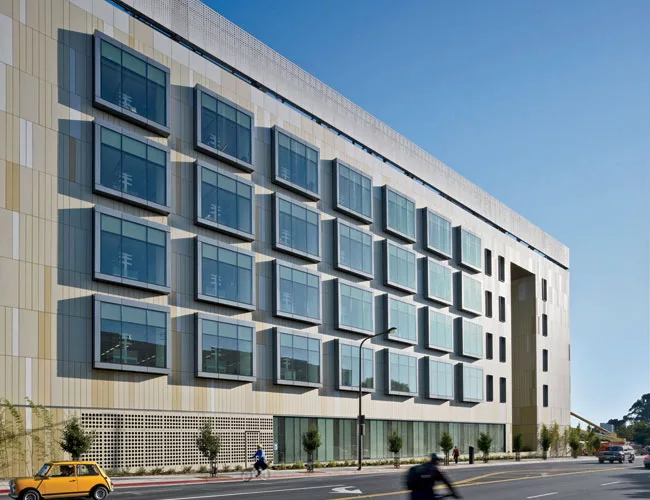
The labs at the Energy Biosciences Building are housed in a bar-shaped wing that has generously sized north-facing windows and a rainscreen skin made of glass-fiber-reinforced concrete panels.
Energy Biosciences Building
SmithGroupJJR / Loisos + Ubbelohde
University of California, Berkeley
The labs at the Energy Biosciences Building are housed in a bar-shaped wing that has generously sized north-facing windows and a rainscreen skin made of glass-fiber-reinforced concrete panels.
Photo © Bruce Damonte
The offices are housed in a wedge that protrudes from the building's south side and wraps a corner. On the exterior of this glazed volume, a series of laminated glass shades directs and diffuses dayli
Energy Biosciences Building
SmithGroupJJR / Loisos + Ubbelohde
University of California, Berkeley
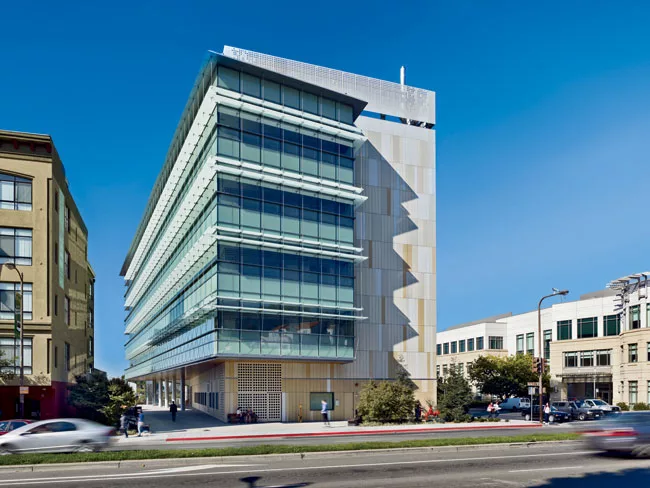
The offices are housed in a wedge that protrudes from the building's south side and wraps a corner. On the exterior of this glazed volume, a series of laminated glass shades directs and diffuses daylight. On the interior, automated shades help further improve occupants' visual comfort. The laboratory windows also include automated shades, but their primary purpose is to shield an adjacent residential neighborhood from light emanating from the facility after dark.
Photo © Bruce Damonte
The building includes several areas intended to promote informal meetings and chance encounters among its occupants. These include a stair whose steel structure is clad in point-supported glass. Thous
Energy Biosciences Building
SmithGroupJJR / Loisos + Ubbelohde
University of California, Berkeley
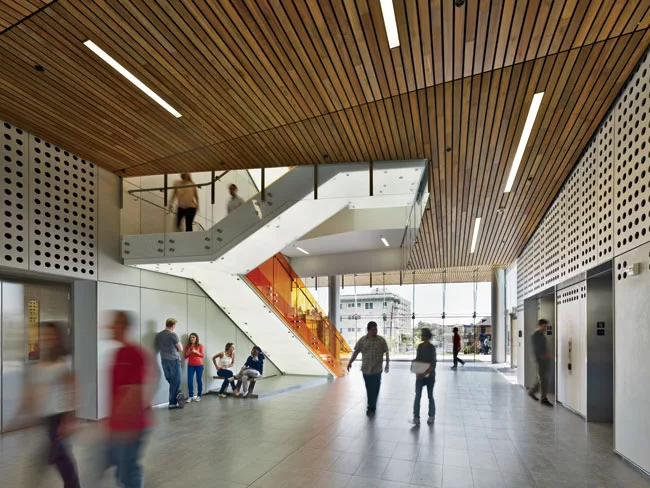
The building includes several areas intended to promote informal meetings and chance encounters among its occupants. These include a stair whose steel structure is clad in point-supported glass. Thousands of LEDs concealed below the treads illuminate the stair. These dim in response to available daylight, but even at full brightness, the five-story stair draws only 3 amps.
Photo © Bruce Damonte
The electric lighting for the laboratories includes pendant luminaires placed between the lab benches for ambient light. Each work surface has its own LED task light equipped with an occupancy sensor
Energy Biosciences Building
SmithGroupJJR / Loisos + Ubbelohde
University of California, Berkeley
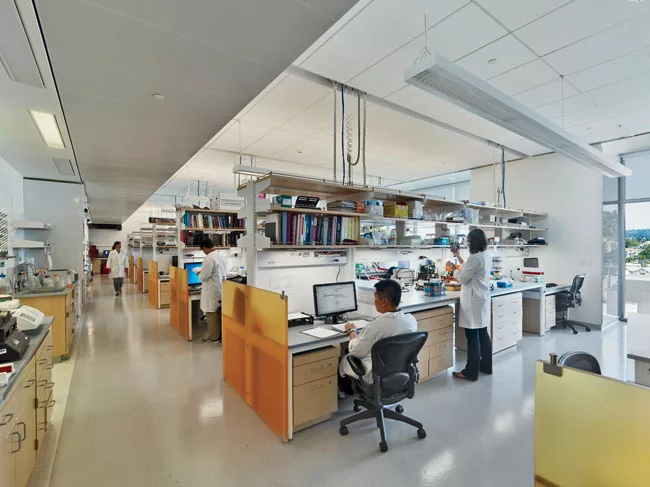
The electric lighting for the laboratories includes pendant luminaires placed between the lab benches for ambient light. Each work surface has its own LED task light equipped with an occupancy sensor that shuts the fixture off when researchers leave for extended periords.
Photo © Bruce Damonte
Designers arrived at the installed lighting scheme after simulating the effect of daylight coming through the laboratory windows at various times of the day and year. The simulations included studies
Energy Biosciences Building
SmithGroupJJR / Loisos + Ubbelohde
University of California, Berkeley
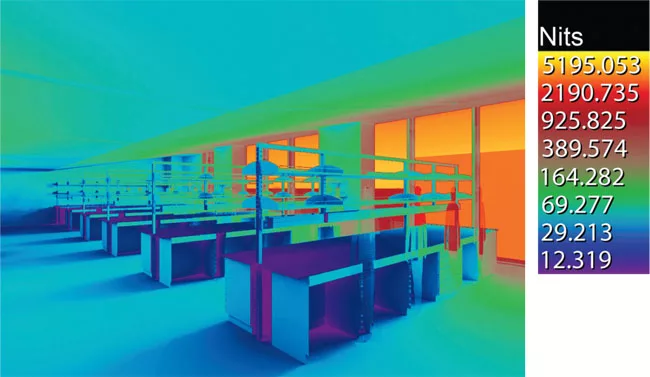
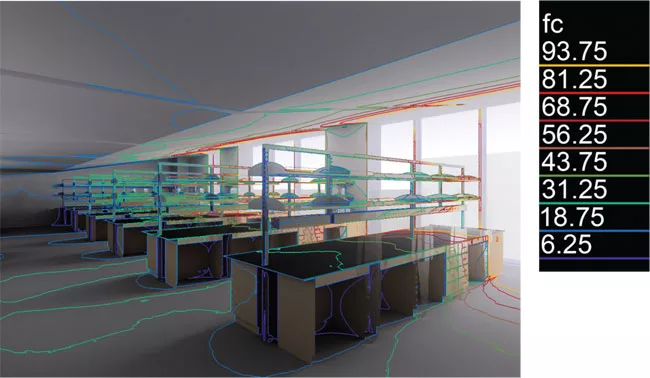
Designers arrived at the installed lighting scheme after simulating the effect of daylight coming through the laboratory windows at various times of the day and year. The simulations included studies of illuminance (slide 6) and luminance (left), which show how much light surfaces receive and emit, respectively.
Simulation courtesy Loisos + Ubbelohde
Designers arrived at the installed lighting scheme after simulating the effect of daylight coming through the laboratory windows at various times of the day and year. The simulations included studies
Energy Biosciences Building
SmithGroupJJR / Loisos + Ubbelohde
University of California, Berkeley
Designers arrived at the installed lighting scheme after simulating the effect of daylight coming through the laboratory windows at various times of the day and year. The simulations included studies of illuminance (left) and luminance (slide 5), which show how much light surfaces receive and emit, respectively.
Simulation courtesy Loisos + Ubbelohde
The labs at the Energy Biosciences Building are housed in a bar-shaped wing that has generously sized north-facing windows and a rainscreen skin made of glass-fiber-reinforced concrete panels.
The offices are housed in a wedge that protrudes from the building's south side and wraps a corner. On the exterior of this glazed volume, a series of laminated glass shades directs and diffuses dayli
The building includes several areas intended to promote informal meetings and chance encounters among its occupants. These include a stair whose steel structure is clad in point-supported glass. Thous
The electric lighting for the laboratories includes pendant luminaires placed between the lab benches for ambient light. Each work surface has its own LED task light equipped with an occupancy sensor
Designers arrived at the installed lighting scheme after simulating the effect of daylight coming through the laboratory windows at various times of the day and year. The simulations included studies
August 16, 2013

Architects & Firms

SmithGroupJJR / Loisos + Ubbelohde

University of California, Berkeley

The scientists and policy experts at the Energy Biosciences Institute (EBI) are tackling some of today's most urgent environmental problems, including climate change and the diminishing supply of fossil fuels. The institute's chemists, biologists, engineers, and economists represent three different public research institutions—the University of California, Berkeley (UC Berkeley); the Lawrence Berkeley National Laboratory; and the University of Illinois at Urbana-Champaign—as well as the energy company BP. Given the diversity of these stakeholders, it is not surprising that the project brief for EBI's $85 million, 1-year-old home at the edge of the UC Berkeley campus called for a flexible facility that would spur innovation and foster cross-pollination.

In response, designers from national architecture and engineering firm SmithGroup JJR have created an open and mostly transparent 113,000-square-foot building. Although largely daylit and designed to perform almost 20 percent better than California's stringent energy code, the five-story structure meets the demanding lighting expectations of the EBI researchers. A long and narrow bar of state-of-the-art labs is rainscreen-clad, with generously sized north-facing bay windows. Offices are enclosed in a wedge that protrudes from the building's south face and wraps one corner. This volume has a fritted glass skin that includes fixed laminated-glass sun shades for diffusing and directing sunlight.

The laboratories presented the toughest challenge to illuminate efficiently, since researchers desired 80 to 100 foot-candles on their work surfaces. Here the lighting scheme includes indirect-direct fixtures suspended from the ceiling. These photosensor-controlled pendants, each with a single T5 lamp, provide ambient light and dim in response to daylight's entering through the 15-foot-wide-by-11-foot-tall bay windows. And, at each lab bench, the project's lighting and daylighting consultant, Loisos + Ubbelohde, provided a low-voltage LED task light. These are manually controlled, but, to keep energy consumption in check, sensors turn the lights off when users leave their stations for extended periods.

Since no such off-the-shelf, sensor-equipped fixture was available at the time, designers devised their own, combining components from several different manufacturers. “On the surface, this solution sounds incredibly simple,” says the firm's principal, George Loisos. But in fact, creating a properly functioning auto-off task light proved surprisingly tricky. It involved development of a special shield so that the sensor would “see” only what was intended, careful placement of the infrared device so that structural elements or other objects wouldn't obstruct it, and calibration of the “gain,” or sensitivity, of the sensor so that the light wouldn't turn off while the work station was occupied.

These task lights, along with the rest of the Energy Biosciences Building's electric lighting, are part of a type of network known as a digital addressable lighting interface, or DALI for short. This network should allow the reconfiguration of the building's lighting without the need for an electrician, even though most of the devices are hard-wired. If a research area is divided into two with a new partition, for example, facility operators can connect the existing fixtures to different switches simply by reprogramming them. The need for such flexibility is more than theoretical, since the Institute has so far been funded for only a 10-year period, making it likely that the structure will house different research groups during its expected 50-year lifespan.

Interspersed throughout the building are social areas intended to encourage collaboration, facilitate informal meetings, and promote chance encounters. Among these is a glass-clad stair that connects all of the floors and has thousands of tiny LEDs hidden beneath its treads and risers. These are controlled by a combination of photosensors and a timer, which dim the stair based on the brightness of sunlight shining through a rooftop skylight and turn it off during late-night hours. Although the controls provide efficiencies, even at full power the stair pulls only three amps, says Loisos. But this vertical-circulation element is much more than an efficient ambient light source. It is a luminous sculpture.

Architect: SmithGroupJJR

Lighting/daylighting Designer: Loisos + Ubbelohde

Engineers: Gayner Engineers (m/e/p)

Owner: University of California, Berkeley

Size: 113,200 square feet (gross)

Cost: $86.5 million

Completion date: August 2012

People

Formal name of building:
Energy Biosciences Building

Location:
University of California, Berkeley

Completion Date:
August 2012

Gross square footage:
113,200 gsf

Total construction cost:
$86.5 million

Owner:
University of California, Berkeley

Architect:
SmithGroupJJR
301 Battery Street, 7th Floor
San Francisco, CA 94111
t 415.227.0100

Personnel in architect's firm who should receive special credit:
Suzanne Napier, AIA, Principal in Charge
Johnny Wong, AIA, Project Architect
Wil Caine, Project Designer
Barbara Abecassis, Project Designer

Lighting + Daylighting Designer:
Loisos + Ubbelohde

Personnel in Lighting Designer’s office who should receive special credit:
George Loisos, AIA, Principal in Charge
M. Susan Ubbelohde, Daylighting
Abe Shameson, Lighting Design
Christian Humann, Daylighting Design

Interior Designer:
SmithGroupJJR

Engineer:
Gayner Engineers

General contractor:
Rudolph and Sletten

Photographer:
Bruce Damonte


Products

Curtain Wall:
Glazing: Wausau Window
Glass fiber-reinforced concrete panels: Rieder

Shading Systems/Devices:
MechoSystems

Shading Controls:
MechoSystems

Lighting
Interior ambient lighting: Ledalite, Linear Lighting, Zumtobel, Finelite, Borden
Downlights: Kurt Versen
Task lighting: Lunera, Luxo
Exterior: We-ef, Kurt Versen, B-K Lighting, Tivoli, IO Lighting, Louis Poulsen, Bega
Lighting controls: Lutron Electronic

Energy
Building Controls:
Automated Logic Corporation (ALC) — Building Control System
Lutron Electronic — Lighting Control System

 
KEYWORDS: California

Share This Story

Looking for a reprint of this article?
From high-res PDFs to custom plaques, order your copy today!

Joann gonchar

Joann Gonchar, FAIA, LEED AP, is deputy editor at Architectural Record. She joined RECORD in 2006, after working for eight years at its sister publication, Engineering News-Record. Before starting her career as a journalist, Joann worked for several architecture firms and spent three years in Kobe, Japan, with the firm Team Zoo, Atelier Iruka. She earned a Master of Architecture degree from the University of Pennsylvania and a Bachelor of Arts from Brown University. She is licensed to practice architecture in New York State.

Post a comment to this article

Report Abusive Comment

Subscription Center
  • Create an Account
  • Start a Subscription
  • Manage My Account
  • Sign Up for Newsletters
  • Visit Customer Service
  • Update Preferences

More Videos

Sponsored Content

Sponsored Content is a special paid section where industry companies provide high quality, objective, non-commercial content around topics of interest to the Architectural Record audience. All Sponsored Content is supplied by the advertising company and any opinions expressed in this article are those of the author and not necessarily reflect the views of Architectural Record or its parent company, BNP Media. Interested in participating in our Sponsored Content section? Contact your local rep!

close
  • TAMLYN XtremeTrim Exterior Trim
    Sponsored byTamlyn

    Designing Cleaner Panel Facades: Why Exterior Trim Details Matter

  • Building with Vapor Barriers
    Sponsored byReef Industries, Inc.

    Vapor Barriers Help Control Moisture in Tighter Building Designs

  • Duct Interior with Prodeq System
    Sponsored byHenry, a Carlisle Company

    Designing Resilient Water Containment Systems

DESIGN:ED Podcast
Listen to Architectural Record’s DESIGN:ED Podcast

Events

June 10, 2026

Rethinking Stormwater – The Power of Porous Paving

Credits: 1 AIA LU/HSW; 1 AIBD P-CE; 0.1 ICC CEU

Learn how porous paving systems support stormwater management, reduce heat island effects, and enhance sustainable site design performance.

June 11, 2026

Very Early Warning Fire Detection for Mission-Critical Facilities

Credits: 1 AIA LU/HSW; 1 AIBD P-CE; 0.1 ICC CEU

Examine advanced fire detection strategies that support uptime and enhance safety in data centers and other mission-critical facilities.

View All Submit An Event

Products

2026 Architect's Square Foot Costbook

2026 Architect's Square Foot Costbook

See More Products

Popular Stories

Practice Matters illustration

What’s in a (Firm’s) Name? Thinking About Succession and Legacy

Practice Matters illustration

By the Numbers: Counting America's Architects

Riverdale House by Studio Lau

Riverdale House by Studio Lau

House on a Hill

Design Vanguard 2026: Forma

Crane Cove, ONO

Design Vanguard 2026 Winners

Broader Sustainability of CMU - Free Webinar - May 21, 2026

Related Articles

  • Winthrop Center

    The Tallest Tower in Boston’s Financial District Moves the Energy Performance Needle

    See More
  • təməsew̓txʷ ACC

    In British Columbia, an All-Electric Aquatic Center by hcma Challenges the Typology’s Energy-Guzzling Reputation

    See More
  • Light Fall

    In a New York Office Building, Loisos + Ubbelohde’s Fiber-Optic Sculpture Glows with the Light of the Sun

    See More

Related Products

See More Products
  • facade.jpg

    Sustainable Facades: Design Methods for High-Performance Building Envelopes

  • sustainable building.jpg

    Sustainable Building Design: Principles and Practice

See More Products

Events

View AllSubmit An Event
  • April 23, 2026

    Propane and the Evolving Energy Landscape

    NOW ON DEMANDCredits: 1 AIA LU/HSW; 1 AIBD P-CE; 0.1 ICC CEUDiscover how propane systems can deliver flexible, resilient, and energy-independent solutions that support high-performance, cost-effective commercial building design.
View AllSubmit An Event
×

The latest news and information

#1 Source for Architectural Design, News and Products

SUBSCRIBE
  • RESOURCES
    • Advertise
    • Contact Us
    • Submit
    • Store
  • ACCOUNT CENTER
    • Create an Account
    • Start a Subscription
    • Manage My Account
    • Sign Up for Newsletters
    • Visit Customer Service
    • Update Preferences
  • PRIVACY
    • PRIVACY POLICY
    • TERMS & CONDITIONS
    • DO NOT SELL MY PERSONAL INFORMATION
    • PRIVACY REQUEST
    • ACCESSIBILITY
  • SERVICES
    • Marketing Services
    • Reprints
    • Market Research
    • List Rental
    • Survey/Respondent Access
  • STAY CONNECTED
    • Linkedin
    • Facebook
    • Instagram
    • YouTube
    • X (Twitter)

Copyright ©2026. All Rights Reserved BNP Media, Inc. and BNP Media II, LLC.

Design, CMS, Hosting & Web Development :: ePublishing