Architectural Record
search
cart
facebook twitter linkedin youtube
  • Sign In
  • Subscribe
  • Sign Out
  • My Account
Architectural Record
  • NEWS
    • Latest News
    • Awards
    • Interviews
    • Obituaries
    • Podcasts
      • Design:Ed Podcast
      • Sponsored Podcasts
  • OPINION
    • Book Reviews / Excerpts
    • Exhibition Reviews
    • Forum
  • EXCLUSIVES
    • Videos
    • Design Vanguard
    • Top 300 Firms
    • Sponsored Content
    • Sponsored eBooks
    • From the Archives
  • CONTINUING ED
    • Editorial Continuing Ed
    • CE Center
    • CE Academies
  • PROJECTS
    • Buildings By Type
    • Reuse & Renovation
    • Museums & Arts Centers
    • Colleges & Universities
    • Multifamily Housing
    • Interiors
    • Lighting
    • Kitchen & Bath
  • HOUSES
    • Record Houses
    • House of the Month
    • Featured Houses
  • PRODUCTS
    • Products by Category
    • Record Products of the Year
    • Latest Products
  • EVENTS
    • Dates & Events
    • Record on the Road
    • Innovation Conference
    • Sustainability in Practice
    • Women In Architecture
    • Webinars
    • Ad Excellence Awards
    • Submit an Event
  • CONNECT
    • Ask RECORD AI
    • Newsletters
    • Contact
    • Advertise
    • Editorial Calendar
    • Store
    • Customer Service
  • SUBMIT
    • Submission Guidelines
    • RECORD Competitions
  • MAGAZINE
    • Subscribe
    • My Account
    • Digital Edition
    • Current Issue
    • Firm Pass
    • Historic Archive
ProjectsLighting Design

Sengukan Museum by Akira Kuryu Architect & Associates and Lighting Planners Associates

Ise City, Japan
By Naomi Pollock, FAIA
Sengukan Museum
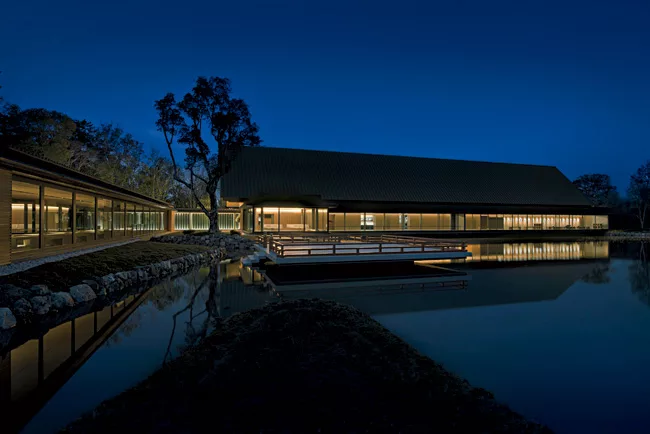
Lit primarily from within, the Sengukan Museum glows like a paper lantern.
 
Photo © Toshio Kaneko
Sengukan Museum
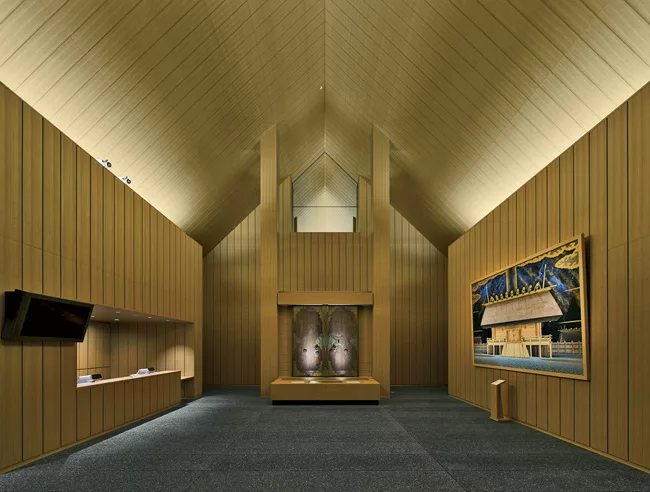
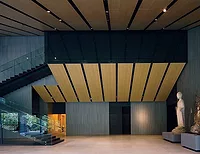
Inside the reception area, spotlights call attention to the tobira doors, while cove lights illuminate the pitched ceiling.
 
Photo © Toshio Kaneko
Sengukan Museum
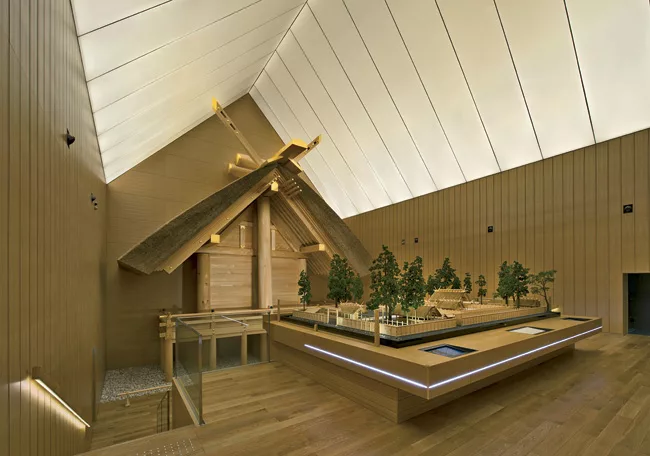
In the main gallery, a split-level floor accommodates two large models: a 1:20 recreation of the entire Geku precinct and a 1:4 version of the Geku shrine itself.
 
Photo © Toshio Kaneko
Sengukan Museum
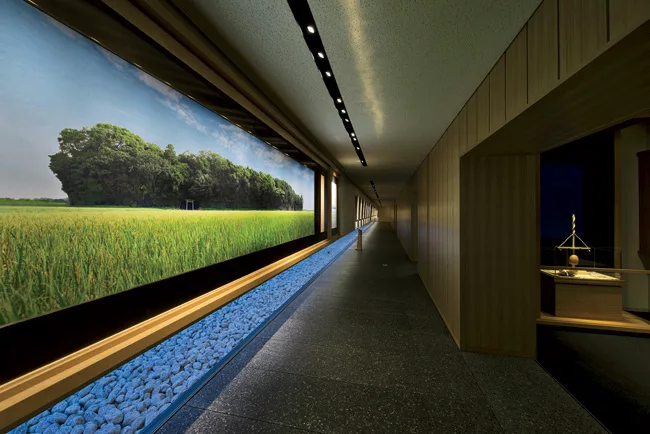
North and south display corridors, with differing daylight exposures, wrap the central exhibition halls. On the north side, a low window (a jimado) —beneath wall displays like the realistic landscape here—hugs the floor, revealing white pebbles outside.
 
Photo © Toshio Kaneko
Sengukan Museum
Sengukan Museum
Sengukan Museum
Sengukan Museum
May 16, 2014

Architects & Firms

Akira Kuryu Architect & Associates

Dedicated to the goddess Amaterasu, Japan's highest Shinto deity, the country's two most sacred sites are the Naiku and the Geku sanctuaries within the Grand Shrine complex at Ise, in the Mie prefecture. Every 20 years, the simple wooden structures supported by wood columns and topped by thatched roofs, undergo a ritual reconstruction. Each of the two buildings is dismantled and erected anew on an adjacent site by highly specialized carpenters. Though this cycle has been going on for centuries, the individual shrines are so revered that they are kept under wraps, leaving most people unaware about what actually takes place. To shed light on the secretive ceremony, known as Sengu, shrine officials commissioned the Tokyo architect Akira Kuryu to design an Ise Shrine Sengu museum where, for the first time, visitors are able to view large-scale models of and artifacts salvaged from the buildings. Because he needed good lighting to accentuate the displays, Kuryu turned to the Tokyo-based Lighting Planners Associates (LPA).

Kuryu's L-shaped building is located near the entrance to the Geku (or outer) precinct and hugs an iris-studded pond. One leg contains a glazed rest pavilion, the other the museum, a single-story sequence of symmetrically organized spaces crowned by a massive pitched roof made of cast iron.

 
LPA developed an illumination plan that creates a series of contrasting light and dark spaces. “Merging natural and artificial light was the most important consideration,” says lighting designer Kaoru Mende. Blending the two enabled the museum to rely on daylight during its hours of operation (it closes at 4 p.m., except on special holidays), so visitors are able to view the displays as if in the shrine's natural setting.
 
Mende and his team lined the museum's approach with LED uplights, controlled to respond to outdoor conditions. These are embedded in the paving and continue into the reception area, guiding visitors inside, and helping the eye shift from exterior to interior light levels. Here, ceiling-mounted fixtures with 3,000-Kelvin, 32-watt fluorescent lamps and daylight-sensing dimmers provide ambient light. Task lights brighten the admissions desk, and halogen spots illuminate ornate tobira doors that once belonged to the Geku shrine but now greet gallery visitors.
 
Enclosed by large glass panes along one wall, the building's south corridor opens to expansive pond views and a flood of sunshine, while the shadowy north corridor is lined with a low window yielding limited views of the pebbly ground outside and a band of daylight at the wall's base. Concealed LED tapes extend the length of the glass, while recessed LED spots in the ceiling highlight wall-mounted displays. “We always try to integrate fixtures with the architecture,” remarks Mende.
 
By contrast, the main gallery has no external exposure. Instead, its carefully calibrated luminous ceiling mimics the aura of a cloudy day. “Unlike [the way it is] in a [Christian] church, the lighting should be diffuse, to convey the spirit of Japanese space,” explains Mende. The lighting team achieved this effect using metal halide spotlights and a ceiling of glass cloth. “It looks like wool but is made of glass fibers,” explains Kuryu. Evenly spaced behind and along the base of a ceiling pitched at 45 degrees, the lamps are covered by oval spread lenses that distribute the light upward to the ridge. Minute adjustments to the lamps and their lenses help limit hot spots of higher lux levels near the ridge. “It was our challenge to make it even,” says Mende.
 
By paying close attention to the sun's daily cycle, keeping the installed lighting elements to a minimum building-wide and fine-tuning the intensity of each one, LPA makes it seem as if there are barely any lights at all.

People

Formal name of building:

Sengukan Museum


Location:

Ise City, Mie Prefecture


Completion date:

2012


Gross square footage:

16,062sqm (site area) 1,969sqm (building area) 2,622sqm (floor area)


Total project cost:

withheld


Total construction cost:

withheld


Client:

Jingu Shikinen Zoueicho


Owner:

Jingu Shikinen Zoueicho


Architect's firm name:

A. Kuryu Architect & Associates


Architect of record:

Tatsuo Iwasa


Engineers:

Katsuo Nakata Engineering


Consultant(s):

Landscape: Placemedia Landscape Architects Collaborative, Shunsaku Miyagi

Lighting: Lighting Planners Associates, Kaoru Mende, Mari Kubota, Tsutomo Nagatsu(*former staff)


General contractor:

Taisei Corporation


Photographer(s):

Toshio Kaneko


Lighting designer:

Lighting Planners Associates — Kaoru Mende, Mari Kubota, Tsutomo Nagatsu


Size:

21,200 square feet


Cost:

withheld


Completion date:

2012


Products

Structural system

List type, e.g. concrete or steel frame, wood, etc.: reinforced concrete, steel frame


Lighting

Interior ambient lighting: Yamagiwa, DN Lighting, TOKI
Downlights: Yamagiwa
Task lighting: Spotlight: Modulex, Daiko, Yamagiwa, Erco
Exterior: Yamagiwa
Dimming System or other lighting controls: Panasonic


Other unique products that contribute to sustainability

Photo sensor


Membrane

Nittobo

 
KEYWORDS: Japan

Share This Story

Looking for a reprint of this article?
From high-res PDFs to custom plaques, order your copy today!

Contributing Editor Naomi Pollock, FAIA, is the author of Japanese Design Since 1945: A Complete Sourcebook and the forthcoming Vanishing Japan: Modern Architecture Gone But Not Forgotten,

Post a comment to this article

Report Abusive Comment

Subscription Center
  • Create an Account
  • Start a Subscription
  • Manage My Account
  • Sign Up for Newsletters
  • Visit Customer Service
  • Update Preferences

More Videos

Sponsored Content

Sponsored Content is a special paid section where industry companies provide high quality, objective, non-commercial content around topics of interest to the Architectural Record audience. All Sponsored Content is supplied by the advertising company and any opinions expressed in this article are those of the author and not necessarily reflect the views of Architectural Record or its parent company, BNP Media. Interested in participating in our Sponsored Content section? Contact your local rep!

close
  • TAMLYN XtremeTrim Exterior Trim
    Sponsored byTamlyn

    Designing Cleaner Panel Facades: Why Exterior Trim Details Matter

  • Building with Vapor Barriers
    Sponsored byReef Industries, Inc.

    Vapor Barriers Help Control Moisture in Tighter Building Designs

  • Duct Interior with Prodeq System
    Sponsored byHenry, a Carlisle Company

    Designing Resilient Water Containment Systems

DESIGN:ED Podcast
Listen to Architectural Record’s DESIGN:ED Podcast

Events

June 10, 2026

Rethinking Stormwater – The Power of Porous Paving

Credits: 1 AIA LU/HSW; 1 AIBD P-CE; 0.1 ICC CEU

Learn how porous paving systems support stormwater management, reduce heat island effects, and enhance sustainable site design performance.

June 11, 2026

Very Early Warning Fire Detection for Mission-Critical Facilities

Credits: 1 AIA LU/HSW; 1 AIBD P-CE; 0.1 ICC CEU

Examine advanced fire detection strategies that support uptime and enhance safety in data centers and other mission-critical facilities.

View All Submit An Event

Products

2026 Architect's Square Foot Costbook

2026 Architect's Square Foot Costbook

See More Products

Popular Stories

Practice Matters illustration

What’s in a (Firm’s) Name? Thinking About Succession and Legacy

Practice Matters illustration

By the Numbers: Counting America's Architects

House on a Hill

Design Vanguard 2026: Forma

Crane Cove, ONO

Design Vanguard 2026 Winners

House A on a Hill

Design Vanguard 2026: Santiago Valdivieso

Broader Sustainability of CMU - Free Webinar - May 21, 2026

Related Articles

  • The Art of Darkness

    Lighting Planners Associates Use Moonlight to Transform Japanese Resort

    See More
  • Kengo Kuma & Associates Tiffany Ginza Lighting Projects

    See More
  • Nezu Museum

    Nezu Museum by Kengo Kuma and Associates

    See More

Related Products

See More Products
  • 0470114223.gif

    Interior Lighting for Designers, 5th Edition

  • bni book

    2026 Architect's Square Foot Costbook

See More Products

Events

View AllSubmit An Event
  • October 30, 2025

    The Bright Side and Benefits of Designing with Integrated Lighting

    NOW ON DEMANDCredits: 1 AIA LU/HSW; 1 AIBD P-CE; 0.1 ICC CEU; 0.1 IACET CEUThis course is all about light designs and the small details that can make or break the space you’re designing.
View AllSubmit An Event
×

The latest news and information

#1 Source for Architectural Design, News and Products

SUBSCRIBE
  • RESOURCES
    • Advertise
    • Contact Us
    • Submit
    • Store
  • ACCOUNT CENTER
    • Create an Account
    • Start a Subscription
    • Manage My Account
    • Sign Up for Newsletters
    • Visit Customer Service
    • Update Preferences
  • PRIVACY
    • PRIVACY POLICY
    • TERMS & CONDITIONS
    • DO NOT SELL MY PERSONAL INFORMATION
    • PRIVACY REQUEST
    • ACCESSIBILITY
  • SERVICES
    • Marketing Services
    • Reprints
    • Market Research
    • List Rental
    • Survey/Respondent Access
  • STAY CONNECTED
    • Linkedin
    • Facebook
    • Instagram
    • YouTube
    • X (Twitter)

Copyright ©2026. All Rights Reserved BNP Media, Inc. and BNP Media II, LLC.

Design, CMS, Hosting & Web Development :: ePublishing