Architectural Record
search
cart
facebook twitter linkedin youtube
  • Sign In
  • Subscribe
  • Sign Out
  • My Account
Architectural Record
  • NEWS
    • Latest News
    • Awards
    • Interviews
    • Obituaries
    • Podcasts
      • Design:Ed Podcast
      • Sponsored Podcasts
  • OPINION
    • Book Reviews / Excerpts
    • Exhibition Reviews
    • Forum
  • EXCLUSIVES
    • Videos
    • Design Vanguard
    • Top 300 Firms
    • Sponsored Content
    • Sponsored eBooks
    • From the Archives
  • CONTINUING ED
    • Editorial Continuing Ed
    • CE Center
    • CE Academies
  • PROJECTS
    • Buildings By Type
    • Reuse & Renovation
    • Museums & Arts Centers
    • Colleges & Universities
    • Multifamily Housing
    • Interiors
    • Lighting
    • Kitchen & Bath
  • HOUSES
    • Record Houses
    • House of the Month
    • Featured Houses
  • PRODUCTS
    • Products by Category
    • Record Products of the Year
    • Latest Products
  • EVENTS
    • Dates & Events
    • Record on the Road
    • Innovation Conference
    • Sustainability in Practice
    • Women In Architecture
    • Webinars
    • Ad Excellence Awards
    • Submit an Event
  • CONNECT
    • Ask RECORD AI
    • Newsletters
    • Contact
    • Advertise
    • Editorial Calendar
    • Store
    • Customer Service
  • SUBMIT
    • Submission Guidelines
    • RECORD Competitions
  • MAGAZINE
    • Subscribe
    • My Account
    • Digital Edition
    • Current Issue
    • Firm Pass
    • Historic Archive
ProjectsLighting Design

One Central Park

With a dramatic cantilever and carefully coordinated sets of mirrors, a design team brings sunlight into a new development in Sydney.
By Elizabeth Farrelly
One Central Park
Ateliers Jean Nouvel
Sydney
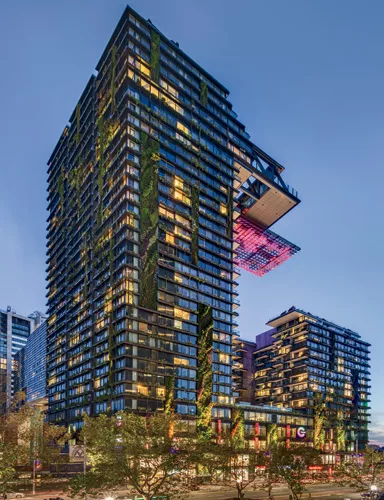
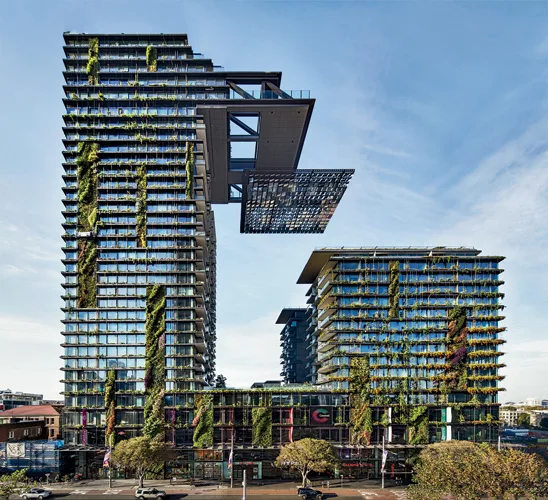
Because One Central Park casts a shadow over its own site, designers suspended a heliostat from a 148-foot cantilever. After dark, LEDs illuminate the device.
One Central Park
Ateliers Jean Nouvel
Sydney
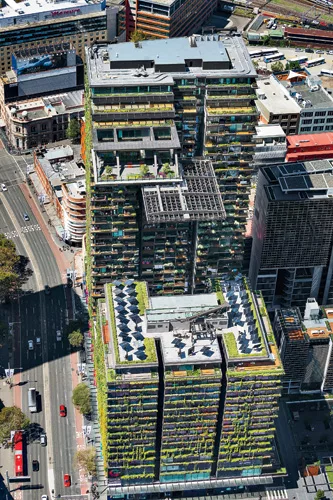
The building is covered with 38,000 native and exotic plants chosen for the climatic suitability, toughness, and aesthetic qualities.
One Central Park
Ateliers Jean Nouvel
Sydney
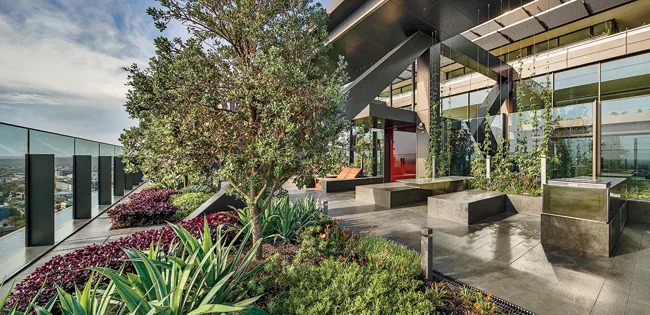
The heliostat cantilever also supports a terrace.
One Central Park
Ateliers Jean Nouvel
Sydney
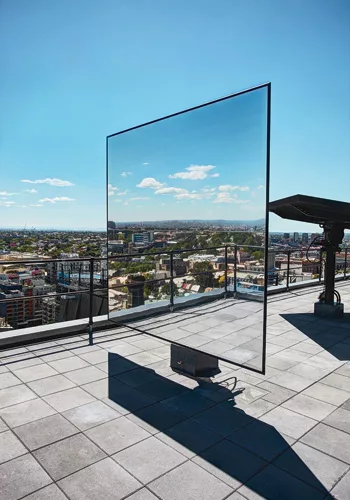
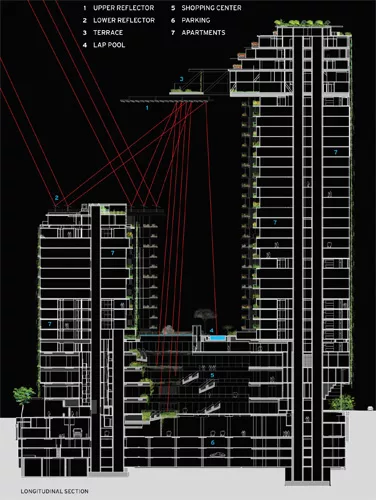
The heliostat includes 40 computer-controlled sun-tracking mirrors on the shorter tower’s roof; these bounce light off fixed reflectors on the cantilever.
One Central Park
Ateliers Jean Nouvel
Sydney
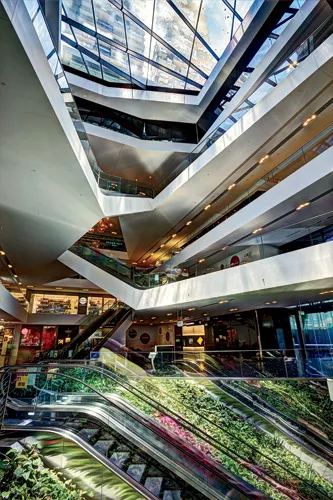
Sunlight is directed from the lower array of mirrors to the upper array, and then down to the development’s garden and through a skylight over the shopping center’s atrium.
One Central Park
Ateliers Jean Nouvel
Sydney
Sunlight is directed from the lower array of mirrors to the upper array, and then down to the development’s garden and through a skylight over the shopping center’s atrium.
One Central Park
Ateliers Jean Nouvel
Sydney
One Central Park
One Central Park
One Central Park
One Central Park
One Central Park
One Central Park
One Central Park
February 15, 2015

Architects & Firms

Ateliers Jean Nouvel

Sydney

Videos

People/Products

The most engaging thing about the immense mixed-use development that is Sydney's Central Park, is neither its $1.6 billion price tag nor its role in bringing much-needed pedestrian porosity to a disused industrial site clotting the city's heart. It's not the “best tall building in the world” award, won last year by the main structure, Jean Nouvel's One Central Park; not its investment in resource-conserving strategies such as trigeneration and sewage mining, its $4.9 million public art program, or even its standout features—the world's tallest green wall and a giant cantilevered heliostat—that are now landmarks for miles around.

What is most engaging about Nouvel's building, and the development as a whole, is how these attributes are interwoven to solve many problems—including bringing daylight into a space that otherwise would have been almost always in shade—with a single, essential diagram.

The story goes like this. In 2003, an old brewery that had sprawled ad hoc for almost two centuries over 14 acres adjacent to Central Station came up for grabs. The site's redevelopment was immediately controversial. Arguments raged over height, density, preservation, and environmental protection. The city council was dismissed and reconstituted, competitions held and won, master plans drawn and redrawn, and litigation initiated. World financial markets collapsed, the site changed hands twice, and jurisdiction shifted from city to state government.

It sounds like a recipe for disaster. Yet the resulting development, masterminded throughout by Singapore-based gynecologist-turned-developer Stanley Quek, has charmed even the residents of surrounding low-rise neighborhoods and their representative politicians.

Quek's vision was to encircle the site with buildings, creating a public garden within dense but fine-grained urban fabric. Nouvel's building is the development's first completed project. It comprises two towers—34 and 16 stories—with 623 apartments. The towers rise from a shared three-story podium that includes a pool, restaurants, and a shopping center. The reinforced-concrete frame, enclosed by a glass curtain wall, is shrouded by horizontal planters and climbing plants. Tall for the area, One Central Park's height matches a brutalist university tower (designed by Michael Dysart in 1964) directly across the road. In urban terms, the pair serve as a gateway to the city center, since the road it straddles is the main access to Sydney from the west. But the placement also meant that Central Park's tallest structure would sit on the development's northern boundary.

This move was diplomatic, since it will keep shadows off adjacent neighborhoods. But it was also problematic, because One Central Park would cast a major shadow over its own site—in particular the 69,000-square-foot public garden fundamental to Quek's vision. The solution was the 148-foot cantilever and its heliostat—an apparatus with a movable mirror that reflects sunlight.

The idea was to bounce sunlight into the tower's own shadow, the garden, and into the shopping center's atrium through a water-topped glass roof.

No one was sure it would work, or even really what working might mean. The structure alone—Australia's largest residential cantilever—weighs 120 tons and is supported by a huge triangular truss (which also supports a terrace).

It was the cantilever, as much as the heliostat, that had people worried. Nothing similar had been attempted on this scale. Where heliostats had been deployed, it was mostly small solar energy installations. A large, multi-mirror heliostat for the enhancement of public pleasure was a whole new deal, bringing aesthetic issues into play alongside the strictly technical.

In fact, there are two sets of mirrors: one facing down from the taller building and one facing up from the shorter edifice. The upper, 320-mirror array that is visible to passersby, appears to flutter. This is especially so after dark when, in an installation by light artist Yann Kersal', the mirrors shimmer with many hues. Yet the flutter is illusory. The nighttime display is produced by 2,880 LEDs, mounted nine to a mirror. The mirrors themselves are actually fixed, and therefore make up the secondary, passive element of the device.

The “real” heliostat is the lower, 40-mirror array, says Tim Phillips, design engineer for Kennovations, the heliostat supplier. These lower mirrors, invisible to the general public, track the sun, relying on specially designed software that works from sun-location data. The mirrors, each of which corresponds to a nine-mirror cluster in the upper array, “remember” their position with regard to their target cluster. Sensors beneath the terrace periodically check and recalibrate the software in order to maintain this complex, three-dimensional relationship.

So, does it work? In a word, yes. Sunlight is reflected from the lower array to the upper array and then down to the ground. The mirror material has a reflectivity of about 88 percent—compared with around 93 percent for standard glass mirrors. So, with two sequential reflections, the quantum of sun hitting the ground is between 70 to 80 percent. This is enough to create patches of light on grass, keep plants alive, and cause a perceptible drift among picnickers and other park users. (It is also worth remembering that for almost half the year in Sydney, shadow is to be sought, not avoided).

The building's other defining move, the 1,000-square-meter vertical garden, also generated widespread skepticism. But it seems similarly to be proving its doubters wrong. Here some 38,000 native and exotic plants, selected for their climatic suitability, their toughness, and their aesthetic qualities, have been pocketed and stapled into hydroponically nourished felt-faced panels.

It's a big ask for plants to grow more than 100 meters off the ground in Sydney's gusty and sun-blasted environment. However, the plants, drip-fed by reclaimed black water and nursed by half a dozen full-time gardeners, are thriving, and flowering. (The recycled water, which is highly purified, is also used throughout the development for toilet flushing, landscaping, laundry, heating, and chilling).

Luscious as the vertical planting now is, it still has about 18 months before reaching maturity, says designer Patrick Blanc (who, like Kersal', frequently collaborates with Nouvel). But it's almost spooky how closely early drawings, showing exteriors sculpted in vegetation, have been replicated.

To those who dismiss the living wall as greenwash, Ateliers Jean Nouvel's project architect Bertram Beissel says, “this project was about the visibility of sustainable design.” Otherwise, he argues, strategies like trigeneration and wastewater recycling remain under the radar. But this building has greater significance. It makes sustainability seductive, enchanting, desired. If the design professions had to choose a mission for the future, that should surely be it.


People

Formal name of building:
One Central Park

Location:
Broadway, within Chippendale
2 Chippendale Way: One Central Park West
1 Carlton Street: Sky at One Central Park
3 Carlton Street: One Central Park East

Completion Date:
January 2014

Gross square footage:
67,626 sqm GFA: 48,391 sqm residential (623 apts), 19,235sqm retail

Total project cost:
600 million Australian dollars

Client:
Frasers Property Australia and Sekisui House Australia

Owner:
Frasers Property Australia and Sekisui House Australia

Personnel in architect's firm who should receive special credit:
Project Architect (PTW Architects): Mark Giles

Design Architect:
Ateliers Jean Nouvel

Local Collaborating Architect:
PTW Architects

Interior designer:
Koichi Takada Architects Interior design, East tower Smart Design Studio Interior design, West tower

Engineers:
Structural Engineer: Robert Bird Group
Civil Engineers: Hughes Trueman

Consultant(s):
Landscape: Turf Design And Jeppe Aagaard Andersen and Aspect Oculus
Lighting: ARUP
Acoustical: Acoustic Logic
Other:
Builder: Watpac Construction
Façade Consultant: Surface Design
Podium Interior Designer: Ateliers Jean Nouvel
Heliostat Lighting Designer: Yann Kersale
Green Wall Designer: Patrick Blanc
Podium & Towers Services/ESD/Fire/Lighting/VT: ARUP
Basement Services/ESD: WSP
Quantity Surveyor: Davis Langdon
BCA Consultant: City Plan Services
Planning Consultant: JBA Planners
Surveyor: Denny Linker & Co
Facade Access Consultant: Farra / Karabiner Access
Wind Consultant: Cermak Peterka Petersen
Heliostat Mirror Consultant: Kennovations
Accessible Consultant: Accessibility Solutions
Traffic Consultant: Masson Wilson Twiney
Façade Contractor: GJames and JML
Green Wall Contractor: Junglefy
Planter Box Contractor: Palamont and Composite Industries
Climbing Cable Contractor: Tensile

Photographer(s):
Simon Wood
Simon Wood Photography
www.swphotography.net.au
Tel: 0422 226 117

John Gollings
John Gollings Photography
gollings@gollings.com.au
Tel: 61 3 9537 0733

Murray Fredericks
Murray Fredericks Photography
Business: +61 (0)2 9043 3350
Mobile: +61 (0)413 750 667

Size:

730,000 square feet

Completion Date:

January 2014


Products

Structural system
pre-stressed concrete structure and steel cantilever trusses

Exterior cladding
Metal Panels: Composite Aluminium cladding panels — G.James
Metal/glass curtain wall: Floor to floor glazing in custom aluminium framing — G James
Precast concrete: Slot facade in precast concrete panels
Curtain wall: none — floor to floor glazing
Other cladding unique to this project: modular polyethylene rotomould planter boxes to floor expression. Green walls panels to North, East and West elevations - Patrick Blanc design

Roofing
Built-up roofing: insulated inverted green roof planting over concrete

Glazing
Glass: high clarity double glazed units

Doors
Entrances: automated sliding glass panels

Interior finishes
Cabinetwork and custom woodwork: joinery and timber cabinetry to apartments - UTJ Joinery
Special surfacing: reconstituted quartz bench tops to apartments

Lighting
Exterior: Underside cantilever reflector frame — reflector panels fitted with lighting — Yann Kersale design [The supplier of the LED's for the cantilever reflectors was Xenian (www.xenian.com.au), distributor for the Philips Color Kinetics iColorFlex LMX9 luminaires / Philips Color Kinetics Video System Manager PRO (VSMP)]
Dimming System or other lighting controls: Pandora's Box Media Player Pro 814 (Heliostat lighting hardware)

Other unique products that contribute to sustainability:
Central thermal plant
Recycled water treatment plant
Heliostat and reflector frame — sunlight reflection system to direct sunlight to south courtyard and retail atrium [Designed and manufactured by Kennovations].

 
KEYWORDS: Sydney

Share This Story

Looking for a reprint of this article?
From high-res PDFs to custom plaques, order your copy today!
Elizabeth Farrelly is a columnist for The Sydney Morning Herald. Her latest book is Killing Sydney: The Fight for a City’s Soul (2021).

Post a comment to this article

Report Abusive Comment

Subscription Center
  • Create an Account
  • Start a Subscription
  • Manage My Account
  • Sign Up for Newsletters
  • Visit Customer Service
  • Update Preferences

More Videos

Sponsored Content

Sponsored Content is a special paid section where industry companies provide high quality, objective, non-commercial content around topics of interest to the Architectural Record audience. All Sponsored Content is supplied by the advertising company and any opinions expressed in this article are those of the author and not necessarily reflect the views of Architectural Record or its parent company, BNP Media. Interested in participating in our Sponsored Content section? Contact your local rep!

close
  • cold storage facility
    Sponsored byCarlisle SynTec Systems

    How Architects Can Design More Continuous Cold Storage Envelopes

  • TAMLYN XtremeTrim Exterior Trim
    Sponsored byTamlyn

    Designing Cleaner Panel Facades: Why Exterior Trim Details Matter

  • Building with Vapor Barriers
    Sponsored byReef Industries, Inc.

    Vapor Barriers Help Control Moisture in Tighter Building Designs

DESIGN:ED Podcast
Listen to Architectural Record’s DESIGN:ED Podcast

Events

June 18, 2026

Rebooting the Aging Office Building

Credits: 1 AIA LU/HSW; 1 AIBD P-CE; 0.1 ICC CEU; 1 PDH

Explore façade retrofit strategies and award-winning design concepts that can transform aging office buildings into healthier, higher-performing workplaces for today’s hybrid workforce.

June 23, 2026

Enhancing Fire Resistance with Advanced PVC Solutions

Credits: 1 AIA LU/HSW; 1 AIBD P-CE; 0.1 ICC CEU; 1 IIBEC CEH

Evaluate advanced PVC solutions that improve fire resistance, support WUI compliance, and enhance resilience in residential and commercial building design.

View All Submit An Event

Products

2026 Architect's Square Foot Costbook

2026 Architect's Square Foot Costbook

See More Products

Popular Stories

SanDiegoAirport

Top 300 Architecture Firms of 2026

Lorcan O' Herilhy

California Architect Lorcan O’Herlihy Has Died, Age 66

Coronado Bridge

The Architect’s Guide to San Diego

CCA, Studio Gang

The Winners of the AIA’s 2026 Architecture Award Range from Collegiate Rowing Hubs to Housing for the Homeless

Dusk House

Design Vanguard 2026: ONO

Rebooting the Aging Office Building - Free Webinar - June 18, 2026

Related Articles

  • Phoenix Central Park.

    Phoenix Central Park by Durbach Block Jaggers and John Wardle Architects

    See More
  • Community Forum Questions Crop of Tall Buildings Around Central Park

    See More
  • The Davis Center

    Central Park’s Davis Center Creates Space to Cool Off and Slow Down

    See More

Related Products

See More Products
  • Architectural Record - August 2025

    Architectural Record August 2025 Issue

See More Products

Events

View AllSubmit An Event
  • April 22, 2026

    One Foot In, One Foot Out—The Balancing Act of Teaching and Practicing Architecture

    NOW ON DEMANDCredits: 1 AIA LU/Elective; 1 AIBD P-CE;  0.1 ICC CEU; 0.1 IACET CEUJoin Architectural Record for a discussion with three leading firms on the future of the academic–practice hybrid model and its impact on the next generation of architects.
View AllSubmit An Event
×

The latest news and information

#1 Source for Architectural Design, News and Products

SUBSCRIBE
  • RESOURCES
    • Advertise
    • Contact Us
    • Submit
    • Store
  • ACCOUNT CENTER
    • Create an Account
    • Start a Subscription
    • Manage My Account
    • Sign Up for Newsletters
    • Visit Customer Service
    • Update Preferences
  • PRIVACY
    • PRIVACY POLICY
    • TERMS & CONDITIONS
    • DO NOT SELL MY PERSONAL INFORMATION
    • PRIVACY REQUEST
    • ACCESSIBILITY
  • SERVICES
    • Marketing Services
    • Reprints
    • Market Research
    • List Rental
    • Survey/Respondent Access
  • STAY CONNECTED
    • Linkedin
    • Facebook
    • Instagram
    • YouTube
    • X (Twitter)

Copyright ©2026. All Rights Reserved BNP Media, Inc. and BNP Media II, LLC.

Design, CMS, Hosting & Web Development :: ePublishing