Architectural Record
search
cart
facebook twitter linkedin youtube
  • Sign In
  • Subscribe
  • Sign Out
  • My Account
Architectural Record
  • NEWS
    • Latest News
    • Awards
    • Interviews
    • Obituaries
    • Podcasts
      • Design:Ed Podcast
      • Sponsored Podcasts
  • OPINION
    • Book Reviews / Excerpts
    • Exhibition Reviews
    • Forum
  • EXCLUSIVES
    • Videos
    • Design Vanguard
    • Top 300 Firms
    • Sponsored Content
    • Sponsored eBooks
    • From the Archives
  • CONTINUING ED
    • Editorial Continuing Ed
    • CE Center
    • CE Academies
  • PROJECTS
    • Buildings By Type
    • Reuse & Renovation
    • Museums & Arts Centers
    • Colleges & Universities
    • Multifamily Housing
    • Interiors
    • Lighting
    • Kitchen & Bath
  • HOUSES
    • Record Houses
    • House of the Month
    • Featured Houses
  • PRODUCTS
    • Products by Category
    • Record Products of the Year
    • Latest Products
  • EVENTS
    • Dates & Events
    • Record on the Road
    • Innovation Conference
    • Sustainability in Practice
    • Women In Architecture
    • Webinars
    • Ad Excellence Awards
    • Submit an Event
  • CONNECT
    • Ask RECORD AI
    • Newsletters
    • Contact
    • Advertise
    • Editorial Calendar
    • Store
    • Customer Service
  • SUBMIT
    • Submission Guidelines
    • RECORD Competitions
  • MAGAZINE
    • Subscribe
    • My Account
    • Digital Edition
    • Current Issue
    • Firm Pass
    • Historic Archive
ProjectsLighting Design

Cofra Group/Good Energies

Perkins + Will devises an enlightened scheme for the Cofra Group/Good Energies New York City base.

By Linda C. Lentz
May 19, 2009

Architects & Firms

Perkins&Will

New York, New York

Located on the 29th floor of a 1960s Park Avenue office tower, the New York City home of the Cofra Group and its Good Energies venture capital company—an investor in such renewable energy enterprises as Sage Electrochromics—is proof that this Switzerland-based corporation takes its business to heart.
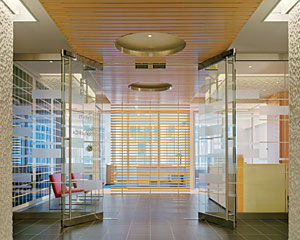
Cofra Group/Good Energies

The project, which has LEED-CI (Commercial Interiors) Gold certification, was spearheaded by architect Pat Sapinsley, AIA, a Good Energies senior associate with her finger on the pulse of energy-efficient and sustainable practices. Hoping to demonstrate the values suggested by the firm’s motto, “People, Planet, Profit,” Sapinsley worked with Perkins+Will director of interiors Joan Blumenfeld, FAIA, and project designer Steven South. The architects gutted the 22,500-square-foot space with the intent of using daylight as the primary means of illumination. Consistent with the green directive, they saved 75 percent of the construction debris for recycling, and replaced as many of the traditional building materials as possible with earth- and people-friendly alternatives: FSC-certified wood; linoleum; recycled polyester fabric panels; denim insulation; carpeting with low-VOC adhesive; low-flow toilets and faucets; and Energy Star–compliant electrical and mechanical equipment, office gear, and kitchen appliances. Daylighting is the primary player in the daily reduction of energy consumption—which, at .76 watts per square foot, is 24 percent better than code.

Newly defined perimeter offices and conference rooms are enclosed with transparent and translucent glass, so that light penetrates through to the floor plate. Similarly, walls across the hall filter this light to inner cubicles and meeting areas. Bordering the reception areas on opposite sides of the building, louverlike partitions direct sunlight into the elevator lobby. Additionally, to maximize illumination and minimize the use of electric light, South specified light-hued reflective surface materials, including white furnishing systems, natural maple, textural limestone mosaics, and glare-free frosted resin.

As for devising the appropriate balance of shading, electric light, and controls, the architects tapped Horton Lees Brogden Lighting Design (HLB). A series of sensors in the perimeter offices monitor several factors: daylight, foot-candles reflected by the surfaces, and occupancy. The sensors activate mechanisms for raising and lowering the motorized, semisheer shades, as well as for operating and dimming the ambient overhead and indirect wall fixtures (both fluorescent) depending on the sun’s brightness and glare or whether the room is occupied. Yet, according to HLB project manager Shoshanna Segal, “The [client] also wanted to have as much control as possible for individual occupants. So everybody was afforded override control over both the shades and the light.” A stylish LED task lamp on each desk operates manually. Nevertheless, Segal notes, for the most part the electric lights are off in at least 85 percent of these offices. “They just don’t use their lights, which is exactly what we wanted.”

The remainder of the scheme has less to do with overt environmentalism than with good design, says Segal. Thus, the hall is lit by slender, 2-foot, 14-watt lamps spaced 10 feet on center—keeping the area slightly darker to define it as a separate space. Large circular T5 fixtures have concave diffusers that cast a pleasant glow over the workstations and into the upper areas of the walls. Halogen, metal-halide, and LED sources combine with fluorescent tubes in the lobby/reception areas, conference rooms, and pantry for flexibility, ambience, and human comfort.

Ultimately, Segal believes that sustainable lighting design is not only about what light bulb you use. “It’s about using all the tools available to you in a way that functions for users and provides a visually comfortable environment for them to work and live in.” When done well, she claims, it’s a compromise. “We save in places where it’s possible to save, so that we can spend in places where we need to.”

KEYWORDS: New York City

Share This Story

Looking for a reprint of this article?
From high-res PDFs to custom plaques, order your copy today!


Linda Lentz is a former editor at Architectural Record.

Post a comment to this article

Report Abusive Comment

Subscription Center
  • Create an Account
  • Start a Subscription
  • Manage My Account
  • Sign Up for Newsletters
  • Visit Customer Service
  • Update Preferences

More Videos

Sponsored Content

Sponsored Content is a special paid section where industry companies provide high quality, objective, non-commercial content around topics of interest to the Architectural Record audience. All Sponsored Content is supplied by the advertising company and any opinions expressed in this article are those of the author and not necessarily reflect the views of Architectural Record or its parent company, BNP Media. Interested in participating in our Sponsored Content section? Contact your local rep!

close
  • TAMLYN XtremeTrim Exterior Trim
    Sponsored byTamlyn

    Designing Cleaner Panel Facades: Why Exterior Trim Details Matter

  • Building with Vapor Barriers
    Sponsored byReef Industries, Inc.

    Vapor Barriers Help Control Moisture in Tighter Building Designs

  • Duct Interior with Prodeq System
    Sponsored byHenry, a Carlisle Company

    Designing Resilient Water Containment Systems

DESIGN:ED Podcast
Listen to Architectural Record’s DESIGN:ED Podcast

Events

June 10, 2026

Rethinking Stormwater – The Power of Porous Paving

Credits: 1 AIA LU/HSW; 1 AIBD P-CE; 0.1 ICC CEU

Learn how porous paving systems support stormwater management, reduce heat island effects, and enhance sustainable site design performance.

June 11, 2026

Very Early Warning Fire Detection for Mission-Critical Facilities

Credits: 1 AIA LU/HSW; 1 AIBD P-CE; 0.1 ICC CEU

Examine advanced fire detection strategies that support uptime and enhance safety in data centers and other mission-critical facilities.

View All Submit An Event

Products

2026 Architect's Square Foot Costbook

2026 Architect's Square Foot Costbook

See More Products

Popular Stories

Practice Matters illustration

What’s in a (Firm’s) Name? Thinking About Succession and Legacy

Coronado Bridge

The Architect’s Guide to San Diego

Practice Matters illustration

By the Numbers: Counting America's Architects

House on a Hill

Design Vanguard 2026: Forma

Crane Cove, ONO

Design Vanguard 2026 Winners

Broader Sustainability of CMU - Free Webinar - May 21, 2026

Related Articles

  • Cofra Group/Good Energies Lighting Projects

    See More
  • American Enterprise Group

    American Enterprise Group Corporate Headquarters by BNIM

    See More
  • Nelson-Atkins Museum of Art Bloch Galleries

    Nelson-Atkins Museum of Art Bloch Galleries Renovation by BNIM and Renfro Design Group

    See More

Related Products

See More Products
  • superlux.jpg

    SuperLux: Smart Light Art, Design & Architecture for Cities

  • 0470114223.gif

    Interior Lighting for Designers, 5th Edition

See More Products
×

The latest news and information

#1 Source for Architectural Design, News and Products

SUBSCRIBE
  • RESOURCES
    • Advertise
    • Contact Us
    • Submit
    • Store
  • ACCOUNT CENTER
    • Create an Account
    • Start a Subscription
    • Manage My Account
    • Sign Up for Newsletters
    • Visit Customer Service
    • Update Preferences
  • PRIVACY
    • PRIVACY POLICY
    • TERMS & CONDITIONS
    • DO NOT SELL MY PERSONAL INFORMATION
    • PRIVACY REQUEST
    • ACCESSIBILITY
  • SERVICES
    • Marketing Services
    • Reprints
    • Market Research
    • List Rental
    • Survey/Respondent Access
  • STAY CONNECTED
    • Linkedin
    • Facebook
    • Instagram
    • YouTube
    • X (Twitter)

Copyright ©2026. All Rights Reserved BNP Media, Inc. and BNP Media II, LLC.

Design, CMS, Hosting & Web Development :: ePublishing