The Israel Museum
A modernist museum in Jerusalem is sensitively updated by James Carpenter Design Associates and Efrat-Kowalsky Architects.


Architects & Firms
Jerusalem, Israel
In the late 1950s, when Teddy Kollek, the future mayor of Jerusalem, first suggested founding a national encyclopedic museum little more than a decade after Israel won its independence, many thought the idea pure folly. The young country was still struggling for its economic and political survival. But Vienna-born Kollek believed culture was “as vital a form of sustenance as the roof over one’s head and the food on one’s plate.”
The Israel Museum opened in 1965, in a Modernist complex nestled on the Judean Hills near the Knesset — the national parliament building — and the Hebrew University. Since that time, it has become the most eminent cultural institution in the region and one of the leading art and archaeology museums in the world, with collections growing exponentially over the past four decades. Now 45 years later, the museum has reopened after a $100 million expansion and renovation. The New York firm of James Carpenter Design Associates (JCDA) was responsible for adding new structures, while Efrat-Kowalsky Architects of Tel Aviv refurbished the museum’s stunning array of low-rise pavilions, spilling down a gently sloped 20-acre site. Together, they reaffirm the museum’s status as the finest contemporary architectural landmark in the Holy City. Another Tel Aviv—based firm, A. Lerman Architects, served as local project architects.
Rather than formulate an entirely new architectural statement that might have proved more attention-getting in the short term — the museum had earlier commissioned a monumental addition by the late James Ingo Freed of Pei Cobb Freed, but then discarded that in favor of the Carpenter/Efrat-Kowalsky plan — the renovation pays homage to the original design by the Israeli architect Alfred Mansfeld and interior designer Dora Gad.
The sprawling Israel Museum campus also includes the recently restored Shrine of the Book (1965), with an eccentric but endearing white-tiled dome designed by Frederick Kiesler and Armand Bartos to house the Dead Sea Scrolls, and a sculpture garden (1965 — now known as the Billy Rose Art Garden) designed by Isamu Noguchi, which contains works by Noguchi, Auguste Rodin, Henry Moore, Aristide Maillol, and James Turrell. Somewhat ironically for the national museum of the Jewish state, Mansfeld likened its design to an Arab village atop the hill. But he used the vocabulary of European Modernism to devise a matrix of modular units, each roughly 120 square feet in size, which could grow organically like that village. JCDA has replicated these modules with three new glass pavilions to create a subtle and elegant expansion while paying homage to the simple beauty of the original scheme.
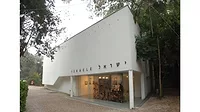
The renovation provides a far clearer and more accessible path into and through the museum, which had expanded several times since it opened nearly a half-century ago. “It grew like topsy, but it was not great for a self-guided museum experience,” says museum director James Snyder. The new pavilions that echo the rectilinear geometry of the original design now serve as the entry and house ticketing and a bookstore. In addition, JCDA reconstructed an existing pavilion to serve as a restaurant and café. But in contrast to the more solid, insular modules for the exhibition areas used by Mansfeld — made of cast-in-place concrete clad in limestone and banded by unshaded clerestory windows — Carpenter wanted a greater transparency to heighten the connection between the architecture and landscape, and so made the new pavilions out of glass, shielded by louvers.
Carpenter, who is not an architect by training, is a Minimalist known for blurring the lines between art and architecture in glass works that involve a highly refined exploration of light and its impact on spatial experience. He has collaborated with many architects, winning acclaim for creating the luminous curtain wall at the base of the Time Warner Center in New York City (2004) and the shimmering facade of 7 World Trade Center (2005) in Lower Manhattan (both designed by David Childs of Skidmore, Owings & Merrill), plus a lens-shaped ceiling for Richard Meier’s Federal Courthouse in Phoenix (2000). Carpenter’s firm has several licensed architects, including the project architect for the Israel Museum, Reid Freeman.
Employing a system of terra-cotta louvers, manufactured in Germany, Carpenter has sought to soften and diffuse the intense Mediterranean sunshine while permitting views of the surrounding rocky terrain, olives trees, pines, and other vegetation. On the north and south exposures, the stationary louvers are more open, while those on the east and west merely allow the light to penetrate and reflect. At night, the pavilions glow like lanterns from within on all sides. Carpenter and his crew tested light levels over two years by building a mock-up of the terra-cotta louver system on-site.
JCDA also inserted an underground passageway leading from the entry to the hilltop exhibition area that permits visitors the choice of avoiding an open-air ascent via steps in the blazing heat. The air-conditioned passageway, reminiscent of one that Carpenter devised a decade ago for the German Foreign Ministry in Berlin, is lined with glass. On its west side, a cast-glass skylight over which water cascades down the hill’s incline now covers the water feature, originally built by landscape architect Lawrence Halprin in concrete and stone. Sunlight passes through the water and prismatic glass, animating the black terrazzo passageway, while vine-filled courtyards rise up behind a wall of frosted glass that also runs along its edge.
The addition of the new enclosed passageway enabled the removal of a service road previously used to transport supplies, the elderly, and the physically challenged by vehicle to the hilltop, and thereby eliminated a visual barrier between the museum buildings and the Noguchi garden. By transferring ticketing and retail services from the center of the museum to the new pavilions at the bottom of the hill, the architects opened up more exhibition space without expanding the museum’s original footprint too much.
Inside the museum itself, Efrat-Kowalsky created a new central corridor off of which the exhibition galleries radiate and are easily reachable by visitors. “We wanted to do almost nothing, but to do almost nothing means a lot,” says Meira Kowalsky of her firm’s seamless reorganization of the earlier parts of the building. “You almost don’t feel it. We see our role as one of continuation and not as one of destroying and making new.”
The new core eliminates the mazelike feel that had prevailed prior to the renovation and gives clarity to the museum’s three original main wings — Archaeology, Jewish Art and Life, and Fine Arts. The museum reedited and reinstalled its permanent collection, showcasing the significant troves of Judaica and Levantine archaeology, as well as Impressionist and Postimpressionist masterpieces, Old Masters, Surrealist photography, and Contemporary art. Also added are new site-specific works, such as a stainless-steel, hourglass-shaped sculpture by Anish Kapoor and a series of 300 canvases re-creating the color spectrum by Olafur Eliasson.
Over the past decades, curators seeking to protect objects in their care from light exposure had sealed up the clerestory windows that Mansfeld had installed to create the appearance of ceilings floating atop the individual pavilions. Efrat-Kowalsky, known for championing heroic Modern architecture during Israel’s first decades, made certain that these windows were exposed again throughout by replacing original glass panels with thicker UV-sensitive glass.
Pentagram Partners of London oversaw the new archaeology installation, while Efrat-Kowalsky refurbished and reconfigured interior spaces, giving them a new unity by relying on Mansfeld’s original vocabulary of corduroy concrete and wood-tread stairways, along with hefty railings and door frames of mahogany and rosewood.
If at first glance this renovation and expansion appears to be highly restrained, the overall approach is anything but timid. The blend of Carpenter’s Minimalism with Efrat-Kowalsky’s preservation skills and successful advocacy of adaptive reuse celebrates the daring original vision and architecture of an Israeli national museum while reconnecting its parts into a more coherent whole.
People
Architects/Designers:
Architects for renovation:
Architect of Record:
Consultants: |
Products
Glazing, mullions, skylights, and stainless steel handrails:
Balanced glass entry doors:
Structural concrete, tile, graulite, terrazzo (wet works contractor):
Terrazzo subcontractor:
Precast Architectural Concrete:
Exterior Terracotta:
Interior Terracotta:
Cast Glass:
Finish contractor: Newmat (fabricator) |
Looking for a reprint of this article?
From high-res PDFs to custom plaques, order your copy today!