Architectural Record
search
cart
facebook twitter linkedin youtube
  • Sign In
  • Subscribe
  • Sign Out
  • My Account
Architectural Record
  • NEWS
    • Latest News
    • Awards
    • Interviews
    • Obituaries
    • Podcasts
      • Design:Ed Podcast
      • Sponsored Podcasts
  • OPINION
    • Book Reviews / Excerpts
    • Exhibition Reviews
    • Forum
  • EXCLUSIVES
    • Videos
    • Design Vanguard
    • Top 300 Firms
    • Sponsored Content
    • Sponsored eBooks
    • From the Archives
  • CONTINUING ED
    • Editorial Continuing Ed
    • CE Center
    • CE Academies
  • PROJECTS
    • Buildings By Type
    • Reuse & Renovation
    • Museums & Arts Centers
    • Colleges & Universities
    • Multifamily Housing
    • Interiors
    • Lighting
    • Kitchen & Bath
  • HOUSES
    • Record Houses
    • House of the Month
    • Featured Houses
  • PRODUCTS
    • Products by Category
    • Record Products of the Year
    • Latest Products
  • EVENTS
    • Dates & Events
    • Record on the Road
    • Innovation Conference
    • Sustainability in Practice
    • Women In Architecture
    • Webinars
    • Ad Excellence Awards
    • Submit an Event
  • CONNECT
    • Ask RECORD AI
    • Newsletters
    • Contact
    • Advertise
    • Editorial Calendar
    • Store
    • Customer Service
  • SUBMIT
    • Submission Guidelines
    • RECORD Competitions
  • MAGAZINE
    • Subscribe
    • My Account
    • Digital Edition
    • Current Issue
    • Firm Pass
    • Historic Archive
Projects

Tel Aviv Museum of Art

A spiraling and twisting core.
By Joann Gonchar, FAIA
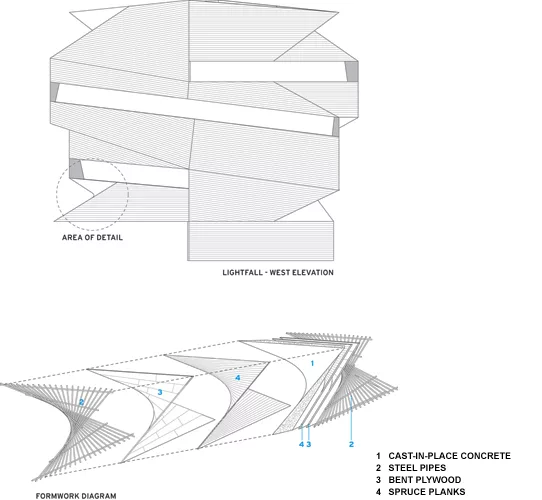
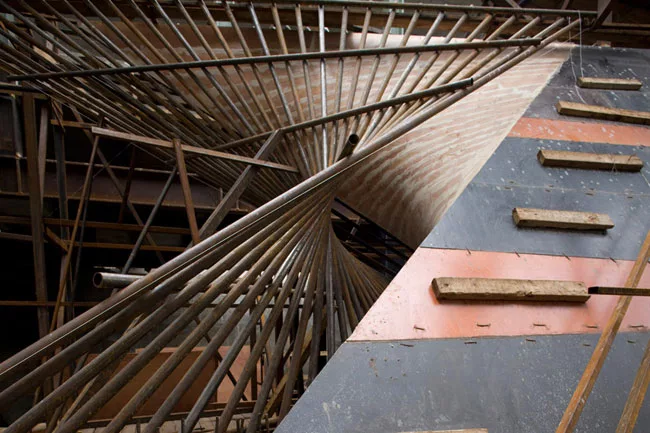
The formwork for the twisting Lightfall consisted of three layers: curved spruce planks assembled in a fashion similar to shipbuilding, sheets of bent plywood, and steel tubes welded together in a fan
Tel Aviv Museum of Art
Preston Scott Cohen
Tel Aviv, Israel
The formwork for the twisting Lightfall consisted of three layers: curved spruce planks assembled in a fashion similar to shipbuilding, sheets of bent plywood, and steel tubes welded together in a fanlike fashion.
Photo: Ohad Matalon, courtesy Tel Aviv Museum of Art
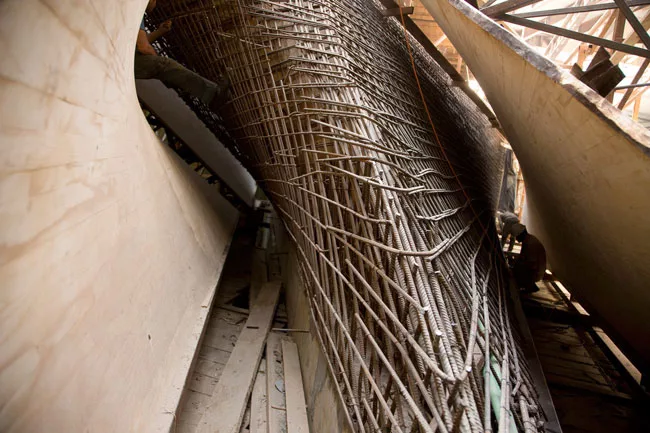
Embedded inside the Lightfall's surfaces is a dense network of rebar.
Tel Aviv Museum of Art
Preston Scott Cohen
Tel Aviv, Israel
Embedded inside the Lightfall's surfaces is a dense network of rebar.
Photo: Ohad Matalon, courtesy Tel Aviv Museum of Art
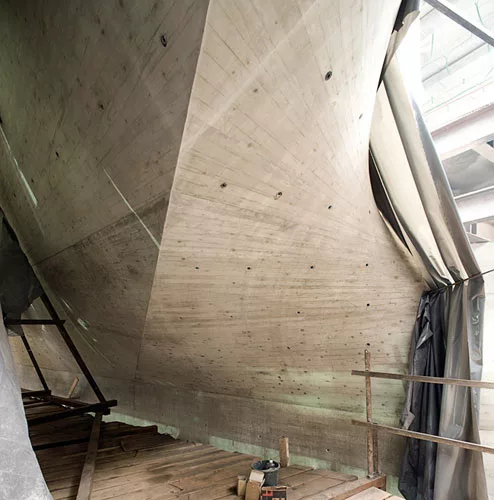
The concrete surface is left exposed on the gallery-facing elevations of the Lightfall, revealing the imprint of the formwork.
Tel Aviv Museum of Art
Preston Scott Cohen
Tel Aviv, Israel
The concrete surface is left exposed on the gallery-facing elevations of the Lightfall, revealing the imprint of the formwork.
Photo: Ohad Matalon, courtesy Tel Aviv Museum of Art
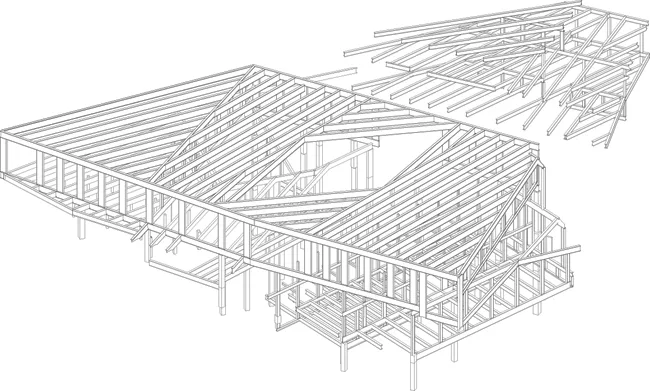
The galleries surrounding the Lightfall are composed of stacked and rotated structural systems. Vierendeel trusses, some carrying two levels and almost 30 feet deep, span as much as 110 feet.
Tel Aviv Museum of Art
Preston Scott Cohen
Tel Aviv, Israel
The galleries surrounding the Lightfall are composed of stacked and rotated structural systems. Vierendeel trusses, some carrying two levels and almost 30 feet deep, span as much as 110 feet.
Photo: Ohad Matalon, courtesy Tel Aviv Museum of Art
Tel Aviv Museum of Art
Preston Scott Cohen
Tel Aviv, Israel
Photo: Ohad Matalon, courtesy Tel Aviv Museum of Art
The formwork for the twisting Lightfall consisted of three layers: curved spruce planks assembled in a fashion similar to shipbuilding, sheets of bent plywood, and steel tubes welded together in a fan
Embedded inside the Lightfall's surfaces is a dense network of rebar.
The concrete surface is left exposed on the gallery-facing elevations of the Lightfall, revealing the imprint of the formwork.
The galleries surrounding the Lightfall are composed of stacked and rotated structural systems. Vierendeel trusses, some carrying two levels and almost 30 feet deep, span as much as 110 feet.
Tel Aviv Museum of Art
November 15, 2011

Architects & Firms

Preston Scott Cohen, Inc.

Tel Aviv, Israel

The atrium, or Lightfall, inside the just-completed Amir Building addition to the Tel Aviv Museum of Art serves much the same purpose as the space at the heart of Frank Lloyd Wright’s Solomon R. Guggenheim Museum in New York City: Both are dramatic, sculptural voids with circulation spiraling around their perimeters. But the similarities end there, points out Preston Scott Cohen, the new building’s architect. Unlike the Guggenheim atrium, the Lightfall “doesn’t consume the whole museum,” says Cohen. It allows for the flexible, rectangular galleries that his client desired.

Although the shapes of the Tel Aviv Museum’s new exhibition spaces are much more conventional than that of the Lightfall they surround, the structure of the galleries is still complex, notes Dani Schacham, a partner with YSS, the project’s structural engineer. The galleries are composed of stacked structural systems, with each level rotated 22.5 degrees relative to the one below. Vierendeel trusses, some carrying two levels and almost 30 feet deep, span as much as 110 feet. These carry smaller intermediary members.

In addition to providing large, mostly column-free exhibition spaces, the strategy permitted designers to take advantage of the structure’s depth for ductwork and other equipment, without encroaching on the height of galleries. However, routing the mechanical systems around and through the steel members required intense coordination with the project’s 3-D model and among different trades, points out Amit Nemlich, project architect. “HVAC integration was a real challenge,” he says.

All involved in the project agree that the Lightfall proved an even tougher design and construction problem because it is made up of 28 poured-in-place concrete hyperbolic paraboloids, or doubly ruled surfaces curved like saddles and often referred to as “hypars.” Schacham describes the configuration of the Lightfall’s surfaces as a “rectangular spring”: Each hypar is supported by adjacent hypars, so that they form a self-supporting object that coils vertically 87 feet, bringing daylight from a skylight to the lowest gallery level, more than 42 feet below grade. The assemblage, which is structurally independent from the surrounding gallery framing, is designed to withstand gravity and seismic loads, but with concrete thicknesses of only 6 or 7 inches. However, in some locations, where two surfaces join, the concrete is as thick as 15 inches. The Lightfall walls would have been even thicker at its prowlike corners, but contractors devised steel cages for these areas that remain buried in the concrete and define interior voids. The hollows reduced the amount of concrete required, along with its associated loads, and made it possible for workers to fasten the formwork with tie rods.

The concrete surfaces are finished in white plaster on the Lightfall’s interior but left exposed on the gallery-facing side, revealing the imprint of the formwork constructed of curved 3-inch spruce strips in a process that Nemlich likens to shipbuilding. Contractors braced this hull-like inner formwork layer with bent plywood sheets and an outer structure of straight steel tubes welded together in a fanlike array to conform to the hypars’ curves.

Embedded inside each hypar is a dense network of reinforcing bars. Once a pour began, contractors hit the formwork with mallets and applied vibration to prevent air from becoming trapped and to ensure the concrete’s complete consolidation. They also carefully monitored the speed of the hydration process to avoid cracking—a particular concern in the few areas where the concrete is especially thick. Because of the demanding geometry and a desire for pristine surfaces, some of the hypars took as long as a month to construct, according to Israel Chaskelevitch, principal of construction management firm Chaskelevitch Engineering. “Even the concrete that would be covered with plaster needed to be precise,” he says.

People


Products

 
KEYWORDS: Israel

Share This Story

Looking for a reprint of this article?
From high-res PDFs to custom plaques, order your copy today!

Joann gonchar

Joann Gonchar, FAIA, LEED AP, is deputy editor at Architectural Record. She joined RECORD in 2006, after working for eight years at its sister publication, Engineering News-Record. Before starting her career as a journalist, Joann worked for several architecture firms and spent three years in Kobe, Japan, with the firm Team Zoo, Atelier Iruka. She earned a Master of Architecture degree from the University of Pennsylvania and a Bachelor of Arts from Brown University. She is licensed to practice architecture in New York State.

Post a comment to this article

Report Abusive Comment

Subscription Center
  • Create an Account
  • Start a Subscription
  • Manage My Account
  • Sign Up for Newsletters
  • Visit Customer Service
  • Update Preferences

More Videos

Sponsored Content

Sponsored Content is a special paid section where industry companies provide high quality, objective, non-commercial content around topics of interest to the Architectural Record audience. All Sponsored Content is supplied by the advertising company and any opinions expressed in this article are those of the author and not necessarily reflect the views of Architectural Record or its parent company, BNP Media. Interested in participating in our Sponsored Content section? Contact your local rep!

close
  • cold storage facility
    Sponsored byCarlisle SynTec Systems

    How Architects Can Design More Continuous Cold Storage Envelopes

  • TAMLYN XtremeTrim Exterior Trim
    Sponsored byTamlyn

    Designing Cleaner Panel Facades: Why Exterior Trim Details Matter

  • Building with Vapor Barriers
    Sponsored byReef Industries, Inc.

    Vapor Barriers Help Control Moisture in Tighter Building Designs

DESIGN:ED Podcast
Listen to Architectural Record’s DESIGN:ED Podcast

Events

June 23, 2026

Enhancing Fire Resistance with Advanced PVC Solutions

Credits: 1 AIA LU/HSW; 1 AIBD P-CE; 0.1 ICC CEU; 1 IIBEC CEH

Evaluate advanced PVC solutions that improve fire resistance, support WUI compliance, and enhance resilience in residential and commercial building design.

June 25, 2026

Designing Glass Railing Systems that Enhance Aesthetics and Meet Code

Credits: 1 AIA LU/HSW; 1 AIBD P-CE; 0.1 ICC CEU

Upon course completion, participants will possess a deeper understanding of glass railings to help ensure that safety, aesthetic, and performance objectives are achieved.

View All Submit An Event

Products

2026 Architect's Square Foot Costbook

2026 Architect's Square Foot Costbook

See More Products

Popular Stories

Lorcan O' Herilhy

California Architect Lorcan O’Herlihy Has Died, Age 66

Obama Presidential Center, Chicago

The Obama Presidential Center Opens on Chicago’s South Side

Spoonbill Ranch

Johnsen Schmaling Architects Integrates Spoonbill Ranch into a Pristine Landscape

West Village Penthouse

Design Vanguard 2026: Brent Buck Architects

Trinity University Business & Humanities District

AIA Announces 2026 COTE Top Ten Awardees

Enhancing Fire Resistance with Advanced PVC Solutions - Free Webinar - June 23, 2026

Related Articles

  • Tel Aviv Museum of Art

    See More
  • Tel Aviv Museum of Art

    See More
  • Museum of Modern Art in Warsaw

    Warsaw’s Museum of Modern Art is a Lesson in Contrast

    See More

Related Products

See More Products
  • superlux.jpg

    SuperLux: Smart Light Art, Design & Architecture for Cities

See More Products
×

The latest news and information

#1 Source for Architectural Design, News and Products

SUBSCRIBE
  • RESOURCES
    • Advertise
    • Contact Us
    • Submit
    • Store
  • ACCOUNT CENTER
    • Create an Account
    • Start a Subscription
    • Manage My Account
    • Sign Up for Newsletters
    • Visit Customer Service
    • Update Preferences
  • PRIVACY
    • PRIVACY POLICY
    • TERMS & CONDITIONS
    • DO NOT SELL MY PERSONAL INFORMATION
    • PRIVACY REQUEST
    • ACCESSIBILITY
  • SERVICES
    • Marketing Services
    • Reprints
    • Market Research
    • List Rental
    • Survey/Respondent Access
  • STAY CONNECTED
    • Linkedin
    • Facebook
    • Instagram
    • YouTube
    • X (Twitter)

Copyright ©2026. All Rights Reserved BNP Media, Inc. and BNP Media II, LLC.

Design, CMS, Hosting & Web Development :: ePublishing