Architectural Record
search
cart
facebook twitter linkedin youtube
  • Sign In
  • Subscribe
  • Sign Out
  • My Account
Architectural Record
  • NEWS
    • Latest News
    • Awards
    • Interviews
    • Obituaries
    • Podcasts
      • Design:Ed Podcast
      • Sponsored Podcasts
  • OPINION
    • Book Reviews / Excerpts
    • Exhibition Reviews
    • Forum
  • EXCLUSIVES
    • Videos
    • Design Vanguard
    • Top 300 Firms
    • Sponsored Content
    • Sponsored eBooks
    • From the Archives
  • CONTINUING ED
    • Editorial Continuing Ed
    • CE Center
    • CE Academies
  • PROJECTS
    • Buildings By Type
    • Reuse & Renovation
    • Museums & Arts Centers
    • Colleges & Universities
    • Multifamily Housing
    • Interiors
    • Lighting
    • Kitchen & Bath
  • HOUSES
    • Record Houses
    • House of the Month
    • Featured Houses
  • PRODUCTS
    • Products by Category
    • Record Products of the Year
    • Latest Products
  • EVENTS
    • Dates & Events
    • Record on the Road
    • Innovation Conference
    • Sustainability in Practice
    • Women In Architecture
    • Webinars
    • Ad Excellence Awards
    • Submit an Event
  • CONNECT
    • Ask RECORD AI
    • Newsletters
    • Contact
    • Advertise
    • Editorial Calendar
    • Store
    • Customer Service
  • SUBMIT
    • Submission Guidelines
    • RECORD Competitions
  • MAGAZINE
    • Subscribe
    • My Account
    • Digital Edition
    • Current Issue
    • Firm Pass
    • Historic Archive
Projects

Mus'oParc Al'sia

Au Naturel: A concrete drum wrapped in a larch wood screen provides a distinctive orientation center for a historic battlefield.
By Suzanne Stephens
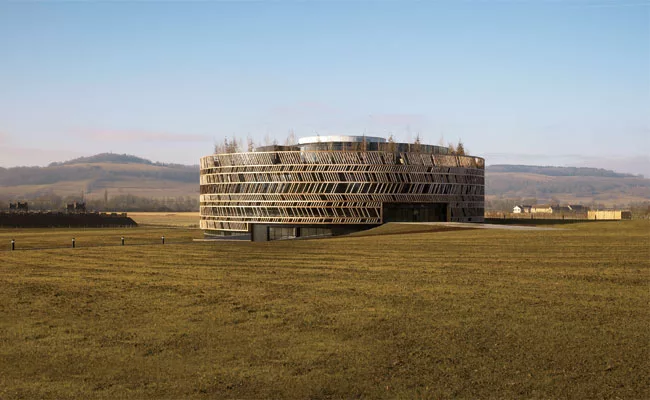
2,060-year-old battlefield On the site where Julius Caesar laid siege to Gallic leader Vercingetorix, Bernard Tschumi has created a circular concrete orientation center wrapped in a wood lattice.
Mus'oParc Al'sia
Bernard Tschumi Architects
2,060-year-old battlefield On the site where Julius Caesar laid siege to Gallic leader Vercingetorix, Bernard Tschumi has created a circular concrete orientation center wrapped in a wood lattice.
Photo © Christian Richters
On the 91-acre site in Burgundy, France, the interpretation center echoes the ringed fortifications built by Julius Caesar in 52 b.c. A concrete gangway with wide, deep steps leads out to the partiall
Mus'oParc Al'sia
Bernard Tschumi Architects
On the 91-acre site in Burgundy, France, the interpretation center echoes the ringed fortifications built by Julius Caesar in 52 b.c. A concrete gangway with wide, deep steps leads out to the partially reconstituted fortifications.
Photo © Christian Richters
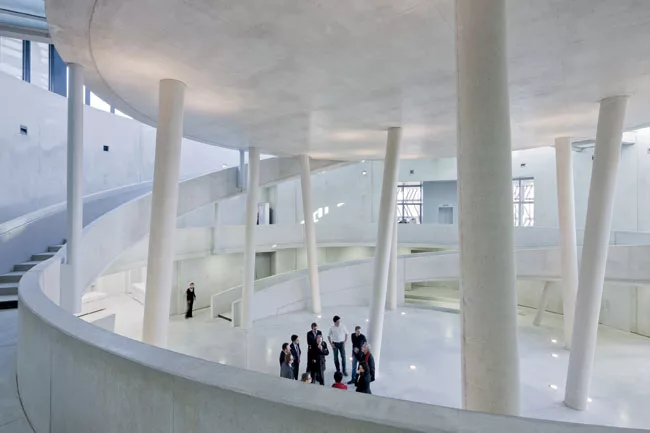
Tschumi wanted to keep the central rotunda of the poured concrete structure free of exhibition elements.
Mus'oParc Al'sia
Bernard Tschumi Architects
Tschumi wanted to keep the central rotunda of the poured concrete structure free of exhibition elements.
Photo © Christian Richters
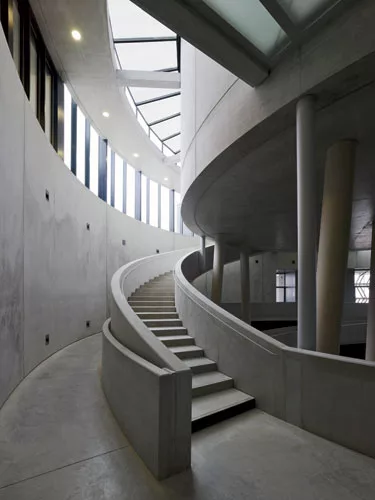
Some of the columns tilt in order to give the space a slightly less monumental air. The stairs swirl upward, with sidelights and top lights illuminating the space dramatically.
Mus'oParc Al'sia
Bernard Tschumi Architects
Some of the columns tilt in order to give the space a slightly less monumental air. The stairs swirl upward, with sidelights and top lights illuminating the space dramatically.
Photo © Christian Richters
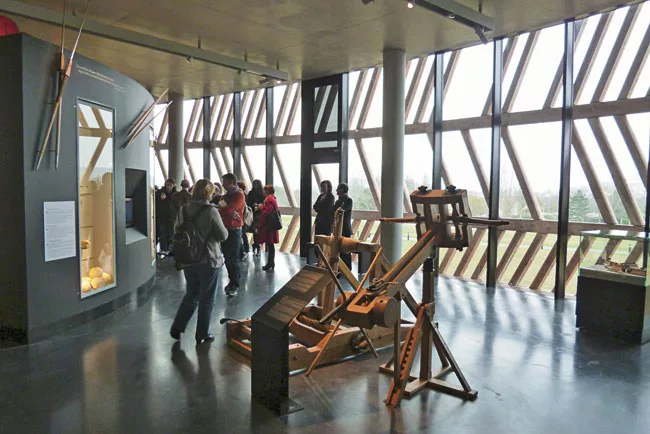
Visitors first encounter the winding rooms of the exhibition space.
Mus'oParc Al'sia
Bernard Tschumi Architects
Visitors first encounter the winding rooms of the exhibition space.
Photo © Christian Richters
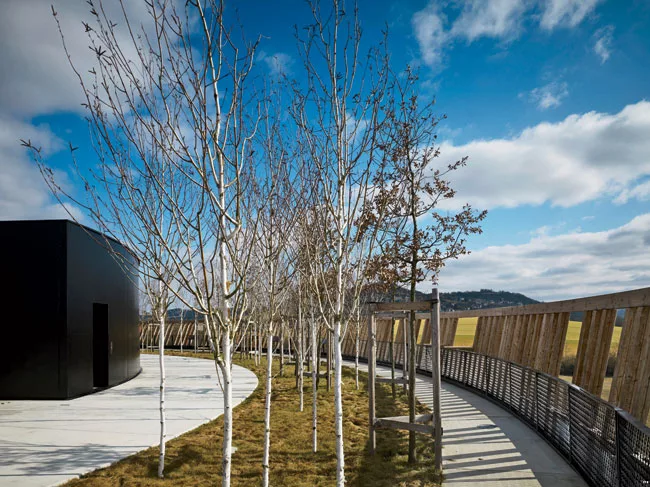
Visitors arrive at the roof, where they have a panoramic view of the partially reconstituted fortifications.
Mus'oParc Al'sia
Bernard Tschumi Architects
Visitors arrive at the roof, where they have a panoramic view of the partially reconstituted fortifications.
Photo courtesy Bernard Tschumi Architects
Behind the larch wood screen, the glass is tinted gray so that the screen is prominent. The lowest floor follows the drop in grade where the architects inserted a glass-enclosed picnic area for childr
Mus'oParc Al'sia
Bernard Tschumi Architects
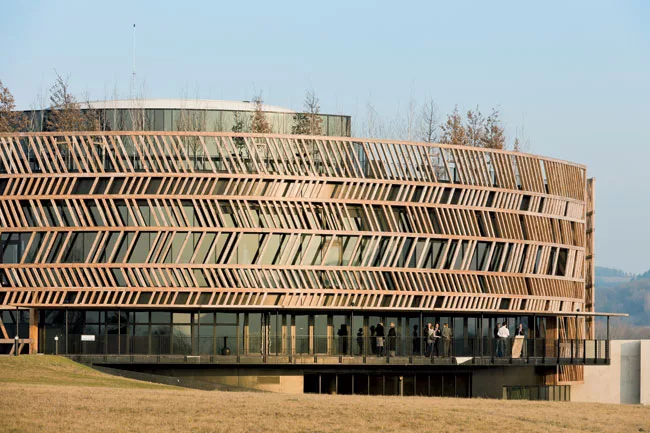
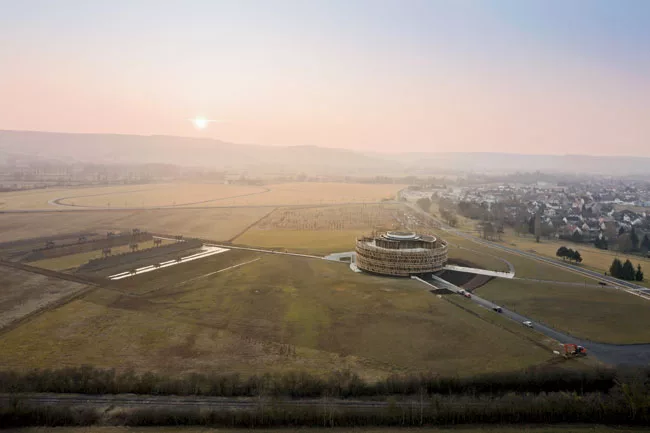
Behind the larch wood screen, the glass is tinted gray so that the screen is prominent. The lowest floor follows the drop in grade where the architects inserted a glass-enclosed picnic area for children; above it, a terrace adjoins the main-floor restaurant. On the roof, trees loom up jauntily from a terrace.
Photo © Iwan Baan
Mus'oParc Al'sia
Mus'oParc Al'sia
Bernard Tschumi Architects
Image courtesy Bernard Tschumi Architects
Mus'oParc Al'sia
Mus'oParc Al'sia
Bernard Tschumi Architects
Image courtesy Bernard Tschumi Architects
Mus'oParc Al'sia
Mus'oParc Al'sia
Bernard Tschumi Architects
Image courtesy Bernard Tschumi Architects
Mus'oParc Al'sia
Mus'oParc Al'sia
Bernard Tschumi Architects
Image courtesy Bernard Tschumi Architects
2,060-year-old battlefield On the site where Julius Caesar laid siege to Gallic leader Vercingetorix, Bernard Tschumi has created a circular concrete orientation center wrapped in a wood lattice.
On the 91-acre site in Burgundy, France, the interpretation center echoes the ringed fortifications built by Julius Caesar in 52 b.c. A concrete gangway with wide, deep steps leads out to the partiall
Tschumi wanted to keep the central rotunda of the poured concrete structure free of exhibition elements.
Some of the columns tilt in order to give the space a slightly less monumental air. The stairs swirl upward, with sidelights and top lights illuminating the space dramatically.
Visitors first encounter the winding rooms of the exhibition space.
Visitors arrive at the roof, where they have a panoramic view of the partially reconstituted fortifications.
Behind the larch wood screen, the glass is tinted gray so that the screen is prominent. The lowest floor follows the drop in grade where the architects inserted a glass-enclosed picnic area for childr
Mus'oParc Al'sia
Mus'oParc Al'sia
Mus'oParc Al'sia
Mus'oParc Al'sia
July 16, 2012

Architects & Firms

Bernard Tschumi Architects

Alise-Sainte-Reine, France

A circular building treated as a monolithic, self-contained volume can be unforgivingly oppressive. The Hirshhorn Museum—a poured concrete donut plopped onto the National Mall in Washington, D.C., in 1974 by Gordon Bunshaft of Skidmore, Owings & Merrill—certainly reminds us of that danger. Yet, using that simple concept (and material), architect Bernard Tschumi recently created a dynamically quirky structure for MuséoParc Alésia's Interpretation Center in France.


For more than a decade, Tschumi, who has offices in New York and Paris, has been exploring curved concrete forms combined with different materials—especially in France. In both the Zénith concert hall and exhibition complex in Rouen and the Zénith concert hall in Limoges, he designed the facade and roof as one continuous envelope. While the earlier project probed the notion of wrapping a concrete structure with stainless steel, the second did so with polycarbonate and wood.

But with the Alésia's interpretation center, 37 miles northwest of Dijon, Tschumi has turned to the purer geometry of the concrete drum, which has been around at least since the Coliseum in Rome (82 a.d.), to explore that form's expressiveness. By superimposing a lattice of larch wood onto it, Tschumi has given the drum a sense of scale and detail that avoids the pitfalls of the Hirshhorn. In addition, the planted trees jauntily sprouting from the roof lend the whole composition a mysterious aura.

Inside the center you find a spiraling stair, much like Frank Lloyd Wright's ramp for the Solomon R. Guggenheim Museum, but easier to climb because of the steps. And at Alésia, you end up on an upper-level terrace with a panoramic view of the countryside and the village of Alise-Sainte-Reine.

On this historic site, in a pastoral area of Burgundy southwest of Paris, Vercingetorix, chief of the Gauls, was besieged in 52 b.c. by Julius Caesar, who was busy transforming the Roman Republic into an empire. While the interpretive center appears at first glance to be a romantic ruin, its circular form actually echoes the trenches and fortifications Caesar built to win the final battle over the Gauls. Caesar had devised two circular cordons of trenches and stockades around the oppidum, or fortified hill town, of Alésia. The inner ring, 9 miles in circumference, entrapped the Gauls; the outer one, 14 miles around, prevented external reinforcements from coming to Vercingetorix's aid. The siege lasted two months, and the rest, as they say, is history.

Archaeological excavations initiated in the mid–19th century and bolstered by digs in the 1990s gave Alésia, now Alise-Sainte-Reine, incentive to bring its legendary past to public attention. Tschumi's proposal, which began with a competition in 2002, actually calls for two cylindrical buildings—of which the first to be completed is the four-story, 86,111-square-foot interpretion center that opened this past March near Caesar's fortifications. His second structure, a three-story, 70,000-square-foot archaeological museum, will be completed in 2016 about a mile away, on the slopes of Mont Auxois, where Vercingetorix and his troops were trapped in their stronghold. Unlike the wood-screened center, the round concrete museum will be wrapped in the same local yellow-tinged limestone (Pierre de Bourgogne) as used for the stone walls of the Gallic ramparts. As Tschumi explains, “The two buildings, with the circular configurations, are in a dialogue,” which relates to the concentric circles of the battlefield and the oppidum.

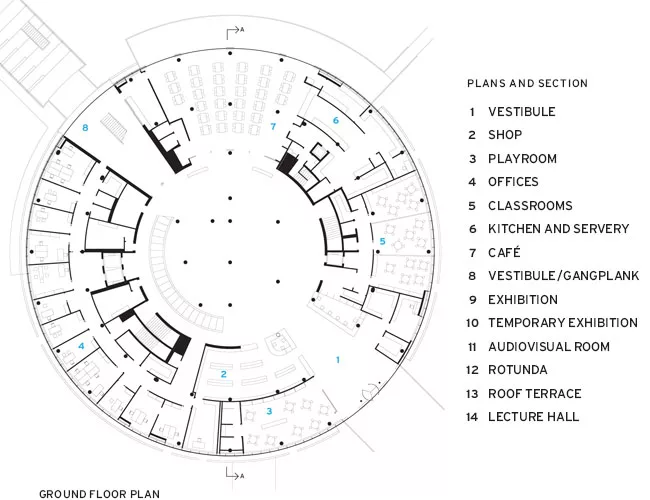
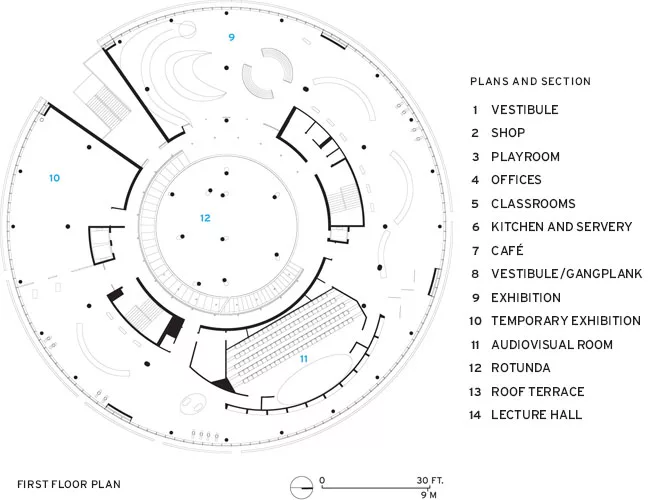
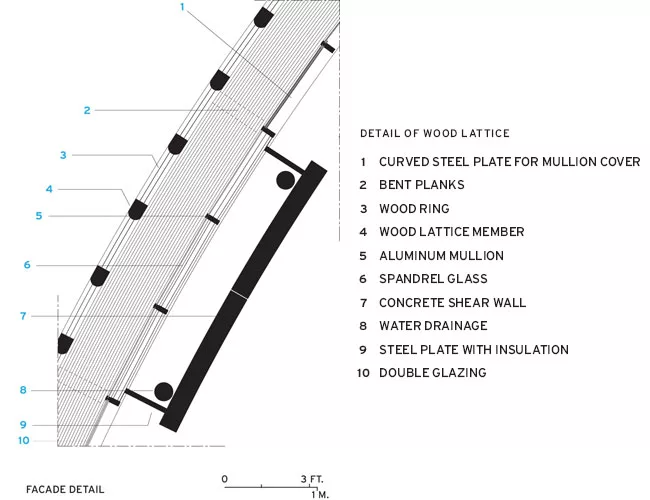
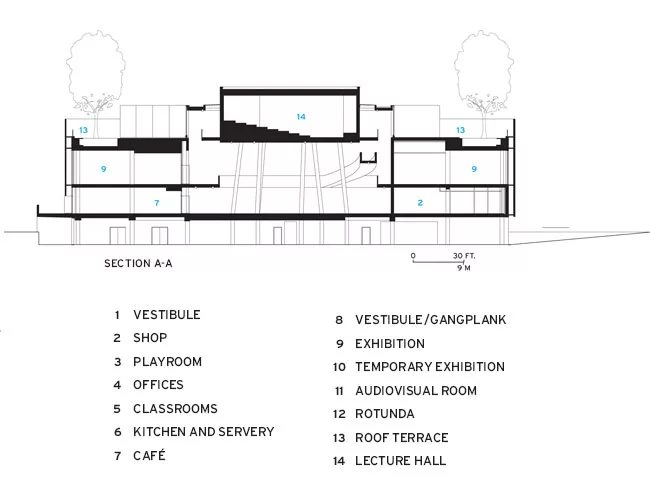
The larch wood for the interpretation center came from Germany—where ringed elements were bent by steam—and was assembled on-site, using galvanized steel pins and sleeve connections. The entrance opens into a large rotunda topped by a concrete disc, which is actually the floor of a 154-seat lecture hall. The disc is supported by slender concrete columns, some perpendicular, others tilting quixotically. “I wanted to keep the rotunda sober and pure,” says Tschumi, “but I didn't want the columns to seem too monumental.”

The architect had white sand mixed into the concrete for the visible portions of the interior, and he used metal formwork for the walls and columns. The warped surfaces of the ramp, however, demanded a more labor-intensive wood formwork for a smooth pour.

The attenuated spiraling stair leads visitors up to exhibition and orientation areas and conference rooms. As it winds up and around, daylight, filtering in from glazing at the top and side walls, gives the place a faint Piranesian air: Translucent glass floors at the upper reaches of the spiral add to the interior's ethereality.

While the 12,917 square feet of exhibition space display models, multimedia terminals, dioramas, films, and reconstructed battle equipment—devices to give visitors an idea of the fateful siege when the Gauls fell to Caesar's veni vidi vici mind-set—the actual high point in the processional tour comes when you arrive on the roof terrace. There you look over partially rebuilt battlements (with a narrower gap between the two rings) and an expansive, softly rolling terrain. Landscape architect Michel Desvigne designed a grassy circular bed planted with white birches and oaks on the terraces, where trees grow no more than 25 feet high. (A rainwater recovery and filtering system fits in with the center's energy measures, as does the energy savings of the wood brise-soleil.)

The wood lattice enclosure that swathes the concrete and gray glass structure gives it a protective, timeless quality. Since the thick filigree hides the solidity of the concrete, and the tree limbs and leaves spring up from the roof, its masklike quality is all the more provocative. Here the mask humanizes the architecture (or should we say naturalizes it) with its use of timber and the diagonal pattern of its component parts. It beckons us to enter and become familiar with the contents within—to become part of history and nature.

Completion Date: March 2012

Gross square footage: 8,000 m2 (site 37 hectares)

Total Project cost: € 22M

Architect:
Bernard Tschumi Architects
227 W. 17th Street
New York, NY 10011
Ph: 212-807-6340 
Fax: 212-242-3693

People

Owner: Conseil Général, Côte d’Or, Bourgogne

Architect
Bernard Tschumi Architects
227 W. 17th Street
New York, NY 10011
Phone: 212-807-6340 
Fax: 212-242-3693

Personnel in architect's firm who should receive special credit:
Architectural Team:
Bernard Tschumi Architects: Bernard Tschumi, Kim Starr, Joel Rutten, Adam Dayem, Jane Kim, K.J. Min, Adrien Durrmeyer, Matthew Stofen, Paula Tomisaki, Nefeli Chatzimina.
Bernard Tschumi urbanistes Architectes: Bernard Tschumi, Véronique Descharrières, Rémy Cointet, Antoine Santiard, Jean-Jacques Hubert, Alice Dufourmantelle, Sarah Gould, Agnes Winiarzska, Christina Devizzi, Adrien Del Grande

Interior designer:  Exhibition design:  Scene, Guy-Claude Francois

Engineer(s):
Civil: France Aires

Structural: BEA Ingénierie

MEP: BET Choulet

Electrical:  Cegelec

Consultant(s):
Landscape: Michel Desvigne with Société Forestière de la CDC

Acoustical: Cial, Jean-Luc Lecoq

Other:  
Wood: Technip TPS

Wood Facade: J. Natterer, consulting engineer

Cost Consultant: Bureau Michel Forgue

Safety Engineer: PCA

Coordinator: IOSIS Grand Est 

Control Bureau: Alpes Contrôle

Safety Coordinator: PMM

Photographer(s): Iwan Baan, Christian Richters

CAD system, project management, or other software used:
AutoCAD, 3d Max, Rhino


Products

Structural system
Reinforced Concrete
Contractor: C3B

Exterior cladding
Metal/glass curtain wall: Glass Facades: Protoy

Wood: Timber Frame Lattice Facade:  Mélèze, Ochs

Moisture barrier: SMAC

Glazing
Glass: Saint Gobain - Parsol

Doors
Metal doors: Protoy

Interior finishes
Acoustical ceilings: Oberflex

Demountable partitions: DBS, Placoplatre

Cabinetwork and custom woodwork: C3B, Sst MEN

Paints and stains: Bonglet

Floor and wall tile: Casal Grande – Marthé,  Del Toso

Resilient flooring: Chape Béton Ciré – Grepi, Pascual

Special interior finishes unique to this project:
Glass Floor: SGG - Glaverbel

Furnishings
Reception furniture: C3B, Sst MEN

Auditorium Seats: Quinette Gallay - Mussidan

Other furniture:  Museum Store:  Vitu

Lighting
Interior ambient lighting: Philips, Regent

Exterior: Philips

Dimming System or other lighting controls: 
General Electric Fixtures:  Legrand

Conveyance
Elevators/Escalators: Kone

Plumbing
Klein

Other unique products that contribute to sustainability:
Green roof includes birch and oak saplings planted around the circumference of the roof terrace.  

Landscape contractors: Duc & Prefeuf / FCE

 
KEYWORDS: France

Share This Story

Looking for a reprint of this article?
From high-res PDFs to custom plaques, order your copy today!

Stephens

Suzanne Stephens, a former deputy editor of Architectural Record, has been a writer, editor, and critic in the field of architecture for several decades. She has a Ph.D. in architectural history from Cornell University, and teaches a seminar in the history of architectural criticism in the architecture program of Barnard and Columbia colleges.

Post a comment to this article

Report Abusive Comment

Subscription Center
  • Create an Account
  • Start a Subscription
  • Manage My Account
  • Sign Up for Newsletters
  • Visit Customer Service
  • Update Preferences

More Videos

Sponsored Content

Sponsored Content is a special paid section where industry companies provide high quality, objective, non-commercial content around topics of interest to the Architectural Record audience. All Sponsored Content is supplied by the advertising company and any opinions expressed in this article are those of the author and not necessarily reflect the views of Architectural Record or its parent company, BNP Media. Interested in participating in our Sponsored Content section? Contact your local rep!

close
  • cold storage facility
    Sponsored byCarlisle SynTec Systems

    How Architects Can Design More Continuous Cold Storage Envelopes

  • TAMLYN XtremeTrim Exterior Trim
    Sponsored byTamlyn

    Designing Cleaner Panel Facades: Why Exterior Trim Details Matter

  • Building with Vapor Barriers
    Sponsored byReef Industries, Inc.

    Vapor Barriers Help Control Moisture in Tighter Building Designs

DESIGN:ED Podcast
Listen to Architectural Record’s DESIGN:ED Podcast

Events

June 23, 2026

Enhancing Fire Resistance with Advanced PVC Solutions

Credits: 1 AIA LU/HSW; 1 AIBD P-CE; 0.1 ICC CEU; 1 IIBEC CEH

Evaluate advanced PVC solutions that improve fire resistance, support WUI compliance, and enhance resilience in residential and commercial building design.

June 25, 2026

Designing Glass Railing Systems that Enhance Aesthetics and Meet Code

Credits: 1 AIA LU/HSW; 1 AIBD P-CE; 0.1 ICC CEU

Upon course completion, participants will possess a deeper understanding of glass railings to help ensure that safety, aesthetic, and performance objectives are achieved.

View All Submit An Event

Products

2026 Architect's Square Foot Costbook

2026 Architect's Square Foot Costbook

See More Products

Popular Stories

Lorcan O' Herilhy

California Architect Lorcan O’Herlihy Has Died, Age 66

Obama Presidential Center, Chicago

The Obama Presidential Center Opens on Chicago’s South Side

Spoonbill Ranch

Johnsen Schmaling Architects Integrates Spoonbill Ranch into a Pristine Landscape

CCA, Studio Gang

The Winners of the AIA’s 2026 Architecture Award Range from Collegiate Rowing Hubs to Housing for the Homeless

West Village Penthouse

Design Vanguard 2026: Brent Buck Architects

Enhancing Fire Resistance with Advanced PVC Solutions - Free Webinar - June 23, 2026

Related Articles

  • Cathedral of the Light

    Cathedral of Christ the Light

    See More
  • 0-14 Tower

    See More
  • Westchester Reform Temple, Rogers Marvel Architects

    See More

Related Products

See More Products
  • manual

    2026 National Building Cost Manual

  • bni book

    BNi Building News Remodeling Costbook 2026 (Print Edition)

  • screen_shot_.png

    Casting Architecture: Ventilation Blocks

See More Products

Events

View AllSubmit An Event
  • July 6, 2026

    Alsace Summer School of Architecture & Crafts

    The Alsace Summer School of Architecture & Crafts (ASSAC) 2026 takes place in Westhoffen, Alsace, France, during July and early August 2026. Participants will explore traditional architecture, drawing, and crafts through a rich combination of site visits, theoretical courses (history, construction, geometry, etc.), hands-on workshops, and a design project.
View AllSubmit An Event
×

The latest news and information

#1 Source for Architectural Design, News and Products

SUBSCRIBE
  • RESOURCES
    • Advertise
    • Contact Us
    • Submit
    • Store
  • ACCOUNT CENTER
    • Create an Account
    • Start a Subscription
    • Manage My Account
    • Sign Up for Newsletters
    • Visit Customer Service
    • Update Preferences
  • PRIVACY
    • PRIVACY POLICY
    • TERMS & CONDITIONS
    • DO NOT SELL MY PERSONAL INFORMATION
    • PRIVACY REQUEST
    • ACCESSIBILITY
  • SERVICES
    • Marketing Services
    • Reprints
    • Market Research
    • List Rental
    • Survey/Respondent Access
  • STAY CONNECTED
    • Linkedin
    • Facebook
    • Instagram
    • YouTube
    • X (Twitter)

Copyright ©2026. All Rights Reserved BNP Media, Inc. and BNP Media II, LLC.

Design, CMS, Hosting & Web Development :: ePublishing