Architectural Record
search
cart
facebook twitter linkedin youtube
  • Sign In
  • Subscribe
  • Sign Out
  • My Account
Architectural Record
  • NEWS
    • Latest News
    • Awards
    • Interviews
    • Obituaries
    • Podcasts
      • Design:Ed Podcast
      • Sponsored Podcasts
  • OPINION
    • Book Reviews / Excerpts
    • Exhibition Reviews
    • Forum
  • EXCLUSIVES
    • Videos
    • Design Vanguard
    • Top 300 Firms
    • Sponsored Content
    • Sponsored eBooks
    • From the Archives
  • CONTINUING ED
    • Editorial Continuing Ed
    • CE Center
    • CE Academies
  • PROJECTS
    • Buildings By Type
    • Reuse & Renovation
    • Museums & Arts Centers
    • Colleges & Universities
    • Multifamily Housing
    • Interiors
    • Lighting
    • Kitchen & Bath
  • HOUSES
    • Record Houses
    • House of the Month
    • Featured Houses
  • PRODUCTS
    • Products by Category
    • Record Products of the Year
    • Latest Products
  • EVENTS
    • Dates & Events
    • Record on the Road
    • Innovation Conference
    • Sustainability in Practice
    • Women In Architecture
    • Webinars
    • Ad Excellence Awards
    • Submit an Event
  • CONNECT
    • Ask RECORD AI
    • Newsletters
    • Contact
    • Advertise
    • Editorial Calendar
    • Store
    • Customer Service
  • SUBMIT
    • Submission Guidelines
    • RECORD Competitions
  • MAGAZINE
    • Subscribe
    • My Account
    • Digital Edition
    • Current Issue
    • Firm Pass
    • Historic Archive
Projects

TED Theater

By Clifford A. Pearson
TED Theater
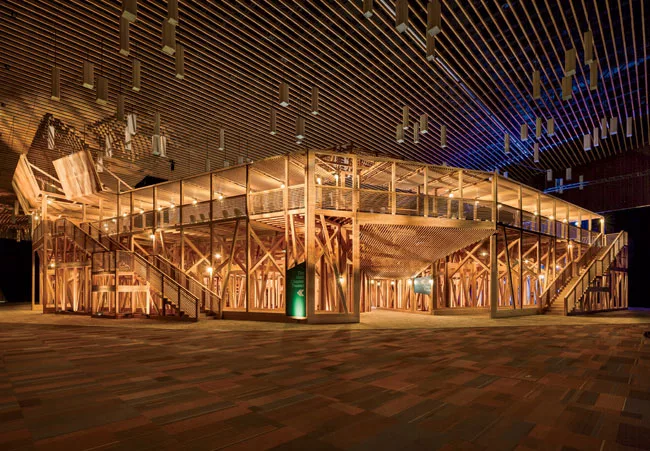
An initial scheme called for a scrim wrapped around the theater, but the architects eventually decided to expose the structure.
 
Photo © Paul Warchol
TED Theater
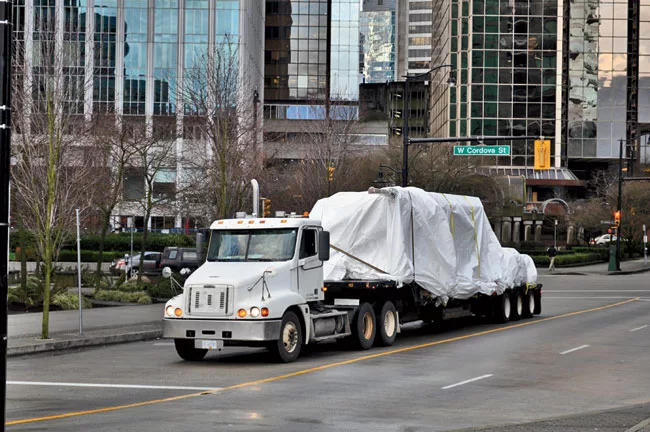
About 160 wood boxes were built off-site, then trucked to the Vancouver convention Center and slipped through the doors of a ballroom.
 
Photo © Paul Warchol
TED Theater
About 160 wood boxes were built off-site, then trucked to the Vancouver convention Center and slipped through the doors of a ballroom.
 
Photo © Paul Warchol
TED Theater
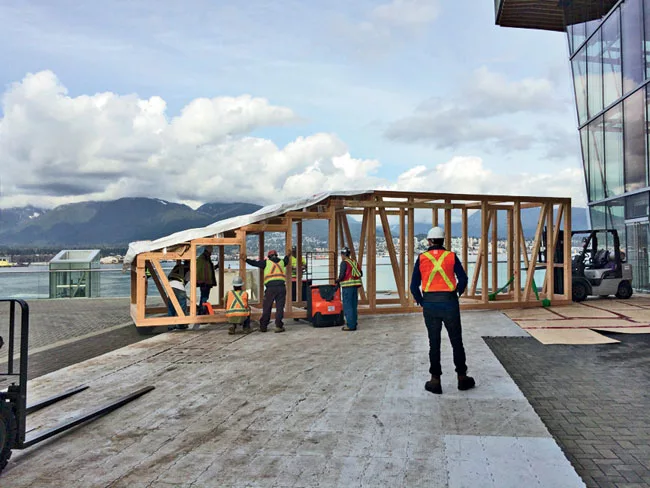
It took five days to erect the theater, using the boxes and in-fill elements added on-site.
 
Photo © Paul Warchol
TED Theater
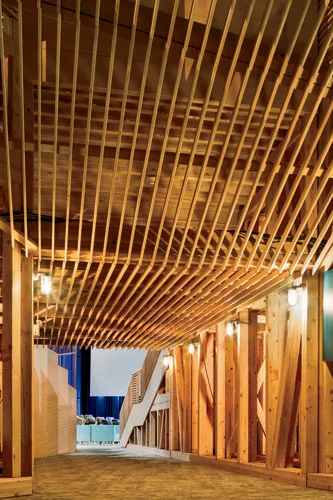
Using wood for almost all elements meant that just one trade was needed for construction and created a forest-like effect when moving through the theater.
 
Photo © Paul Warchol
TED Theater
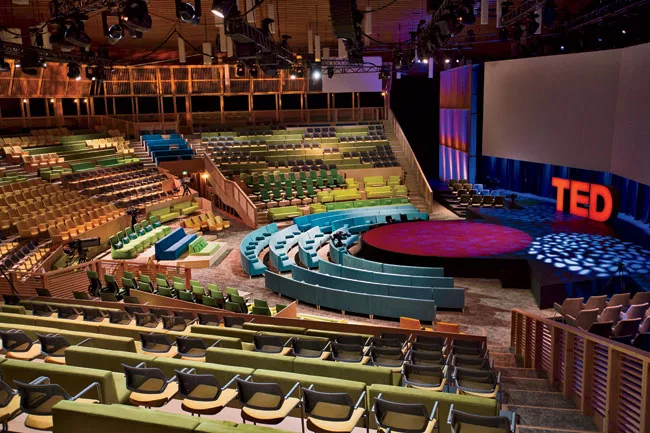
Ten different types of seating—including sofas, benches, and chairs—offered a broad range of gathering areas in the theater.
 
Photo © Paul Warchol
TED Theater
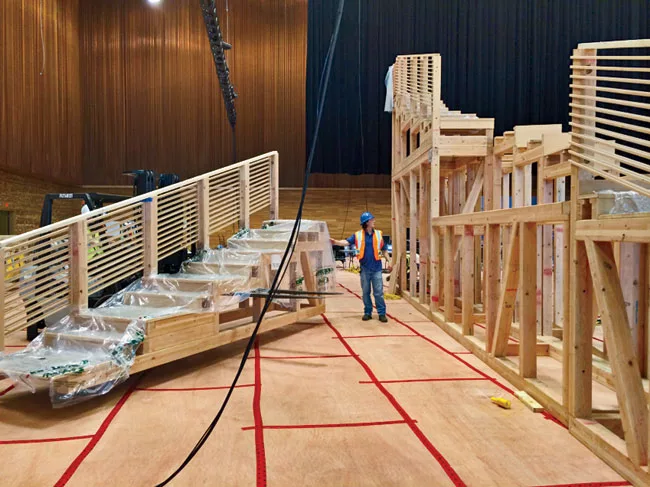
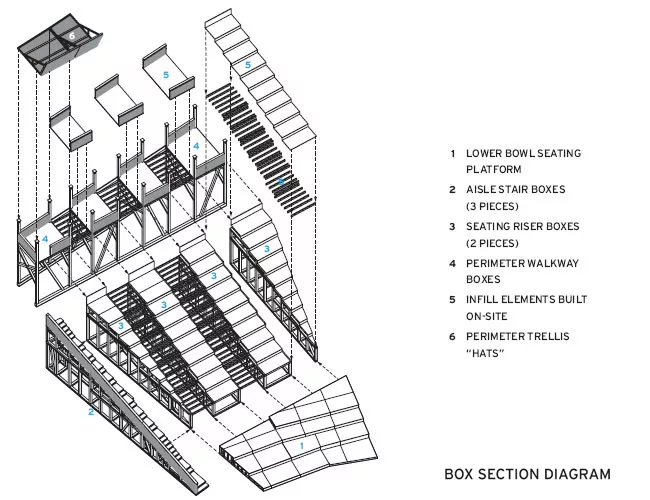
The pre-made boxes could be attached side by side or stacked on top of each other.
 
Image courtesy Rockwell Group
TED Theater
TED Theater
TED Theater
TED Theater
TED Theater
TED Theater
TED Theater
July 16, 2014

Architects & Firms

Rockwell Group

Vancouver, British Columbia

People/Products

Having designed theater sets for Broadway shows and the Oscars, architect David Rockwell knew a lot about temporary structures. But he had never designed a temporary theater. Until Chris Anderson, who runs the organization behind the Technology, Entertainment and Design (TED) talks, asked Rockwell to create a pop-up home for its annual conference—one that could be erected inside a ballroom at the Vancouver Convention Center, disassembled, stored, and then reassembled a year later in the same place or shipped somewhere else.

Rockwell, who had attended many of the TED conferences and presented at some, loved their “campfire” nature, with a community gathered to hear stories told well. A better analogy, though, might be to Chautauqua, the adult-education movement that once brought thousands of people together for summer camps of lectures and cultural performances. Retaining that character was important to Rockwell and Anderson and informed their decision to specify wood as the primary material for the project. Using one material for all of the structural elements seemed like the best strategy, since it would limit work to one trade and take advantage of British Columbia's large pool of skilled carpenters. Also, says Anderson, “It was a natural choice to select locally harvested wood. It made sense for the environment, and it was a nod to our new home in Vancouver.”

Though the project was a different kind of challenge for the architects, “it intersected with things we have been investigating for the past 30 years—craft, spectacle, community, and the ephemeral nature of theater,” says Rockwell.

Making the theater feel intimate, even as it holds 1,200 people, was imperative. In TED's previous home in Long Beach, California, some seats were as far as 125 feet from the stage; the custom-built theater in Vancouver would reduce this to 80 feet. And instead of a uniform arc of seats with one or two aisles, Rockwell created a patchwork of sections with 10 different kinds of seating—including ringside benches, lounge-type arrangements with sofas, and rows that have a combination of chairs and benches. “People like having a choice,” says Rockwell, and the different options help them gather in informal groups within the larger community.

As they worked, Rockwell and his project manager, Michael Fischer, kept a few precedents in mind: medieval pageant plays with their mobile stages, Shakespeare's timber-frame Globe Theater in London, and Hans Scharoun's Berlin Philharmonic. Though neither temporary nor made of wood, the Berlin Philharmonic (completed in 1963) breaks a large expanse of 2,440 seats into various sections, which inspired Rockwell to do the same. “We liked the way Scharoun created a topography of seating,” says Rockwell.

To speed construction, Rockwell worked with Nussli, a Swiss company that supplies temporary structures for trade fairs and now has offices in the U.S. Together they designed a system of “boxes” that could be attached side by side or stacked on top of each other—some as seating sections, some as stairs, and others as “hats” crowning the theater's perimeter. Like a building, the structure needed to handle live and dead loads, but each individual box also had to accommodate the dynamic forces imposed when picked up and moved. The dimensions of the boxes were dictated by the ballroom doors through which they would pass: 10 feet by 8 feet. Their length was limited by the size of the flatbed trucks that would transport them: 30 feet (but most pieces were just 12 feet).

A Vancouver company, CutMyTimber, used computer-numerical-controlled (CNC) milling that reduced waste to just 2 percent. Nussli assembled the pieces—mostly 4-by-6-inch Douglas fir glulam and Douglas fir plywood—into about 160 boxes, starting with the ones that would be needed last (and could be stored in the back of the warehouse) and finishing with those needed first. After three months of manufacturing off-site, trucks delivered the boxes in 60 loads, plus three of equipment, tools, and floor protection. Over the course of just five days last March, two 12-hour shifts of 30 workers built the stage, connected the boxes using nuts and washers—on threaded steel rods embedded in the wood—and added infill elements such as beams, slatted guardrails, cross-laminated-timber railings, and plywood flooring, all made of the same Douglas fir as the boxes.

After the conference, the crews took two and a half days to disassemble the theater. Nussli has guaranteed the project for 10 iterations, but Fischer says, “We feel it could probably last more than that.” Though no one has decided what will happen to the wood after such a time, Fischer says CutMyTimber has a database of the 8,000 pieces it cut and could use it as an inventory for recycling and remilling them.

According to Rockwell, the new theater helped “give a boost” to a 30-year-old event while highlighting the ephemeral nature of such gatherings. Anderson, the client, says, “Our community absolutely loved the theater. We'll make just some minor tweaks—a slightly smaller stage, a few more seats, and some lighting and audio adjustments.” The biggest surprise, he says, was “the powerful scent of the wood itself. It blew us away.”


People

Formal name of building: TED Theater

Location: Vancouver, B.C.

Client: TED

Owner: TED

Architect:
Rockwell Group
5 Union Square West, 8th Floor
New York, NY 10003

Personnel in architect's firm who should receive special credit:
Founder & President, David Rockwell (yes – registered architect)
Project Manager: Michael Fischer
Staff: JT Bachman

Interior designer: Rockwell Group

Engineers:
Structural Engineering: Equilibrium (Glotman Simpson: VCC review)

Consultant(s):
Lighting:
Architectural Lighting: Rockwell Group

Stage Lighting Design: Intensity Advisors

Stage Lighting Show Install: Christie Lites

Acoustical:
Sound System Design, Projection Design and Show Install: McCune Audio Visual

Other:
Construction/Installation and Project Management: Nussli

Rigging: Riggit

Facility Management: Vancouver Convention Center

General contractor: Nussli

Photographer(s):
Paul Warchol
www.warcholphotography.com

Gross square footage:

20,000 SF / 1,200 seats

Project cost:

Withheld

Completion date:

March 2014


Products

Structural system
Locally harvested Douglas Fir from Pacific NW (British Columbia, Oregon & Washington)

Types of Wood:

  • Substructure of seating bowl – Douglas fir glulam industrial grade
  • Substructure of walkways – Douglas fir glulam architectural grade
  • Platforms and risers – Vertical grain Douglas fir plywood 1” treads and ¾” risers
  • Lattice work and handrails – Vertical grain Douglas fir 1x3 slats
  • Trellis frame – Douglas fir glulam architectural grade
  • Low walls at seating – Cross laminated timber


Manufacturer of any structural components unique to this project:
Timber CNC Fabrication: CutMyTimber

Interior finishes
Carpet: Custom carpet by Shaw

Furnishings
Chairs/Sofas: Steelcase

Other furniture:
All seating: Steelcase

Lighting
Interior lighting: Hubbell, Barn Light Electric

Other unique products that contribute to sustainability:
The model that Nussli built (which was uploaded directly to the CNC machine) was built from our own Rhino model and then tweaked to meet the structural and fabrication requirements in CADWorks.  Its tolerance is to about 1/32” to 1/16” (the thickness of a saw blade). The efficiency of the computer aided cutting machine means there is only about 2% waste once all of the material is cut and processed.

Add any additional building components or special equipment that made a significant contribution to this project:
The theater is comprised of smaller components that can be repeatedly assembled and disassembled. The various paired posts/columns and paired beams show where individual “boxes” abut each other, whether side-by-side or one on top of the other. Maximum size of any box frame is roughly 8’ x’ 10’ x 12’. So not only does this structure need to stand up to the normal live/dead loads like any other building, each individual “box” needs to withstand the dynamic forces imposed when they are picked up and moved around.

 
KEYWORDS: Canada

Share This Story

Looking for a reprint of this article?
From high-res PDFs to custom plaques, order your copy today!

Cliff portrait 2 0t5a1761 0031

Contributing editor Clifford Pearson is the co-author, with A. Eugene Kohn, of The World By Design, and writes about architecture and urbanism.

Post a comment to this article

Report Abusive Comment

Subscription Center
  • Create an Account
  • Start a Subscription
  • Manage My Account
  • Sign Up for Newsletters
  • Visit Customer Service
  • Update Preferences

More Videos

Sponsored Content

Sponsored Content is a special paid section where industry companies provide high quality, objective, non-commercial content around topics of interest to the Architectural Record audience. All Sponsored Content is supplied by the advertising company and any opinions expressed in this article are those of the author and not necessarily reflect the views of Architectural Record or its parent company, BNP Media. Interested in participating in our Sponsored Content section? Contact your local rep!

close
  • cold storage facility
    Sponsored byCarlisle SynTec Systems

    How Architects Can Design More Continuous Cold Storage Envelopes

  • TAMLYN XtremeTrim Exterior Trim
    Sponsored byTamlyn

    Designing Cleaner Panel Facades: Why Exterior Trim Details Matter

  • Building with Vapor Barriers
    Sponsored byReef Industries, Inc.

    Vapor Barriers Help Control Moisture in Tighter Building Designs

DESIGN:ED Podcast
Listen to Architectural Record’s DESIGN:ED Podcast

Events

June 18, 2026

Rebooting the Aging Office Building

Credits: 1 AIA LU/HSW; 1 AIBD P-CE; 0.1 ICC CEU; 1 PDH

Explore façade retrofit strategies and award-winning design concepts that can transform aging office buildings into healthier, higher-performing workplaces for today’s hybrid workforce.

June 23, 2026

Enhancing Fire Resistance with Advanced PVC Solutions

Credits: 1 AIA LU/HSW; 1 AIBD P-CE; 0.1 ICC CEU; 1 IIBEC CEH

Evaluate advanced PVC solutions that improve fire resistance, support WUI compliance, and enhance resilience in residential and commercial building design.

View All Submit An Event

Products

2026 Architect's Square Foot Costbook

2026 Architect's Square Foot Costbook

See More Products

Popular Stories

SanDiegoAirport

Top 300 Architecture Firms of 2026

Lorcan O' Herilhy

California Architect Lorcan O’Herlihy Has Died, Age 66

Coronado Bridge

The Architect’s Guide to San Diego

CCA, Studio Gang

The Winners of the AIA’s 2026 Architecture Award Range from Collegiate Rowing Hubs to Housing for the Homeless

Dusk House

Design Vanguard 2026: ONO

Rebooting the Aging Office Building - Free Webinar - June 18, 2026

Related Articles

  • Jacobs Music Center

    In San Diego, HGA and Akustics Revive a Historic Theater as a World-Class Symphony Hall

    See More
  • storefront of a theater space in manhattan

    Beyer Blinder Belle Gives New Life to a Downtown Theater Space in New York

    See More
  • Shim-Sutcliffe Architects Integral House Project Portfolio

    See More

Related Products

See More Products
  • manual

    2026 National Building Cost Manual

  • bni book

    BNi Building News Remodeling Costbook 2026 (Print Edition)

See More Products
×

The latest news and information

#1 Source for Architectural Design, News and Products

SUBSCRIBE
  • RESOURCES
    • Advertise
    • Contact Us
    • Submit
    • Store
  • ACCOUNT CENTER
    • Create an Account
    • Start a Subscription
    • Manage My Account
    • Sign Up for Newsletters
    • Visit Customer Service
    • Update Preferences
  • PRIVACY
    • PRIVACY POLICY
    • TERMS & CONDITIONS
    • DO NOT SELL MY PERSONAL INFORMATION
    • PRIVACY REQUEST
    • ACCESSIBILITY
  • SERVICES
    • Marketing Services
    • Reprints
    • Market Research
    • List Rental
    • Survey/Respondent Access
  • STAY CONNECTED
    • Linkedin
    • Facebook
    • Instagram
    • YouTube
    • X (Twitter)

Copyright ©2026. All Rights Reserved BNP Media, Inc. and BNP Media II, LLC.

Design, CMS, Hosting & Web Development :: ePublishing