James Corner Field Operations and Diller Scofidio + Renfro
New York City
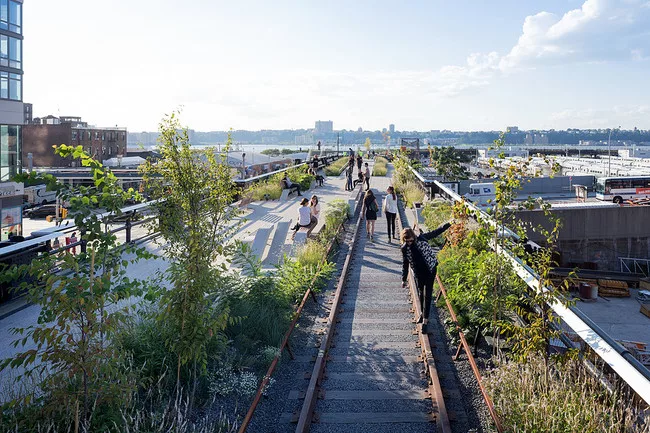
When DS+R and James Corner Field Operations won the job to transform Manhattan’s abandoned High Line into an elevated urban park in 2004, the two firms faced the challenge of crafting a new identity for the pathway without stretching it too far from its past.
Photo © Iwan Baan
James Corner Field Operations and Diller Scofidio + Renfro
Like our own personalities, urban identities evolve over time but risk snapping if pushed too far. The High Line—an elevated rail that snakes through Manhattan’s Meatpacking District and Chelsea, sidling up to some old buildings and slicing through others—has stamped its ever-changing character on its environs for 75 years. Opened in 1934 as a freight line bringing sides of beef and cases of milk to warehouses on the city’s west side, it morphed from a symbol of progress to a white elephant to a noirish backdrop for late-night assignations with hookers and drug dealers. Over the years, the hulking metal viaduct had attracted people who loved it—such as Robert Hammond and Joshua David, who founded Friends of the High Line to spearhead efforts to save it—and others who hated it as an eyesore, a magnet for illicit activities, and an impediment to new development. So when James Corner Field Operations (JCFO) and Diller Scofidio + Renfro (DS+R) won the job to transform the abandoned High Line into an elevated urban park in 2004, the two firms needed to craft yet another identity for the 1.5-mile-long behemoth without stretching it too far from its past.
RECORD walks the High Line with Lisa Switkin of James Corner Field Operations and Ricardo Scofidio of Diller, Scofidio + Renfro.
The designers approached this challenge by resisting the temptation to do too much. “We kept protecting the High Line from architecture,” says Ricardo Scofidio, the principal in charge for DS+R. “The idea was to retain the singularity of the place, to capture its postindustrial charm,” explains James Corner, principal of JCFO. In the past, various parties had proposed building housing on the High Line, using it as a passenger rail linking the Jacob Javits Convention Center to Chelsea and Greenwich Village, even turning it into one very long swimming pool. But, after holding an open ideas competition, the clients—the nonprofit organization Friends of the High Line and the City of New York (represented by its Department of Parks and Recreation and its Economic Development Corporation)—determined it should be an elevated park. At a few points, private developers would be allowed to erect buildings (such as the Standard Hotel) that touch the rail line, but such intrusions would be kept to a minimum to prevent clutter. After years of clamoring for its destruction, the city’s developers suddenly realized the High Line was an asset increasing their property values, not real estate poison.
A pivotal moment in the long battle to save the High Line occurred in 2001, when Joel Sternfeld published photographs he took of the derelict structure throughout 2000. The haunting beauty of wild grasses growing on a rail line in the middle of the city captured the public’s imagination and helped galvanize support. It also fixed in people’s minds the image of a green ribbon running 30 feet above street level. JCFO and DS+R’s design retains that spirit, featuring some of the grasses and wild species seen in those images, along with plantings selected by Piet Oudolf that will bloom at different times of the year.
“We didn’t want a sharp delineation between the plantings and the hardscape,” states Corner. “So we treated the park as a continuous carpet where the hard and soft blend together,” he adds. That carpet unfolds as a system of concrete planks interwoven with strips of greenery. In certain places, planks seem to have been yanked up to form ipé-wood benches with metal grilles underneath for drainage. The designers refer to this feathering of hard and soft elements as “agri-tecture.”
The first phase of the park, stretching from Gansevoort Street (where the Whitney Museum of American Art plans to build a downtown branch designed by Renzo Piano) to 20th Street, opened in June. Phase Two, which runs from 20th to 30th Street and is under construction, will open in late 2010. A potential third phase would encompass the spur looping west around the 30th Street rail yards and up to the Javits Center, but is threatened by private development.
With steel trestles 5 feet deep and muscular steel columns, the High Line offered plenty of structure to support an elevated park. But workers needed to repair rusted beams and parts of the viaduct’s concrete “bathtub.” They also needed to remove the old rail surface and clean up materials contaminated with lead paint and oil.
As part of their design of the new park, JCFO and DS+R returned some of the old tracks to the new surface. They also created a series of outdoor spaces, some that act as memorable moments and others that emphasize the park’s spatial continuity. Highlights include a sunning area at 16th Street with wooden chaise longues (some of which roll on wheels set on old tracks), an overlook at 17th Street where the architects cut a large window into the steel structure as it crosses 10th Avenue, and a grasslands south of 19th Street where the old rails and plantings provide an inkling of the rail line’s once-derelict charms. As you walk the project, you brush past giant billboards, third-story apartments, fire escapes, and the roofs of low buildings. “Most parks provide an escape from the city,” says Scofidio, “but this one puts you in the middle of it.” Although surrounded by the familiar, you find everything looks a little different from 30 feet up. At the 17th Street overlook, for example, you stare out the “window,” then realize you’ve spent five minutes looking at traffic! The power of the High Line lies in its ability to change our perspective without taking us very far away.
Looking for quick answers on architecture and design topics?
Try Ask RECORD, our new smart AI search tool.
Ask RECORD →
Looking for a reprint of this article?
From high-res PDFs to custom plaques, order your copy today!


