Architectural Record
search
cart
facebook twitter linkedin youtube
  • Sign In
  • Subscribe
  • Sign Out
  • My Account
Architectural Record
  • NEWS
    • Latest News
    • Awards
    • Interviews
    • Obituaries
    • Podcasts
      • Design:Ed Podcast
      • Sponsored Podcasts
  • OPINION
    • Book Reviews / Excerpts
    • Exhibition Reviews
    • Forum
  • EXCLUSIVES
    • Videos
    • Design Vanguard
    • Top 300 Firms
    • Sponsored Content
    • Sponsored eBooks
    • From the Archives
  • CONTINUING ED
    • Editorial Continuing Ed
    • CE Center
    • CE Academies
  • PROJECTS
    • Buildings By Type
    • Reuse & Renovation
    • Museums & Arts Centers
    • Colleges & Universities
    • Multifamily Housing
    • Interiors
    • Lighting
    • Kitchen & Bath
  • HOUSES
    • Record Houses
    • House of the Month
    • Featured Houses
  • PRODUCTS
    • Products by Category
    • Record Products of the Year
    • Latest Products
  • EVENTS
    • Dates & Events
    • Record on the Road
    • Innovation Conference
    • Sustainability in Practice
    • Women In Architecture
    • Webinars
    • Ad Excellence Awards
    • Submit an Event
  • CONNECT
    • Ask RECORD AI
    • Newsletters
    • Contact
    • Advertise
    • Editorial Calendar
    • Store
    • Customer Service
  • SUBMIT
    • Submission Guidelines
    • RECORD Competitions
  • MAGAZINE
    • Subscribe
    • My Account
    • Digital Edition
    • Current Issue
    • Firm Pass
    • Historic Archive
Residential Architecture

Mount Rainier Artist Lofts

Mount Rainier Artist Lofts entices creative people into the role of urban pioneers.

By Beth Broome
October 19, 2008

Architects & Firms

HGA Architects and Engineers

Mount Rainier, Maryland

Artists have long served as conduits for change in marginalized neighborhoods, braving difficult environments in exchange for low rent and often unwittingly paving the way for mainstream inhabitants. In the case of the Mount Rainier Artist Lofts, creative people were lured quite intentionally as pioneers for change in hopes of turning around the fate for Mount Rainier, Maryland, a small, deteriorating street-car suburb just a block from the border with the District of Columbia.
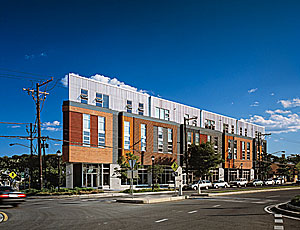
Mount Rainier Artist Lofts

With the goal of reinventing the small, historic residential neighborhood, the Prince Georges County Redevelopment Authority, community activists, and local nonprofit groups combined forces to create the Gateway Arts District and develop a master plan for a 2-mile-long stretch of Rhode Island Avenue Extended, or Route 1, the area’s commercial corridor. Artspace, a Minneapolis-based nonprofit developer involved in the project, brought in Minneapolis-based HGA Architects and Engineers to help create, on the former site of three derelict businesses, a mixed-use building that would provide affordable live/work spaces for artists and their families.

While Mount Rainier is on the National Register of Historic Places, the building would serve a forward-thinking community. “The artists, on one hand, wanted a funky, contemporary building,” says Bill Madden, AIA, project architect and manager, “while the Design Review Board and the Mount Rainier residents requested a more contextual architecture emulating the modestly scaled historic styles of the neighborhood.” During initial planning phases, the design team held public forums, garnering community input about the scale, design, and materials for the project. Responding to the board’s requests, the architects incorporated Classical elements in the facade, such as a base and cornice, and used double-hung windows, proportioned to match those of surrounding buildings. However, they took liberal creative license with these features; for example, installing corrugated metal horizontally around windows to mimic louvered shutters and creating a metal-strip cornice.

In the early stages of the project, the size of the site was decreased, presenting the architects with another challenge: how to keep the scale of the building (whose structure is composed principally of precast concrete) down while maintaining the same number of units on a now smaller footprint. To do so, they set back the top floor and clad it in galvanized-metal siding, giving it the appearance of a line of boxcars, a nod to the main railroad spur that sits behind the site. In response to a tight construction budget ($8.3 million—about $110 a square foot for the 73,000-square-foot building), the architects concentrated their efforts on the exterior, leaving the residents to fit out the interiors. The discovery that quilting had been a regional tradition piqued the interest of one of the designers, a quilter herself, who created imagery that morphed into a patchwork look for the facades, incorporating a variety of brick and corrugated-metal-siding colors, including clear galvanized, red, orange, and gray.

The wedgelike site led to an arrow-shaped building, which lends itself to a collection of unique units, with 18 different configurations for the 44 apartments. Interiors are simple to an extreme, boasting a preponderance of drywall, red vinyl flooring in the public halls, and exposed pipes and ducts and plywood-decked lofts in the double-height apartments. Ornamentation and personalization has been left up to the residents, who have adorned public spaces with their sculptures and collages, and inside the units have painted murals, applied large photographs to stair risers, or even installed soundproof recording studios.

HGA’s other projects for the Arts District—including residential buildings and a museum and cultural center—are currently on hold, and the area still has the feel of being in the early stages of emergence. However, on a smaller scale, at least, Mount Rainier Artist Lofts (which is almost always fully occupied) is fostering change as it has evolved into a tight-knit nexus for creative individuals who, enjoying subsidized rents as low as $555 for a studio apartment, are able to pursue their art.


KEYWORDS: Maryland

Share This Story

Looking for a reprint of this article?
From high-res PDFs to custom plaques, order your copy today!

Former Architectural Record managing editor Beth Broome is a freelance writer based in Brooklyn, New York.

Post a comment to this article

Report Abusive Comment

Subscription Center
  • Create an Account
  • Start a Subscription
  • Manage My Account
  • Sign Up for Newsletters
  • Visit Customer Service
  • Update Preferences

More Videos

Sponsored Content

Sponsored Content is a special paid section where industry companies provide high quality, objective, non-commercial content around topics of interest to the Architectural Record audience. All Sponsored Content is supplied by the advertising company and any opinions expressed in this article are those of the author and not necessarily reflect the views of Architectural Record or its parent company, BNP Media. Interested in participating in our Sponsored Content section? Contact your local rep!

close
  • cold storage facility
    Sponsored byCarlisle SynTec Systems

    How Architects Can Design More Continuous Cold Storage Envelopes

  • TAMLYN XtremeTrim Exterior Trim
    Sponsored byTamlyn

    Designing Cleaner Panel Facades: Why Exterior Trim Details Matter

  • Building with Vapor Barriers
    Sponsored byReef Industries, Inc.

    Vapor Barriers Help Control Moisture in Tighter Building Designs

DESIGN:ED Podcast
Listen to Architectural Record’s DESIGN:ED Podcast

Events

June 23, 2026

Enhancing Fire Resistance with Advanced PVC Solutions

Credits: 1 AIA LU/HSW; 1 AIBD P-CE; 0.1 ICC CEU; 1 IIBEC CEH

Evaluate advanced PVC solutions that improve fire resistance, support WUI compliance, and enhance resilience in residential and commercial building design.

June 25, 2026

Designing Glass Railing Systems that Enhance Aesthetics and Meet Code

Credits: 1 AIA LU/HSW; 1 AIBD P-CE; 0.1 ICC CEU

Upon course completion, participants will possess a deeper understanding of glass railings to help ensure that safety, aesthetic, and performance objectives are achieved.

View All Submit An Event

Products

2026 Architect's Square Foot Costbook

2026 Architect's Square Foot Costbook

See More Products

Popular Stories

Lorcan O' Herilhy

California Architect Lorcan O’Herlihy Has Died, Age 66

Obama Presidential Center, Chicago

The Obama Presidential Center Opens on Chicago’s South Side

Spoonbill Ranch

Johnsen Schmaling Architects Integrates Spoonbill Ranch into a Pristine Landscape

Image of Bruce Springsteen Center for American Music

The CookFox-designed Bruce Springsteen Center for American Music Opens in New Jersey

Three Courtyards House

Design Vanguard 2026: Balsa Crosetto Piazzi

Enhancing Fire Resistance with Advanced PVC Solutions - Free Webinar - June 23, 2026

Related Articles

  • Mount Rainier Artist Lofts Residential

    See More
  • MainStreetHouse_FT

    Main Street House

    See More
  • Biscuit Company Lofts

    Biscuit Company Lofts

    See More

Related Products

See More Products
  • 0470126736.gif

    Modern Sustainable Residential Design: A Guide for Design Professionals

See More Products
×

The latest news and information

#1 Source for Architectural Design, News and Products

SUBSCRIBE
  • RESOURCES
    • Advertise
    • Contact Us
    • Submit
    • Store
  • ACCOUNT CENTER
    • Create an Account
    • Start a Subscription
    • Manage My Account
    • Sign Up for Newsletters
    • Visit Customer Service
    • Update Preferences
  • PRIVACY
    • PRIVACY POLICY
    • TERMS & CONDITIONS
    • DO NOT SELL MY PERSONAL INFORMATION
    • PRIVACY REQUEST
    • ACCESSIBILITY
  • SERVICES
    • Marketing Services
    • Reprints
    • Market Research
    • List Rental
    • Survey/Respondent Access
  • STAY CONNECTED
    • Linkedin
    • Facebook
    • Instagram
    • YouTube
    • X (Twitter)

Copyright ©2026. All Rights Reserved BNP Media, Inc. and BNP Media II, LLC.

Design, CMS, Hosting & Web Development :: ePublishing