Architectural Record
search
cart
facebook twitter linkedin youtube
  • Sign In
  • Subscribe
  • Sign Out
  • My Account
Architectural Record
  • NEWS
    • Latest News
    • Awards
    • Interviews
    • Obituaries
    • Podcasts
      • Design:Ed Podcast
      • Sponsored Podcasts
  • OPINION
    • Book Reviews / Excerpts
    • Exhibition Reviews
    • Forum
  • EXCLUSIVES
    • Videos
    • Design Vanguard
    • Top 300 Firms
    • Sponsored Content
    • Sponsored eBooks
    • From the Archives
  • CONTINUING ED
    • Editorial Continuing Ed
    • CE Center
    • CE Academies
  • PROJECTS
    • Buildings By Type
    • Reuse & Renovation
    • Museums & Arts Centers
    • Colleges & Universities
    • Multifamily Housing
    • Interiors
    • Lighting
    • Kitchen & Bath
  • HOUSES
    • Record Houses
    • House of the Month
    • Featured Houses
  • PRODUCTS
    • Products by Category
    • Record Products of the Year
    • Latest Products
  • EVENTS
    • Dates & Events
    • Record on the Road
    • Innovation Conference
    • Sustainability in Practice
    • Women In Architecture
    • Webinars
    • Ad Excellence Awards
    • Submit an Event
  • CONNECT
    • Ask RECORD AI
    • Newsletters
    • Contact
    • Advertise
    • Editorial Calendar
    • Store
    • Customer Service
  • SUBMIT
    • Submission Guidelines
    • RECORD Competitions
  • MAGAZINE
    • Subscribe
    • My Account
    • Digital Edition
    • Current Issue
    • Firm Pass
    • Historic Archive
Residential Architecture

Shobac Cottages and Studio

Shobac Cottages and Studio form a protourban setting on a craggy Nova Scotia coast.

By Suzanne Stephens
January 19, 2009

Architects & Firms

MacKay-Lyons Sweetapple Architects

Upper Kingsburg, Nova Scotia

The place seems to be at the edge of the world, where an expansive sky, shimmering water, and a hilly landscape dotted with spruce and pines are only interrupted by rustic cottages and barns. It is here that Brian MacKay-Lyons, whose firm, MacKay-Lyons Sweetapple Architects, located in Halifax, Nova Scotia, has renovated or designed a cluster of buildings. The architect started buying property some years ago in Upper Kingsburg on the southeastern coast of the province. Known for its hilly, glacial land formations (called drumlins) with panoptic views of the Atlantic Ocean, this peninsula held a primordial attraction for MacKay- Lyons: His French-Acadian forebears had settled there after Champlain’s arrival in 1604.
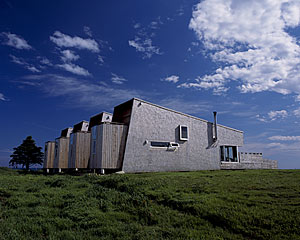
Shobac Cottages and Studio

In 1994, MacKay-Lyons established a camp on the property where architecture students (mostly from Canada and the U.S.) and a few architects and critics would meet two weeks each year for a design-build workshop. The idea was to connect contemporary architectural practice to timeless construction techniques, materials, and vernacular forms. It was soon dubbed Ghost Lab, partly inspired by the eerie look of the new structures at night, and partly by the presence of ruins and other traces of earlier communities nearby.

The first series of design-build enclosures were temporary. But others, including four cabins and a studio, were envisioned as permanent structures. The four cabins provide sleeping accommodations for the design-build students for two weeks each summer, then are rented out the rest of the season. The studio, a barnlike structure that serves as a work space and meeting house for the workshop, is used the rest of the time by Brian MacKay-Lyons and his wife, Marilyn, as a summer office and living space.

Both cabins and studio were designed and (largely) constructed in two different Ghost Lab sessions—the cabins in July 2005 and the studio, the following year. Since the lab runs for a short term, with the first week devoted to design and the second to construction, only certain stages in each project could be brought to completion by the students—many of them novices at building. (Fortunately, practicing architects and builder Gordon MacLean were on hand to guide them.) Both projects were finished during the remainder of the year by MacKay-Lyons Sweetapple working with MacLean.

The cabins, positioned on a 12-foot grid, are 14 feet wide, with 10-foot-wide spaces separating the pavilions. Inserted into the high, narrow end of each wedge-shaped shed is a two-level block containing kitchen, bedroom, and bath on the ground floor, with a bedroom loft above. Living and dining areas open out to east-facing decks and views of the Atlantic Ocean. Exterior sheathing is white-cedar shingles for the long sides of the cabin, with 1-by-4, tongue-and-groove vertical boards—a mixture of two-thirds hemlock and one-third spruce, pine, and fir (called SPF)—for the protruding bedroom blocks. The architects used rough-sawn lumber with the same mix of wood for the stud walls, bolstering them with prefabricated built-up wood trusses, 12 feet on center.

The studio employs similar rough-sawn local timber for a post-and-beam structure, although exterior cladding is corrugated steel sheet. Angled steel struts and beams span the space and give the upper portion of the hall a strong tectonic quality. The 100-foot-long studio is designed so that residents can work or dine at centrally placed refectorylike tables, with a bathroom, kitchen, and fireplace arranged along the south perimeter wall. At the east end are sleeping and sitting nooks, with more sleeping accommodations contained in the mezzanine that wraps around the east and south sides of the structure overlooking the main room.

In Ghost, Building an Architectural Vision (Princeton Architectural Press, 2008), which details the efforts of the first nine sessions of the design-build labs, MacKay-Lyons calls the entire compound an “idealized protourban court.” The cabins and the studio partially enclose two sides of a grassy turf that gently slopes to a ledge over the sea. The manner in which the cabins, the studio, and a new horse barn, plus an earlier nonfunctional “tower,” sit on the clearing furnishes the lab participants with a strong sense of community. Juhani Pallasmaa, as guest critic for the Ghost 7, noted in Ghost that the settlement represents the “primordial encounter of land and water, air and fire.” But the encounter with the sky, especially on a starry night, deepens and strengthens that awe-inspiring, yet strangely intimate communion.


KEYWORDS: Canada

Share This Story

Looking for a reprint of this article?
From high-res PDFs to custom plaques, order your copy today!


Stephens

Suzanne Stephens, a former deputy editor of Architectural Record, has been a writer, editor, and critic in the field of architecture for several decades. She has a Ph.D. in architectural history from Cornell University, and teaches a seminar in the history of architectural criticism in the architecture program of Barnard and Columbia colleges.

Post a comment to this article

Report Abusive Comment

Subscription Center
  • Create an Account
  • Start a Subscription
  • Manage My Account
  • Sign Up for Newsletters
  • Visit Customer Service
  • Update Preferences

More Videos

Sponsored Content

Sponsored Content is a special paid section where industry companies provide high quality, objective, non-commercial content around topics of interest to the Architectural Record audience. All Sponsored Content is supplied by the advertising company and any opinions expressed in this article are those of the author and not necessarily reflect the views of Architectural Record or its parent company, BNP Media. Interested in participating in our Sponsored Content section? Contact your local rep!

close
  • TAMLYN XtremeTrim Exterior Trim
    Sponsored byTamlyn

    Designing Cleaner Panel Facades: Why Exterior Trim Details Matter

  • Building with Vapor Barriers
    Sponsored byReef Industries, Inc.

    Vapor Barriers Help Control Moisture in Tighter Building Designs

  • Duct Interior with Prodeq System
    Sponsored byHenry, a Carlisle Company

    Designing Resilient Water Containment Systems

DESIGN:ED Podcast
Listen to Architectural Record’s DESIGN:ED Podcast

Events

June 10, 2026

Rethinking Stormwater – The Power of Porous Paving

Credits: 1 AIA LU/HSW; 1 AIBD P-CE; 0.1 ICC CEU

Learn how porous paving systems support stormwater management, reduce heat island effects, and enhance sustainable site design performance.

June 11, 2026

Very Early Warning Fire Detection for Mission-Critical Facilities

Credits: 1 AIA LU/HSW; 1 AIBD P-CE; 0.1 ICC CEU

Examine advanced fire detection strategies that support uptime and enhance safety in data centers and other mission-critical facilities.

View All Submit An Event

Products

2026 Architect's Square Foot Costbook

2026 Architect's Square Foot Costbook

See More Products

Popular Stories

Practice Matters illustration

What’s in a (Firm’s) Name? Thinking About Succession and Legacy

Practice Matters illustration

By the Numbers: Counting America's Architects

Riverdale House by Studio Lau

Riverdale House by Studio Lau

House on a Hill

Design Vanguard 2026: Forma

Crane Cove, ONO

Design Vanguard 2026 Winners

Broader Sustainability of CMU - Free Webinar - May 21, 2026

Related Articles

  • Shobac Cottages and Studio Residential

    See More
  • The Conrad Washington D.C.

    The Conrad Washington DC by Herzog & de Meuron / Rottet Studio

    See More
  • St. Luke's School Expansion

    St. Luke's School Expansion by ABA Studio

    See More

Related Products

See More Products
  • Architectural Record - September 2025

    Architectural Record September 2025 Issue

See More Products
×

The latest news and information

#1 Source for Architectural Design, News and Products

SUBSCRIBE
  • RESOURCES
    • Advertise
    • Contact Us
    • Submit
    • Store
  • ACCOUNT CENTER
    • Create an Account
    • Start a Subscription
    • Manage My Account
    • Sign Up for Newsletters
    • Visit Customer Service
    • Update Preferences
  • PRIVACY
    • PRIVACY POLICY
    • TERMS & CONDITIONS
    • DO NOT SELL MY PERSONAL INFORMATION
    • PRIVACY REQUEST
    • ACCESSIBILITY
  • SERVICES
    • Marketing Services
    • Reprints
    • Market Research
    • List Rental
    • Survey/Respondent Access
  • STAY CONNECTED
    • Linkedin
    • Facebook
    • Instagram
    • YouTube
    • X (Twitter)

Copyright ©2026. All Rights Reserved BNP Media, Inc. and BNP Media II, LLC.

Design, CMS, Hosting & Web Development :: ePublishing