Architectural Record
search
cart
facebook twitter linkedin youtube
  • Sign In
  • Subscribe
  • Sign Out
  • My Account
Architectural Record
  • NEWS
    • Latest News
    • Awards
    • Interviews
    • Obituaries
    • Podcasts
      • Design:Ed Podcast
      • Sponsored Podcasts
  • OPINION
    • Book Reviews / Excerpts
    • Exhibition Reviews
    • Forum
  • EXCLUSIVES
    • Videos
    • Design Vanguard
    • Top 300 Firms
    • Sponsored Content
    • Sponsored eBooks
    • From the Archives
  • CONTINUING ED
    • Editorial Continuing Ed
    • CE Center
    • CE Academies
  • PROJECTS
    • Buildings By Type
    • Reuse & Renovation
    • Museums & Arts Centers
    • Colleges & Universities
    • Multifamily Housing
    • Interiors
    • Lighting
    • Kitchen & Bath
  • HOUSES
    • Record Houses
    • House of the Month
    • Featured Houses
  • PRODUCTS
    • Products by Category
    • Record Products of the Year
    • Latest Products
  • EVENTS
    • Dates & Events
    • Record on the Road
    • Innovation Conference
    • Sustainability in Practice
    • Women In Architecture
    • Webinars
    • Ad Excellence Awards
    • Submit an Event
  • CONNECT
    • Ask RECORD AI
    • Newsletters
    • Contact
    • Advertise
    • Editorial Calendar
    • Store
    • Customer Service
  • SUBMIT
    • Submission Guidelines
    • RECORD Competitions
  • MAGAZINE
    • Subscribe
    • My Account
    • Digital Edition
    • Current Issue
    • Firm Pass
    • Historic Archive
Residential ArchitectureRecord Houses

House Roces

Belgian Modern: Outside the medieval city of Bruges, an architect designed a shimmering glass pavilion for himself and his family.

By Suzanne Stephens
On the narrow slice of property, Benny Govaert inserted a 14-foot-high glass rectangular house for himself and his family.
House Roces
Govaert and Vanhoutte Architects
Bruges, Belgium
On the narrow slice of property, Benny Govaert inserted a 14-foot-high glass rectangular house for himself and his family.
Photo © Tim Van de Velde
At the front of the house a large glass panel, 13.5 feet high, pivots open to allow access to the outdoors.
House Roces
Govaert and Vanhoutte Architects
Bruges, Belgium
At the front of the house a large glass panel, 13.5 feet high, pivots open to allow access to the outdoors.
Photo © Tim Van de Velde
The two levels of the bedroom wing at the rear of the house step back to make room for a 7.5-foot-wide lap pool, of which 4.5 feet is covered by the pavement.
House Roces
Govaert and Vanhoutte Architects
Bruges, Belgium
The two levels of the bedroom wing at the rear of the house step back to make room for a 7.5-foot-wide lap pool, of which 4.5 feet is covered by the pavement.
Photo © Tim Van de Velde
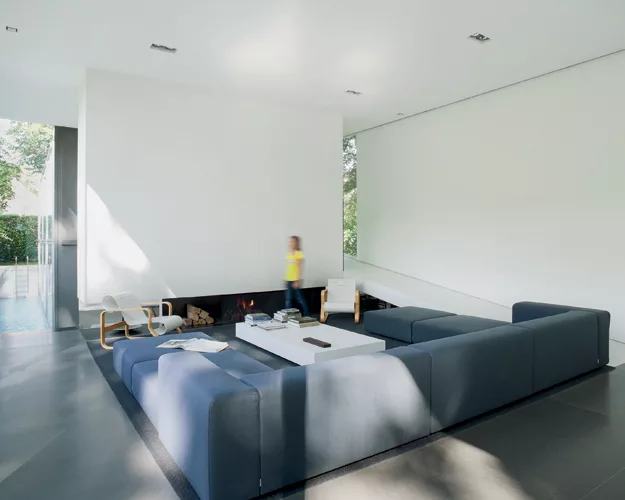
The concrete chimney wall of the living area is suspended over the hearth. A ramp on the northeast side of the house leads up to the second-level bedrooms for the son and daughter.
House Roces
Govaert and Vanhoutte Architects
Bruges, Belgium
The concrete chimney wall of the living area is suspended over the hearth. A ramp on the northeast side of the house leads up to the second-level bedrooms for the son and daughter.
Photo © Tim Van de Velde
The driveway leading to the garage below ground is carved out of the rectilinear volume on the street side of the house.
House Roces
Govaert and Vanhoutte Architects
Bruges, Belgium
The driveway leading to the garage below ground is carved out of the rectilinear volume on the street side of the house.
Photo © Tim Van de Velde
From the living area cantilevered metal treads lead down to the lower-level family room. The soffit under the second-level bedrooms belies the fact that the room soars to a 21-foot height.
House Roces
Govaert and Vanhoutte Architects
Bruges, Belgium
From the living area cantilevered metal treads lead down to the lower-level family room. The soffit under the second-level bedrooms belies the fact that the room soars to a 21-foot height.
Photo © Tim Van de Velde
The elongated kitchen faces directly onto the tree-studded lawn.
House Roces
Govaert and Vanhoutte Architects
Bruges, Belgium
The elongated kitchen faces directly onto the tree-studded lawn.
Photo © Tim Van de Velde
For the front door, Govaert cut out a panel in the back of the wood wall from which the glazed living spaces are extruded. The door opens onto a glazed bridge overlooking the driveway.
House Roces
Govaert and Vanhoutte Architects
Bruges, Belgium
For the front door, Govaert cut out a panel in the back of the wood wall from which the glazed living spaces are extruded. The door opens onto a glazed bridge overlooking the driveway.
Photo © Tim Van de Velde
Another incision in the rectangle accommodates the long lap pool by the bedroom wing.
House Roces
Govaert and Vanhoutte Architects
Bruges, Belgium
Another incision in the rectangle accommodates the long lap pool by the bedroom wing.
Photo © Tim Van de Velde
Historic downtown Bruges.
House Roces
Govaert and Vanhoutte Architects
Bruges, Belgium
Historic downtown Bruges.
Photo by Suzanne Stephens
Entrance vestibule looking over driveway.
House Roces
Govaert and Vanhoutte Architects
Bruges, Belgium
Entrance vestibule looking over driveway.
Photo by Suzanne Stephens
View of suspended fireplace wall from the family room.
House Roces
Govaert and Vanhoutte Architects
Bruges, Belgium
View of suspended fireplace wall from the family room.
Photo by Suzanne Stephens
House Roces
House Roces
Govaert and Vanhoutte Architects
Bruges, Belgium
Image courtesy Govaert and Vanhoutte
House Roces
House Roces
Govaert and Vanhoutte Architects
Bruges, Belgium
Image courtesy Govaert and Vanhoutte
House Roces
Govaert and Vanhoutte Architects
Bruges, Belgium
Image courtesy Govaert and Vanhoutte
On the narrow slice of property, Benny Govaert inserted a 14-foot-high glass rectangular house for himself and his family.
At the front of the house a large glass panel, 13.5 feet high, pivots open to allow access to the outdoors.
The two levels of the bedroom wing at the rear of the house step back to make room for a 7.5-foot-wide lap pool, of which 4.5 feet is covered by the pavement.
The concrete chimney wall of the living area is suspended over the hearth. A ramp on the northeast side of the house leads up to the second-level bedrooms for the son and daughter.
The driveway leading to the garage below ground is carved out of the rectilinear volume on the street side of the house.
From the living area cantilevered metal treads lead down to the lower-level family room. The soffit under the second-level bedrooms belies the fact that the room soars to a 21-foot height.
The elongated kitchen faces directly onto the tree-studded lawn.
For the front door, Govaert cut out a panel in the back of the wood wall from which the glazed living spaces are extruded. The door opens onto a glazed bridge overlooking the driveway.
Another incision in the rectangle accommodates the long lap pool by the bedroom wing.
Historic downtown Bruges.
Entrance vestibule looking over driveway.
View of suspended fireplace wall from the family room.
House Roces
House Roces
April 16, 2012

Architects & Firms

Govaert and Vanhoutte Architects

Bruges, Belgium

Bruges may be best known for its centuries-old stepped-gable structures edging cobblestoned streets and narrow canals, and for its urban squares enclosed by idiosyncratic Gothic and Flemish Renaissance buildings. Nonetheless, the small Belgian port has produced at least one architecture firm that leans not to the earthy romanticism of the medieval picturesque, but to the transcendent romanticism of the Modern Movement.

Benny Govaert and his partner, Damiaan Vanhoutte, who founded a practice in Bruges in 1989, have adhered to the crisp geometries of modern pioneers such as Mies van der Rohe and Le Corbusier since their architectural studies at the Higher Architecture Institute in Ghent. “We also love Richard Neutra's and Rudolf Schindler's California houses in the Hollywood era,” adds Vanhoutte. In recent years the two architects have attracted attention for their poured-concrete, low-rise, rectilinear volumes found in the D-Hotel in nearby Marke (2009), and the award-winning visitors center for the World War I Tyne Cot Cemetery (2008), near Ypres.

Govaert longed to live in a house of his own design, and fortunately his wife, Martine Neirinck, was sympathetic: as a photographer and the architects' office manager she was at home with Govaert & Vanhoutte's unswerving allegiance to minimal and austere geometries. Govaert found a narrow 230-by-99-foot slice of land in a sylvan residential area on the outskirts of the historic city for which he would design a 2,874-square-foot house for his family, including a young son and daughter. Responding to the grassy, tree-studded property, the architect-client opted for the ineffable transparency and translucency of glass that would make the house dissolve into its natural setting. “As a starting point I placed the long [168 feet] and narrow [23 feet] glass box against a wood back wall at the northeast edge of the property,” he says. The living areas face south and west onto the tree-shaded lawn through an expansive, floor-to-ceiling wall of glass.

In his desire to keep the rectangular form intact, Govaert carved into the overall volume in three places: First he cut a large notch for the driveway to the underground garage; then he took a slice out of the northwest corner to create a lap pool that skims past the bedroom wing; and finally he made a small incision between the bedroom wing and the rear wood wall for a back entrance.

The architect wanted to retain the flat, horizontal roof plane at a 14-foot height above-ground for the full length of the steel-frame house. In order to fit bedrooms and a family room into the single volume, he created two levels, with a lower one (containing the master bedroom and the family room) sunk a half-level below grade. Since this bedroom wing jogs 6 feet back to accommodate the lap pool, not only does the lower level receive light, but it has an intriguing view overlooking the water's edge.

As you enter the house views unfold: From the street you see only a glass end bay of the kitchen, a driveway, and the narrow profile of the whitened African teak back wall. The “front door”—actually a floor-to-ceiling narrow panel in the wood wall—opens into a glazed vestibule bridging the driveway. Stepping into the kitchen/dining area, you are drawn visually to the smooth, flat lawn through 9-by-13½-foot glass panels attached to bladelike steel columns.

The legendary Modernist compulsion to align all joints according to severely meticulous arithmetic measurements is much in evidence: You may notice the generous basalt floor pavers (3 by 4½ feet) line up precisely with the butt-jointed glass walls; the length of the dining table (12 feet) echoes the width of the kitchen's service block. We could go on.

From the dining area, you are pulled into the living room, where a concrete chimney wall floats above the fireplace hearth. (A steel beam perpendicular to the suspended wall carries the load to the poured-concrete substructure of the family room a half-level down.) Descending a stair's metal treads cantilevered from the perimeter wall, you find yourself in a family room that soars to a 21-foot height. “I wanted to emphasize extreme horizontal and vertical spaces in the house,” Govaert says. The master bedroom behind the family room is smaller and more secluded. It, too, overlooks the lap pool.

By ascending a ramp from the living room, you can find the bedrooms of the son and daughter each individually decorated—and awash in colorful art and personal objects. While Govaert intended the rear wall to be solid for the full length of the house, with the glass bar extruded from it, he cut out a large glazed opening in this taut wood plane on the east side of the ramp. “Actually, I didn't want to puncture the wall with an opening,” says the architect. “But Martine insisted, and she's right. It brings more light and view to the family room.”

Back in Bruges, bridges replace modern ramps; cobblestones substitute for basalt pavers, and stone and brick abound, rather than glass. There is much to marvel at in the city's rich architectural stew of spires, scrolls, serpentine contours, and craggy textures. Yet the memory of Benny Govaert's glass pavilion surrounded by grass and trees lingers as a soothing tonic: ethereal, elegant, and transporting.

Completion Date: February 2010

Size: 2,874 square feet

Total construction cost: withheld

Location: Belgium, Bruges (Sint-Andries) Doornstraat 292a

Architect:
Govaert&Vanhoutte Architects
Koningin Astridlaan 25/4
8200 Sint-Michiels
Phone: +32 50 388822
Fax: +32 50 392314

People

Owner: Benny Govaert and Martine
Neirinck

Architect
Govaert&Vanhoutte Architects
Koningin Astridlaan 25/4
8200 Sint-Michiels
Phone: +32 50 388822
Fax: +32 50 392314

Personnel in architect's firm who should receive special credit:
Benny Govaert

Interior designer: Govaert&Vanhoutte Architects

Engineer(s): Claeys Engineering Bvba

Consultant(s):
Lighting: Delta Light Belgium

General contractor: Eddy De Mey Oostende

Photographer(s): Tim Van De Velde

CAD system, project management, or other software used: AutoCad


Products

Structural system
Steel Frame: Liebaert Staalbouw

Manufacturer of any structural components unique to this project: Eddy De Mey

Exterior cladding
Metal/glass curtain wall: Lootens Line

Concrete slabs: Eddy De Mey

Curtain wall: Coco bvba

Roofing
Built-up roofing: Six

Windows
Metal frame: Lootens Line

Glazing
Glass: Lootens Line

Doors
Entrances: Lootens Line

Metal doors: Lootens Line

Sliding doors: Lootens Line

Interior finishes
Cabinetwork and custom woodwork: Gert Daels Zulte

Paints and stains: Paul Van Menen

Floor and wall tile: Vloeren Franssens Beernem

Carpet: BIC carpets

Furnishings
Chairs: Mies Van Der Rohe, Le Corbusier, Alvar Aalto, Hans Wegner

Tables: Fabiaan Van Severen

Other furniture: Living Divani

Lighting
All Lighting: Delta Light Belgium

 
KEYWORDS: Belgium

Share This Story

Looking for a reprint of this article?
From high-res PDFs to custom plaques, order your copy today!

Stephens

Suzanne Stephens, a former deputy editor of Architectural Record, has been a writer, editor, and critic in the field of architecture for several decades. She has a Ph.D. in architectural history from Cornell University, and teaches a seminar in the history of architectural criticism in the architecture program of Barnard and Columbia colleges.

Post a comment to this article

Report Abusive Comment

Subscription Center
  • Create an Account
  • Start a Subscription
  • Manage My Account
  • Sign Up for Newsletters
  • Visit Customer Service
  • Update Preferences

More Videos

Sponsored Content

Sponsored Content is a special paid section where industry companies provide high quality, objective, non-commercial content around topics of interest to the Architectural Record audience. All Sponsored Content is supplied by the advertising company and any opinions expressed in this article are those of the author and not necessarily reflect the views of Architectural Record or its parent company, BNP Media. Interested in participating in our Sponsored Content section? Contact your local rep!

close
  • TAMLYN XtremeTrim Exterior Trim
    Sponsored byTamlyn

    Designing Cleaner Panel Facades: Why Exterior Trim Details Matter

  • Building with Vapor Barriers
    Sponsored byReef Industries, Inc.

    Vapor Barriers Help Control Moisture in Tighter Building Designs

  • Duct Interior with Prodeq System
    Sponsored byHenry, a Carlisle Company

    Designing Resilient Water Containment Systems

DESIGN:ED Podcast
Listen to Architectural Record’s DESIGN:ED Podcast

Events

June 16, 2026

Focus on the Façade: Exploring Steel, Timber & Fire-Rated Curtain Walls and Channel Glass Systems

Credits: 1 AIA LU/HSW; 1 AIBD P-CE; 0.1 ICC CEU

Explore modern façade and glazing systems that enhance daylighting, fire safety, and thermal performance while expanding architectural design possibilities.

June 18, 2026

Rebooting the Aging Office Building

Credits: 1 AIA LU/HSW; 1 AIBD P-CE; 0.1 ICC CEU; 1 PDH

Explore façade retrofit strategies and award-winning design concepts that can transform aging office buildings into healthier, higher-performing workplaces for today’s hybrid workforce.

View All Submit An Event

Products

2026 Architect's Square Foot Costbook

2026 Architect's Square Foot Costbook

See More Products

Popular Stories

Coronado Bridge

The Architect’s Guide to San Diego

SanDiegoAirport

Top 300 Architecture Firms of 2026

Crane Cove, ONO

Design Vanguard 2026 Winners

House on a Hill

Design Vanguard 2026: Forma

House A on a Hill

Design Vanguard 2026: Santiago Valdivieso

Focus on the Facade - Free Webinar - June 16, 2026

Related Articles

  • 18.36.54 House

    See More
  • BrillhartHouse_FT

    Brillhart House

    See More
  • Stony Hill House.

    Stony Hill House by Bates + Masi Architects

    See More

Related Products

See More Products
  • biogenic.jpg

    Manual of Biogenic House Sections

  • iconic house.jpg

    The Iconic House

See More Products
×

The latest news and information

#1 Source for Architectural Design, News and Products

SUBSCRIBE
  • RESOURCES
    • Advertise
    • Contact Us
    • Submit
    • Store
  • ACCOUNT CENTER
    • Create an Account
    • Start a Subscription
    • Manage My Account
    • Sign Up for Newsletters
    • Visit Customer Service
    • Update Preferences
  • PRIVACY
    • PRIVACY POLICY
    • TERMS & CONDITIONS
    • DO NOT SELL MY PERSONAL INFORMATION
    • PRIVACY REQUEST
    • ACCESSIBILITY
  • SERVICES
    • Marketing Services
    • Reprints
    • Market Research
    • List Rental
    • Survey/Respondent Access
  • STAY CONNECTED
    • Linkedin
    • Facebook
    • Instagram
    • YouTube
    • X (Twitter)

Copyright ©2026. All Rights Reserved BNP Media, Inc. and BNP Media II, LLC.

Design, CMS, Hosting & Web Development :: ePublishing