
by Tracy Metz and Maartje van den Heuvel. Rotterdam: NAi Publishers (distributed in the U.S. by D.A.P.), 2012, 296 pages, $45. As cleanup from Hurricane Sandy segues to rebuilding, Sweet & Salt could have been ripped from newspaper headlines. The not-sounderlying theme is of the Dutch as canaries in the global-warming coal mine. Much of Holland’s most productive land is below sea level, so the Dutch are acutely aware of subtle changes in the rivers, seas, and weather that get lost in all the background noise masking the climate-change debate in America. After all, Holland has built its culture, social
What are some of the lessons that Sandy teaches us about the way we build? Almost two weeks after Sandy struck, my wife and I got our heat and hot water back; electric power had returned a few days earlier. Our apartment in Lower Manhattan relies on the Con Edison steam system, not a boiler; the utility's slow repair process was the source of the lag between the restoration of power and the return of heat. In both cases, though, we had relied on a centralized technology, rather than a distributed one, which raises fundamental questions about how we conceptualize
In this special section, record presents the latest installment of its annual feature “America's Top Architecture Schools,” ranking the top 10 programs, both undergraduate and graduate
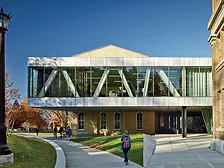
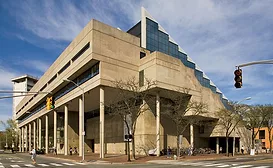
As Marc Treib writes in an essay in Joan Ockman's Architecture School: Three Centuries of Educating Architects in North America, architecture-school buildings haven't changed much from their early-20th century design roots:
Growing up in Miami, Candace Hoskins was always drawn to the arts. Her interest deepened at Design and Architecture Senior High School, a premier magnet school with a diverse student body.
As we know, the nature of architectural practice is changing, and architecture education must keep up with the profession. Below are key points that I would suggest be considered by architecture schools, based on research undertaken by DesignIntelligence and the Design Futures Council.
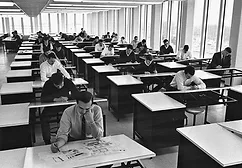
Architecture School: Three Centuries of Educating Architects in North America, edited by Joan Ockman with Rebecca Williamson. Cambridge, MA: MIT Press, 2012, 400 pages, $50. Academic Discourse Photo courtesy Associat ion of Collegiate Schools of Architecture Architecture students hard at work at drafting tables at MIT in 1898. Photo courtesy Association of Collegiate Schools of Architecture Architecture students hard at work at drafting tables at Kent State in 1967. What is the status of the “big book” today? The editors of Architecture School, along with the board of advisers of the Association of Collegiate Schools of Architecture—which initiated the book
Report card: Zaha Hadid's MAXXI turns out to be a good place to see art. There's a giant, white, habitable sculpture sitting in the midst of Rome's nondescript Flaminio district just north of the city center. Its exterior juxtaposes sinuous curves and sharply angled planes, and its interior flows in smooth, serpentine capaciousness. It's Zaha Hadid's National Museum of XXI Century Arts (better known as MAXXI), and doubtless it's a work of art itself. But museums aren't supposed to be stand-alone masterpieces. They're supposed to display and enhance other works of art to visual and contextual advantage. The 228,000-square-foot MAXXI
Plans proceed apace at Harvard, Columbia, Penn, Yale, and Princeton. During the last 10 years or so, five leading American universities have produced large-scale plans to guide their expansion, all of which are currently in various stages of implementation. The realization of these proposals will add millions of square feet of academic and related space to the campuses and cost billions of dollars. At the same time, higher education online is increasing in popularity, paradoxically offering the possibility of reduced demand for teaching space as well as lower education costs for students. Because of new online capabilities, could the expansion