Site size: 5,920 square feet Project size: 7,750 square feet Program: The clients wanted to remodel and expand their three-bedroom house, originally built in the 1970s, adding a gym, movie theater, and wine cellar within the existing envelope plus a new 2,260-square-foot master bedroom and bath. Location: The terraced house follows a steep slope in the Lomas de Chapultepec neighborhood of Mexico City. This topography limited the architect's ability to expand the overall envelope. Solution: The architects reorganized existing spaces using movable walls made from a wood lattice or glass. On the first floor, a living and dining room opens
Site size: 3,879 square feet Project size: 1,470 square feet Program: A couple sought a home that could accommodate children or possibly elderly parents as well as their extensive collection of books. Location: The steeply sloping suburban site consists of a deep rocky substrate and two large hardwood trees. Solution: Shogo Aratani Architect & Associates determined that the site's extreme beauty represented an opportunity for the house to adapt and flourish. The two-floor house is fundamentally two main rectilinear volumes angled away from a central triangular stair. Two parking spaces, just below the first floor, are cut directly from the
Site size: 87,000 square feet Project size: 16,244 square feet Program: A family that enjoys cooking and entertaining guests desired a spacious residence in suburban Toronto. The clients also wanted their house, an expansion and renovation of an existing structure, to reflect their Asian-Canadian background. Location: The Echo House is located on a flat, two-acre plot in the serene and verdant Bridle Path neighborhood of Toronto. Solution: Architect Paul Raff sought to balance several objectives: to furnish ample room for socializing, to utilize traditional Asian craft techniques, and to harmoniously connect the family and their guests to the natural environment.
Site size: 317,535 square feet Project size: 1,700 square feet Program: A young Vancouver couple desired a weekend retreat for themselves and their two children on the rugged coast of British Columbia. Location: The site was critical in shaping the house's design and construction. Situated within a protected forest and next to its own waterfront, its remoteness promised tranquility but demanded environmental sensitivity in its construction strategy. Solution: The principal in charge of the project, Steve McFarlane, based in North Vancouver, sought a modern take on the classic 'cabin in the woods' by balancing picturesque roughness with a modern aesthetic.
Site size: 13,850 square feet Project Size: 3,230 square feet Program: The clients'avid landscapers and gardeners'approached Canadian architecture firm DIALOG to build a house with a strong connection to their property's natural environment. Location: The house occupies a lush, 0.3-acre site site in Vancouver's Dunbar-Southlands neighborhood. A freshwater, fish-bearing stream bisects the property and culminates in a basin at the property's south end. The footings of a former structure are visible on the site. Solution: The architects reinterpreted the site's existing conditions'the natural basin, the existing footings'to design a two-level house that spans the existing stream and blurs indoor and
Site Size: 9,310 square feet Project Size: 1,830 square feet Program: A recently-married couple'with a blended family of eight children'had outgrown their existing 2,960-square-foot, four-bedroom Victorian home they settled into. Not wanting to move, they hired the London-based firm De Matos Ryan to refurbish the house and build a second one at the opposite end of the property. The parents and youngest children live in the new structure, while the older children occupy the main house. Location: The 9,310-square-foot property is located in Battersea, in southwest London, near the River Thames. The new 1,830-square-foot structure, along the western edge of
Site Size: 6,922 square feet Project Size: 5,900 square feet Program: The clients wanted a house with an abundance of natural light, a direct connection to the outdoors, and privacy from the neighboring houses and elementary school. Location: Set on the last lot on a block of repetitive single-family homes to the north, the house is separated from a nearby elementary school to the south by a large parking lot and playground. Solution: The three-story house, clad in wood and glass on the ground floor and copper and glass above, is separated from its neighbors by a freestanding, board-formed concrete
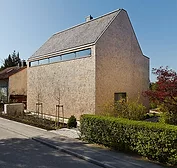
The clients, a family of five, asked the Germany-based firm to design a house in Stuttgart with light-filled living spaces, connecting to a gallery space for exhibiting the family's private art collection.
 RSS
RSS