Architectural Record
search
cart
facebook twitter linkedin youtube
  • Sign In
  • Subscribe
  • Sign Out
  • My Account
Architectural Record
  • NEWS
    • Latest News
    • Awards
    • Interviews
    • Obituaries
    • Podcasts
      • Design:Ed Podcast
      • Sponsored Podcasts
  • OPINION
    • Book Reviews / Excerpts
    • Exhibition Reviews
    • Forum
  • EXCLUSIVES
    • Videos
    • Design Vanguard
    • Top 300 Firms
    • Sponsored Content
    • Sponsored eBooks
    • From the Archives
  • CONTINUING ED
    • Editorial Continuing Ed
    • CE Center
    • CE Academies
  • PROJECTS
    • Buildings By Type
    • Reuse & Renovation
    • Museums & Arts Centers
    • Colleges & Universities
    • Multifamily Housing
    • Interiors
    • Lighting
    • Kitchen & Bath
  • HOUSES
    • Record Houses
    • House of the Month
    • Featured Houses
  • PRODUCTS
    • Products by Category
    • Record Products of the Year
    • Latest Products
  • EVENTS
    • Dates & Events
    • Record on the Road
    • Innovation Conference
    • Sustainability in Practice
    • Women In Architecture
    • Webinars
    • Ad Excellence Awards
    • Submit an Event
  • CONNECT
    • Ask RECORD AI
    • Newsletters
    • Contact
    • Advertise
    • Editorial Calendar
    • Store
    • Customer Service
  • SUBMIT
    • Submission Guidelines
    • RECORD Competitions
  • MAGAZINE
    • Subscribe
    • My Account
    • Digital Edition
    • Current Issue
    • Firm Pass
    • Historic Archive
Architect Continuing Education

Innovations in Glass

Continuing Education: Corning Museum of Glass, New York

Reflections on the Box: A new addition at the Corning Museum of Glass by Thomas Phifer and Partners continues a tradition of invention at its upstate New York campus.

By Josephine Minutillo
Corning Museum of Glass, New York
The addition's pristine exterior masks a series of inventive details that made it possible to sheathe the structure in a single layer of glass with few joints.
 
Photo © Iwan Baan
Corning Museum of Glass, New York
The gabled roof features a combination of opaque panels and transparent and translucent glazing that allows sunlight to pour between the concrete beams over the gallery.
 
Photo © Iwan Baan
Corning Museum of Glass, New York
The gabled roof features a combination of opaque panels and transparent and translucent glazing that allows sunlight to pour between the concrete beams over the gallery.
 
Photo © Iwan Baan
Corning Museum of Glass, New York
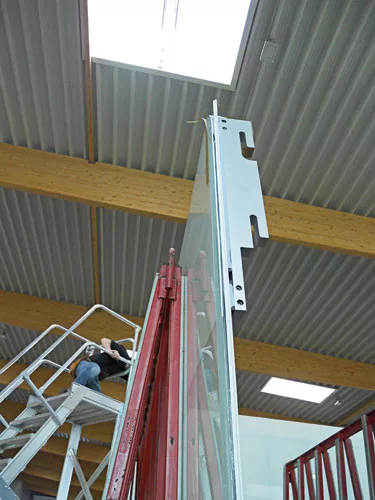
The large glass panels were delivered to the site pre-assembled with coat-hook-like supports already affixed to their backs for easy installation.
 
Photo © Katie Bennett
Corning Museum of Glass, New York
Hefty but sinuous interior walls made of cast-in-place concrete support much of the structure, allowing the perimeter walls to be designed as a light steel frame.
 
Image courtesy Thomas Phifer and Partners
Corning Museum of Glass, New York
Image courtesy Thomas Phifer and Partners
Corning Museum of Glass, New York
March 1, 2015
Continuing Education
 
It goes without saying that the material of choice for a glass museum is glass. At the Corning Museum of Glass in Corning, New York, this has been the case for every incarnation of its sprawling structure, beginning with the original 1951 International Style building by Harrison & Abramowitz, though the glass-block portions of its facade are now interior walls. A free-flowing addition by Gunnar Birkerts (1980) features a peculiarly tinted, steel-backed, rolled-glass facade over an angled mirrored surface, while Smith-Miller & Hawkinson's 2001 cable-stayed contribution is animated with glass stairs, freestanding glass walls, and glass walkways.

This month, a new addition opens. Though connected to the earlier constructions, it is as different from them as they were from each other. 'We wanted our building to be a quiet voice in that ensemble,' explains Thomas Phifer, architect of the new 100,000-square-foot Contemporary Art + Design Wing. Taking a reductivist approach, Phifer was inspired by the vitrines that typically house museum objects, which led to an extreme decision for a complex building type: his museum, like those display cases, would employ a single layer of glass to encase the 26,000-square-foot, one-story gallery and lower-level offices. (The new wing also links to a historic factory building renovated to contain a 500-seat facility for glassblowing demonstrations.)

The result is a pristine, frosty-white glass box with a visual simplicity that belies its underlying complexity. Thomas Phifer and Partners worked with structural engineers Guy Nordenson and Associates to create hefty but sinuous interior walls that take on much of the structural duty and house mechanical equipment, allowing the glass-clad exterior walls to be designed as a light steel frame. The 20-foot-tall cast-in-place curving concrete walls are topped by 3'-inch-wide and 4-foot-deep precast-concrete beams. Spaced 3 feet, 2' inches apart, the slender beams direct daylight from the skylight-covered roof to the floor, where the large contemporary glass works'which, unlike many types of art, are unharmed by sunlight'will sit.

The real innovation, however, happens at the facade itself, where the glass transitions from rainscreen to window'a highly unusual design that maximizes the glass size and creates a skin with very few joints.

The facade's 10'-foot-wide glass panels, on average 19 feet, 8 inches tall, are stacked three high, each one supporting the one above it and transferring dead loads to the foundation. The 140 panels were fabricated in Germany by Thiele Glas. German facade contractor MBM Konstruktionen coordinated their assembly at Thiele's factory, affixing aluminum supports to the back of the glass with structural silicone. These coat-hook-type elements fasten onto U-channels mounted on the building's exterior sheathing, facilitating installation.

Most of the perimeter walls that visitors will experience from within the gallery comprise an interior stud wall, the building frame, a rainscreen cavity, and the glass cladding, for a typical depth of 3 feet, 11 inches. But select zones consist of just 1-inch-thick low-iron glass, without vertical mullions, to provide views. These include the 'porch,' a display area along the building's northern edge with a 144-foot-long window that overlooks Corning's campus. Another large window, on the east elevation, has glass panels that are 24 feet, 4 inches tall. The PVB interlayer between the two '-inch-thick sheets of fully tempered, laminated glass features an opaque white color where it passes in front of the cavity wall. Where it is used as vision glass, it is covered by a white dot-frit pattern.

That transition, where the weatherproof enclosure goes from a nearly 4-foot-thick insulated wall to a 1-inch-thick piece of glass, required an inventive detail. To keep water out at the windows, the silicone membrane wraps the mullion at the head, sill, and jambs, and is clamped and sealed to the window perimeter. 'It sounds like a typical waterproofing detail, but it's used in a unique way because we have to drain all the water out between the joints of the glass,' says Jessica Young, a senior associate at facade consultant Heintges & Associates.

Draining water, especially from melting snow, was also a concern on the roof. But this was achieved with a series of gables, each designed as a three-hinged arch, with gutters at each trough, concealed behind a fairly traditional parapet that extends past the skylights. The skylights feature insulated glass panels'some transparent, some acid-etched for translucency'made domestically by Viracon, and a number of opaque white metal panels, that combined allow up to 450 footcandles of light inside the gallery on a sunny day.

Phifer's minimal environment offers few distractions. 'If you have a detail that shouts more than the works themselves, you've done a disservice to the works,' he says. 'Here, the poetry of the light, the systems, and the structure are all wound up together."


CE logo

To earn one AIA learning unit (LU), including one hour of health, safety, and welfare (HSW) credit, read each of the articles below, and complete the test online. Upon passing, you will receive a certificate of completion and your credit will automatically be reported to the AIA. Find additional information regarding credit-reporting and continuing-education requirements at ce.construction.com, under “requirements.”

Innovations In Glass

  • Straight Story On Curves
  • Thick-Skinned
  • Bigger, Flatter, Clearer
  • Dynamic Glass
  • The Future Is Crystal Clear

Learning Objectives

  1. Discuss glass manufacturing processes as well as fabrication options and limitations that architects should take into account while designing glazed building skins.
  2. Define terms relevant to glass and glazing selection, such as VLT, U-value, and solar heat gain coefficient.
  3. Discuss how architects like SANAA and Foster + Partners have overcome the detailing challenges presented by curved glass.
  4. Describe how technologies such as electrochromic glazing and double skins work to improve energy efficiency.

AIA/CES Course K1503A

Take the Continuing Education Test

KEYWORDS: innovation

Share This Story

Looking for a reprint of this article?
From high-res PDFs to custom plaques, order your copy today!

Josephine minutillo

Josephine Minutillo is editor in chief of Architectural Record. Trained as an architect, she began writing for RECORD in 2001 while practicing architecture, and has held several positions at the magazine over the past two decades. Her articles have appeared in many international publications. She has been an invited critic at Washington University in St. Louis, The Cooper Union, Columbia GSAPP, Pratt Institute, The City College of New York, and Yale University.
Instagram: @josephineminutillo_

Post a comment to this article

Report Abusive Comment

Subscription Center
  • Create an Account
  • Start a Subscription
  • Manage My Account
  • Sign Up for Newsletters
  • Visit Customer Service
  • Update Preferences

More Videos

Sponsored Content

Sponsored Content is a special paid section where industry companies provide high quality, objective, non-commercial content around topics of interest to the Architectural Record audience. All Sponsored Content is supplied by the advertising company and any opinions expressed in this article are those of the author and not necessarily reflect the views of Architectural Record or its parent company, BNP Media. Interested in participating in our Sponsored Content section? Contact your local rep!

close
  • TAMLYN XtremeTrim Exterior Trim
    Sponsored byTamlyn

    Designing Cleaner Panel Facades: Why Exterior Trim Details Matter

  • Building with Vapor Barriers
    Sponsored byReef Industries, Inc.

    Vapor Barriers Help Control Moisture in Tighter Building Designs

  • Duct Interior with Prodeq System
    Sponsored byHenry, a Carlisle Company

    Designing Resilient Water Containment Systems

DESIGN:ED Podcast
Listen to Architectural Record’s DESIGN:ED Podcast

Events

June 10, 2026

Rethinking Stormwater – The Power of Porous Paving

Credits: 1 AIA LU/HSW; 1 AIBD P-CE; 0.1 ICC CEU

Learn how porous paving systems support stormwater management, reduce heat island effects, and enhance sustainable site design performance.

June 11, 2026

Very Early Warning Fire Detection for Mission-Critical Facilities

Credits: 1 AIA LU/HSW; 1 AIBD P-CE; 0.1 ICC CEU

Examine advanced fire detection strategies that support uptime and enhance safety in data centers and other mission-critical facilities.

View All Submit An Event

Products

2026 Architect's Square Foot Costbook

2026 Architect's Square Foot Costbook

See More Products

Popular Stories

Practice Matters illustration

What’s in a (Firm’s) Name? Thinking About Succession and Legacy

Practice Matters illustration

By the Numbers: Counting America's Architects

Riverdale House by Studio Lau

Riverdale House by Studio Lau

House on a Hill

Design Vanguard 2026: Forma

Crane Cove, ONO

Design Vanguard 2026 Winners

Broader Sustainability of CMU - Free Webinar - May 21, 2026

Related Articles

  • Corning Museum of Glass Contemporary Art + Design Wing

    See More
  • Thomas Phifer Unveils Design for Corning Museum of Glass Expansion

    See More
  • Corning Studio Lead.jpg

    Corning Museum of Glass Opens Expanded Studio in 1951 Harrison & Abramovitz Building

    See More
×

The latest news and information

#1 Source for Architectural Design, News and Products

SUBSCRIBE
  • RESOURCES
    • Advertise
    • Contact Us
    • Submit
    • Store
  • ACCOUNT CENTER
    • Create an Account
    • Start a Subscription
    • Manage My Account
    • Sign Up for Newsletters
    • Visit Customer Service
    • Update Preferences
  • PRIVACY
    • PRIVACY POLICY
    • TERMS & CONDITIONS
    • DO NOT SELL MY PERSONAL INFORMATION
    • PRIVACY REQUEST
    • ACCESSIBILITY
  • SERVICES
    • Marketing Services
    • Reprints
    • Market Research
    • List Rental
    • Survey/Respondent Access
  • STAY CONNECTED
    • Linkedin
    • Facebook
    • Instagram
    • YouTube
    • X (Twitter)

Copyright ©2026. All Rights Reserved BNP Media, Inc. and BNP Media II, LLC.

Design, CMS, Hosting & Web Development :: ePublishing