Architectural Record
search
cart
facebook twitter linkedin youtube
  • Sign In
  • Subscribe
  • Sign Out
  • My Account
Architectural Record
  • NEWS
    • Latest News
    • Awards
    • Interviews
    • Obituaries
    • Podcasts
      • Design:Ed Podcast
      • Sponsored Podcasts
  • OPINION
    • Book Reviews / Excerpts
    • Exhibition Reviews
    • Forum
  • EXCLUSIVES
    • Videos
    • Design Vanguard
    • Top 300 Firms
    • Sponsored Content
    • Sponsored eBooks
    • From the Archives
  • CONTINUING ED
    • Editorial Continuing Ed
    • CE Center
    • CE Academies
  • PROJECTS
    • Buildings By Type
    • Reuse & Renovation
    • Museums & Arts Centers
    • Colleges & Universities
    • Multifamily Housing
    • Interiors
    • Lighting
    • Kitchen & Bath
  • HOUSES
    • Record Houses
    • House of the Month
    • Featured Houses
  • PRODUCTS
    • Products by Category
    • Record Products of the Year
    • Latest Products
  • EVENTS
    • Dates & Events
    • Record on the Road
    • Innovation Conference
    • Sustainability in Practice
    • Women In Architecture
    • Webinars
    • Ad Excellence Awards
    • Submit an Event
  • CONNECT
    • Ask RECORD AI
    • Newsletters
    • Contact
    • Advertise
    • Editorial Calendar
    • Store
    • Customer Service
  • SUBMIT
    • Submission Guidelines
    • RECORD Competitions
  • MAGAZINE
    • Subscribe
    • My Account
    • Digital Edition
    • Current Issue
    • Firm Pass
    • Historic Archive
Design Vanguard

HHF Architects

A trio of young architects just a few years out of school launch a practice with work around the world.

By Josephine Minutillo
HHF Architects
Artfarm
 
From the outside, Artfarm does not look all that different from other sheds that dot the landscape surrounding its upstate New York location, 90 miles north of Manhattan. Prefab corrugated steel structures are often used in the area for agricultural purposes. Artfarm's interior, however, reveals an entirely unexpected space, with a very different agenda from that of its neighbors. Its three volumes, set on solid concrete slabs that follow the existing grade of the site ' which was already home to a private residence built in the 1980s ' contain art storage, offices, and areas for showcasing contemporary Chinese art. The different levels are connected by a continuous cascading ramp along a single axis, which also facilitates the moving of large works of art. North-facing windows, which are located at the end of each hall above the ramp, provide the only daylight. Glossy vinyl-coated batt insulation provides a dramatic counterpoint to the stark white interiors while maintaining a consistent climate for the sensitive artworks housed within, an especially difficult challenge in an area that witnesses extreme fluctuations in temperature. The award-winning building, completed on an extremely tight budget, was designed in collaboration with Chinese artist Ai Weiwei.
 
Photo © Iwan Baan
HHF Architects
Artfarm
 
From the outside, artfarm does not look all that different from other sheds that dot the landscape surrounding its upstate New York location, 90 miles north of Manhattan. Prefab corrugated steel structures are often used in the area for agricultural purposes. Artfarm's interior, however, reveals an entirely unexpected space, with a very different agenda from that of its neighbors. Its three volumes, set on solid concrete slabs that follow the existing grade of the site ' which was already home to a private residence built in the 1980s ' contain art storage, offices, and areas for showcasing contemporary Chinese art. The different levels are connected by a continuous cascading ramp along a single axis, which also facilitates the moving of large works of art. North-facing windows, which are located at the end of each hall above the ramp, provide the only daylight. Glossy vinyl-coated batt insulation provides a dramatic counterpoint to the stark white interiors while maintaining a consistent climate for the sensitive artworks housed within, an especially difficult challenge in an area that witnesses extreme fluctuations in temperature. The award-winning building, completed on an extremely tight budget, was designed in collaboration with Chinese artist Ai Weiwei.
 
Photo © Iwan Baan
HHF Architects
Baby Dragon
 
Baby Dragon was the first of 17 public structures designed by 17 architects and artists to be built at Jinhua Architecture Park in Jinhua, China. It also represents the first time HHF worked with Ai Weiwei, who designed the park landscape as a tribute to his poet father and selected all the international designers. Considering the distance that separated HHF's office and the site, the firm designed its structure with very few details. The pavilion, which features three shelters, is built completely of colored concrete poured on-site ' except for the floor, which is partly covered in the same gray brick used for the park's circulation path. The massive walls are perforated from both sides. The large openings, which are the result of a system of 11 different shapes that can be added together in an endless pattern, have made the pavilion popular among children who enjoy climbing through the walls.
 
Photo © Iwan Baan
HHF Architects
Ruta Del Peregrino
 
Finishing up construction this year, HHF's Lookout Point for the Ruta del Peregrino is part of a series of architectural pieces that are meant to heighten the experiences of over two million pilgrims a year from both a symbolic and a practical perspective, punctuating the long journey and improving travel conditions. Located in the Mexican state of Jalisco, the constructions along the 73-mile religious route provide shelter and lookouts. HHF's round concrete and brick structure functions as an additional loop in the pilgrim's path. The asymmetrical arched openings provide access to an open hall. The inner walls are a shifted repetition of the primary facade resulting in four tangential circles, between which are two staircases leading to the platform above.
 
Photo © Iwan Baan
HHF Architects
Ruta Del Peregrino
 
Finishing up construction this year, HHF's Lookout Point for the Ruta del Peregrino is part of a series of architectural pieces that are meant to heighten the experiences of over two million pilgrims a year from both a symbolic and a practical perspective, punctuating the long journey and improving travel conditions. Located in the Mexican state of Jalisco, the constructions along the 73-mile religious route provide shelter and lookouts. HHF's round concrete and brick structure functions as an additional loop in the pilgrim's path. The asymmetrical arched openings provide access to an open hall. The inner walls are a shifted repetition of the primary facade resulting in four tangential circles, between which are two staircases leading to the platform above.
 
Photo © Iwan Baan
HHF Architects
Labels 2
 
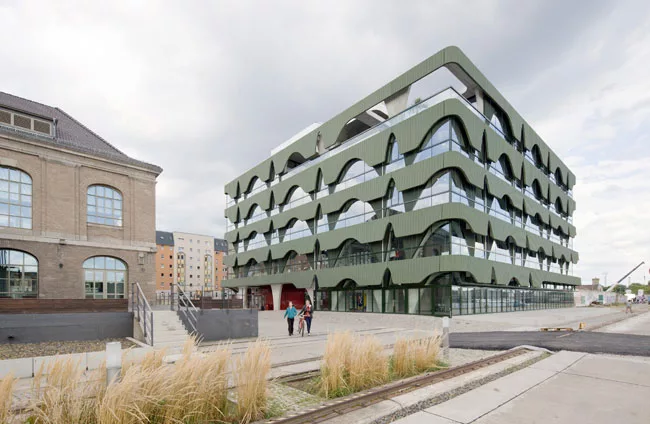
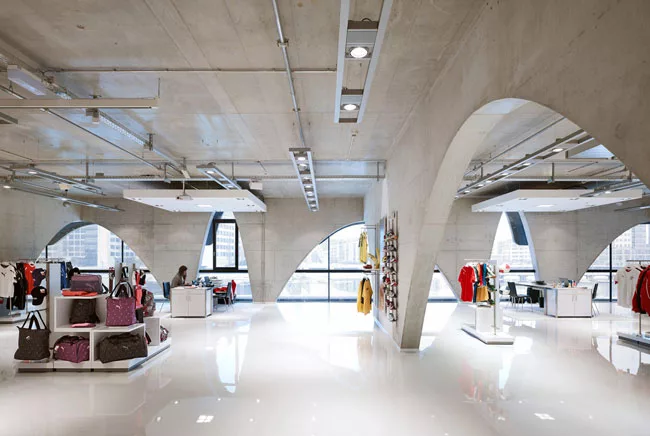
HHF won its largest project to date in a 2007 competition. Located along the Spree River in Berlin, the 71,000-square-foot Labels 2 Fashion Center, inaugurated in January 2010, houses two event spaces, a rooftop nightclub, and permanent showrooms for up to 30 international fashion brands in one building. HHF developed its design based on the adjacent Labels 1, a historic warehouse building whose facade is characterized by the repetition of arched windows. HHF's use of two differently cut sine curves generates the specific aesthetic for both the concrete structure and the facade, where a second, ornamental layer of concrete in the form of green, grooved, curtainlike arches partially conceal the windows behind them. The entire concrete structure is permeated with water tubes that both heat and cool the building. The one unique feature of the interior is a monumental, spiraling staircase. The rest of the interiors are kept neutral to allow individual showrooms to develop their own looks.
 
Photo © Iwan Baan
HHF Architects
Labels 2
 
HHF won its largest project to date in a 2007 competition. Located along the Spree River in Berlin, the 71,000-square-foot Labels 2 Fashion Center, inaugurated in January 2010, houses two event spaces, a rooftop nightclub, and permanent showrooms for up to 30 international fashion brands in one building. HHF developed its design based on the adjacent Labels 1, a historic warehouse building whose facade is characterized by the repetition of arched windows. HHF's use of two differently cut sine curves generates the specific aesthetic for both the concrete structure and the facade, where a second, ornamental layer of concrete in the form of green, grooved, curtainlike arches partially conceal the windows behind them. The entire concrete structure is permeated with water tubes that both heat and cool the building. The one unique feature of the interior is a monumental, spiraling staircase. The rest of the interiors are kept neutral to allow individual showrooms to develop their own looks.
 
Photo © Christian Gahl
HHF Architects
HHF Architects
HHF Architects
HHF Architects
HHF Architects
HHF Architects
HHF Architects
December 16, 2010

Architects & Firms

Herzog & de Meuron

The Swiss have long held a reputation for creating products of impeccable precision. Tilo Herlach, Simon Hartmann, and Simon Frommenwiler, partners in the Basel-based HHF Architects, have found early international success by turning that stereotype on its head. That’s not a knock on the firm’s work. In the short time since the opening of their studio in 2003, the young trio’s focus on simple, straightforward, and buildable design, rather than a fastidious attention to detail on projects whose construction they had very little control over, has helped them swiftly complete eye-catching structures in Europe, Mexico, the United States, and China.

Among the first of these projects was a children’s pavilion, Baby Dragon, built in 2006 in Jinhua, China. HHF had been recommended by Jacques Herzog and Pierre de Meuron — those other Basel-based architects — to prominent artist Ai Weiwei, who invited over a dozen young, international designers to create structures for a park in memory of his father, the poet Ai Qing. The Swiss newcomers and the Chinese impresario hit it off and began collaborating on a number of projects. Together they completed the Tsai Residence and Artfarm, a private home and a gallery in upstate New York for two different collectors of contemporary Chinese art. For Ai’s Ordos 100 project in Inner Mongolia, HHF is the only firm to design two houses, one of which is finishing up construction.

HHF recognizes that collaboration, both with well-known figures and with other young architects, has been a key to its success. Working on the Jinhua and Ordos projects gave HHF the opportunity to meet colleagues from around the world. “For Ordos, there were over 200 architects gathered together in the middle of nowhere,” says Frommenwiler. “We did a lot of talking over table tennis.” They struck up a friendship with Mexican architect Tatiana Bilbao (Vanguard 2007), which led to a design for a lookout point along Mexico’s Ruta del Peregrino pilgrimage route. As with Baby Dragon, HHF combined simple concrete construction with tantalizing geometry to create a stunning pavilion in a far-off land.

A similar approach led to a competition win for the firm’s largest project to date, the Labels 2 Fashion Center, completed earlier this year in Berlin. Its striking simplicity and completely fresh form are a large part of its appeal. Though HHF focuses on uncomplicated design, the firm does not shy away from the ornamental. With Labels 2, it reinvented the run-of-the-mill warehouse building with what appear to be permanent, albeit sinuous, drapes cascading over the facades’ straightforward windows.

For work that is closer to home, HHF relies on a different strategy. Tackling the renovation of Confiserie Bachmann, a celebrated chocolate shop and café in Basel, HHF oversaw all aspects of the design, including furniture, fixtures, and finishes, to give the historic brand a contemporary look. In a project closer to their hearts, Herlach, Hartmann, and Frommenwiler converted a former factory building into their new offices. Everything, even detailed touch-up work, was carefully carried out in order to maintain the industrial character of the building while providing a bright, open space for the growing studio.

HHF Architects

LOCATION: Basel, Switzerland

FOUNDED: 2003

DESIGN STAFF: 12

PRINCIPALS: Simon Hartmann (left), Simon Frommenwiler (center), Tilo Herlach (right)

EDUCATION: Hartmann — dipl.Arch., ETH Lausanne, TU Berlin, and ETH Zurich, 2000. Frommenwiler — dipl.Arch., ETH Zurich, 2000. Herlach — dipl.Arch., ETH Zurich and ETH Lausanne, 1998

WORK HISTORY: Hartmann — Rolf Furrer Architekten, Basel, 2000–03. Frommenwiler — Skidmore, Owings & Merrill, New York, 2001–03; ARchos Architektur, Basel, 2000–01; Bearth & Deplazes, Chur, Switzerland, 1997. Herlach — Rolf Furrer Architekten, Basel, 2001–03; d-company, Bern, Switzerland, 1998–2001

KEY COMPLETED PROJECTS: Lookout Point for Ruta del Peregrino, Mexico, 2010; Labels 2 Fashion Center, Berlin, 2010; Confiserie Bachmann, Basel, 2009; Artfarm, Salt Point, N.Y., and Tsai Residence, Ancram, N.Y., 2008 (both in collaboration with Ai Weiwei); Kirschgarten cafeteria, Basel, 2008; Infopoints for SBB Swiss Railways, throughout Switzerland, 2007; Restaurant Bar ONO, Basel, 2007; Baby Dragon, Jinhua Architecture Park, Jinhua, China, 2006

KEY CURRENT PROJECTS: Dune House, 2010, Ordos, China; Studio Tsai, Ancram, N.Y., 2011 (with Ai Weiwei); Five Houses, Long Island, N.Y., date to be determined (with Ai Weiwei); HHF House, Ordos, Inner Mongolia, China, 2012; Apartment building Byfangweg, Basel, 2013

WEB SITE: www.hhf.ch

 
KEYWORDS: Switzerland

Share This Story

Looking for a reprint of this article?
From high-res PDFs to custom plaques, order your copy today!

Josephine minutillo

Josephine Minutillo is editor in chief of Architectural Record. Trained as an architect, she began writing for RECORD in 2001 while practicing architecture, and has held several positions at the magazine over the past two decades. Her articles have appeared in many international publications. She has been an invited critic at Washington University in St. Louis, The Cooper Union, Columbia GSAPP, Pratt Institute, The City College of New York, and Yale University.
Instagram: @josephineminutillo_

Post a comment to this article

Report Abusive Comment

Subscription Center
  • Create an Account
  • Start a Subscription
  • Manage My Account
  • Sign Up for Newsletters
  • Visit Customer Service
  • Update Preferences

More Videos

Sponsored Content

Sponsored Content is a special paid section where industry companies provide high quality, objective, non-commercial content around topics of interest to the Architectural Record audience. All Sponsored Content is supplied by the advertising company and any opinions expressed in this article are those of the author and not necessarily reflect the views of Architectural Record or its parent company, BNP Media. Interested in participating in our Sponsored Content section? Contact your local rep!

close
  • cold storage facility
    Sponsored byCarlisle SynTec Systems

    How Architects Can Design More Continuous Cold Storage Envelopes

  • TAMLYN XtremeTrim Exterior Trim
    Sponsored byTamlyn

    Designing Cleaner Panel Facades: Why Exterior Trim Details Matter

  • Building with Vapor Barriers
    Sponsored byReef Industries, Inc.

    Vapor Barriers Help Control Moisture in Tighter Building Designs

DESIGN:ED Podcast
Listen to Architectural Record’s DESIGN:ED Podcast

Events

June 23, 2026

Enhancing Fire Resistance with Advanced PVC Solutions

Credits: 1 AIA LU/HSW; 1 AIBD P-CE; 0.1 ICC CEU; 1 IIBEC CEH

Evaluate advanced PVC solutions that improve fire resistance, support WUI compliance, and enhance resilience in residential and commercial building design.

June 25, 2026

Designing Glass Railing Systems that Enhance Aesthetics and Meet Code

Credits: 1 AIA LU/HSW; 1 AIBD P-CE; 0.1 ICC CEU

Upon course completion, participants will possess a deeper understanding of glass railings to help ensure that safety, aesthetic, and performance objectives are achieved.

View All Submit An Event

Products

2026 Architect's Square Foot Costbook

2026 Architect's Square Foot Costbook

See More Products

Popular Stories

Lorcan O' Herilhy

California Architect Lorcan O’Herlihy Has Died, Age 66

Obama Presidential Center, Chicago

The Obama Presidential Center Opens on Chicago’s South Side

Spoonbill Ranch

Johnsen Schmaling Architects Integrates Spoonbill Ranch into a Pristine Landscape

West Village Penthouse

Design Vanguard 2026: Brent Buck Architects

Trinity University Business & Humanities District

AIA Announces 2026 COTE Top Ten Awardees

Enhancing Fire Resistance with Advanced PVC Solutions - Free Webinar - June 23, 2026

Related Articles

  • Mirror Point Cottage

    Mirror Point Cottage by MacKay-Lyons Sweetapple Architects

    See More
  • Grafton Architects Arkansas

    Grafton Architects to Design Applied Research Center for University of Arkansas

    See More
  • Ed Kaplan Family Institute

    Ed Kaplan Family Institute for Innovation and Tech Entrepreneurship by John Ronan Architects

    See More
×

The latest news and information

#1 Source for Architectural Design, News and Products

SUBSCRIBE
  • RESOURCES
    • Advertise
    • Contact Us
    • Submit
    • Store
  • ACCOUNT CENTER
    • Create an Account
    • Start a Subscription
    • Manage My Account
    • Sign Up for Newsletters
    • Visit Customer Service
    • Update Preferences
  • PRIVACY
    • PRIVACY POLICY
    • TERMS & CONDITIONS
    • DO NOT SELL MY PERSONAL INFORMATION
    • PRIVACY REQUEST
    • ACCESSIBILITY
  • SERVICES
    • Marketing Services
    • Reprints
    • Market Research
    • List Rental
    • Survey/Respondent Access
  • STAY CONNECTED
    • Linkedin
    • Facebook
    • Instagram
    • YouTube
    • X (Twitter)

Copyright ©2026. All Rights Reserved BNP Media, Inc. and BNP Media II, LLC.

Design, CMS, Hosting & Web Development :: ePublishing