Architectural Record
search
cart
facebook twitter linkedin youtube
  • Sign In
  • Subscribe
  • Sign Out
  • My Account
Architectural Record
  • NEWS
    • Latest News
    • Awards
    • Interviews
    • Obituaries
    • Podcasts
      • Design:Ed Podcast
      • Sponsored Podcasts
  • OPINION
    • Book Reviews / Excerpts
    • Exhibition Reviews
    • Forum
  • EXCLUSIVES
    • Videos
    • Design Vanguard
    • Top 300 Firms
    • Sponsored Content
    • Sponsored eBooks
    • From the Archives
  • CONTINUING ED
    • Editorial Continuing Ed
    • CE Center
    • CE Academies
  • PROJECTS
    • Buildings By Type
    • Reuse & Renovation
    • Museums & Arts Centers
    • Colleges & Universities
    • Multifamily Housing
    • Interiors
    • Lighting
    • Kitchen & Bath
  • HOUSES
    • Record Houses
    • House of the Month
    • Featured Houses
  • PRODUCTS
    • Products by Category
    • Record Products of the Year
    • Latest Products
  • EVENTS
    • Dates & Events
    • Record on the Road
    • Innovation Conference
    • Sustainability in Practice
    • Women In Architecture
    • Webinars
    • Ad Excellence Awards
    • Submit an Event
  • CONNECT
    • Ask RECORD AI
    • Newsletters
    • Contact
    • Advertise
    • Editorial Calendar
    • Store
    • Customer Service
  • SUBMIT
    • Submission Guidelines
    • RECORD Competitions
  • MAGAZINE
    • Subscribe
    • My Account
    • Digital Edition
    • Current Issue
    • Firm Pass
    • Historic Archive
Design Vanguard

Standardarchitecture

This firm pursues multiple narratives in projects of very different scales, attitudes, and settings.

By Aric Chen
The French-Chinese art Center in Wuhan was conceived as an 'urban container' that would serve as a cultural facility and public space. Its location across the street from the city's Tanhualin historic
French-Chinese Art Center
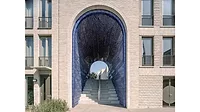
The French-Chinese art Center in Wuhan was conceived as an 'urban container' that would serve as a cultural facility and public space. Its location across the street from the city's Tanhualin historic district, where many intellectuals once lived, inspired Standard to look to traditional Chinese artistic practices ' in this case, ink drawings, expressed in the brushstrokelike articulation of the buildings' concrete walls. Just as significant as the cultural context, however, were the physical parameters, which included the unexpected discovery of a flood tunnel bisecting the site. In response, the architects divided the complex into two exhibition halls with a plaza directly above the tunnel. To connect the halls, the firm devised a 260-foot-long bridge ' a hollow 18-foot-tall concrete tube whose brushstroke patterns coincide with the structural requirements of the reinforced-concrete span. 'One of the most interesting aspects of this project was how urban infrastructure played a role here,' says Zhang Ke. 'The discovery of the flood tunnel created a problem, but then the problem generated this floating footbridge, which has become one of the hallmarks.'
Photo © Chen Su
The French-Chinese art Center in Wuhan was conceived as an 'urban container' that would serve as a cultural facility and public space. Its location across the street from the city's Tanhualin historic
French-Chinese Art Center
The French-Chinese art Center in Wuhan was conceived as an 'urban container' that would serve as a cultural facility and public space. Its location across the street from the city's Tanhualin historic district, where many intellectuals once lived, inspired Standard to look to traditional Chinese artistic practices ' in this case, ink drawings, expressed in the brushstrokelike articulation of the buildings' concrete walls. Just as significant as the cultural context, however, were the physical parameters, which included the unexpected discovery of a flood tunnel bisecting the site. In response, the architects divided the complex into two exhibition halls with a plaza directly above the tunnel. To connect the halls, the firm devised a 260-foot-long bridge ' a hollow 18-foot-tall concrete tube whose brushstroke patterns coincide with the structural requirements of the reinforced-concrete span. 'One of the most interesting aspects of this project was how urban infrastructure played a role here,' says Zhang Ke. 'The discovery of the flood tunnel created a problem, but then the problem generated this floating footbridge, which has become one of the hallmarks.'
Photo © Chen Su
The French-Chinese art Center in Wuhan was conceived as an 'urban container' that would serve as a cultural facility and public space. Its location across the street from the city's Tanhualin historic
French-Chinese Art Center
The French-Chinese art Center in Wuhan was conceived as an 'urban container' that would serve as a cultural facility and public space. Its location across the street from the city's Tanhualin historic district, where many intellectuals once lived, inspired Standard to look to traditional Chinese artistic practices ' in this case, ink drawings, expressed in the brushstrokelike articulation of the buildings' concrete walls. Just as significant as the cultural context, however, were the physical parameters, which included the unexpected discovery of a flood tunnel bisecting the site. In response, the architects divided the complex into two exhibition halls with a plaza directly above the tunnel. To connect the halls, the firm devised a 260-foot-long bridge ' a hollow 18-foot-tall concrete tube whose brushstroke patterns coincide with the structural requirements of the reinforced-concrete span. 'One of the most interesting aspects of this project was how urban infrastructure played a role here,' says Zhang Ke. 'The discovery of the flood tunnel created a problem, but then the problem generated this floating footbridge, which has become one of the hallmarks.'
Photo © Chen Su
Set in a spectacular region of Tibet, the Yalu Tsangpo River Boat Terminal (2008) is the farthest one can go via boat to the foot of Namcha Barwa mountain, the eastern anchor of the Himalayas. A serie
Yalu Tsangpo River Boat Terminal
Set in a spectacular region of Tibet, the Yalu Tsangpo River Boat Terminal (2008) is the farthest one can go via boat to the foot of Namcha Barwa mountain, the eastern anchor of the Himalayas. A series of ramps wind from the river's edge around poplar trees, then over and through a structure housing a waiting lounge, ticket office, toilets, and lodgings. The ramp terminates on the roof, where it projects over the water. Standard sought to create a work of contemporary architecture that would blend into the natural landscape, so the structure uses mostly indigenous materials. Walls and roofs were built of rocks gathered nearby by Tibetan masons, who determined the stones' patterns, while cabinetry and floors were made of local timber.
Photo © Chen Su
Situated at the start of a scenic drive in Tibet, between a road and a river, the Niyang River Visitor Center (2009) houses a ticket office, a changing room for rafting, and toilets. Like other Standa
Niyang River Visitor Center
Situated at the start of a scenic drive in Tibet, between a road and a river, the Niyang River Visitor Center (2009) houses a ticket office, a changing room for rafting, and toilets. Like other Standardarchitecture projects in Tibet, it is built of local stone and timber beams, and has thick walls with deep recesses. The building's angled geometry was a response to the site boundaries, while its four entry points ' one on each side ' accommodate circulation needs, merging at an open central courtyard carved out from the main volume. In contrast to the exterior walls, this inner void is painted in mineral-derived pigments of bright blue, orange, and red to create a visual effect that shifts as one glimpses it through the building's various openings and at various times of day. Zhang Ke wanted to reference the importance of color in Tibetan culture ' though in this case, he stresses, the hues hold no symbolic meaning. 'We want to create an equal standpoint where we're neither ignoring Tibetan culture nor imitating it,' says Zhang Ke. 'The building had to have an autonomous beauty within itself.'
Photo © Chen Su
Situated at the start of a scenic drive in Tibet, between a road and a river, the Niyang River Visitor Center (2009) houses a ticket office, a changing room for rafting, and toilets. Like other Standa
Niyang River Visitor Center
Situated at the start of a scenic drive in Tibet, between a road and a river, the Niyang River Visitor Center (2009) houses a ticket office, a changing room for rafting, and toilets. Like other Standardarchitecture projects in Tibet, it is built of local stone and timber beams, and has thick walls with deep recesses. The building's angled geometry was a response to the site boundaries, while its four entry points ' one on each side ' accommodate circulation needs, merging at an open central courtyard carved out from the main volume. In contrast to the exterior walls, this inner void is painted in mineral-derived pigments of bright blue, orange, and red to create a visual effect that shifts as one glimpses it through the building's various openings and at various times of day. Zhang Ke wanted to reference the importance of color in Tibetan culture ' though in this case, he stresses, the hues hold no symbolic meaning. 'We want to create an equal standpoint where we're neither ignoring Tibetan culture nor imitating it,' says Zhang Ke. 'The building had to have an autonomous beauty within itself.'
Photo © Chen Su
Completed in 2007, this project is a clubhouse for a residential development near the base of a well-known mountain outside the city of Chengdu. Adding a twist to China's time-honored courtyard-house
Qingcheng Mountain Teahouse
Completed in 2007, this project is a clubhouse for a residential development near the base of a well-known mountain outside the city of Chengdu. Adding a twist to China's time-honored courtyard-house typology, it is, in fact, a succession of five structures ' three tearoom courtyards bracketed by entry and guesthouse courtyards ' that appear to be compressed together. Zhang Ke explains, 'We wanted not only to play with the traditional courtyard spatial sequence but also to create a place for local craftsmen.' Accordingly, carpenters from the area were invited to help design and build the facility's timber roofs using vernacular techniques that, due to the buildings' attenuated forms, produced an elegantly distorted result.
Photo © Chen Su
Completed in 2007, this project is a clubhouse for a residential development near the base of a well-known mountain outside the city of Chengdu. Adding a twist to China's time-honored courtyard-house
Qingcheng Mountain Teahouse
Completed in 2007, this project is a clubhouse for a residential development near the base of a well-known mountain outside the city of Chengdu. Adding a twist to China's time-honored courtyard-house typology, it is, in fact, a succession of five structures ' three tearoom courtyards bracketed by entry and guesthouse courtyards ' that appear to be compressed together. Zhang Ke explains, 'We wanted not only to play with the traditional courtyard spatial sequence but also to create a place for local craftsmen.' Accordingly, carpenters from the area were invited to help design and build the facility's timber roofs using vernacular techniques that, due to the buildings' attenuated forms, produced an elegantly distorted result.
Photo © Chen Su
The theme of the 2009 Shenzhen & Hong Kong Bi-City Biennale of Architecture\Urbanism was 'City Mobilization.' So Standardarchitecture created Eggs of the City ' a pair of mobile living pods designed w
KTV House
The theme of the 2009 Shenzhen & Hong Kong Bi-City Biennale of Architecture\Urbanism was 'City Mobilization.' So Standardarchitecture created Eggs of the City ' a pair of mobile living pods designed with China's enormous population of young migrant workers in mind. Made of fiberglass, the playful egg-shaped units stood on the plaza of Shenzhen's civic center; one doubled as a bench with a small sleeping area inside, while the other served as a karaoke room. Both were purely experimental, but a third, more fully outfitted variation was later made of bamboo at Standard's office, by a firm member who, as of press time, had lived there full-time for more than three months.
Photo © Chen Su
The theme of the 2009 Shenzhen & Hong Kong Bi-City Biennale of Architecture\Urbanism was 'City Mobilization.' So Standardarchitecture created Eggs of the City ' a pair of mobile living pods designed w
Bench House
The theme of the 2009 Shenzhen & Hong Kong Bi-City Biennale of Architecture\Urbanism was 'City Mobilization.' So Standardarchitecture created Eggs of the City ' a pair of mobile living pods designed with China's enormous population of young migrant workers in mind. Made of fiberglass, the playful egg-shaped units stood on the plaza of Shenzhen's civic center; one doubled as a bench with a small sleeping area inside, while the other served as a karaoke room. Both were purely experimental, but a third, more fully outfitted variation was later made of bamboo at Standard's office, by a firm member who, as of press time, had lived there full-time for more than three months.
Photo © Chen Su
The French-Chinese art Center in Wuhan was conceived as an 'urban container' that would serve as a cultural facility and public space. Its location across the street from the city's Tanhualin historic
Set in a spectacular region of Tibet, the Yalu Tsangpo River Boat Terminal (2008) is the farthest one can go via boat to the foot of Namcha Barwa mountain, the eastern anchor of the Himalayas. A serie
Situated at the start of a scenic drive in Tibet, between a road and a river, the Niyang River Visitor Center (2009) houses a ticket office, a changing room for rafting, and toilets. Like other Standa
Completed in 2007, this project is a clubhouse for a residential development near the base of a well-known mountain outside the city of Chengdu. Adding a twist to China's time-honored courtyard-house
The theme of the 2009 Shenzhen & Hong Kong Bi-City Biennale of Architecture\Urbanism was 'City Mobilization.' So Standardarchitecture created Eggs of the City ' a pair of mobile living pods designed w
December 16, 2010

Beijing, China

When architect Zhang Ke set up Standardarchitecture in Beijing, he chose the name because “it sounds neutral. It doesn’t imply any specific form,” he says. But for a studio that’s on a roll, in a country stuck in fast-forward, perhaps it’s equally fitting that the firm recently adopted the shorter alias START (as in Standard Architecture Team). “For every project, we want a completely new start, to throw off all preconceptions — like we’re almost pretending we don’t know anything,” says Zhang Ke. Founded in 2001, and now including partners Zhang Hong and Claudia Taborda (a Lisbon-based landscape architect), Standard is positioned at the forefront of China’s latest generation of emerging architects. It takes each brief as a new point of departure — a series of existing givens — and has shown itself flexible enough to explore projects both massive and small, spectacular and understated.


In Tibet, for example, the firm has built a number of much-praised projects in the Yalu Tsangpo Grand Canyon region, including the Yalu Tsangpo River Boat Terminal (2008), the Niyang River Visitor Center (2009), and the forthcoming Niangou Wharf. Quietly emerging from a landscape of dramatic mountains and pristine water, these modest projects consist of austere pavilions and meandering ramps constructed from locally gathered stone and timber. “They’re like experiments in how we can make contemporary architecture that feels like it’s actually growing out of the place,” Zhang Ke says.

On the other end of the spectrum, Standard has proposed a pair of 525-foot-tall skyscrapers of unevenly stacked floors, called the Dancing Books Towers, and has imagined enormous buildings that double as terraced rice paddies in Hong Kong. For this year’s inaugural Audi Urban Future Award, for which Standard was the only Chinese finalist, Zhang Ke suggested transforming Beijing’s main Ring Road arteries into giant conveyor belts for cars. “We focus a lot on the use of materials, but also urban spaces,” says Zhang Ke, 40, who holds master’s degrees from Harvard and from Beijing’s Tsinghua University. “We’re not bound by what’s already established or what’s known.”

The firm got its big break in 2001, when it won a competition to design a park around the ruins of Beijing’s Ming Dynasty city walls. Since then, Standard has stood out not so much for one thing — radical forms, a consistent methodology, an easily articulated polemic — but rather for its multifarious approaches. Its French-Chinese Art Center, in Wuhan, China, includes two angled cultural buildings connected by a 260-foot-long bridge, their concrete forms suggesting the brushstrokes of a Chinese scholar. Its Eggs of the City project for last year’s Shenzhen & Hong Kong Bi-City Biennale of Urbanism\Architecture proposed mobile living pods for migrant workers, using playful forms that immediately engage all kinds of people.

In many ways, Standardarchitecture tellingly reflects the current Chinese condition: Singular narratives are inadequate here, in a country undergoing enormous flux. There’s a need for subtlety as well as daring, for cultural continuity as well as breakaway change — in short, a neutral stance that offers the flexibility to experiment in divergent ways, plus an open-ended belief that anything is possible. “It’s a process of daydreaming,” Zhang Ke says of the firm’s work, “but at the same time it’s about realization, to bring these seemingly impossible things to life.”

Standardarchitecture

LOCATION:Beijing, China

FOUNDED: 2001

DESIGN STAFF: 25

PRINCIPALS: Zhang Hong (left), Zhang Ke (center), Claudia Taborda (right)

EDUCATION: Zhang Hong — Tsinghua, M.Arch., 1999; Southeast University, B.Arch., 1990. Zhang Ke — Harvard, M.Arch., 1998; Tsinghua, M.Arch., 1996; Tsinghua, B.Arch., 1993. Taborda — Harvard, M.L.A., 1999; University of York, M. Conservation Studies, 1991; University of Evora, Portugal, B.L.A., 1990

WORK HISTORY: Zhang Hong — Architectural Research & Design Institute of Tsinghua University, Beijing, 1999–2004. Zhang Ke — Zhang Ke Studio, New York, 1998–2001. Taborda — Global Arquitectura Paisagista, Lisbon, 1993–2005; Taba Arquitectos, Oeiras, Portugal, 1991–92

COMPLETED PROJECTS: Grand Canyon Museum and Restaurant, Tibet, 2010; Eggs of the City, Shenzhen, 2010; De Cafe, Beijing, 2009; Niyang River Visitor Center, Tibet, 2009; Yalu Tsangpo River Boat Terminal, Tibet, 2008; French-Chinese Art Center, Wuhan, 2005

CURRENT PROJECTS: Municipal Meeting Center, Beijing, 2010; Sports Club, Wuxi, 2011; “Ming” tray design for Alessi, 2011; Vanke Twin Towers, Tianjin, 2011; Elementary School, Quanzhou, 2012; Civic and Education Center, Jiading, 2012; Novartis Campus Building, Shanghai, 2014

WEB SITES: www.standardarchitecture.cn — www.star-t.cn


Share This Story

Looking for a reprint of this article?
From high-res PDFs to custom plaques, order your copy today!
Aric Chen is director of the Nieuwe Instituut in Rotterdam.

Post a comment to this article

Report Abusive Comment

Subscription Center
  • Create an Account
  • Start a Subscription
  • Manage My Account
  • Sign Up for Newsletters
  • Visit Customer Service
  • Update Preferences

More Videos

Sponsored Content

Sponsored Content is a special paid section where industry companies provide high quality, objective, non-commercial content around topics of interest to the Architectural Record audience. All Sponsored Content is supplied by the advertising company and any opinions expressed in this article are those of the author and not necessarily reflect the views of Architectural Record or its parent company, BNP Media. Interested in participating in our Sponsored Content section? Contact your local rep!

close
  • TAMLYN XtremeTrim Exterior Trim
    Sponsored byTamlyn

    Designing Cleaner Panel Facades: Why Exterior Trim Details Matter

  • Building with Vapor Barriers
    Sponsored byReef Industries, Inc.

    Vapor Barriers Help Control Moisture in Tighter Building Designs

  • Duct Interior with Prodeq System
    Sponsored byHenry, a Carlisle Company

    Designing Resilient Water Containment Systems

DESIGN:ED Podcast
Listen to Architectural Record’s DESIGN:ED Podcast

Events

June 16, 2026

Focus on the Façade: Exploring Steel, Timber & Fire-Rated Curtain Walls and Channel Glass Systems

Credits: 1 AIA LU/HSW; 1 AIBD P-CE; 0.1 ICC CEU

Explore modern façade and glazing systems that enhance daylighting, fire safety, and thermal performance while expanding architectural design possibilities.

June 18, 2026

Rebooting the Aging Office Building

Credits: 1 AIA LU/HSW; 1 AIBD P-CE; 0.1 ICC CEU; 1 PDH

Explore façade retrofit strategies and award-winning design concepts that can transform aging office buildings into healthier, higher-performing workplaces for today’s hybrid workforce.

View All Submit An Event

Products

2026 Architect's Square Foot Costbook

2026 Architect's Square Foot Costbook

See More Products

Popular Stories

Coronado Bridge

The Architect’s Guide to San Diego

SanDiegoAirport

Top 300 Architecture Firms of 2026

Crane Cove, ONO

Design Vanguard 2026 Winners

House on a Hill

Design Vanguard 2026: Forma

House A on a Hill

Design Vanguard 2026: Santiago Valdivieso

Focus on the Facade - Free Webinar - June 16, 2026

Related Articles

  • New Delft Blue

    Design Vanguard 2024: Studio RAP

    See More
  • The kindergarten at the Qingpu Pinghe International School.

    Qingpu Pinghe International School by OPEN Architecture

    See More
  • Design Vanguard 2010 Features

    See More
×

The latest news and information

#1 Source for Architectural Design, News and Products

SUBSCRIBE
  • RESOURCES
    • Advertise
    • Contact Us
    • Submit
    • Store
  • ACCOUNT CENTER
    • Create an Account
    • Start a Subscription
    • Manage My Account
    • Sign Up for Newsletters
    • Visit Customer Service
    • Update Preferences
  • PRIVACY
    • PRIVACY POLICY
    • TERMS & CONDITIONS
    • DO NOT SELL MY PERSONAL INFORMATION
    • PRIVACY REQUEST
    • ACCESSIBILITY
  • SERVICES
    • Marketing Services
    • Reprints
    • Market Research
    • List Rental
    • Survey/Respondent Access
  • STAY CONNECTED
    • Linkedin
    • Facebook
    • Instagram
    • YouTube
    • X (Twitter)

Copyright ©2026. All Rights Reserved BNP Media, Inc. and BNP Media II, LLC.

Design, CMS, Hosting & Web Development :: ePublishing