Architectural Record
search
cart
facebook twitter linkedin youtube
  • Sign In
  • Subscribe
  • Sign Out
  • My Account
Architectural Record
  • NEWS
    • Latest News
    • Awards
    • Interviews
    • Obituaries
    • Podcasts
      • Design:Ed Podcast
      • Sponsored Podcasts
  • OPINION
    • Book Reviews / Excerpts
    • Exhibition Reviews
    • Forum
  • EXCLUSIVES
    • Videos
    • Design Vanguard
    • Top 300 Firms
    • Sponsored Content
    • Sponsored eBooks
    • From the Archives
  • CONTINUING ED
    • Editorial Continuing Ed
    • CE Center
    • CE Academies
  • PROJECTS
    • Buildings By Type
    • Reuse & Renovation
    • Museums & Arts Centers
    • Colleges & Universities
    • Multifamily Housing
    • Interiors
    • Lighting
    • Kitchen & Bath
  • HOUSES
    • Record Houses
    • House of the Month
    • Featured Houses
  • PRODUCTS
    • Products by Category
    • Record Products of the Year
    • Latest Products
  • EVENTS
    • Dates & Events
    • Record on the Road
    • Innovation Conference
    • Sustainability in Practice
    • Women In Architecture
    • Webinars
    • Ad Excellence Awards
    • Submit an Event
  • CONNECT
    • Ask RECORD AI
    • Newsletters
    • Contact
    • Advertise
    • Editorial Calendar
    • Store
    • Customer Service
  • SUBMIT
    • Submission Guidelines
    • RECORD Competitions
  • MAGAZINE
    • Subscribe
    • My Account
    • Digital Edition
    • Current Issue
    • Firm Pass
    • Historic Archive
Design Vanguard

Johnsen Schmaling Architects

An enterprising duo explores materials and context in a series of projects that make big statements on a small scale.
By Asad Syrkett
Johnsen Schmaling Architects
 
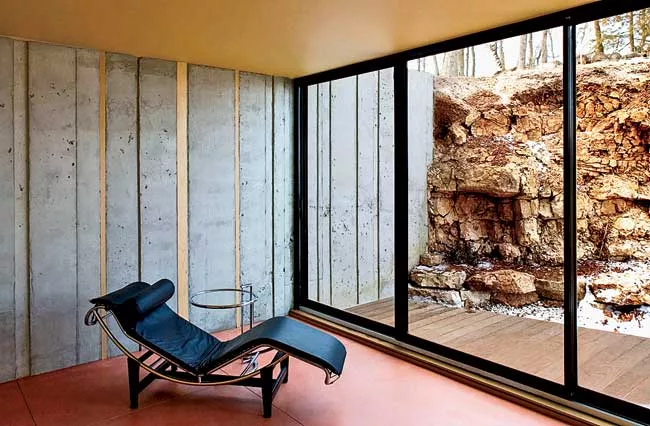
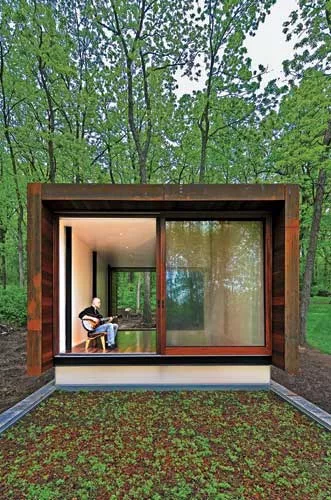
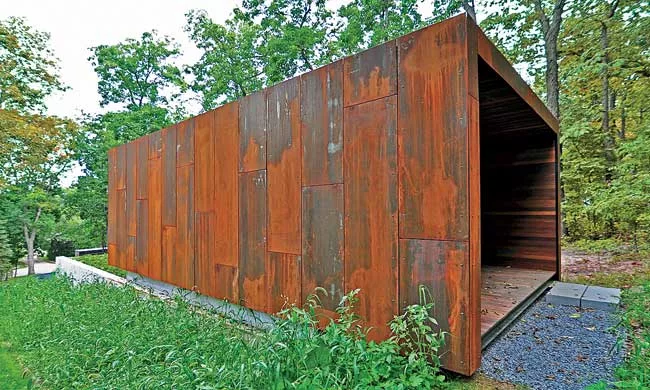
For a country-music composer, the duo created a 300-square-foot studio and retreat. The project sits atop a concrete plinth carved into the hilly landscape. Soundproof interiors are contained in a weathering-steel envelope that receives some of its aesthetic charm from natural forces: The effects of gradual oxidization produce a marbled pattern on the facade. Light enters the open space through large windows on either end of the boxlike volume, and a covered porch on the studio's southern end creates an outdoor room for casual music composition.
 
Photo © John J. Macaulay
Johnsen Schmaling Architects
 
For a country-music composer, the duo created a 300-square-foot studio and retreat. The project sits atop a concrete plinth carved into the hilly landscape. Soundproof interiors are contained in a weathering-steel envelope that receives some of its aesthetic charm from natural forces: The effects of gradual oxidization produce a marbled pattern on the facade. Light enters the open space through large windows on either end of the boxlike volume, and a covered porch on the studio's southern end creates an outdoor room for casual music composition.
 
Photo © John J. Macaulay
Johnsen Schmaling Architects
 
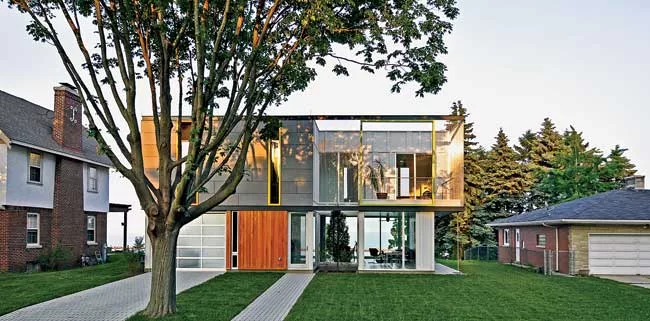
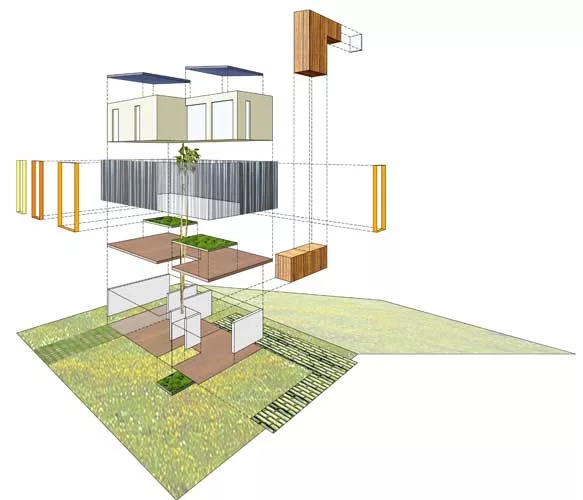
The architects designed this 1,948-square-foot LEED Platinum house, built on an infill lot in a historic neighborhood in Racine, Wisconsin, for a young family. Completed in May 2010, it employs a series of sustainable strategies, including PV panels on the roof and in the backyard. Because the structure is sited along the shores of Lake Michigan, Johnsen and Schmaling set out to emphasize the visual and spatial relationship between the house and the water, creating a transparent, glazed main level and a protruding window box on the second floor. They also cut a series of outdoor spaces from the building volume, creating an open-air entry court, a ground-level terrace, and a second-story patio fronted in slender aluminum columns. Windows are framed in punchy, colored steel, adding to the graphic aesthetic of the facade.
 
Photo © John J. Macaulay
Johnsen Schmaling Architects
 
The architects designed this 1,948-square-foot LEED Platinum house, built on an infill lot in a historic neighborhood in Racine, Wisconsin, for a young family. Completed in May 2010, it employs a series of sustainable strategies, including PV panels on the roof and in the backyard. Because the structure is sited along the shores of Lake Michigan, Johnsen and Schmaling set out to emphasize the visual and spatial relationship between the house and the water, creating a transparent, glazed main level and a protruding window box on the second floor. They also cut a series of outdoor spaces from the building volume, creating an open-air entry court, a ground-level terrace, and a second-story patio fronted in slender aluminum columns. Windows are framed in punchy, colored steel, adding to the graphic aesthetic of the facade.
 
Photo © John J. Macaulay
Johnsen Schmaling Architects
 
The architects designed this 1,948-square-foot LEED Platinum house, built on an infill lot in a historic neighborhood in Racine, Wisconsin, for a young family. Completed in May 2010, it employs a series of sustainable strategies, including PV panels on the roof and in the backyard. Because the structure is sited along the shores of Lake Michigan, Johnsen and Schmaling set out to emphasize the visual and spatial relationship between the house and the water, creating a transparent, glazed main level and a protruding window box on the second floor. They also cut a series of outdoor spaces from the building volume, creating an open-air entry court, a ground-level terrace, and a second-story patio fronted in slender aluminum columns. Windows are framed in punchy, colored steel, adding to the graphic aesthetic of the facade.
 
Photo © John J. Macaulay
Johnsen Schmaling Architects
 
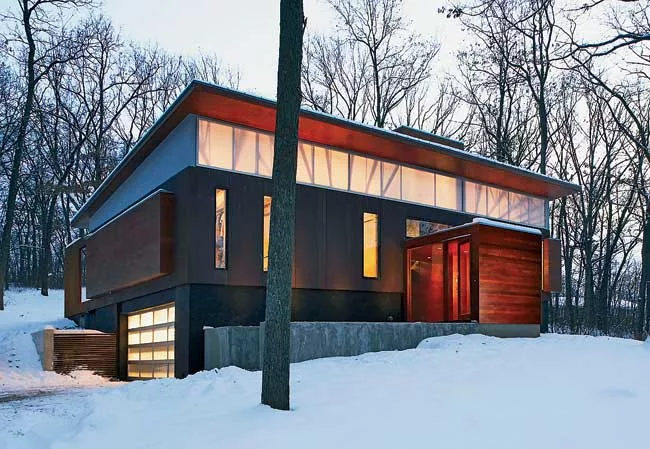
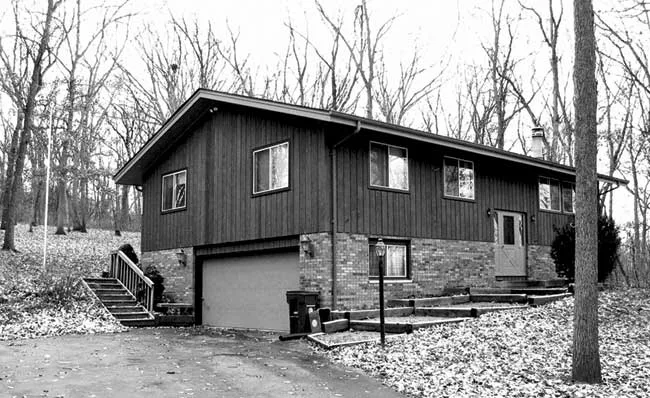
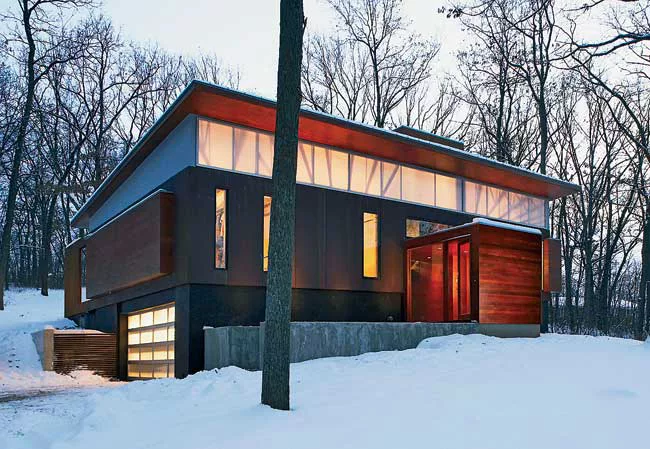
This 2008 project, named for the Cor-Ten steel panels that wrap around it, is a 1,450-square-foot residence for a young couple and their daughter. The house, which repurposes the original foundation and perimeter walls of a 1970s ranch, sits on the edge of a Wisconsin nature preserve. Exposed metal and engineered-lumber trusses support a canted roof, the angle of which adds height and light to the house's interiors. Johnsen and Schmaling aimed to maximize transparency, so they punched vertical slots in the entrance facade and used large windows along the back. As happens in many of their works, the surrounding environment influenced the final design. The nighttime glow emitted by local dairy barns, for example, inspired the band of windows under the house's angled roof.
 
Photo © John J. Macaulay
Johnsen Schmaling Architects
 
This 2008 project, named for the Cor-Ten steel panels that wrap around it, is a 1,450-square-foot residence for a young couple and their daughter. The house, which repurposes the original foundation and perimeter walls of a 1970s ranch, sits on the edge of a Wisconsin nature preserve. Exposed metal and engineered-lumber trusses support a canted roof, the angle of which adds height and light to the house's interiors. Johnsen and Schmaling aimed to maximize transparency, so they punched vertical slots in the entrance facade and used large windows along the back. As happens in many of their works, the surrounding environment influenced the final design. The nighttime glow emitted by local dairy barns, for example, inspired the band of windows under the house's angled roof.
 
Photo © John J. Macaulay
Johnsen Schmaling Architects
 
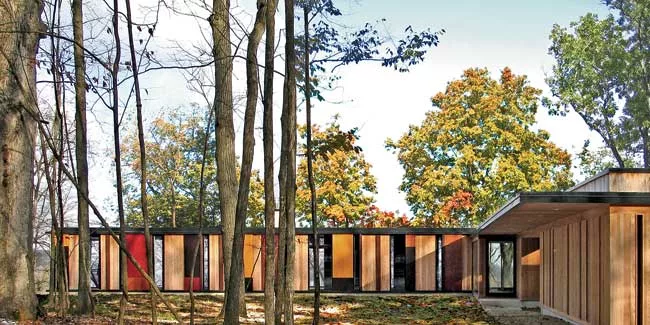
Autumn foliage inspired the polychrome facade of Camouflage House, a private residence for a family of four. Situated on a lakeside property, the 2,700-square-foot home sits lightly on a forested cliff. The facade, comprised of untreated cedar and colored, laminated-wood veneer, was designed with the elements in mind; over time, weathering will turn the cedar panels from brown to silver to match the tone of the stands of trees around the house. Collages of apertures along the house's northern and southern facades, and large windows on either end of the intersecting volumes, allow in daylight. Inside, seating clusters near these glazed areas, which permit views out to the landscape. The living/dining space can be extended or retracted, according to the wants of the user, by folding a glass door that separates the main living spaces from the screen porch.
 
Photo © John J. Macaulay
Johnsen Schmaling Architects
 
Autumn foliage inspired the polychrome facade of Camouflage House, a private residence for a family of four. Situated on a lakeside property, the 2,700-square-foot home sits lightly on a forested cliff. The facade, comprised of untreated cedar and colored, laminated-wood veneer, was designed with the elements in mind; over time, weathering will turn the cedar panels from brown to silver to match the tone of the stands of trees around the house. Collages of apertures along the house's northern and southern facades, and large windows on either end of the intersecting volumes, allow in daylight. Inside, seating clusters near these glazed areas, which permit views out to the landscape. The living/dining space can be extended or retracted, according to the wants of the user, by folding a glass door that separates the main living spaces from the screen porch.
 
Photo © John J. Macaulay
Johnsen Schmaling Architects
 
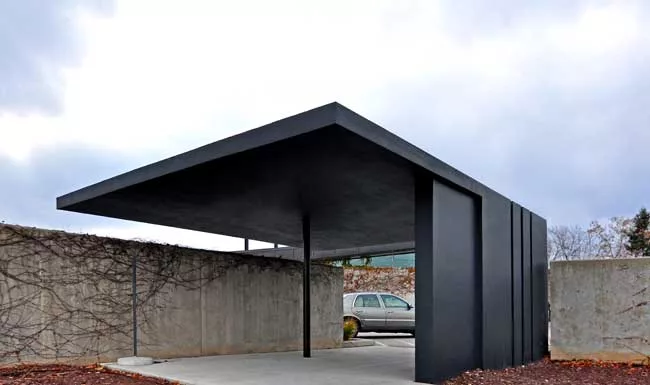
In 2008, the duo was commissioned to create a 315-square-foot entry pavilion for a suburban strip-mall parking lot. Their client, who owns a nearby burger joint and a custard stand, had purchased the adjacent lot once occupied by a gas station: a suburban trinity. The black, cast-in-place concrete pavilion sits in sharp contrast to the mostly beige commercial architecture around it. A small garden beside the structure collects rainwater, allowing a bit of green to thrive in a largely asphalt field. Vertical slots along one side of the building frame views of nearby stores. The aim, the architects say, was to offer respite from the sterility of the pavilion's surroundings.
 
Photo © John J. Macaulay
Johnsen Schmaling Architects
 
In 2008, the duo was commissioned to create a 315-square-foot entry pavilion for a suburban strip-mall parking lot. Their client, who owns a nearby burger joint and a custard stand, had purchased the adjacent lot once occupied by a gas station: a suburban trinity. The black, cast-in-place concrete pavilion sits in sharp contrast to the mostly beige commercial architecture around it. A small garden beside the structure collects rainwater, allowing a bit of green to thrive in a largely asphalt field. Vertical slots along one side of the building frame views of nearby stores. The aim, the architects say, was to offer respite from the sterility of the pavilion's surroundings.
 
Photo © John J. Macaulay
Johnsen Schmaling Architects
 
In 2008, the duo was commissioned to create a 315-square-foot entry pavilion for a suburban strip-mall parking lot. Their client, who owns a nearby burger joint and a custard stand, had purchased the adjacent lot once occupied by a gas station: a suburban trinity. The black, cast-in-place concrete pavilion sits in sharp contrast to the mostly beige commercial architecture around it. A small garden beside the structure collects rainwater, allowing a bit of green to thrive in a largely asphalt field. Vertical slots along one side of the building frame views of nearby stores. The aim, the architects say, was to offer respite from the sterility of the pavilion's surroundings.
 
Photo © John J. Macaulay
Johnsen Schmaling Architects
 
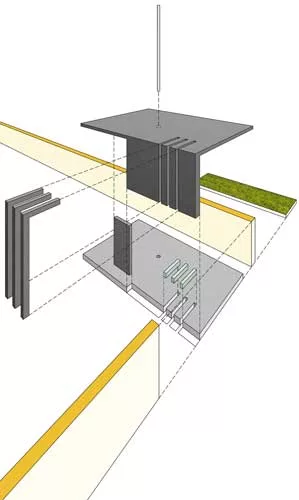
Image courtesy Johnsen Schmaling Architects
Johnsen Schmaling Architects

Johnsen Schmaling Architects

For a country-music composer, the duo created a 300-square-foot studio and retreat. The project sits atop a concrete plinth carved into the hilly landscape. Soundproof interiors are contained in a weathering-steel envelope that receives some of its aesthetic charm from natural forces: The effects of gradual oxidization produce a marbled pattern on the facade. Light enters the open space through large windows on either end of the boxlike volume, and a covered porch on the studio’s southern end creates an outdoor room for casual music composition.

Photo © John J. Macaulay

Johnsen Schmaling Architects
December 16, 2011

Milwaukee, Wisconsin

Sebastian Schmaling and Brian Johnsen describe their studio’s work as being “informed by a reading of site and terrain.” But don’t call it a philosophy. “We’ve always been suspicious of grandiose philosophical statements that can’t be backed up by an equally grandiose body of work,” says Schmaling. And grandiose the duo’s work is not. Since founding their four-person practice, Johnsen Schmaling Architects, in Milwaukee, Wisconsin in 2003, Johnsen, 39, and Schmaling, 40, have made a name for themselves by designing buildings of near-monastic simplicity. Proportion, material, and setting reign supreme in the twosome’s work, rather than showmanship or formal flamboyance. The result is a collection of buildings with a sense of place and an unfussy precision.

The two met in 1995, while in graduate school at the University of Wisconsin–Milwaukee, Wisconsin. After eight years of working together for a Milwaukee, Wisconsin-based firm, they decided to become business partners at their own firm. “We wanted more control over the design process,” Johnsen explains, “and to focus our attention on a set of architectural issues that we were interested in exploring more seriously.” Those issues include how materials age and how built work relates and responds to its context. In their work, the “context” is generally a suburban one: The firm’s Ferrous House, which rethinks the classic ranch, and its linear OS House both ask the old residential typology to do new tricks, creating open and transparent spaces inside and more direct connections to the outdoors.

Much of the studio’s work has thus far consisted of private residences and other small-scale projects. “Architectural significance transcends particular programs and building types. We’ve never felt that there’s a particular correlation between the scale and the quality of a project,” Schmaling says. Indeed, for a 300-square-foot musician’s studio, the pair packed a lot of program into a tight plan. The tiny, rectilinear structure has a soundproof studio, below-grade storage, a covered porch, and a casing of weathered-steel panels that wouldn’t look out of place on a much larger building for a cultural institution. “We think an architecture based on restraint is more appropriate now than ever,” Schmaling says.

In the years to come, Schmaling and Johnsen will finish a series of projects, such as sustainable infill housing in Kansas City, Missouri, and a residence that takes its stepped form from Wisconsin’s hilly Blue Mounds region. They also hope to increase the time they spend teaching and lecturing. Both have been adjunct professors at their alma mater, the University of Wisconsin–Milwaukee, Wisconsin, and visiting professors at the University of Toronto and the University of Oklahoma. “We started our office without a grand business plan or any far-fetched goals, except to create relevant architecture and survive while doing so,” Johnsen says. “We hope to keep working on projects that let us experiment, without partaking in the breathless competition for instant architectural gratification.”


Johnsen Schmaling Architects

LOCATION: Milwaukee, Wisconsin

FOUNDED: 2003

DESIGN STAFF: 4

PRINCIPALS: Sebastian Schmaling; Brian Johnsen

EDUCATION: Schmaling – Harvard GSD, MAUD, 2002, University of Wisconsin-Milwaukee, Wisconsin, M.Arch., 1996. Johnsen – University of Wisconsin–Milwaukee, Wisconsin, M. Arch., 1997, and BSAS, 1994

WORK HISTORY: Schmaling – Vetter Denk, Milwaukee, Wisconsin, 1996–2000, 2002–03. Johnsen – Vetter Denk, Milwaukee, Wisconsin, 1997–2002

KEY COMPLETED PROJECTS:  Studio for a Composer, Spring Prairie, Wi., 2011; OS House, Racine, Wi., 2010; Layton Pavilion, Greenfield, Wi., 2010; Downtown Bar, Milwaukee, Wisconsin, 2008; Ferrous House, East Troy, Wi., 2008; The Blatz, Milwaukee, Wisconsin, 2007; Camouflage House, Green Lake, Wi., 2007

KEY CURRENT PROJECTS: Topo House, Blue Mounds, Wi., 2012; Hilton Cafeteria, Milwaukee, Wisconsin, 2012; Cube House, Delafield, Wi., 2012; Mountain Retreat, Big Sky, Mt., 2013; Q House, Merton, Wi., 2013

WEB SITE: www.johnsenschmaling.com

Share This Story

Looking for a reprint of this article?
From high-res PDFs to custom plaques, order your copy today!

Post a comment to this article

Report Abusive Comment

Subscription Center
  • Create an Account
  • Start a Subscription
  • Manage My Account
  • Sign Up for Newsletters
  • Visit Customer Service
  • Update Preferences

More Videos

Sponsored Content

Sponsored Content is a special paid section where industry companies provide high quality, objective, non-commercial content around topics of interest to the Architectural Record audience. All Sponsored Content is supplied by the advertising company and any opinions expressed in this article are those of the author and not necessarily reflect the views of Architectural Record or its parent company, BNP Media. Interested in participating in our Sponsored Content section? Contact your local rep!

close
  • TAMLYN XtremeTrim Exterior Trim
    Sponsored byTamlyn

    Designing Cleaner Panel Facades: Why Exterior Trim Details Matter

  • Building with Vapor Barriers
    Sponsored byReef Industries, Inc.

    Vapor Barriers Help Control Moisture in Tighter Building Designs

  • Duct Interior with Prodeq System
    Sponsored byHenry, a Carlisle Company

    Designing Resilient Water Containment Systems

DESIGN:ED Podcast
Listen to Architectural Record’s DESIGN:ED Podcast

Events

June 16, 2026

Focus on the Façade: Exploring Steel, Timber & Fire-Rated Curtain Walls and Channel Glass Systems

Credits: 1 AIA LU/HSW; 1 AIBD P-CE; 0.1 ICC CEU

Explore modern façade and glazing systems that enhance daylighting, fire safety, and thermal performance while expanding architectural design possibilities.

June 18, 2026

Rebooting the Aging Office Building

Credits: 1 AIA LU/HSW; 1 AIBD P-CE; 0.1 ICC CEU; 1 PDH

Explore façade retrofit strategies and award-winning design concepts that can transform aging office buildings into healthier, higher-performing workplaces for today’s hybrid workforce.

View All Submit An Event

Products

2026 Architect's Square Foot Costbook

2026 Architect's Square Foot Costbook

See More Products

Popular Stories

SanDiegoAirport

Top 300 Architecture Firms of 2026

Coronado Bridge

The Architect’s Guide to San Diego

Crane Cove, ONO

Design Vanguard 2026 Winners

House on a Hill

Design Vanguard 2026: Forma

House A on a Hill

Design Vanguard 2026: Santiago Valdivieso

Focus on the Facade - Free Webinar - June 16, 2026

Related Articles

  • Johnson Schmaling Architects

    510 House by Johnsen Schmaling Architects

    See More
  • Broadway Housing

    Broadway Housing by Johnsen Schmaling Architects

    See More
  • Flex House.

    Flex House by Johnsen Schmaling Architects

    See More
×

The latest news and information

#1 Source for Architectural Design, News and Products

SUBSCRIBE
  • RESOURCES
    • Advertise
    • Contact Us
    • Submit
    • Store
  • ACCOUNT CENTER
    • Create an Account
    • Start a Subscription
    • Manage My Account
    • Sign Up for Newsletters
    • Visit Customer Service
    • Update Preferences
  • PRIVACY
    • PRIVACY POLICY
    • TERMS & CONDITIONS
    • DO NOT SELL MY PERSONAL INFORMATION
    • PRIVACY REQUEST
    • ACCESSIBILITY
  • SERVICES
    • Marketing Services
    • Reprints
    • Market Research
    • List Rental
    • Survey/Respondent Access
  • STAY CONNECTED
    • Linkedin
    • Facebook
    • Instagram
    • YouTube
    • X (Twitter)

Copyright ©2026. All Rights Reserved BNP Media, Inc. and BNP Media II, LLC.

Design, CMS, Hosting & Web Development :: ePublishing