Architectural Record
search
cart
facebook twitter linkedin youtube
  • Sign In
  • Subscribe
  • Sign Out
  • My Account
Architectural Record
  • NEWS
    • Latest News
    • Awards
    • Interviews
    • Obituaries
    • Podcasts
      • Design:Ed Podcast
      • Sponsored Podcasts
  • OPINION
    • Book Reviews / Excerpts
    • Exhibition Reviews
    • Forum
  • EXCLUSIVES
    • Videos
    • Design Vanguard
    • Top 300 Firms
    • Sponsored Content
    • Sponsored eBooks
    • From the Archives
  • CONTINUING ED
    • Editorial Continuing Ed
    • CE Center
    • CE Academies
  • PROJECTS
    • Buildings By Type
    • Reuse & Renovation
    • Museums & Arts Centers
    • Colleges & Universities
    • Multifamily Housing
    • Interiors
    • Lighting
    • Kitchen & Bath
  • HOUSES
    • Record Houses
    • House of the Month
    • Featured Houses
  • PRODUCTS
    • Products by Category
    • Record Products of the Year
    • Latest Products
  • EVENTS
    • Dates & Events
    • Record on the Road
    • Innovation Conference
    • Sustainability in Practice
    • Women In Architecture
    • Webinars
    • Ad Excellence Awards
    • Submit an Event
  • CONNECT
    • Ask RECORD AI
    • Newsletters
    • Contact
    • Advertise
    • Editorial Calendar
    • Store
    • Customer Service
  • SUBMIT
    • Submission Guidelines
    • RECORD Competitions
  • MAGAZINE
    • Subscribe
    • My Account
    • Digital Edition
    • Current Issue
    • Firm Pass
    • Historic Archive
Design Vanguard

Marc Fornes/TheVeryMany

A small studio deploys computational design and digital fabrication to make inventive structures that define space.

By Joann Gonchar, FAIA
The pavilion that Fornes designed and built while an artist-in-residence at the Atelier Calder in Saché, France, can be taken apart for storage. Although it is approximately 11 feet tall and 20
Marc Fornes/TheVeryMany
Brooklyn, New York
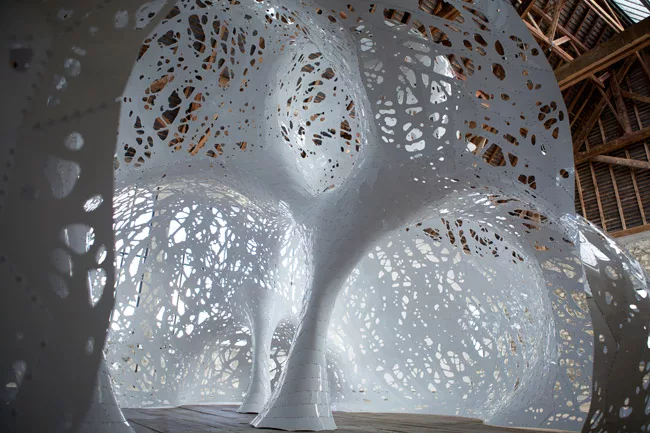
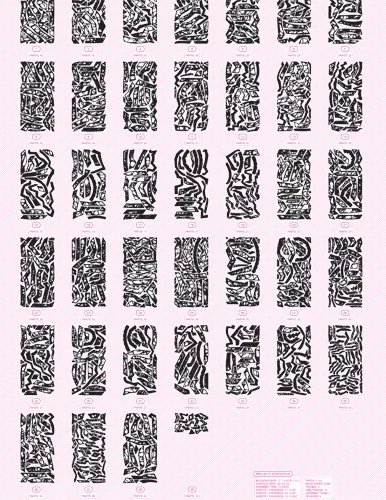
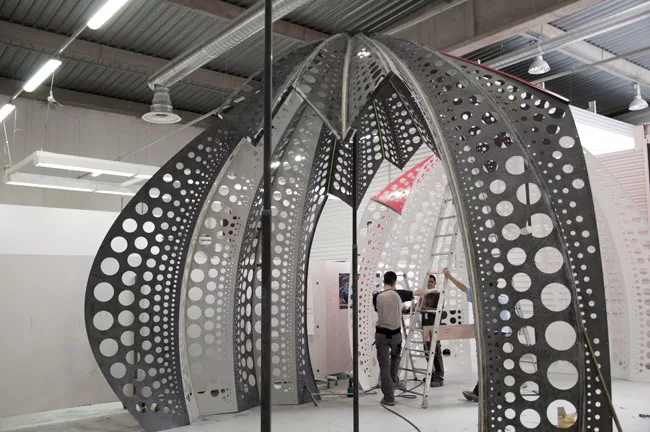
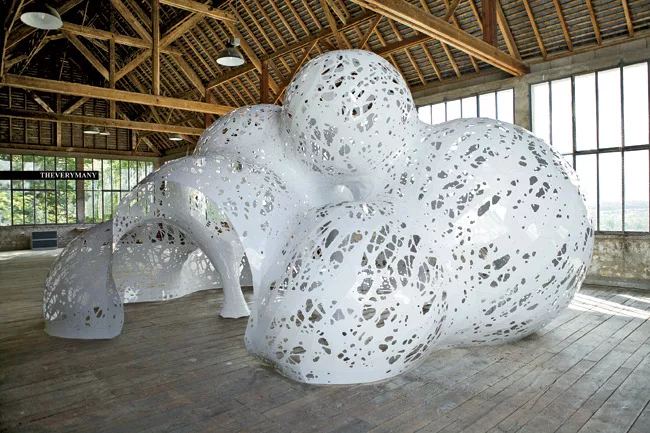
The pavilion that Fornes designed and built while an artist-in-residence at the Atelier Calder in Saché, France, can be taken apart for storage. Although it is approximately 11 feet tall and 20 feet in diameter, the work can be broken up into sub-assemblies and packed in a 14-by-12-by-9-foot crate. Fornes’s fabrication files included information about how the project’s thousands of elements would be positioned on the aluminum sheets they were cut from.
The pavilion that Fornes designed and built while an artist-in-residence at the Atelier Calder in Saché, France, can be taken apart for storage. Although it is approximately 11 feet tall and 20
Marc Fornes/TheVeryMany
Double Agent White
Atelier Calder, Saché, France
The pavilion that Fornes designed and built while an artist-in-residence at the Atelier Calder in Saché, France, can be taken apart for storage. Although it is approximately 11 feet tall and 20 feet in diameter, the work can be broken up into sub-assemblies and packed in a 14-by-12-by-9-foot crate. Fornes’s fabrication files included information about how the project’s thousands of elements would be positioned on the aluminum sheets they were cut from.
Photo © Guillaume Blanc
The pavilion that Fornes designed and built while an artist in residence at the Atelier Calder in Saché, France, can be taken apart for storage and transport. Although it is approximately 11 fe
Marc Fornes/TheVeryMany
Double Agent White
Atelier Calder, Saché, France
The pavilion that Fornes designed and built while an artist in residence at the Atelier Calder in Saché, France, can be taken apart for storage and transport. Although it is approximately 11 feet tall and more than 20 feet in diameter, the work can be broken up into sub-assemblies and packed in a 14-by-12-foot by 9-foot-tall crate. Fornes’ fabrication files included information about how the project’s thousands of elements would 'nest' on the aluminum sheets they were cut from.
Photo © Guillaume Blanc
The pavilion that Fornes designed and built while an artist in residence at the Atelier Calder in Saché, France, can be taken apart for storage and transport. Although it is approximately 11 fe
Marc Fornes/TheVeryMany
Double Agent White
Atelier Calder, Saché, France
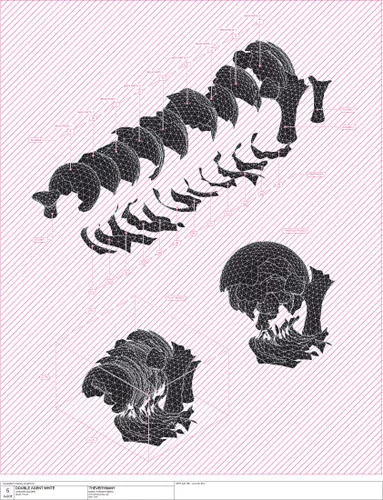
The pavilion that Fornes designed and built while an artist in residence at the Atelier Calder in Saché, France, can be taken apart for storage and transport. Although it is approximately 11 feet tall and more than 20 feet in diameter, the work can be broken up into sub-assemblies and packed in a 14-by-12-foot by 9-foot-tall crate. Fornes’ fabrication files included information about how the project’s thousands of elements would 'nest' on the aluminum sheets they were cut from.
Drawing courtesy TheVeryMany
The pavilion that Fornes designed and built while an artist in residence at the Atelier Calder in Saché, France, can be taken apart for storage and transport. Although it is approximately 11 fe
Marc Fornes/TheVeryMany
Double Agent White
Atelier Calder, Saché, France
The pavilion that Fornes designed and built while an artist in residence at the Atelier Calder in Saché, France, can be taken apart for storage and transport. Although it is approximately 11 feet tall and more than 20 feet in diameter, the work can be broken up into sub-assemblies and packed in a 14-by-12-foot by 9-foot-tall crate. Fornes’ fabrication files included information about how the project’s thousands of elements would 'nest' on the aluminum sheets they were cut from.
Drawing courtesy TheVeryMany
Fornes helped Japanese artist Yayoi Kusama and Louis Vuitton create a pop-up store that was installed at Selfridges in London during the late summer and fall of 2012. Doubly curved V-shaped 'slices' o
Marc Fornes/TheVeryMany
Pop-Up Store
London
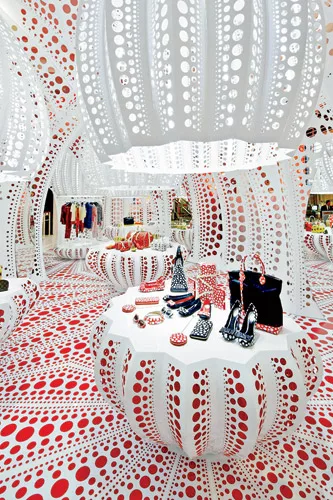
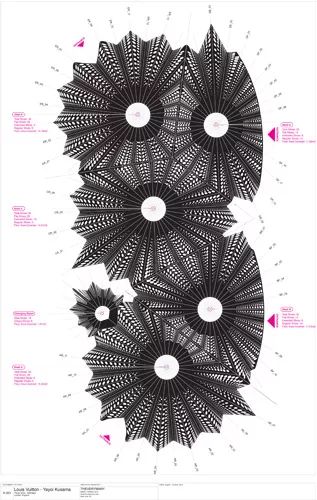
Fornes helped Japanese artist Yayoi Kusama and Louis Vuitton create a pop-up store that was installed at Selfridges in London during the late summer and fall of 2012. Doubly curved V-shaped 'slices' or segments of carbon fiber comprised the installation’s pumpkinlike shapes. Kusama’s signature polka dots, which were water-jet cut into the individual elements, made the pieces lighter and easier to handle.
Photo © Stephane Muratet
Fornes helped Japanese artist Yayoi Kusama and Louis Vuitton create a pop-up store that was installed at Selfridges in London during the late summer and fall of 2012. Doubly curved V-shaped 'slices' o
Marc Fornes/TheVeryMany
Pop-Up Store
London
Fornes helped Japanese artist Yayoi Kusama and Louis Vuitton create a pop-up store that was installed at Selfridges in London during the late summer and fall of 2012. Doubly curved V-shaped 'slices' or segments of carbon fiber comprised the installation’s pumpkinlike shapes. Kusama’s signature polka dots, which were water-jet cut into the individual elements, made the pieces lighter and easier to handle.
Photo courtesy TheVeryMany
Fornes helped Japanese artist Yayoi Kusama and Louis Vuitton create a pop-up store that was installed at Selfridges in London during the late summer and fall of 2012. Doubly curved V-shaped 'slices' o
Marc Fornes/TheVeryMany
Pop-Up Store
London
Fornes helped Japanese artist Yayoi Kusama and Louis Vuitton create a pop-up store that was installed at Selfridges in London during the late summer and fall of 2012. Doubly curved V-shaped 'slices' or segments of carbon fiber comprised the installation’s pumpkinlike shapes. Kusama’s signature polka dots, which were water-jet cut into the individual elements, made the pieces lighter and easier to handle.
Drawing courtesy TheVeryMany
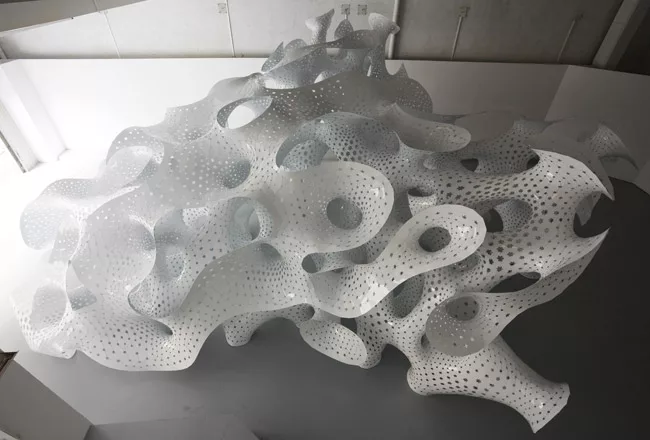
For the 2011 Art Basel in Miami Beach, Flroida, Fornes created a piece that seems to be inspired by sea coral. Its more than 12,000 parts are made from 256 sheets of aluminum. The resulting self-suppo
Marc Fornes/TheVeryMany
Labrys Frisae
Miami, Florida
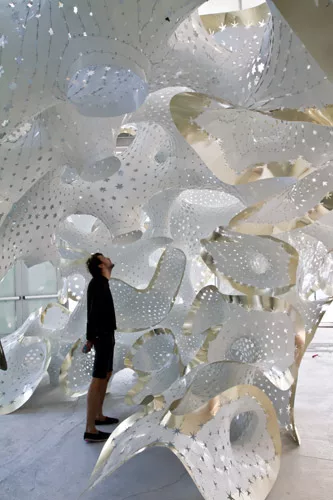
For the 2011 Art Basel in Miami Beach, Flroida, Fornes created a piece that seems to be inspired by sea coral. Its more than 12,000 parts are made from 256 sheets of aluminum. The resulting self-supporting skin, held together with rivets, is strong enough to bear the weight of a standing person.
Photo courtesy TheVeryMany
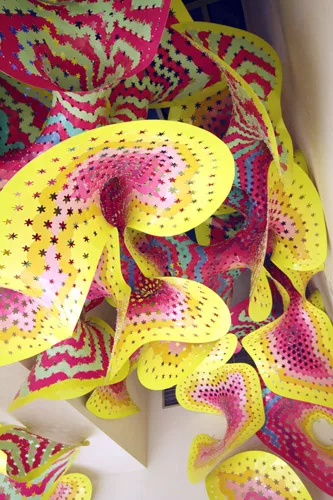
With his permanent installation at the Denver Botanic Gardens, Fornes has made a skylit stair erupt in tropical color.
Marc Fornes/TheVeryMany
Chromatae
Denver
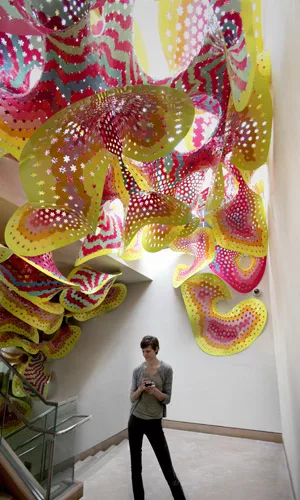
With his permanent installation at the Denver Botanic Gardens, Fornes has made a skylit stair erupt in tropical color.
Photo courtesy TheVeryMany
With his permanent installation at the Denver Botanic Gardens, Fornes has made a skylit stair erupt in tropical color.
Marc Fornes/TheVeryMany
Chromatae
Denver
With his permanent installation at the Denver Botanic Gardens, Fornes has made a skylit stair erupt in tropical color.
Photo courtesy TheVeryMany
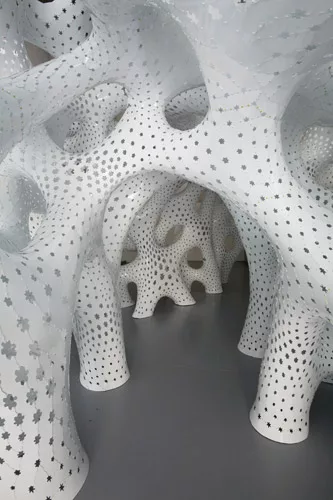
For the permanent collection of the FRAC Centre in Orléans, Fornes and his team have developed a pavilion made of elements that branch away from each other and connect at nodes to describe open
Marc Fornes/TheVeryMany
nonLin/Lin Pavilion
Orléans, France
For the permanent collection of the FRAC Centre in Orléans, Fornes and his team have developed a pavilion made of elements that branch away from each other and connect at nodes to describe openings and create enclosure.
Photo © Francois Lauginie
For the permanent collection of the FRAC Centre in Orléans, Fornes and his team have developed a pavilion made of elements that branch away from each other and connect at nodes to describe open
Marc Fornes/TheVeryMany
nonLin/Lin Pavilion
Orléans, France
For the permanent collection of the FRAC Centre in Orléans, Fornes and his team have developed a pavilion made of elements that branch away from each other and connect at nodes to describe openings and create enclosure.
Photo © Francois Lauginie
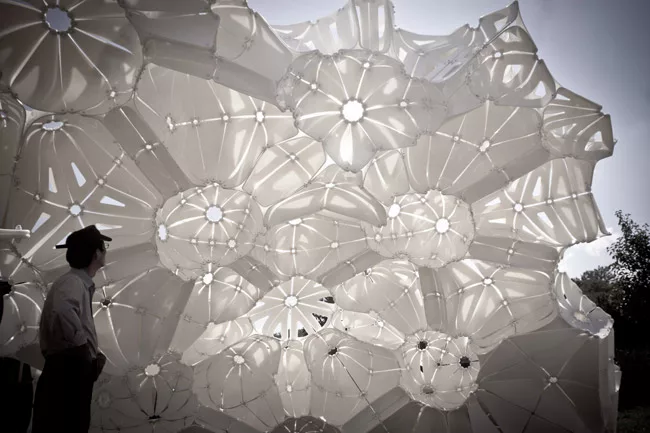
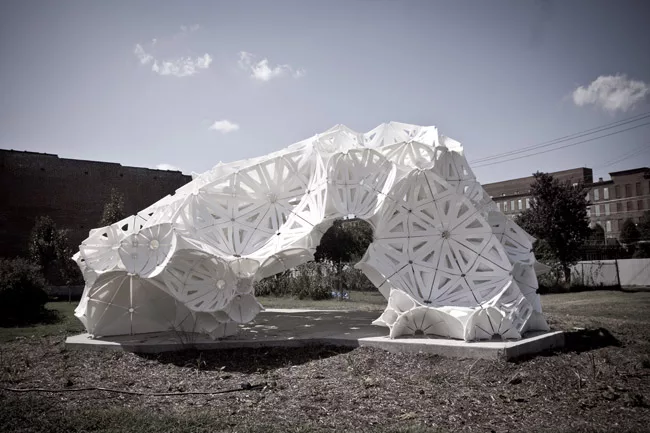
Plasti(k) is made of 150 4-by-8-foot sheets of polyethylene held together by more than 1,300 bolts. Washington University architecture students helped fabricate and assemble the piece, which was insta
Marc Fornes/TheVeryMany
Plasti(k) Pavilion
St. Louis
Plasti(k) is made of 150 4-by-8-foot sheets of polyethylene held together by more than 1,300 bolts. Washington University architecture students helped fabricate and assemble the piece, which was installed in the spring and summer of 2011 as part of a playground they designed for the Botanical Heights neighborhood.
Photo courtesy TheVeryManye
Plasti(k) is made of 150 4-by-8-foot sheets of polyethylene held together by more than 1,300 bolts. Washington University architecture students helped fabricate and assemble the piece, which was insta
Marc Fornes/TheVeryMany
Plasti(k) Pavilion
St. Louis
Plasti(k) is made of 150 4-by-8-foot sheets of polyethylene held together by more than 1,300 bolts. Washington University architecture students helped fabricate and assemble the piece, which was installed in the spring and summer of 2011 as part of a playground they designed for the Botanical Heights neighborhood.
Photo courtesy TheVeryMany
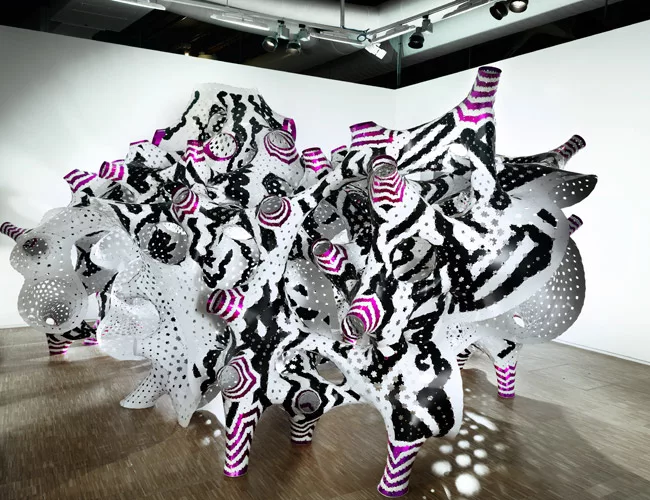
Y/Surf/Structure, part of the permanent collection of the Centre Pompidou, has more than 7,000 parts assembled with 32,000 rivets. The perforations here, and in other works by TheVeryMany, make the in
Marc Fornes/TheVeryMany
Y/Surf/Structure
Paris
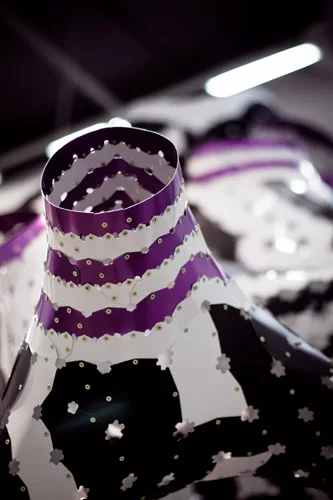
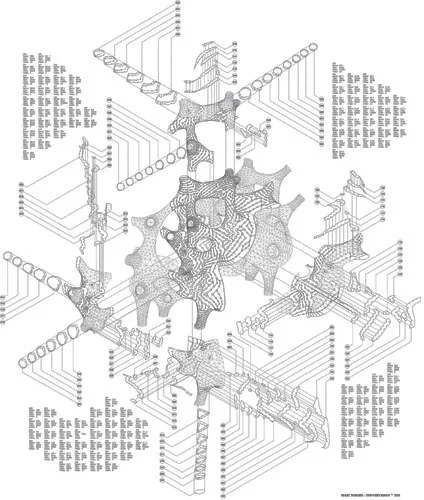
Y/Surf/Structure, part of the permanent collection of the Centre Pompidou, has more than 7,000 parts assembled with 32,000 rivets. The perforations here, and in other works by TheVeryMany, make the individual components easier to handle during installation, says Fornes. They also allow the flat aluminum sheets to be twisted into compound curves.
Photo © Brice Pelleschi
Y/Surf/Structure, part of the permanent collection of the Centre Pompidou, has more than 7,000 parts assembled with 32,000 rivets. The perforations here, and in other works by TheVeryMany, make the in
Marc Fornes/TheVeryMany
Y/Surf/Structure
Paris
Y/Surf/Structure, part of the permanent collection of the Centre Pompidou, has more than 7,000 parts assembled with 32,000 rivets. The perforations here, and in other works by TheVeryMany, make the individual components easier to handle during installation, says Fornes. They also allow the flat aluminum sheets to be twisted into compound curves.
Photo © Brice Pelleschi
Y/Surf/Structure, part of the permanent collection of the Centre Pompidou, has more than 7,000 parts assembled with 32,000 rivets. The perforations here, and in other works by TheVeryMany, make the in
Marc Fornes/TheVeryMany
Y/Surf/Structure
Paris
Y/Surf/Structure, part of the permanent collection of the Centre Pompidou, has more than 7,000 parts assembled with 32,000 rivets. The perforations here, and in other works by TheVeryMany, make the individual components easier to handle during installation, says Fornes. They also allow the flat aluminum sheets to be twisted into compound curves.

Click here to view enlarged drawing.
Drawing courtesy TheVeryMany
The pavilion that Fornes designed and built while an artist-in-residence at the Atelier Calder in Saché, France, can be taken apart for storage. Although it is approximately 11 feet tall and 20
The pavilion that Fornes designed and built while an artist in residence at the Atelier Calder in Saché, France, can be taken apart for storage and transport. Although it is approximately 11 fe
Fornes helped Japanese artist Yayoi Kusama and Louis Vuitton create a pop-up store that was installed at Selfridges in London during the late summer and fall of 2012. Doubly curved V-shaped 'slices' o
For the 2011 Art Basel in Miami Beach, Flroida, Fornes created a piece that seems to be inspired by sea coral. Its more than 12,000 parts are made from 256 sheets of aluminum. The resulting self-suppo
With his permanent installation at the Denver Botanic Gardens, Fornes has made a skylit stair erupt in tropical color.
For the permanent collection of the FRAC Centre in Orléans, Fornes and his team have developed a pavilion made of elements that branch away from each other and connect at nodes to describe open
Plasti(k) is made of 150 4-by-8-foot sheets of polyethylene held together by more than 1,300 bolts. Washington University architecture students helped fabricate and assemble the piece, which was insta
Y/Surf/Structure, part of the permanent collection of the Centre Pompidou, has more than 7,000 parts assembled with 32,000 rivets. The perforations here, and in other works by TheVeryMany, make the in
December 16, 2013

Architects & Firms

Marc Fornes / TheVeryMany

Brooklyn, New York

At first glance, the work of Marc Fornes, founder of Brooklyn-based Marc Fornes/TheVeryMany, seems more like sculpture than architecture. His geometrically complex pieces, developed through computational design and fabrication, include museum installations, public art, and pop-up environments. They appear to take their cues from natural forms including those of crustaceans, plants, and wild animals. But Fornes, who is a native of France but moved to New York in 2006 to work for Skidmore, Owings and Merrill, insists that his approach is that of an architect rather than a sculptor. TheVeryMany's formal language, he says, is the product of exploiting curvature to make efficient structures. “With each project, we are trying to produce space and structure,” he explains.

Fornes's objects are usually comprised of thousands of flat elements—hence the name TheVeryMany. These are cut with a computer numerical control (CNC) machine from sheets of aluminum and are held together with rivets to form self-supporting skins. And, although they do not provide shelter in the conventional sense, the finished works define space and are often large enough to occupy. One example is Double Agent White, which Fornes designed and built in 2012 while an artist-in-residence at the Atelier Calder in Sach', France. Made of weblike aluminum surfaces describing nine intersecting spheres, it is now at the FRAC Centre in Orl'ans (record, October 2013, page 80), where visitors can walk under the roughly 11-foot-tall canopy, 20 feet in diameter, and circulate around its supporting “trunks.”

Although Fornes has not yet completed any buildings, his projects nevertheless involve a host of practical, real-world concerns. For instance, TheVeryMany served as executive architect for a pop-up store at Selfridges in London that was the product of a collaboration between artist Yayoi Kusama and Louis Vuitton. Here, Fornes had to devise components that would be small and light enough to easily maneuver inside the department store, but also large enough to minimize the need for on-site assembly. The resulting environment, which features elements reminiscent of pumpkins or sea urchins perforated by Kusama's signature dots, represents a technical innovation, says Fornes. It is the first self-supported carbon-fiber shell used in a work of architecture.

Fornes and his team of five employees—all of whom are trained as architects—perform almost every stage of the work themselves. They take each project from conceptual design through development of fabrication files, and they ultimately assemble the pieces on-site. Only one step—the cutting and milling—is performed by others. This process, says Fornes, gives him tight control over the finished product.

TheVeryMany has begun to win more traditional types of architectural commissions: the firm was recently selected for an open-air theater in Columbia, Maryland, and has a house under construction in Fornes's hometown of Strasbourg. Fornes hopes that as his projects grow in size and complexity, there will still be opportunities to build smaller-scale pieces. These are the kinds of projects, he says, that allow him to keep testing new ideas in design and fabrication.


Marc Fornes/TheVeryMany

FOUNDED: 2005

DESIGN STAFF: 6

PRINCIPALS: Marc Fornes

EDUCATION: Architectural Association School of Architecture, M.Arch., 2004; École Nationale Supérieure d'Architecture de Strasbourg, Architecte DPLG, 2001

WORK HISTORY: Zaha Hadid Architects, 2004'06; Skidmore, Owings & Merrill, 2006'08

KEY COMPLETED PROJECTS: Under Tension, Rennes, France, 2013; Les Danseurs du Tailor, Moss Bureau, New York, 2013; Chromatae, Denver Botanic Gardens, 2013

KEY CURRENT PROJECTS: MaHouse, Strasbourg, France, 2014; Amphitheater, Columbia, Maryland, 2015

WEB SITE: www.theverymany.com


Share This Story

Looking for a reprint of this article?
From high-res PDFs to custom plaques, order your copy today!

Joann gonchar

Joann Gonchar, FAIA, LEED AP, is deputy editor at Architectural Record. She joined RECORD in 2006, after working for eight years at its sister publication, Engineering News-Record. Before starting her career as a journalist, Joann worked for several architecture firms and spent three years in Kobe, Japan, with the firm Team Zoo, Atelier Iruka. She earned a Master of Architecture degree from the University of Pennsylvania and a Bachelor of Arts from Brown University. She is licensed to practice architecture in New York State.

Post a comment to this article

Report Abusive Comment

Subscription Center
  • Create an Account
  • Start a Subscription
  • Manage My Account
  • Sign Up for Newsletters
  • Visit Customer Service
  • Update Preferences

More Videos

Sponsored Content

Sponsored Content is a special paid section where industry companies provide high quality, objective, non-commercial content around topics of interest to the Architectural Record audience. All Sponsored Content is supplied by the advertising company and any opinions expressed in this article are those of the author and not necessarily reflect the views of Architectural Record or its parent company, BNP Media. Interested in participating in our Sponsored Content section? Contact your local rep!

close
  • cold storage facility
    Sponsored byCarlisle SynTec Systems

    How Architects Can Design More Continuous Cold Storage Envelopes

  • TAMLYN XtremeTrim Exterior Trim
    Sponsored byTamlyn

    Designing Cleaner Panel Facades: Why Exterior Trim Details Matter

  • Building with Vapor Barriers
    Sponsored byReef Industries, Inc.

    Vapor Barriers Help Control Moisture in Tighter Building Designs

DESIGN:ED Podcast
Listen to Architectural Record’s DESIGN:ED Podcast

Events

June 23, 2026

Enhancing Fire Resistance with Advanced PVC Solutions

Credits: 1 AIA LU/HSW; 1 AIBD P-CE; 0.1 ICC CEU; 1 IIBEC CEH

Evaluate advanced PVC solutions that improve fire resistance, support WUI compliance, and enhance resilience in residential and commercial building design.

June 25, 2026

Designing Glass Railing Systems that Enhance Aesthetics and Meet Code

Credits: 1 AIA LU/HSW; 1 AIBD P-CE; 0.1 ICC CEU

Upon course completion, participants will possess a deeper understanding of glass railings to help ensure that safety, aesthetic, and performance objectives are achieved.

View All Submit An Event

Products

2026 Architect's Square Foot Costbook

2026 Architect's Square Foot Costbook

See More Products

Popular Stories

SanDiegoAirport

Top 300 Architecture Firms of 2026

Lorcan O' Herilhy

California Architect Lorcan O’Herlihy Has Died, Age 66

Coronado Bridge

The Architect’s Guide to San Diego

CCA, Studio Gang

The Winners of the AIA’s 2026 Architecture Award Range from Collegiate Rowing Hubs to Housing for the Homeless

Spoonbill Ranch

Johnsen Schmaling Architects Integrates Spoonbill Ranch into a Pristine Landscape

Enhancing Fire Resistance with Advanced PVC Solutions - Free Webinar - June 23, 2026

Related Articles

  • Moonrise

    Snapshot: A Bulbous Buckminster Fuller–Inspired Pavilion Rises Along the Tennessee River

    See More
  • LEVER Architecture

    Design Vanguard 2017: LEVER Architecture

    See More
  • Cambridge Public Library

    See More

Related Products

See More Products
  • manuelle gutrand arch.jpg

    Manuelle Gautrand Architecture

See More Products
×

The latest news and information

#1 Source for Architectural Design, News and Products

SUBSCRIBE
  • RESOURCES
    • Advertise
    • Contact Us
    • Submit
    • Store
  • ACCOUNT CENTER
    • Create an Account
    • Start a Subscription
    • Manage My Account
    • Sign Up for Newsletters
    • Visit Customer Service
    • Update Preferences
  • PRIVACY
    • PRIVACY POLICY
    • TERMS & CONDITIONS
    • DO NOT SELL MY PERSONAL INFORMATION
    • PRIVACY REQUEST
    • ACCESSIBILITY
  • SERVICES
    • Marketing Services
    • Reprints
    • Market Research
    • List Rental
    • Survey/Respondent Access
  • STAY CONNECTED
    • Linkedin
    • Facebook
    • Instagram
    • YouTube
    • X (Twitter)

Copyright ©2026. All Rights Reserved BNP Media, Inc. and BNP Media II, LLC.

Design, CMS, Hosting & Web Development :: ePublishing