Prototypes
2008 Product Reports Prototypes
Prototypes 2008
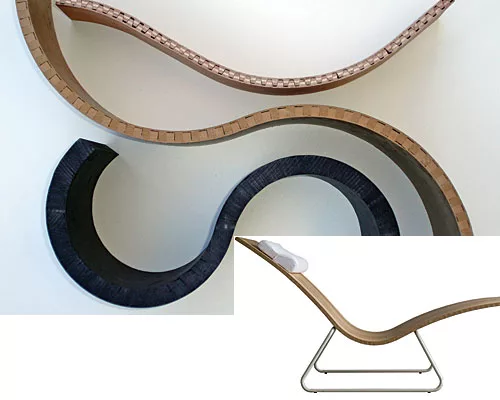
Schindlersalmerón, a Swiss furniture design company founded by architects Christoph Schindler and Margarita Salmerón Espinosa, is collaborating with the Hamburg School for Timber Technology to further develop Zipshape, a computer-aided fabrication method to create single curved panels from any bendable material without molds. A unit consists of two individually slotted panels that interlock when bent to the predefined curvature. schindlersalmerón, Zürich. www.schindlersalmeron.com

Prototypes 2008
Designer Alexa Lixfeld experimented with temperature, molds, and the basic ingredients of concrete to develop Creacrete, a dense, permanently glossy material that can be less than 3 mm thick. Abrasion- and acid-resistant, Creacrete is an alternative to ceramics for floor and wall coverings, decorative objects, and facades. Alexa Lixfeld Design, Hamburg, Germany. www.alexalixfeld.com
Prototypes 2008
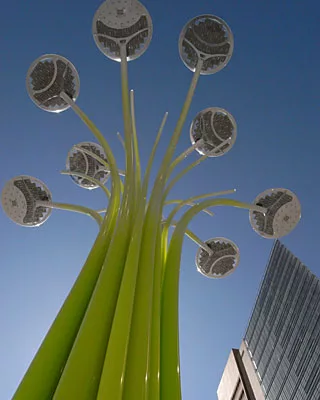
The Solar Tree was originally designed by Ross Lovegrove and manufactured by Artemide (in cooperation with Sharp Solar) to be exhibited outside the MAK museum in Vienna. Developed as a experimental urban-lighting project, the structure consists of 10, 18' tall curved steel poles topped by heads housing photovoltaic cells and LEDs. It should be available by mid-2009. Artemide, Farmingdale, N.Y. www.artemide.com

Prototypes 2008
Greenpix, designed by architect Simone Giostra, is both a glass curtain wall and display featuring 2,400 LEDs. The project, developed with the German photovoltaic firms Schüco and Sunways for Beijings Xicui Entertainment Center, uses solar energy to fuel a massive multicolored display at night. Arup helped Giostra engineer the system, which uses laminated polycrystalline embedded in the curtain wall. Schüco USA, Newington, Conn. www.schueco.com; Sunways, Konstanz, Germany. www.sunways.de