Architectural Record
search
cart
facebook twitter linkedin youtube
  • Sign In
  • Subscribe
  • Sign Out
  • My Account
Architectural Record
  • NEWS
    • Latest News
    • Awards
    • Interviews
    • Obituaries
    • Podcasts
      • Design:Ed Podcast
      • Sponsored Podcasts
  • OPINION
    • Book Reviews / Excerpts
    • Exhibition Reviews
    • Forum
  • EXCLUSIVES
    • Videos
    • Design Vanguard
    • Top 300 Firms
    • Sponsored Content
    • Sponsored eBooks
    • From the Archives
  • CONTINUING ED
    • Editorial Continuing Ed
    • CE Center
    • CE Academies
  • PROJECTS
    • Buildings By Type
    • Reuse & Renovation
    • Museums & Arts Centers
    • Colleges & Universities
    • Multifamily Housing
    • Interiors
    • Lighting
    • Kitchen & Bath
  • HOUSES
    • Record Houses
    • House of the Month
    • Featured Houses
  • PRODUCTS
    • Products by Category
    • Record Products of the Year
    • Latest Products
  • EVENTS
    • Dates & Events
    • Record on the Road
    • Innovation Conference
    • Sustainability in Practice
    • Women In Architecture
    • Webinars
    • Ad Excellence Awards
    • Submit an Event
  • CONNECT
    • Ask RECORD AI
    • Newsletters
    • Contact
    • Advertise
    • Editorial Calendar
    • Store
    • Customer Service
  • SUBMIT
    • Submission Guidelines
    • RECORD Competitions
  • MAGAZINE
    • Subscribe
    • My Account
    • Digital Edition
    • Current Issue
    • Firm Pass
    • Historic Archive
Architecture News

Mid-Century Architecture at Risk in New Orleans
By Shawn Kennedy
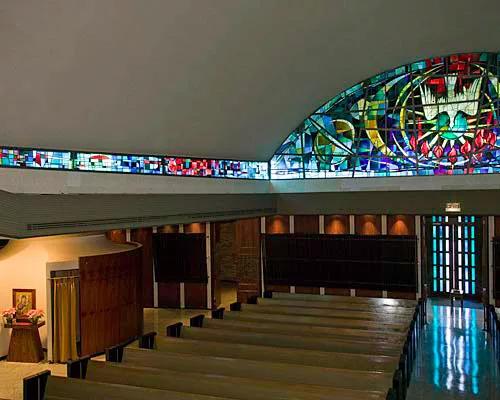
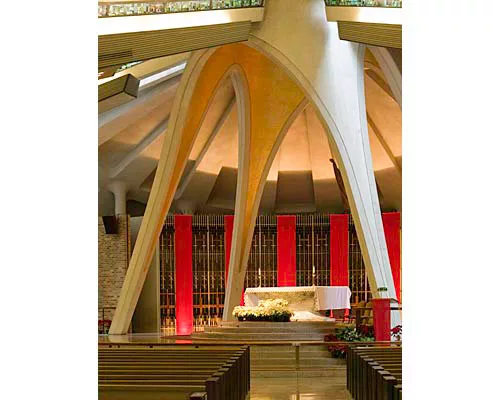
St. Francis Cabrini Church
The interior of the St. Francis Cabrini Church, in New Orleans' Gentilly neighborhood, photographed in 2003.
 
Photo © Neil Alexander


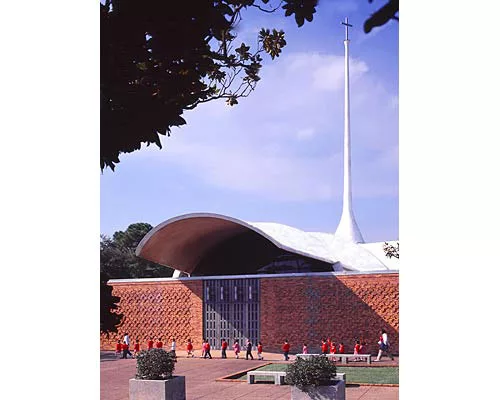
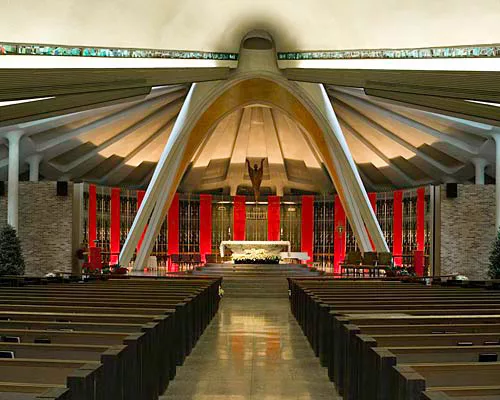
St. Francis Cabrini Church
The church, completed in 1964, largely escaped damage during hurricanes Katrina and Rita.

Photo © Neil Alexander

St. Francis Cabrini Church
The church was demolished in June 2007 to make way for a Catholic boys' school, whose old Ninth Ward campus was completely destroyed by Katrina.
 
Photo © Neil Alexander


St. Francis Cabrini Church
 

St. Cabrini's architect, Arthur Q. Davis, says of the church's demolition: "(Architects) are outliving our buildings and that's not right."

Photo © Neil Alexander
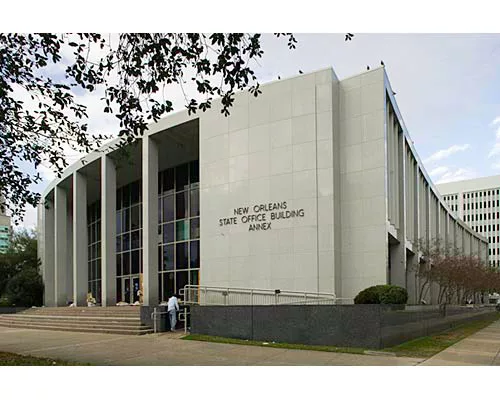
 

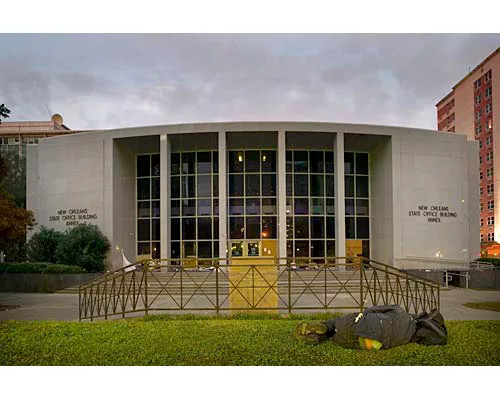
Louisiana state office building
A Louisiana state office building dating to 1958 is slated for demolition later this year.

Photo © Neil Alexander

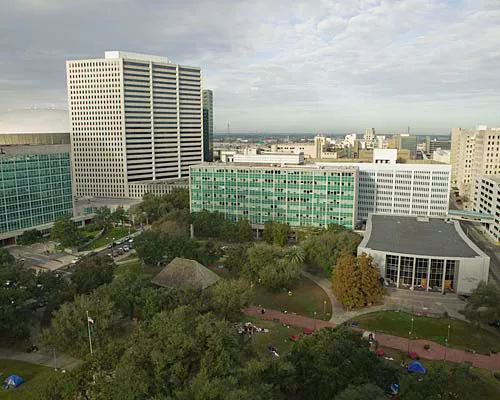
Louisiana state office building
Designed by the local firm of August Perez & Associates, the office building and a nearby state courthouse compose a downtown government complex with City Hall, another Modernist structure whose days may be numbered.

Photo © Neil Alexander

Louisiana state office building
The building's basement was flooded in the aftermath of Hurricane Katrina and the state lacks the money to repair its mechanical systems.
 
Photo © Neil Alexander


Louisiana state office building
The building will be replaced with a new structure designed by Holly & Smith Architects, of Hammond, Louisiana.

 Photo © Neil Alexander

St. Francis Cabrini Church
Louisiana state office building
February 26, 2008
 

New Orleans’ 20th century architectural heritage is at risk due to the public’s desire to see the storm-damaged city rebuilt quickly and a general disregard for structures of the Modern era. That warning came earlier this month from a panel of architects, architecture critics, preservationists, and planners who gathered for a public forum titled “At Risk: 20th Century New Orleans Urban Design and Architecture.”


Held at the Ogden Museum of Southern Art, the forum drew an audience of roughly 150 people largely sympathetic to the premise that many 20th century structures—including storm-damaged schools, government offices, and public housing—are worth saving because of their architectural significance, and because many are more durable than the buildings likely to replace them.

Several panelists, and a least one speaker who rose from the audience, made the point that the city lacks a set of design standards that would improve the stature of modern architecture. “Part of what defines New Orleans is its 18th and 19th century architecture, and it is plain to us the elements that make [this] architecture unique,” said Dr. Michael Sartisky, executive director of the Louisiana Endowment for the Humanities, speaking from the audience. “Modernism seems to have been dropped into New Orleans. There are no clarifying principals of Modern design here that give it value.”

Jack Davis, a panelist in the forum who is a trustee of the National Trust for Historic Preservation, said that 20th century architecture is also vulnerable because the public lacks the protective impulse for contemporary buildings that it has for those in the French Quarter, Garden District, and other neighborhoods with older structures. “The momentum since Katrina is pro-demolition because it’s a sign of progress; a sign that something is being done,” Davis said, adding that this impulse is strongest when it comes to Modern buildings.

Other panelists included New Orleans architects Arthur Q. Davis and Ray Manning; Ferrel Guillory, director of the University of North Carolina’s Department of Journalism and Mass Communications; and Sally Hernandez-Pinero, former chairwoman of the New York City Housing Authority. Nicolai Ouroussoff, architecture critic for The New York Times, moderated the discussion.

Among the 20th century edifices being demolished, slated, or proposed for demolition are Charity Hospital, a 1930s Art Deco building that did not re-open after the storm; four of the city’s largest public housing complexes, including the 1940s-era St. Bernard Houses that are currently being razed; and the 1950s-vintage Louisiana State Supreme Courthouse and adjacent Supreme Court Office Building.

The courthouse and court office buildings compose a downtown government complex with City Hall, another Modernist structure whose days may be numbered. Designed by the local firm of August Perez & Associates, and completed in 1958, the courthouse was relegated to storeroom status in 2004 when the Louisiana Supreme Court moved back into a Beaux-Arts-styled building in the French Quarter. At the time, the state government had planned to renovate and upgrade the buildings, but plans changed after Katrina, which flooded mechanical systems in the basement and made these renovations more expensive, says Jerry Jones, director of the Louisiana State Office of Facilities Planning. Jones says that demolition is expected to begin by the end of 2008, after the completion of asbestos removal. Holly & Smith Architects, of Hammond, Louisiana, is designing a new state office building to occupy the site.

Wayne Troyer, a principal of Wayne Troyer Architects, is among a group of design professionals who are forming a New Orleans chapter of DOCOMOMO, the international organization that promotes preservation and awareness of Modernist architecture and urban design. “Our purpose will be about educating the public on the importance Modern buildings and how they interact with the fabric of the city and why it is important to preserve them,” he explains. “Modern buildings often lend a sense of optimism about the future to a cityscape.” Troyer is pressing the state to evaluate an adaptive reuse of the courthouse, even if the office building comes down.

Another 20th century landmark already lost to the wrecking ball in June 2007 was the St. Francis Cabrini Church, in the Gentilly neighborhood. Completed in 1964 with a decidedly Modernist silhouette, the church building was sacrificed for the sake of a new campus for Holy Cross School, a Catholic boys’ institution whose Ninth Ward campus was completely destroyed by Katrina.

St. Francis Cabrini’s architect, panelist Arthur Q. Davis, added a personal perspective to last week’s forum when he spoke of how distressing demolition can be for architects to witness: “We are outliving our buildings and that’s not right.”


Share This Story

Looking for a reprint of this article?
From high-res PDFs to custom plaques, order your copy today!

Post a comment to this article

Report Abusive Comment

Subscription Center
  • Create an Account
  • Start a Subscription
  • Manage My Account
  • Sign Up for Newsletters
  • Visit Customer Service
  • Update Preferences

More Videos

Sponsored Content

Sponsored Content is a special paid section where industry companies provide high quality, objective, non-commercial content around topics of interest to the Architectural Record audience. All Sponsored Content is supplied by the advertising company and any opinions expressed in this article are those of the author and not necessarily reflect the views of Architectural Record or its parent company, BNP Media. Interested in participating in our Sponsored Content section? Contact your local rep!

close
  • TAMLYN XtremeTrim Exterior Trim
    Sponsored byTamlyn

    Designing Cleaner Panel Facades: Why Exterior Trim Details Matter

  • Building with Vapor Barriers
    Sponsored byReef Industries, Inc.

    Vapor Barriers Help Control Moisture in Tighter Building Designs

  • Duct Interior with Prodeq System
    Sponsored byHenry, a Carlisle Company

    Designing Resilient Water Containment Systems

DESIGN:ED Podcast
Listen to Architectural Record’s DESIGN:ED Podcast

Events

June 10, 2026

Rethinking Stormwater – The Power of Porous Paving

Credits: 1 AIA LU/HSW; 1 AIBD P-CE; 0.1 ICC CEU

Learn how porous paving systems support stormwater management, reduce heat island effects, and enhance sustainable site design performance.

June 11, 2026

Very Early Warning Fire Detection for Mission-Critical Facilities

Credits: 1 AIA LU/HSW; 1 AIBD P-CE; 0.1 ICC CEU

Examine advanced fire detection strategies that support uptime and enhance safety in data centers and other mission-critical facilities.

View All Submit An Event

Products

2026 Architect's Square Foot Costbook

2026 Architect's Square Foot Costbook

See More Products

Popular Stories

Practice Matters illustration

What’s in a (Firm’s) Name? Thinking About Succession and Legacy

Coronado Bridge

The Architect’s Guide to San Diego

Practice Matters illustration

By the Numbers: Counting America's Architects

Riverdale House by Studio Lau

Riverdale House by Studio Lau

House on a Hill

Design Vanguard 2026: Forma

Broader Sustainability of CMU - Free Webinar - May 21, 2026

Related Articles

  • Lawsuit Aims to Prevent Razing of New Orleans Historic District

    See More
  • Quick Take: St. Katharine Drexel Chapel in New Orleans

    See More
  • In New Orleans, Pitt's First "Make It Right" Homes Complete

    See More

Related Products

See More Products
  • bim design firms.jpg

    BIM for Design Firms: Data Rich Architecture at Small and Medium Scales

  • ribbonarch.jpg

    Ribbon Architecture: Light, Shadow, and Reflection in Architecture

See More Products
×

The latest news and information

#1 Source for Architectural Design, News and Products

SUBSCRIBE
  • RESOURCES
    • Advertise
    • Contact Us
    • Submit
    • Store
  • ACCOUNT CENTER
    • Create an Account
    • Start a Subscription
    • Manage My Account
    • Sign Up for Newsletters
    • Visit Customer Service
    • Update Preferences
  • PRIVACY
    • PRIVACY POLICY
    • TERMS & CONDITIONS
    • DO NOT SELL MY PERSONAL INFORMATION
    • PRIVACY REQUEST
    • ACCESSIBILITY
  • SERVICES
    • Marketing Services
    • Reprints
    • Market Research
    • List Rental
    • Survey/Respondent Access
  • STAY CONNECTED
    • Linkedin
    • Facebook
    • Instagram
    • YouTube
    • X (Twitter)

Copyright ©2026. All Rights Reserved BNP Media, Inc. and BNP Media II, LLC.

Design, CMS, Hosting & Web Development :: ePublishing