Architectural Record
search
cart
facebook twitter linkedin youtube
  • Sign In
  • Subscribe
  • Sign Out
  • My Account
Architectural Record
  • NEWS
    • Latest News
    • Awards
    • Interviews
    • Obituaries
    • Podcasts
      • Design:Ed Podcast
      • Sponsored Podcasts
  • OPINION
    • Book Reviews / Excerpts
    • Exhibition Reviews
    • Forum
  • EXCLUSIVES
    • Videos
    • Design Vanguard
    • Top 300 Firms
    • Sponsored Content
    • Sponsored eBooks
    • From the Archives
  • CONTINUING ED
    • Editorial Continuing Ed
    • CE Center
    • CE Academies
  • PROJECTS
    • Buildings By Type
    • Reuse & Renovation
    • Museums & Arts Centers
    • Colleges & Universities
    • Multifamily Housing
    • Interiors
    • Lighting
    • Kitchen & Bath
  • HOUSES
    • Record Houses
    • House of the Month
    • Featured Houses
  • PRODUCTS
    • Products by Category
    • Record Products of the Year
    • Latest Products
  • EVENTS
    • Dates & Events
    • Record on the Road
    • Innovation Conference
    • Sustainability in Practice
    • Women In Architecture
    • Webinars
    • Ad Excellence Awards
    • Submit an Event
  • CONNECT
    • Ask RECORD AI
    • Newsletters
    • Contact
    • Advertise
    • Editorial Calendar
    • Store
    • Customer Service
  • SUBMIT
    • Submission Guidelines
    • RECORD Competitions
  • MAGAZINE
    • Subscribe
    • My Account
    • Digital Edition
    • Current Issue
    • Firm Pass
    • Historic Archive
Projects

Tower at PNC Plaza

Let the Fresh Air In: A tower offers an alternative to the hermetically sealed glass box

By Joann Gonchar, FAIA
Tower at PNC Plaza
Tower at PNC Plaza
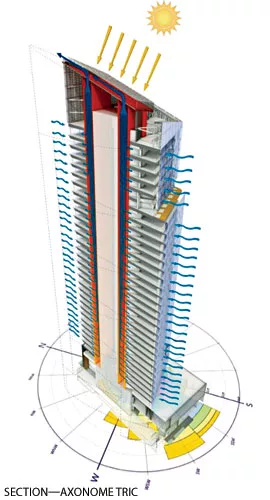
The keys to the tower's natural ventilation strategy are automated windows and flaps in its double-skin curtain wall and a solar chimney.
 
Image courtesy Gensler
Tower at PNC Plaza
Tower at PNC Plaza
The tower's chimney is comprised of two shafts at the building's core and is topped by a glass-roofed chamber that traps solar radiation.
 
Image courtesy Gensler
Tower at PNC Plaza
Tower at PNC Plaza
The building's floors are primarily devoted to open-offices but also include collaborative spaces like the multi-story atriums that are clearly visible on the west facade.
 
Image courtesy Gensler
Tower at PNC Plaza
Tower at PNC Plaza
The windows on the exterior of the tower's double skin will be controlled by the building management system which will monitor environmental conditions. The system will open (left) and close (right) the tall and narrow glazed units.
 
Image courtesy Gensler
Tower at PNC Plaza
Tower at PNC Plaza
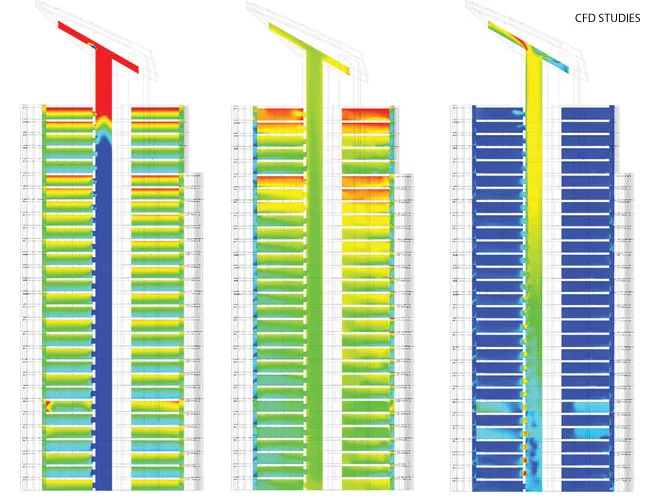
To determine the optimal configuration of the tower and the solar chimney, engineers relied on several tools, including CFD analyses of the pressure, temperature, and velocity of the air inside the tower.
 
Image courtesy Buro Happold
Tower at PNC Plaza
Tower at PNC Plaza
Tower at PNC Plaza
Tower at PNC Plaza
Tower at PNC Plaza
October 16, 2012

Architects & Firms

Gensler

Pittsburgh, Pennsylvania

People/Products

At 33 stories and about 550 feet, PNC Financial Services Group's new headquarters in Pittsburgh will not break any records for its height. But when the under-construction, $400 million building designed by Gensler is completed in the summer of 2015, it will be among a handful of naturally ventilated office towers in the U.S. And it is expected to be the country's tallest tower relying on such a passive strategy for environmental control.

The goal for the Tower at PNC Plaza was to design 'a building that would breathe,' says Hao Ko, design director for Gensler. The high-rise's steel structure is wrapped in a glazed double curtain wall that includes automated windows on the exterior and flaps on the interior to bring in fresh air. Designers estimate that the tower will operate in this natural-ventilation mode, without the need for fan power, for more than 40 percent of working hours.

The scheme's key feature is a solar chimney comprising two shafts at the core of the building's trapezoidal floor plate. It will create a 'controlled' stack effect to draw hot air out of the building, according to Denzil Gallagher, principal at Buro Happold, the skyscraper's structural and mechanical engineer. At the top is a 5,000-square-foot chamber with a glass roof and a concrete slab, sloped and angled toward the south in order to trap solar radiation. During much of the spring and fall, when temperatures are mild and humidity is low, this configuration will create a pressure differential that should pull outdoor air through the operable facade and the 30-inch cavity it defines; the air will be drawn across the floor plates, and then vented through the solar chimney. In the winter, the chamber will help preheat fresh outdoor air before its distribution throughout the tower.

To make sure the air would keep moving through the building, but flow slowly and gently, the project-team members built an approximately 5-by-5-foot mockup of the glass-topped chamber on the roof of another PNC-owned building near the site. With the mockup, they recorded factors like air and surface temperatures inside the chamber in order to calibrate their computational fluid dynamics (CFD) studies and energy models. The ultimate goal of this process was optimization of the solar chimney's size and shape.

Consultants predict that the natural ventilation, along with features like active chilled beams, efficient lighting, and automated shades, will produce a skyscraper that exceeds LEED Platinum requirements. And they estimate that the tower will consume only about half the energy of a building that complies with the 2007 version of the ASHRAE 90.1 standard.

But conserving energy is not the only objective. PNC, which has about 160 LEED-certified facilities nationwide, hopes the tower will provide a comfortable working environment. For example, its employees will be able to enjoy views over the city from the multistory atriums, or 'sky gardens,' that make up the tower's west facade and provide space for informal meetings. They will also be able to open sliding windows on the building's interior skin to let the air circulating within the curtain-wall cavity into the office spaces. Even though the tower will rely on passive ventilation for much of the time, points out Ko, the occupants' relationship with the structure will be an active one.


People

Owner:
The PNC Financial Service Group

Architect:
Gensler
One Beacon Street, Third Floor
Boston, MA 02108
T: (617) 619-5700
F: (617) 619-5701

Personnel in architect's firm who should receive special credit:
Project Director – Douglas Gensler AIA
Project Manager – Lisa Adkins AIA
Design Director – Hao Ko AIA
Technical Directors – Benedict Tranel AIA, Richard Peake

Interior designer: Gensler

Engineer(s): Buro Happold

Consultant(s):
Landscape: LaQuatra Bonci Associates
Lighting: Fisher Marantz Stone, Studio I Architectural Lighting
Acoustical: Pin Drop Acoustics

Other:
Paladino (Sustainability)
Heintges & Associates (Facade)
Civil and Environmental Consultants, Inc (Civil)
Cadmus Group (Commissioning)
Trans Associates (Traffic)
Rolf Jensen & Associates (Code/Fire Protection)
Lerch Bates (Façade Maintenance)
Edgett Williams Consulting Group (Vertical Transportation)
CS Technology (IT)
DVS Security Consulting & Engineering (Security)
The Boundary Layer Wind Tunnel Laboratory (Wind)
Christine Davis (Archaeology)

General contractor: PJ Dick

Renderer(s): Light CG, Tangram 3D S

CAD system, project management, or other software used: Revit

Gross square footage:

800,000 square ft

Cost:

$400 million

Completion date:

2015


Products

Structural system
The Tower at PNC is a steel structure with an efficient braced frame core and lightweight concrete floor slabs, an innovative feature which reduces material use and assists in meeting the sustainability goals of the project.  

Exterior cladding

Curtain wall: Permasteelisa

Glazing

Glass: PPG Industries

Conveyance

Elevators/Escalators: Schindler

Energy
Energy management or building automation system: Automated Logic

 
KEYWORDS: Pittsburgh

Share This Story

Looking for a reprint of this article?
From high-res PDFs to custom plaques, order your copy today!


Joann gonchar

Joann Gonchar, FAIA, LEED AP, is deputy editor at Architectural Record. She joined RECORD in 2006, after working for eight years at its sister publication, Engineering News-Record. Before starting her career as a journalist, Joann worked for several architecture firms and spent three years in Kobe, Japan, with the firm Team Zoo, Atelier Iruka. She earned a Master of Architecture degree from the University of Pennsylvania and a Bachelor of Arts from Brown University. She is licensed to practice architecture in New York State.

Post a comment to this article

Report Abusive Comment

Subscription Center
  • Create an Account
  • Start a Subscription
  • Manage My Account
  • Sign Up for Newsletters
  • Visit Customer Service
  • Update Preferences

More Videos

Sponsored Content

Sponsored Content is a special paid section where industry companies provide high quality, objective, non-commercial content around topics of interest to the Architectural Record audience. All Sponsored Content is supplied by the advertising company and any opinions expressed in this article are those of the author and not necessarily reflect the views of Architectural Record or its parent company, BNP Media. Interested in participating in our Sponsored Content section? Contact your local rep!

close
  • TAMLYN XtremeTrim Exterior Trim
    Sponsored byTamlyn

    Designing Cleaner Panel Facades: Why Exterior Trim Details Matter

  • Building with Vapor Barriers
    Sponsored byReef Industries, Inc.

    Vapor Barriers Help Control Moisture in Tighter Building Designs

  • Duct Interior with Prodeq System
    Sponsored byHenry, a Carlisle Company

    Designing Resilient Water Containment Systems

DESIGN:ED Podcast
Listen to Architectural Record’s DESIGN:ED Podcast

Events

June 10, 2026

Rethinking Stormwater – The Power of Porous Paving

Credits: 1 AIA LU/HSW; 1 AIBD P-CE; 0.1 ICC CEU

Learn how porous paving systems support stormwater management, reduce heat island effects, and enhance sustainable site design performance.

June 11, 2026

Very Early Warning Fire Detection for Mission-Critical Facilities

Credits: 1 AIA LU/HSW; 1 AIBD P-CE; 0.1 ICC CEU

Examine advanced fire detection strategies that support uptime and enhance safety in data centers and other mission-critical facilities.

View All Submit An Event

Products

2026 Architect's Square Foot Costbook

2026 Architect's Square Foot Costbook

See More Products

Popular Stories

Practice Matters illustration

What’s in a (Firm’s) Name? Thinking About Succession and Legacy

Practice Matters illustration

By the Numbers: Counting America's Architects

House on a Hill

Design Vanguard 2026: Forma

Crane Cove, ONO

Design Vanguard 2026 Winners

KRESA by DLR

In Kalamazoo, DLR Group Completes a Mass-Timber Hub for Career and Technical Education Programs

Broader Sustainability of CMU - Free Webinar - May 21, 2026

Related Articles

  • Three PNC Plaza

    See More
  • Testing Tool

    See More
  • NYC Skyscraper First to LEED Platinum

    NYC Skyscraper Is First U.S. Commercial Tower to Earn LEED Platinum

    See More

Related Products

See More Products
  • bim design firms.jpg

    BIM for Design Firms: Data Rich Architecture at Small and Medium Scales

See More Products
×

The latest news and information

#1 Source for Architectural Design, News and Products

SUBSCRIBE
  • RESOURCES
    • Advertise
    • Contact Us
    • Submit
    • Store
  • ACCOUNT CENTER
    • Create an Account
    • Start a Subscription
    • Manage My Account
    • Sign Up for Newsletters
    • Visit Customer Service
    • Update Preferences
  • PRIVACY
    • PRIVACY POLICY
    • TERMS & CONDITIONS
    • DO NOT SELL MY PERSONAL INFORMATION
    • PRIVACY REQUEST
    • ACCESSIBILITY
  • SERVICES
    • Marketing Services
    • Reprints
    • Market Research
    • List Rental
    • Survey/Respondent Access
  • STAY CONNECTED
    • Linkedin
    • Facebook
    • Instagram
    • YouTube
    • X (Twitter)

Copyright ©2026. All Rights Reserved BNP Media, Inc. and BNP Media II, LLC.

Design, CMS, Hosting & Web Development :: ePublishing