Architectural Record
search
cart
facebook twitter linkedin youtube
  • Sign In
  • Subscribe
  • Sign Out
  • My Account
Architectural Record
  • NEWS
    • Latest News
    • Awards
    • Interviews
    • Obituaries
    • Podcasts
      • Design:Ed Podcast
      • Sponsored Podcasts
  • OPINION
    • Book Reviews / Excerpts
    • Exhibition Reviews
    • Forum
  • EXCLUSIVES
    • Videos
    • Design Vanguard
    • Top 300 Firms
    • Sponsored Content
    • Sponsored eBooks
    • From the Archives
  • CONTINUING ED
    • Editorial Continuing Ed
    • CE Center
    • CE Academies
  • PROJECTS
    • Buildings By Type
    • Reuse & Renovation
    • Museums & Arts Centers
    • Colleges & Universities
    • Multifamily Housing
    • Interiors
    • Lighting
    • Kitchen & Bath
  • HOUSES
    • Record Houses
    • House of the Month
    • Featured Houses
  • PRODUCTS
    • Products by Category
    • Record Products of the Year
    • Latest Products
  • EVENTS
    • Dates & Events
    • Record on the Road
    • Innovation Conference
    • Sustainability in Practice
    • Women In Architecture
    • Webinars
    • Ad Excellence Awards
    • Submit an Event
  • CONNECT
    • Ask RECORD AI
    • Newsletters
    • Contact
    • Advertise
    • Editorial Calendar
    • Store
    • Customer Service
  • SUBMIT
    • Submission Guidelines
    • RECORD Competitions
  • MAGAZINE
    • Subscribe
    • My Account
    • Digital Edition
    • Current Issue
    • Firm Pass
    • Historic Archive
Projects

U.S. Courthouse by Mack Scogin Merrill Elam Architects

Austin, Texas
By Clifford A. Pearson
Scogin says he and Elam wanted the building to feel bigger than it is so it would have a presence in the burgeoning city. With that in mind, they used a rugged palette of limestone, stainless steel, a
U.S. Courthouse
Mack Scogin Merrill Elam Architects
Austin, Texas
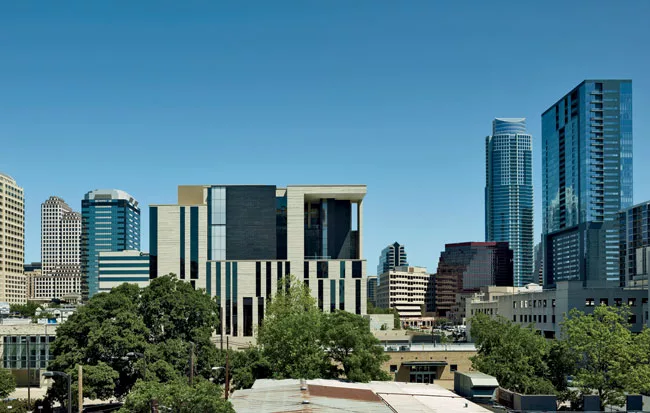
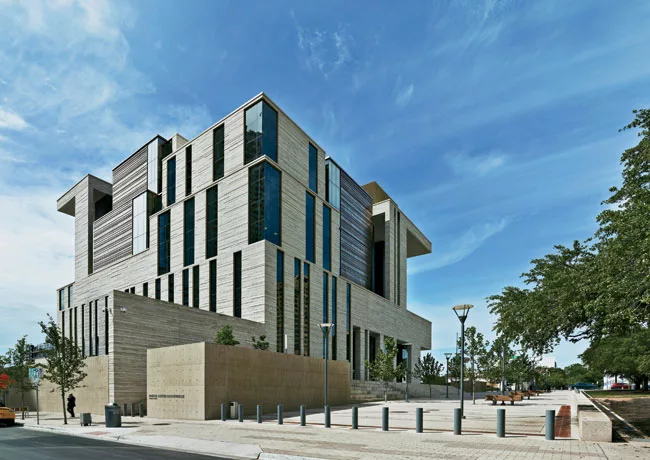
Scogin says he and Elam wanted the building to feel bigger than it is so it would have a presence in the burgeoning city. With that in mind, they used a rugged palette of limestone, stainless steel, and black, preweathered zinc. A new plaza connects the courthouse and its wide stairs to Republic Square Park.
Photo © Tim Hursley
Scogin says he and Elam wanted the building to feel bigger than it is so it would have a presence in the burgeoning city. With that in mind, they used a rugged palette of limestone, stainless steel, a
U.S. Courthouse
Mack Scogin Merrill Elam Architects
Austin, Texas
Scogin says he and Elam wanted the building to feel bigger than it is so it would have a presence in the burgeoning city. With that in mind, they used a rugged palette of limestone, stainless steel, and black, preweathered zinc. A new plaza connects the courthouse and its wide stairs to Republic Square Park.
Photo © Tim Hursley
A large glass artwork by Clifford Ross separates the main lobby from the jury-assembly room. Its colorful upper portion brings together pieces of a photograph of a Colorado mountain; the lower part is
U.S. Courthouse
Mack Scogin Merrill Elam Architects
Austin, Texas
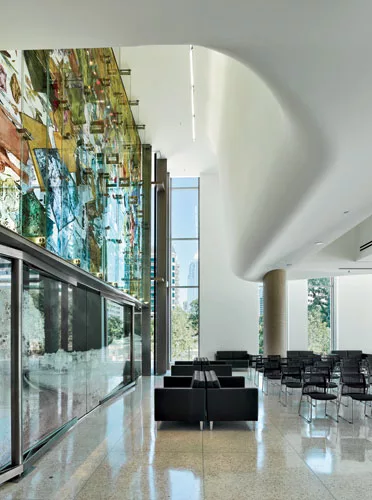
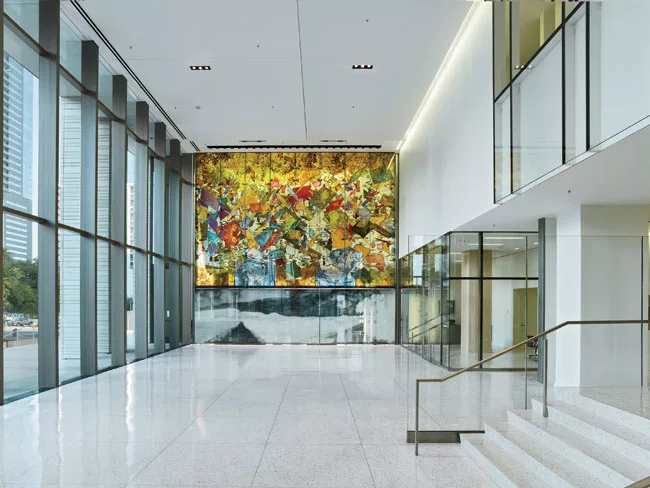
A large glass artwork by Clifford Ross separates the main lobby from the jury-assembly room. Its colorful upper portion brings together pieces of a photograph of a Colorado mountain; the lower part is a pair of pivoting glass doors imprinted with a photo of a Texas landscape.
Photo © Tim Hursley
A large glass artwork by Clifford Ross separates the main lobby from the jury-assembly room. Its colorful upper portion brings together pieces of a photograph of a Colorado mountain; the lower part is
U.S. Courthouse
Mack Scogin Merrill Elam Architects
Austin, Texas
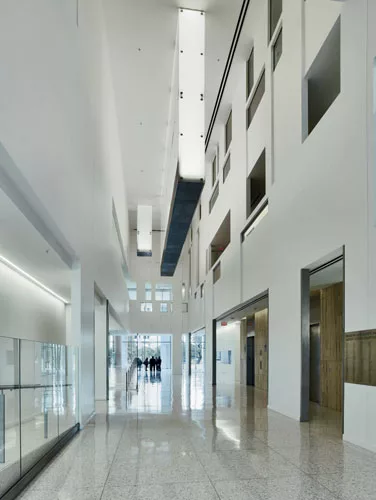
A large glass artwork by Clifford Ross separates the main lobby from the jury-assembly room. Its colorful upper portion brings together pieces of a photograph of a Colorado mountain; the lower part is a pair of pivoting glass doors imprinted with a photo of a Texas landscape.
Photo © Tim Hursley
Daylight helps animate the elevator lobby.
U.S. Courthouse
Mack Scogin Merrill Elam Architects
Austin, Texas
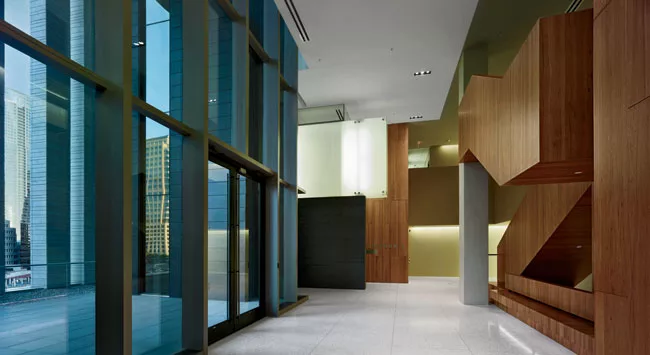
Daylight helps animate the elevator lobby.
Photo © Tim Hursley
Internal stairs face outdoor terraces and connect double-height courtrooms with single-story spaces for jury deliberation and judges' offices.
U.S. Courthouse
Mack Scogin Merrill Elam Architects
Austin, Texas
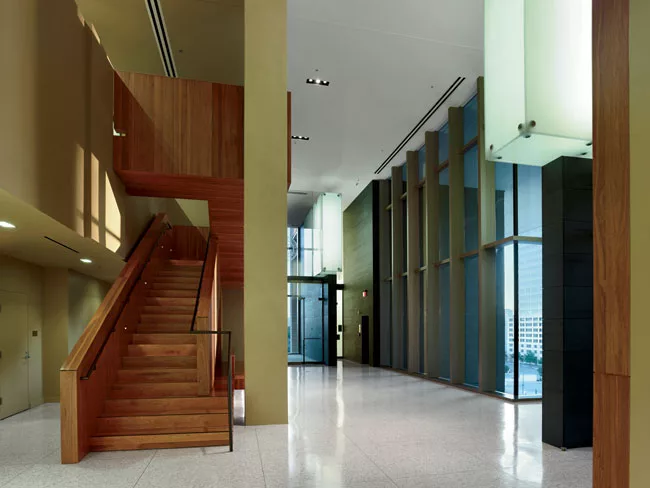
Internal stairs face outdoor terraces and connect double-height courtrooms with single-story spaces for jury deliberation and judges' offices.
Photo © Tim Hursley
In each courtroom, the architects brought daylight in from two sides and paneled walls with pecan veneer. In most cases, they were able to extend some windows above the ceiling height to bring in extr
U.S. Courthouse
Mack Scogin Merrill Elam Architects
Austin, Texas
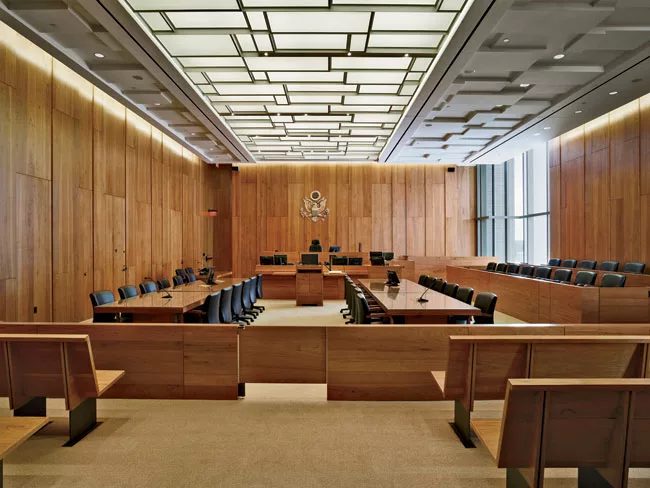
In each courtroom, the architects brought daylight in from two sides and paneled walls with pecan veneer. In most cases, they were able to extend some windows above the ceiling height to bring in extra light.
Photo © Tim Hursley
Internal stairs face outdoor terraces and connect double-height courtrooms with single-story spaces for jury deliberation and judges' offices.
U.S. Courthouse
Mack Scogin Merrill Elam Architects
Austin, Texas
Internal stairs face outdoor terraces and connect double-height courtrooms with single-story spaces for jury deliberation and judges' offices.
Photo © Tim Hursley
1 Lobby<br />2 Jury assembly<br />3 Patio<br />4 Atrium<br />5 Special-proceedings courtroom
U.S. Courthouse
Mack Scogin Merrill Elam Architects
Austin, Texas
1 Lobby
2 Jury assembly
3 Patio
4 Atrium
5 Special-proceedings courtroom
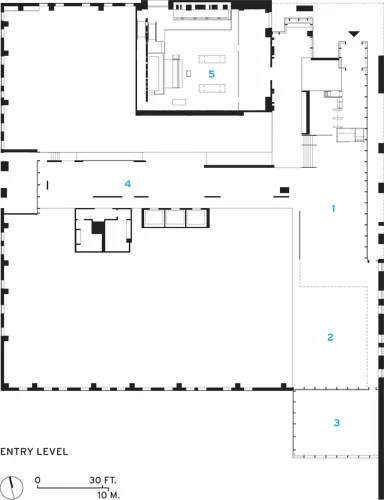
Image courtesy Mack Scogin Merrill Elam Architects
1 Lobby<br />2 Jury assembly<br />3 Patio<br />4 Atrium<br />5 Special-proceedings courtroom
U.S. Courthouse
Mack Scogin Merrill Elam Architects
Austin, Texas
1 Lobby
2 Jury assembly
3 Patio
4 Atrium
5 Special-proceedings courtroom
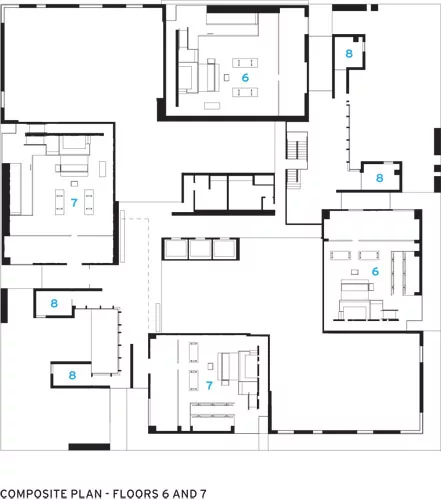
Image courtesy Mack Scogin Merrill Elam Architects
6 Courtroom (sixth floor)<br />7 Courtroom (seventh floor)<br />8 Attorney/witness conference
U.S. Courthouse
Mack Scogin Merrill Elam Architects
Austin, Texas
6 Courtroom (sixth floor)
7 Courtroom (seventh floor)
8 Attorney/witness conference
Image courtesy Mack Scogin Merrill Elam Architects
Scogin says he and Elam wanted the building to feel bigger than it is so it would have a presence in the burgeoning city. With that in mind, they used a rugged palette of limestone, stainless steel, a
A large glass artwork by Clifford Ross separates the main lobby from the jury-assembly room. Its colorful upper portion brings together pieces of a photograph of a Colorado mountain; the lower part is
Daylight helps animate the elevator lobby.
Internal stairs face outdoor terraces and connect double-height courtrooms with single-story spaces for jury deliberation and judges' offices.
In each courtroom, the architects brought daylight in from two sides and paneled walls with pecan veneer. In most cases, they were able to extend some windows above the ceiling height to bring in extr
Internal stairs face outdoor terraces and connect double-height courtrooms with single-story spaces for jury deliberation and judges' offices.
1 Lobby<br />2 Jury assembly<br />3 Patio<br />4 Atrium<br />5 Special-proceedings courtroom
6 Courtroom (sixth floor)<br />7 Courtroom (seventh floor)<br />8 Attorney/witness conference
June 16, 2013

Architects & Firms

Mack Scogin Merrill Elam Architects

Unless you're a lawyer, you probably don't look forward to spending time in courthouses, since most of us associate them with jury duty or maybe lawsuits. Courthouses of the past captured our attention with their handsome expressions of judicial authority and civic pride. But in recent years, security concerns have turned many of these buildings into glorified bunkers. Americans today have an uneasy relationship with government; we want our public institutions to instill respect and project strength, but we don't want them to cost much or be too powerful. In their design for the new U.S. Courthouse in Austin, Texas, the Atlanta-based architects Mack Scogin and Merrill Elam wrestled with these conflicting notions, finding resolution in a building that's muscular in its massing and materials but engaging in its use of daylight and transparency.

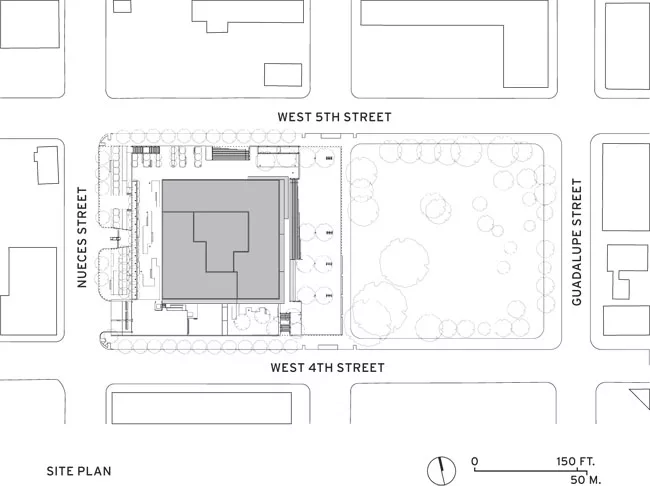
The 252,000-square-foot, $102.6 million courthouse replaces a smaller one a few blocks north, which was designed by local architect Charles H. Page and New York architect Kenneth Franzheim and opened in 1936. Like its predecessor, the new courthouse was built during a severe economic downturn, thanks to stimulus spending. Its full-block site, west of Republic Square Park, one of the city's three remaining downtown historic squares, places it strategically near Antoine Predock's City Hall (2004), Andersson-Wise's 37-story W Hotel and Residences (2010), and all the honky-tonk bars on West Sixth Street.

To connect the courthouse and Republic Square, the architects closed a city street that runs between them and turned it into a plaza landscaped with hardy sycamore trees and wood benches. “We wanted the building to be of its place, of Austin,” says Elam, “so its relationship with Republic Square was critical.” Now a farmers' market that takes place in the square every Saturday spills onto the plaza, right up to the wide courthouse steps.

Scogin and Elam had to pack a lot of program—eight courtrooms and accompanying jury-deliberation spaces, judges' chambers, offices, attorney/witness conference rooms, a jury-assembly room, and various holding spaces for defendants—onto a fairly tight site. So they envisioned the building as a cubic structure practically bursting at the seams. The largest courtroom—the only one on the ground floor—pushes out 2 feet on one side, while roof canopies jut out at two corners to cover terraces carved from the building mass. Courtrooms are expressed on the outside with vertical windows and corner glazing. The overall effect is that of an enormous Rubik's cube—a stately, orthogonal mass subverted by smaller components that look as if they might have been rotated from their original positions.

Scogin and Elam clad the courthouse in the same local limestone seen on many nearby public buildings to tie it to its context, but applied the material in a very different way. Instead of turning the rough face out, they used the smooth side as the facade. To add texture to the exterior, they made a subtle quilt of the stone—varying the dimensions of the pieces, sloping some out from the vertical and others in.

During the design process, the architects toured a number of courthouses with U.S. Magistrate Judge Andrew Austin and other members of the project's building committee. They noticed that most of these buildings have convoluted hallways, in part because courthouses must have three distinct circulation systems: one for the public, one for court staff (restricted), and one for prisoners and government marshals (secure). Many buildings tucked courtrooms inside large floor plates, away from windows. “At the old courthouse here in Austin, the courtrooms had daylight and views outside,” says Judge Austin. “All of the judges wanted to keep that in the new building.”

So Scogin and Elam devised an unusual plan with two cores (one with separate elevators for the public, staff, and prisoners, and the other just for restricted and secure use) that help reduce hallways and keep floors as compact as possible. While two cores are more expensive than one, the architects say their scheme is more efficient in organizing interior spaces and minimizing building envelope, and therefore did not cost more to construct.

Looking for quick answers on architecture and design topics?
Try Ask RECORD, our new smart AI search tool.
Ask RECORD →

The plan also allowed them to maximize daylight in important spaces by placing a pair of courtrooms (and their jury rooms and judges' chambers) on alternating corners of the building and carving out a terrace shared by each pair of courtrooms. Because the courtrooms are double-height spaces, while the jury rooms and judges' chambers are single-height, the architects rotated their placement on the different corners and inserted a wood-clad interior stair to connect each pair of floors. For example, on the sixth floor, the two courtrooms bookend the northeast corner, while on the seventh they sit on the southwest corner. “Bringing in daylight drove everything we did,” says Scogin. “The trick was to create a pinwheel plan around a double core. That allowed us to provide natural light to all of the courtrooms, and also the jury rooms and offices.”

The building stands on a one-story podium, which allows parking to be tucked underneath and provides the blastproof walls required by current security mandates. Unfortunately, the long walls on its three street sides and the wide steps on Republic Square undermine the goal of engaging with the city. Once you walk up those steps, though, you're greeted by a double-height lobby with a long glazed wall overlooking the square and a four-story atrium that houses the elevators and helps distribute daylight deep inside the building.

A product of the General Services Administration's Design Excellence program, the U.S. Courthouse in Austin shows what can happen when top-tier architects work on public projects. The result here is a building that may not be warm and fuzzy, but asserts a rugged sense of civic pride that seems just right for Texas.


A conversation with Merrill Elam and Mack Scogin

Merrill Elam and Mack Scogin, photo © Rubi Xu

“Merrill was a renegade,” says Mack Scogin about his wife and business partner. “She didn’t show up on time, and she didn’t follow the rules.” He would know. The two have worked together since 1968, first at Heery and Heery and then at their own firm. Both acknowledge their ex-boss George Heery for allowing Elam’s talent to shine. Scogin and Elam are jointly concerned with each project, with one taking the lead as principal in charge, and each as co'lead designer. “But sometimes all that switches around as the project progresses,” says Elam. “There’s no hierarchy.” It’s a collaboration that works, says Scogin, because they don’t try to find common ground, but to maintain their individuality, together. “You have to be continuously fascinated by the other person’s ideas,” he says.


People

Owner: General Services Administration

Architect:
Mack Scogin Merrill Elam Architects
111 John Wesley Dobbs Ave
Atlanta, Georgia  30303

Personnel in architect's firm who should receive special credit:
Mack Scogin, AIA – Principal-in-Charge / Collaborating Lead Designer*
Merrill Elam, AIA – Collaborating Principal / Collaborating Lead Designer*
John Trefry – Project Manager*
David Yocum, AIA – Project Manager*
Carrie Hunsicker – Project Manager

Brian Bell, AIA*
Misty Boykin
Lloyd Bray*
Barrett Feldman*
Michael Filisky
Margaret Fletcher
Helen Han
Jason Hoeft
Christopher Hoxie
Jennifer Hurst
DeMar Jones
Chase Jordan
Andrea Kavouklis
Jeffrey Kemp
Matthew Leach
Jane Lee
Alan Locke, AIA*
Jeremy Magner
Gary McGaha
Justin Miller
Claudia Montesinos
Ashley Moore
Sarah Nelson
Ted Paxton
Michael Patino
Dennis Sintic
Barnum Tiller
Stephen Trimble
Anja Turowski
Matthew Weaver
Rubi Xu

*registered architect

Architect of record: Mack Scogin Merrill Elam Architects

Interior designer: Mack Scogin Merrill Elam Architects

Engineer(s):
 PageSoutherlandPage – MEP, Civil, and Fire Protection Engineers;
Architectural Engineers Collaborative – Structural Engineers;
Hinman Consulting Engineers – Blast Consultant

Consultant(s):
Landscape: Hargreaves Associates

Lighting: LAM Partners

Acoustical: Shen Milson & Wilke

Other:
Center for Maximum Potential Building Systems – Sustainability Consultant
Kroll Security Services Group – Security Consultant
Rolf Jensen Associates – Life Safety
Curtainwall Design Consultants – Curtainwall Consultant

General contractor: White Construction Company

Photographer(s): Timothy Hursley

Renderer(s): Mack Scogin Merrill Elam Architects

Owner: General Services Administration

CAD system, project management, or other software used: Autocad, Rhino, 3D Studio, Proliance (construction management, used by GSA)


Products

Exterior cladding
Masonry:
SpectraGlaze - AMP Brick and Stone (interior)
Leuders Limestone (exterior)

Metal Panels: Rimex stainless steel, VM zinc preweathered zinc

Metal/glass curtain wall: custom

Curtain wall:
Curtainwall Design Consulting

Other cladding unique to this project:
Ackerstone – Unit Pavers;
Lauren Concrete – Concrete Materials;

Roofing
Other:
Johnson Roofing, Inc. (Membrane Roofing);
CMC Alamo Steel (Metal Materials)

Glazing
Glass: Harmon, Inc.

Doors
Entrances: Ellison balanced entry doors

Interior finishes
Acoustical ceilings:
Arahed Plaster (Star Silent)

Cabinetwork and custom woodwork: Pecan veneer, Beaubois

Paints and stains:
Shnurr, Inc. (Sherwin Williams)

Paneling: Pecan veneer, Beaubois

Floor and wall tile (cite where used): Boyd Tile and Stone (Daltile)

Special interior finishes unique to this project:
National Terrazo (Venetian Terrazo Flooring);
Ebénisterie Beaubois Ltée (Architectural Woodwork)

Conveyance
Elevators/Escalators:
Lerch, Bates & Associates

Other unique products that contribute to sustainability:
Water Cooled Magnetic Bearing Chiller (product), Johnson Controls – York Equipment (supplier)

Add any additional building components or special equipment that made a significant contribution to this project:
“The Austin Wall,” - Artwork and Wall Design – Clifford Ross Studio
“The Austin Wall,” - Stained-Glass Fabrication – Franz Mayer of Munich
“The Austin Wall,” - Glass and Structural Engineers – Dewhurst Macfarlane and Partners
“The Austin Wall,” – Glass Firing and Lamination – Steindl Glas

Size: 252,420 square feet

Cost: $102.6 million

Completion date: November 2012

 
KEYWORDS: Texas

Share This Story

Looking for a reprint of this article?
From high-res PDFs to custom plaques, order your copy today!

Cliff portrait 2 0t5a1761 0031

Contributing editor Clifford Pearson is the co-author, with A. Eugene Kohn, of The World By Design, and writes about architecture and urbanism.

Post a comment to this article

Report Abusive Comment

Subscription Center
  • Create an Account
  • Start a Subscription
  • Manage My Account
  • Sign Up for Newsletters
  • Visit Customer Service
  • Update Preferences

More Videos

Sponsored Content

Sponsored Content is a special paid section where industry companies provide high quality, objective, non-commercial content around topics of interest to the Architectural Record audience. All Sponsored Content is supplied by the advertising company and any opinions expressed in this article are those of the author and not necessarily reflect the views of Architectural Record or its parent company, BNP Media. Interested in participating in our Sponsored Content section? Contact your local rep!

close
  • cold storage facility
    Sponsored byCarlisle SynTec Systems

    How Architects Can Design More Continuous Cold Storage Envelopes

  • TAMLYN XtremeTrim Exterior Trim
    Sponsored byTamlyn

    Designing Cleaner Panel Facades: Why Exterior Trim Details Matter

  • Building with Vapor Barriers
    Sponsored byReef Industries, Inc.

    Vapor Barriers Help Control Moisture in Tighter Building Designs

DESIGN:ED Podcast
Listen to Architectural Record’s DESIGN:ED Podcast

Events

June 18, 2026

Rebooting the Aging Office Building

Credits: 1 AIA LU/HSW; 1 AIBD P-CE; 0.1 ICC CEU; 1 PDH

Explore façade retrofit strategies and award-winning design concepts that can transform aging office buildings into healthier, higher-performing workplaces for today’s hybrid workforce.

June 23, 2026

Enhancing Fire Resistance with Advanced PVC Solutions

Credits: 1 AIA LU/HSW; 1 AIBD P-CE; 0.1 ICC CEU; 1 IIBEC CEH

Evaluate advanced PVC solutions that improve fire resistance, support WUI compliance, and enhance resilience in residential and commercial building design.

View All Submit An Event

Products

2026 Architect's Square Foot Costbook

2026 Architect's Square Foot Costbook

See More Products

Popular Stories

SanDiegoAirport

Top 300 Architecture Firms of 2026

Coronado Bridge

The Architect’s Guide to San Diego

Lorcan O' Herilhy

California Architect Lorcan O’Herlihy Has Died, Age 66

CCA, Studio Gang

The Winners of the AIA’s 2026 Architecture Award Range from Collegiate Rowing Hubs to Housing for the Homeless

Dusk House

Design Vanguard 2026: ONO

Rebooting the Aging Office Building - Free Webinar - June 18, 2026

Related Articles

  • ARRA Funding Stimulates Austin Federal Courthouse Project

    See More
  • U.S. Courthouse

    See More
  • Byron G. Rogers U.S. Courthouse

    See More
×

The latest news and information

#1 Source for Architectural Design, News and Products

SUBSCRIBE
  • RESOURCES
    • Advertise
    • Contact Us
    • Submit
    • Store
  • ACCOUNT CENTER
    • Create an Account
    • Start a Subscription
    • Manage My Account
    • Sign Up for Newsletters
    • Visit Customer Service
    • Update Preferences
  • PRIVACY
    • PRIVACY POLICY
    • TERMS & CONDITIONS
    • DO NOT SELL MY PERSONAL INFORMATION
    • PRIVACY REQUEST
    • ACCESSIBILITY
  • SERVICES
    • Marketing Services
    • Reprints
    • Market Research
    • List Rental
    • Survey/Respondent Access
  • STAY CONNECTED
    • Linkedin
    • Facebook
    • Instagram
    • YouTube
    • X (Twitter)

Copyright ©2026. All Rights Reserved BNP Media, Inc. and BNP Media II, LLC.

Design, CMS, Hosting & Web Development :: ePublishing