Teaching an Old Material New Tricks
Three projects under construction in North America demonstrate that timber can be used as an alternative to concrete, steel, and even masonry.
Taking Timber Taller
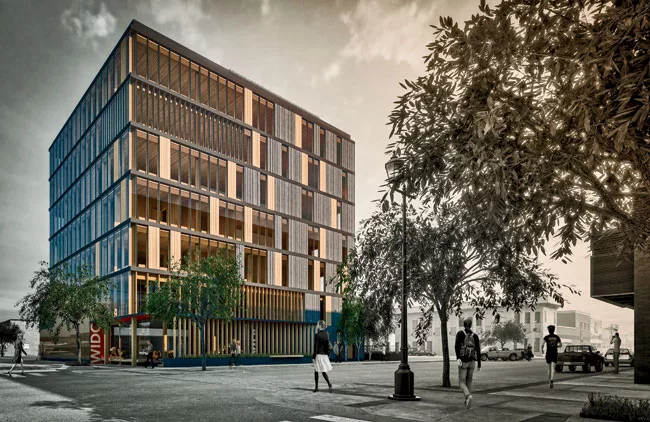
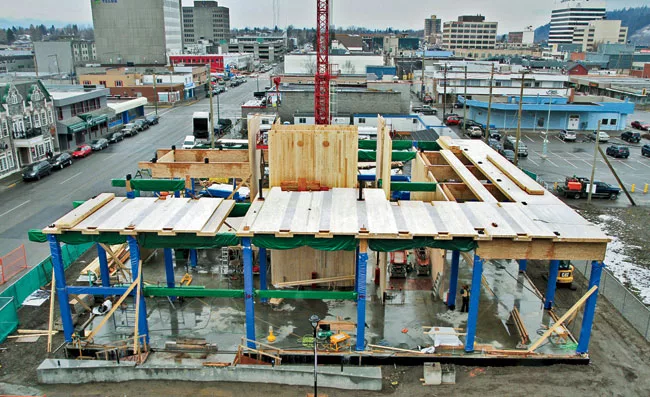
What is behind wood's new allure? The attribute increasingly cited as a reason to substitute it for other materials is its ability to store the greenhouse gas carbon dioxide—so long as the wood doesn't burn or decompose. These storage properties are among the key factors that interested Vancouver- based architect Michael Green in developing a hypothetical scheme for a 30-story tower with a structure made almost entirely of wood. He has now built a wood “tower”—albeit one that is only six stories: the Wood Innovation Design Centre (WIDC) now nearing completion in Prince George, British Columbia. Topped out in April at just under 100 feet, it is the world's tallest wood building, says Green.
The $23 million (U.S.) WIDC, owned by the province, is intended as a showcase for the region's expertise in designing and constructing innovative timber buildings. It relies almost exclusively on engineered wood components, left largely exposed, and made from a variety of species grown in the region, including Douglas fir, spruce, and pine. Starting this fall, the approximately 51,000-square-foot structure, which takes the form of a straightforward box, will house the University of Northern British Columbia's wood-engineering program and office space for other tenants.
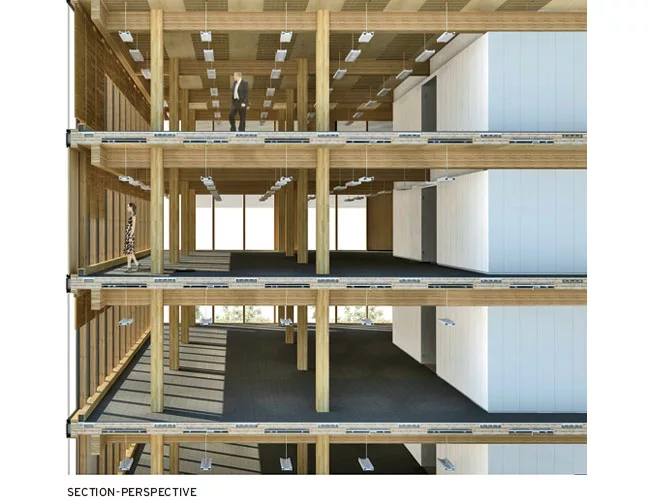
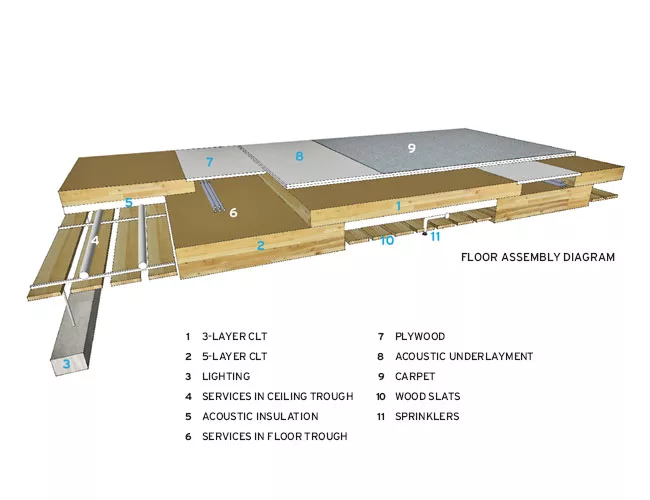
Clad in cedar siding that has been charred (to reduce flame spread, explains Green), the WIDC is supported by glued-laminated timber (glulam) post-and-beam structure. Even its stair and elevator-core walls, which make up the primary lateral load-resisting system, are wood. These consist of cross-laminated timber, or CLT (spruce strips glued under pressure in perpendicular lamellae) anchored to the foundation and connected vertically with self-tapping screws. But the WIDC's most ingenious feature is its wood floor slabs made of overlapping panels of 3- and 5-layer CLT joined together with adhesives and a mesh connector. The configuration provides troughs, above and below the slab, for services such as sprinklers and lighting. The finished floor assembly sits on top of the slab, while removable wood slats conceal the service trenches from below.
Green points out that one of the chief advantages of the arrangement is the absence of a topping slab, which should make post-occupancy modifications to the building systems relatively straightforward. And, at the end of the structure's life, he says, it will be easy to disassemble it and reuse the timber components due to the limited use of concrete.
To go beyond the code-permitted height for commercial wood buildings—four stories—the design and construction team received a special exemption from the provincial government, following a peer-review process. But the system deployed at the WIDC could be used for buildings at least as tall as 20 stories, says Eric Karsh, principal of Equilibrium Consulting, the project's Vancouver-based structural engineer. In order to build to that height, more tests for fire and lateral load resistance would be needed, but he is confident that the system would perform well. The current height limitations are based on the properties of light-frame construction, he explains. “Post-and-beam systems behave differently, as does solid-panel construction,” he says.
Play on the Past
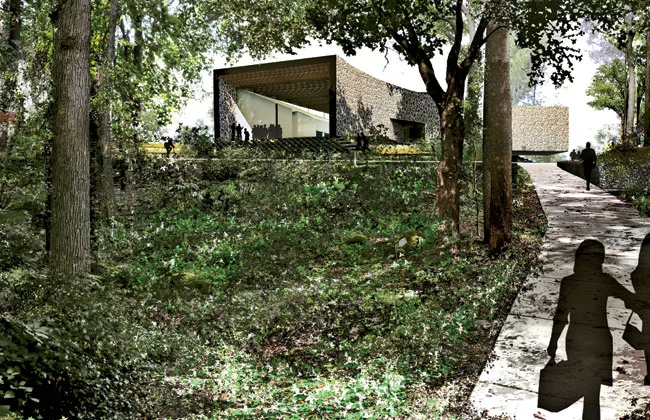
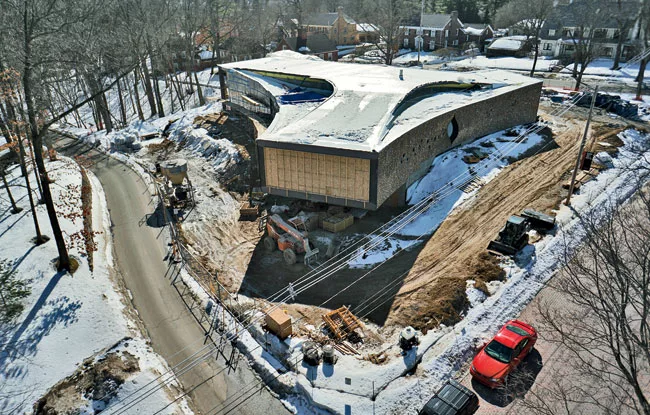
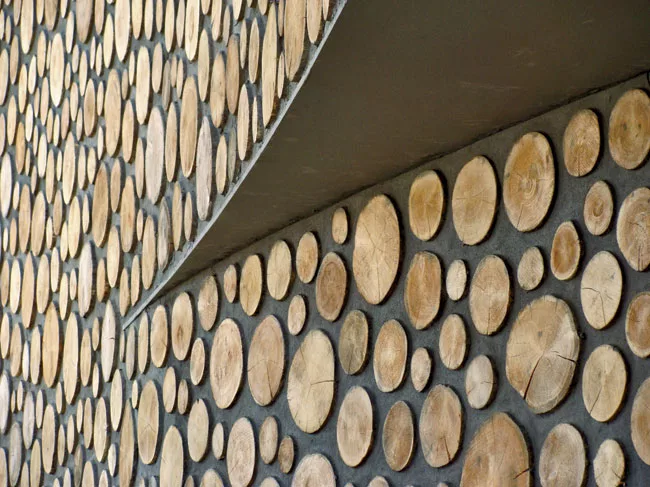
Performance attributes such as structural properties and fire resistance are just one set of issues that design teams consider when selecting a material. Chicago-based Studio Gang Architects clad its Arcus Center for Social Justice Leadership, nearing completion on the campus of Kalamazoo College, in Michigan, with stacked white cedar logs harvested in the northern part of the state. They chose the material, known as cordwood masonry, for the outside of the boomerang-shaped steel-framed building, in part because of its connection to the place: it was first used in the region by early homesteaders. “The material is renewable and has a history there,” explains Todd Zima, a Studio Gang design principal.
The building's cladding and construction method also offered a number of other “synergies” with the center's mission to support the pursuit of human rights, says Zima. In addition to its tie to a vernacular building technique, each of the log sections has its own color, shape, and size, reflecting the diversity of the population that the center will serve. He describes the process of building a cordwood masonry wall as “democratic”—it doesn't depend on sophisticated technology or machinery and allows people with a wide range of abilities to participate.
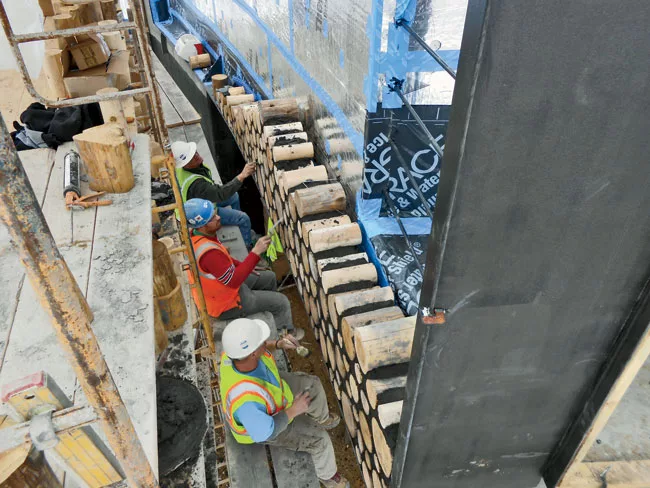
As it turns out, professional masons are constructing the 10,000-square-foot center's cordwood walls. “For various reasons, like liability, it was better to have professionals build them,” says Zima. But despite such real-world concerns, project stakeholders—including the architects, the contractors, and the client—did get a chance to try their hands at the technique. They took part in workshops led by cordwood-masonry experts Rob and Jaki Roy, from Earthwood Building School of West Chazy, New York. The training sessions, held during the design and construction phases, helped generate enthusiasm for the method and provided the project team with a solid foundation for experimenting with the material. For example, it gave the architects the necessary knowledge to detail the building's curved walls and allowed them to understand the criteria involved in selecting a mortar mix—one that wouldn't cure too fast and pull moisture out of the wood, creating unsightly cracks.
Although cordwood is inherently a good insulator, the project team improved its performance by incorporating it into an assembly that is similar to a brick cavity wall. In addition to the wood, which is 11 inches deep, and a 1½-inch cavity, the exterior enclosure also includes continuous insulation, air and waterproof barriers, and a stud wall. Like a typical brick cavity wall, it also has weep holes. The entire system is almost 2 feet deep and provides a thermal resistance of R 30.25—an insulation value that comfortably surpasses the minimum set by the code. The wall section, points out Zima, also serves to update a traditional material, making it appropriate for a modern, pressurized building.
Making waves in Wood
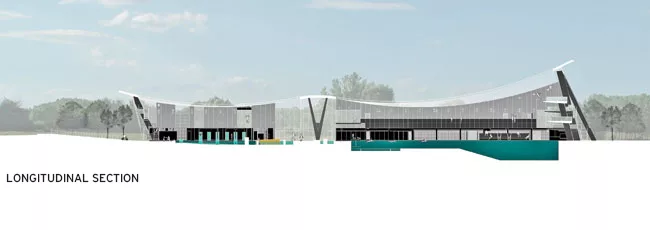
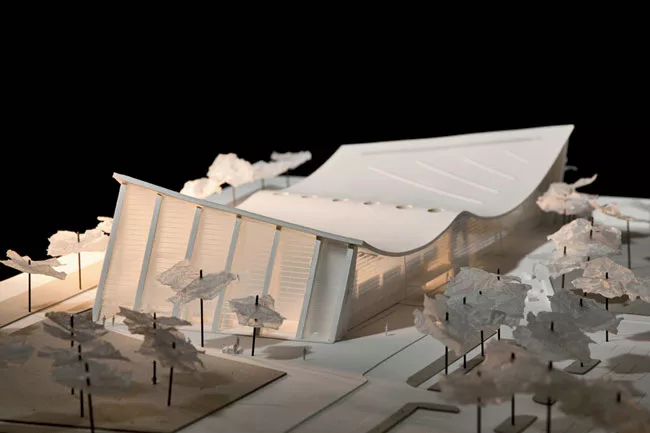
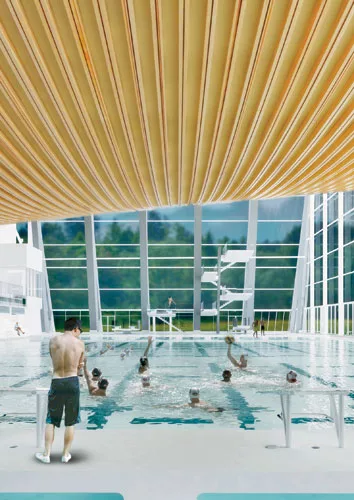
While some designers are attracted to timber for its ability to store carbon and some for its cultural and historical associations, other project teams are using the material to creatively solve the problem of longer spans. The $42 million (U.S.) Grandview Heights Aquatics Centre is the result of such an approach. Here Vancouver-based Hughes Condon Marler Architects (HCMA) has devised an undulating timber roof to cover a municipal swimming pool complex under construction in Surrey, British Columbia. The roof structure is made up of glulam beams, only 5 inches wide and 10½ inches deep, which span 425 feet with just one set of intermediary supports. Even HCMA's project architect, Melissa Higgs, says the beams, placed in pairs every 30 inches on center, are “astonishingly thin.”
These beams behave, in fact, like cables, performing in tension. Suspended from a line of post-tensioned concrete buttresses at each end of the building, and a set of V-shaped concrete columns at midspan, they form catenary curves that dip from a maximum height of 72 feet to a minimum of about 29 feet. The impetus for this swooping profile was the need for the roof to clear a set of diving platforms at the deep end of the complex's competition pool. The architects considered the height unnecessary for the rest of the 86,000- square-foot building, which also houses a leisure pool, a waterslide, a café, and a fitness center. All are enclosed within a curtain wall that combines glass and translucent polycarbonate.
The team explored other options for supporting the roof, including steel trusses. However, these would have needed to be almost 10 feet deep, making the structure even taller. That would have made the conditioned space within the building envelope greater, raising construction costs (for the additional curtain wall enclosure) as well as energy costs. Designers also considered a traditional steel cable. But such a solution would have provided “zero bending stiffness,” says Derek Ratzlaff, an associate at Fast + Epp, the project's Vancouver-based structural engineer. In order to prevent it from deflecting too much in the wind, the steel cable version of the roof would have needed to be heavier, as well as less elegant, he adds. The glued-laminated elements have bending stiffness, so extra weight was not required.
The timber structure also offered the advantage of being better suited than steel for the potentially corrosive pool environment. But the biggest benefit of the wavy wood roof is its drama, says Higgs: “The ceiling ends up being a big part of the visitor's experience.” It is such possibilities, in addition to its structural and environmental characteristics, that make wood so alluring. The material's aesthetic value, as well as its performance attributes, will continue to push architects and engineers to find new applications, create longer spans, and reach for new heights.
People |
Products |
Looking for a reprint of this article?
From high-res PDFs to custom plaques, order your copy today!

