Architectural Record
search
cart
facebook twitter linkedin youtube
  • Sign In
  • Subscribe
  • Sign Out
  • My Account
Architectural Record
  • NEWS
    • Latest News
    • Awards
    • Interviews
    • Obituaries
    • Podcasts
      • Design:Ed Podcast
      • Sponsored Podcasts
  • OPINION
    • Book Reviews / Excerpts
    • Exhibition Reviews
    • Forum
  • EXCLUSIVES
    • Videos
    • Design Vanguard
    • Top 300 Firms
    • Sponsored Content
    • Sponsored eBooks
    • From the Archives
  • CONTINUING ED
    • Editorial Continuing Ed
    • CE Center
    • CE Academies
  • PROJECTS
    • Buildings By Type
    • Reuse & Renovation
    • Museums & Arts Centers
    • Colleges & Universities
    • Multifamily Housing
    • Interiors
    • Lighting
    • Kitchen & Bath
  • HOUSES
    • Record Houses
    • House of the Month
    • Featured Houses
  • PRODUCTS
    • Products by Category
    • Record Products of the Year
    • Latest Products
  • EVENTS
    • Dates & Events
    • Record on the Road
    • Innovation Conference
    • Sustainability in Practice
    • Women In Architecture
    • Webinars
    • Ad Excellence Awards
    • Submit an Event
  • CONNECT
    • Ask RECORD AI
    • Newsletters
    • Contact
    • Advertise
    • Editorial Calendar
    • Store
    • Customer Service
  • SUBMIT
    • Submission Guidelines
    • RECORD Competitions
  • MAGAZINE
    • Subscribe
    • My Account
    • Digital Edition
    • Current Issue
    • Firm Pass
    • Historic Archive

Take It from the Top

Mayor Rahm Emanuel reinforces a legacy for the built environment.
By Blair Kamin
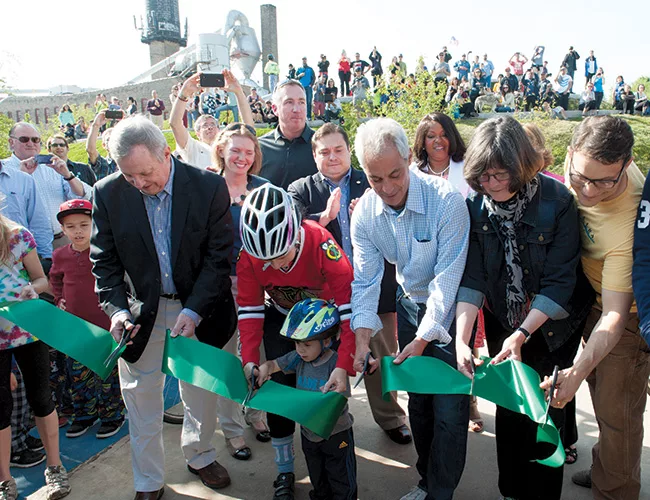
Chicago Mayor Rahm Emanuel

Photo © Walter Mitchell/City of Chicago
October 16, 2015
Chicago’s Rahm Emanuel had big—no, huge—shoes to fill when he took office in 2011. His predecessor, Richard M. Daley, was straight out of central casting—scion of a legendary Chicago mayor, more street-smart than book-smart, but nonetheless a visionary who vowed to make his once-polluted Rust Belt burg “the greenest city in America.” Daley was boss and builder, a democratically elected king who ruled with an iron fist and a green thumb. He often used the power of the former to carry out the agenda of the latter. During his 21-year reign, Chicago planted more than 600,000 trees, constructed more than 85 miles of landscaped medians, and built more than 7 million square feet of planted roofs—which, at the time, was more than any other city in America.
 
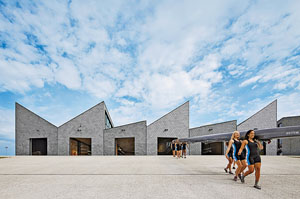
Studio Gang designed the WMS Boathouse at Clark Park (2013), one of a set of riverfront boathouses, as part of this mission.
Photo © Steve Hall/Hedrich Blessing
Mayor Emanuel spearheaded an initiative to transform the long-neglected Chicago River into a public asset. Studio Gang designed the WMS Boathouse at Clark Park (2013), one of a set of riverfront boathouses, as part of this mission.
 
Daley oversaw the building of Millennium Park, ordered Donald Trump to put a spire on his Chicago megatower, and lined city streets with imitation wrought-iron fences that fit his traditional taste. In speeches to architects and planners, he would mangle the English language but invariably earn a standing ovation, owing to his passion for Chicago and his rock-star stature. Daley was, in short, a very hard act to follow, even after it became clear upon his departure from City Hall that his rampant overspending had left the city drowning in red ink.

Though Emanuel is no shrinking violet—he’s famous for dropping f-bombs and once mailed a dead fish to a pollster who ticked him off—the mayor at first neither wowed nor wooed the city’s architects. He kicked two of them—even the venerable Ben Weese—off the city’s landmarks commission and installed a celebrity chef and the obstetrician who delivered Barack Obama’s daughters. Huh? While there were some early good moves, such as installing protected bike lanes, architecture and urban design didn’t seem to be high on Emanuel’s agenda.

They are now. The mayor isn’t just presiding over the inaugural Chicago Architectural Biennial, which runs from October 3 to January 3 and is billed as North America’s largest survey of contemporary architecture. He is backing the exhibition enthusiastically. If nothing else, it offers relief from a drumbeat of bad news, from rising homicides to underfunded pensions. The biennial, he told me in a recent interview, aims to brand Chicago as “the place, as it always has been, of modern architecture.” With people around the world flocking to cities, he explained, there’s fresh urgency to making them livable and sustainable: “I think the conference is going to be an important part of that conversation, and I want Chicago dead center in the middle of it.”

The biennial’s leaders insist Emanuel’s passion for the event is genuine, not simply born of a boosterish desire to lure tourist dollars. According to biennial vice chair Jack Guthman, a Chicago zoning lawyer, the mayor’s involvement stems from Emanuel’s desire “to have Chicago again on the international stage, not just as a center where great buildings are built but also as a place where architectural ideas are being considered.”

Whatever the biennial’s outcome, the fiercely competitive, frequently wisecracking Emanuel is relishing not just new architecture but a wave of well-received public spaces, from the 606, a recently opened 2.7-mile trail and park system that is Chicago’s neighborhood-centric answer to New York’s tourist-mobbed High Line, to the extended downtown Riverwalk, where he drops by every so often for lunch. Because Emanuel grew up in the Chicago area—he and brothers Ezekiel, an esteemed bioethicist, and Ari, a powerhouse Hollywood agent, were raised in an affluent suburb—the river’s improbable transformation from toxic industrial waterway to postindustrial (albeit still-polluted) recreational amenity is particularly gratifying. When he was growing up, he said, no one would have believed that, one day, people would be going out to the river and “enjoying nature, eating lunch, having a drink, [and] listening to music.” 

Asked if he’s relieved to be free from Washington’s political gridlock, the former Congressman and chief of staff in the Obama White House channels Edvard Munch’s Expressionist painting The Scream, clamping his hands on the sides of his head and shaping his lips to form an O. (When I compliment him on using an artistic allusion, Emanuel replies, “My parents paid for Sarah Lawrence. I’ve got to use that liberal-arts degree.”) To him, Washington is the land of political posturing, removed from gritty, everyday reality. “D.C. is Disneyland on the Potomac,” he said. “Here, you make a decision . . . see it through, and have an impact on the quality of life and the way you live your life.”

Yet building new public works is proving far easier for the mayor than solving Chicago’s most pressing problems, among them a credit rating reduced to junk status and shootings that continue to roil impoverished African-American neighborhoods. But Emanuel considers public works to be an important way to address Chicago’s fiscal woes, not a bread-and-circuses distraction from them. Since his 2011 pledge to turn the Chicago River into a “second waterfront,” on a par with Chicago’s celebrated lakefront, he claims that developers have committed to invest $8 billion in new riverfront buildings. To be sure, some of the projects would have happened anyway. Yet the forest of construction cranes along the river—symbols of both prosperity and Chicago’s capacity to reinvent itself—is nonetheless impressive.

Now in the fifth year of his mayoralty, Emanuel has emerged as both a “pick-up-the-baton” figure who has found ways to realize Daley-initiated projects like the 606, and one who is intent upon charting his own course. New riverfront boathouses, the Divvy bike-sharing network, and some 100 miles of new bike lanes are his initiatives, and he’s already built more of the downtown Riverwalk than Daley, with another extension still to come. As head of the city’s Public Building Commission, which erects libraries and other public buildings, Emanuel is forging alternatives to the cookie-cutter “prototypes” Daley backed on grounds of efficiency. “Public buildings don’t have to be just brick and mortar,” he said as his intense brown eyes took in the light-filled interior of the Chicago Public Library’s new Chinatown branch, an elegantly transparent rounded triangle by Brian Lee of the Chicago office of Skidmore, Owings & Merrill. “They can be real, great artworks.”

The library reveals another difference from Daley: Emanuel’s openness to modern architecture, a taste it took his predecessor years to cultivate. Asked to name his favorite Chicago architecture, the mayor lists Kohn Pedersen Fox’s 333 West Wacker, the exquisite contextual skyscraper that marks a bend in the Chicago River, and Frank Gehry’s Pritzker Pavilion in Millennium Park. “One of the things I constantly hear [from visitors],” Emanuel said, “is this: ‘What an incredibly beautiful city’ . . . And when they say it’s really beautiful, there’s two things they put side by side: one, they’re in awe of the size, scope, and scale of nature on [Lake Michigan]; and then, this incredibly human space, our architecture, and the way the city just looks and feels. The beauty of our architecture is one of a kind.”

Share This Story

Looking for a reprint of this article?
From high-res PDFs to custom plaques, order your copy today!


Blair Kamin is the architectural critic for the Chicago Tribune and a contributing editor to Architectural Record.

Post a comment to this article

Report Abusive Comment

Subscription Center
  • Create an Account
  • Start a Subscription
  • Manage My Account
  • Sign Up for Newsletters
  • Visit Customer Service
  • Update Preferences

More Videos

Sponsored Content

Sponsored Content is a special paid section where industry companies provide high quality, objective, non-commercial content around topics of interest to the Architectural Record audience. All Sponsored Content is supplied by the advertising company and any opinions expressed in this article are those of the author and not necessarily reflect the views of Architectural Record or its parent company, BNP Media. Interested in participating in our Sponsored Content section? Contact your local rep!

close
  • TAMLYN XtremeTrim Exterior Trim
    Sponsored byTamlyn

    Designing Cleaner Panel Facades: Why Exterior Trim Details Matter

  • Building with Vapor Barriers
    Sponsored byReef Industries, Inc.

    Vapor Barriers Help Control Moisture in Tighter Building Designs

  • Duct Interior with Prodeq System
    Sponsored byHenry, a Carlisle Company

    Designing Resilient Water Containment Systems

DESIGN:ED Podcast
Listen to Architectural Record’s DESIGN:ED Podcast

Events

June 11, 2026

Very Early Warning Fire Detection for Mission-Critical Facilities

Credits: 1 AIA LU/HSW; 1 AIBD P-CE; 0.1 ICC CEU

Examine advanced fire detection strategies that support uptime and enhance safety in data centers and other mission-critical facilities.

June 16, 2026

Focus on the Façade: Exploring Steel, Timber & Fire-Rated Curtain Walls and Channel Glass Systems

Credits: 1 AIA LU/HSW; 1 AIBD P-CE; 0.1 ICC CEU

Explore modern façade and glazing systems that enhance daylighting, fire safety, and thermal performance while expanding architectural design possibilities.

View All Submit An Event

Products

2026 Architect's Square Foot Costbook

2026 Architect's Square Foot Costbook

See More Products

Popular Stories

Practice Matters illustration

What’s in a (Firm’s) Name? Thinking About Succession and Legacy

Coronado Bridge

The Architect’s Guide to San Diego

Practice Matters illustration

By the Numbers: Counting America's Architects

SanDiegoAirport

Top 300 Architecture Firms of 2026

Crane Cove, ONO

Design Vanguard 2026 Winners

Broader Sustainability of CMU - Free Webinar - May 21, 2026

Related Articles

  • Tips from the Top

    ‘Tips from the Top’ Gathers Advice and Wisdom from More than 60 Global Architecture Practitioners

    See More
  • Cathleen McGuigan

    It's the Top

    See More
  • Dina Griffin

    Rise to the Top: Dina Griffin

    See More

Related Products

See More Products
  • drawingfrommodel.jpg

    Drawing from the Model: Fundamentals of Digital Drawing, 3D Modeling, and Visual Programming in Architectural Design

See More Products
×

The latest news and information

#1 Source for Architectural Design, News and Products

SUBSCRIBE
  • RESOURCES
    • Advertise
    • Contact Us
    • Submit
    • Store
  • ACCOUNT CENTER
    • Create an Account
    • Start a Subscription
    • Manage My Account
    • Sign Up for Newsletters
    • Visit Customer Service
    • Update Preferences
  • PRIVACY
    • PRIVACY POLICY
    • TERMS & CONDITIONS
    • DO NOT SELL MY PERSONAL INFORMATION
    • PRIVACY REQUEST
    • ACCESSIBILITY
  • SERVICES
    • Marketing Services
    • Reprints
    • Market Research
    • List Rental
    • Survey/Respondent Access
  • STAY CONNECTED
    • Linkedin
    • Facebook
    • Instagram
    • YouTube
    • X (Twitter)

Copyright ©2026. All Rights Reserved BNP Media, Inc. and BNP Media II, LLC.

Design, CMS, Hosting & Web Development :: ePublishing