Continuing Education: Bird-Safe Design
For the Birds: Three projects demonstrate how glass buildings can be designed to protect our feathered friends from deadly collisions.

Everyone has heard the thunk of a bird hitting a window. It’s startling, and then it’s sad. But what few of us realize is just how widespread the problem is. Across North America, buildings account for hundreds of millions of bird deaths annually—perhaps more, according to the nonprofit group the American Bird Conservancy. A running estimate of North America’s collision-killed birds—posted online by another nonprofit organization, Toronto’s Fatal Light Awareness Program—ticks along at roughly 30 bird deaths per second. After habitat destruction, collisions with buildings are the single biggest killer of birds.
If birds are plummeting to the ground in such mind-boggling numbers, why aren’t the streets littered with their carcasses? Scavengers, such as gulls and raccoons, get to them, quickly learning which buildings yield the most pickings. Maintenance workers dispose of them. And, in some cities, conservation groups collect them as part of their efforts to promote awareness and push for change, and for research.
Buildings kill birds in three primary ways. The greatest daytime hazard is glazing that reflects habitat or sky. Transparent glazing is also a significant hazard when it offers a view of plants or appears to offer an unobstructed passage through the building. In both cases, birds try to fly through the glass. At night, migratory birds navigate in part by starlight. Light-emitting buildings act as beacons, luring birds and causing them to collide with the facades.
The good news is that, with awareness and know-how, a building can be designed or retrofitted to pose almost no hazard to birds at all. “You don’t have to compromise aesthetics or functionality, as long as you’ve got imagination,” says Christine Sheppard, an ornithologist who heads the American Bird Conservancy’s collision-reduction program. “You don’t really have to compromise anything.”
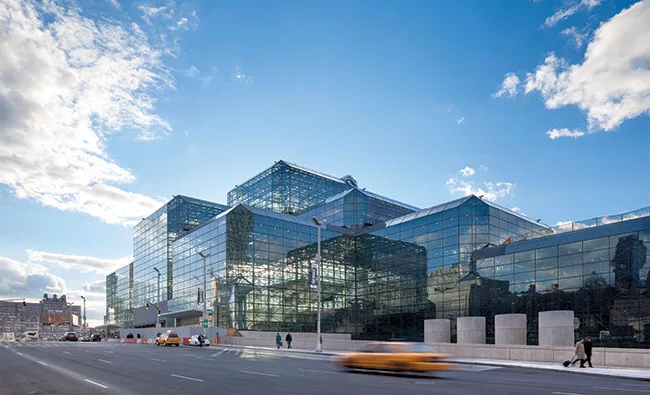
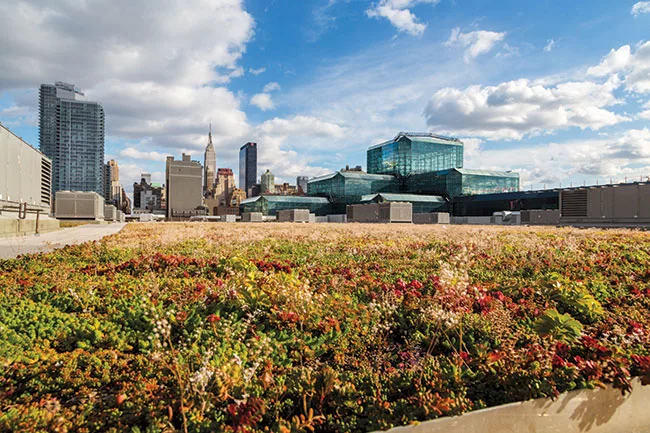
One project that illustrates Sheppard’s point is New York’s Javits Center, a 1.8 million-square-foot convention center designed by Pei Cobb Freed & Partners and first opened in 1986. A recent renovation by FXFOWLE and Epstein not only redeems the dark glass building—infamous for its visual kinship with Darth Vader’s helmet—it transforms one of the city’s worst bird killers into a bird sanctuary.
The Javits, which was originally clad entirely in a thermally unbroken gray-bronze-glass curtain wall, was a reflective box and leaked from the start. In order to make the building more transparent and improve its energy and weather performance, the architects decided to reclad it. The strategy also allowed FXFOWLE to make the glazing more bird-safe, a priority for the firm’s founding principal, Bruce Fowle, who has been incorporating bird safety into his work for more than a decade. “We kind of slipped the bird-safe aspect in. If I’d had to get extra money for it, I’m not sure I could have done it,” says Fowle.
To make the Javits Center more expressive, the redesign assigned glazing to the public areas and clad the remainder in stainless-steel panels, shrinking the scale of the bird-hazard, which is mainly a function of glass area. To make the building more transparent, the design team specified glazing that would lower the building’s reflectance from 35 percent to 8 (less than 15 percent is generally better for birds, notes Fowle). The architects then worked with the glass manufacturer’s paint shop to develop a frit tint and pattern that would provide the overall look and level of glare reduction and solar shading desired.
Looking for quick answers on architecture and design topics?
Try Ask RECORD, our new smart AI search tool.
Ask RECORD →
The design team also made sure the pattern complied with the “2-by-4 rule” which is derived from research showing that most birds won’t try to fly through horizontal spaces less than 2 inches high or vertical spaces less than 4 inches wide. Using this rule, a pattern covering as little as 5 percent of the glass surface can deter 90 percent of strikes, according to tests conducted by Austrian researcher Martin Rössler.
The Javits Center’s dot-pattern frit is located on the insulated glazing unit’s number-two surface—the cavity-facing side of the exterior lite. The frit would be more readily perceived by birds, and therefore more effective, explains Fowle, had it been on the first surface—the outside of the exterior lite. However, the team opted for a second-surface frit due to concerns about durability (few manufacturers offer or warranty first-surface frits). Nonetheless, a study conducted by New York City Audubon and Fordham University found a 90 percent reduction in the number of birds killed on the Javits Center since the renovation. (The only post-renovation strikes have occurred on an area near the entrance where the frit was not used.)
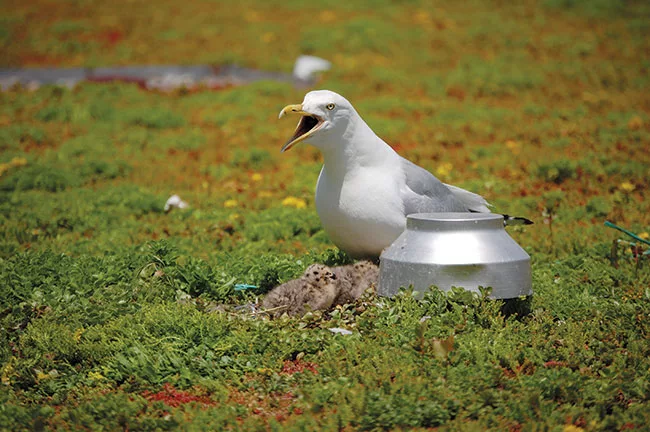
The new Javits goes beyond hazard reduction and now serves as a bird refuge. The building boasts the second-largest green roof in the country, with almost seven acres of mixed-sedum plantings that decrease stormwater runoff, mitigate heat island effect, and improve energy performance. The vegetation also provides a welcome urban habitat for native and migratory birds. Hundreds of birds, of a dozen or so species—including swallows, starlings, geese, gulls, and even some juvenile kestrels—have been spotted there.
Besides fritting, strategies for reducing the hazard factor of glass include energy-performance options such as exterior screens, grilles, shutters, and blinds, and aesthetic and privacy options such as etching, sandblasting, or texturing. Patterned films can be used to help make transparent site elements more evident to birds or to economically retrofit reflective windows.
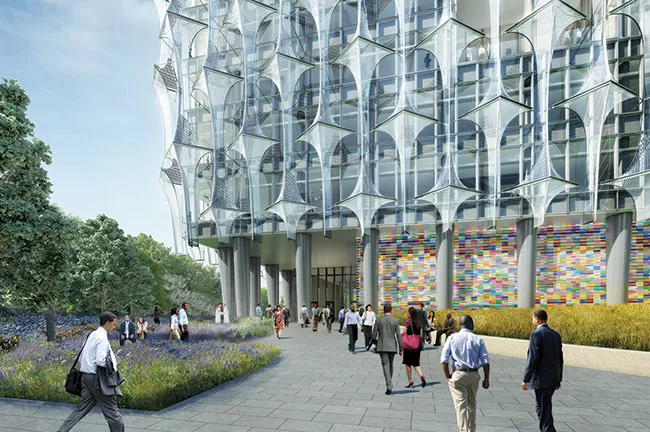
For the new U.S. Embassy in London, designed by KieranTimberlake and scheduled for completion in 2017, a 12-story glass cube will be wrapped in an outer envelope of translucent white kite-like components, linked to form a ridged lattice of four-point stars. The lattice, made of ethylene tetrafluoroethylene (ETFE) film, projects from the building’s curtain wall to reduce solar gain, cut glare, and admit an even, diffuse daylight, while still allowing occupants generous views of London. Photovoltaic cells on skyward surfaces of the ETFE elements will harvest solar energy, and the entire assembly will interrupt downdrafts for more comfortable outdoor spaces below. Not least, the outer envelope is intended to deter bird strikes.
London’s amateur ornithologists have inventoried a surprisingly large population of migratory and resident birds in the vicinity of the new embassy; there are even endangered redstarts nesting nearby. So birds will certainly be making themselves at home in the embassy’s OLIN-designed park, with its pond, gardens, shrubs, and trees.
“If you’re creating an attractant, you have to be very certain that you’re not also creating a hazard,” says Roderick Bates, a KieranTimberlake associate and author of the firm’s study on bird-strike deterrence.
In any bird-strike deterrent strategy, the height of the adjacent habitat defines the critical zone. As a general rule, that’s often a building’s lower three stories, or 40 feet above grade. The embassy’s approach to bird-friendly design, as well as its security strategy, keeps shrubs and trees away from the face of the building. A colonnade wrapping all four sides of the structure shades the upper portion of the ground-floor glass, thereby reducing reflections. By recessing the glass, the colonnade restricts the vantage points from which birds can see reflected habitat.
Above the ground floor, the ETFE lattice breaks up reflections on three sides of the building. On the north side, which has no outer envelope, a star-patterned frit generates the visual noise birds need to perceive the glass. The density of the frit is designed so that spaces between pattern elements are no bigger than “about the palm of a hand,” says Bates, which compares to the 2-by-4 rule’s 4-inch width for vertical spaces.
Although bird-safe design can successfully slip along in the wake of other priorities, some projects put bird safety front and center, treating it as an opportunity for architectural expression. For the Integrated Science Center (ISC) at Vassar College in Poughkeepsie, New York, the client “wanted us to use every [bird-friendly] trick in our bag,” says Guy Maxwell, a partner at Ennead, the firm designing the 157,000-square-foot facility slated to open later this year.
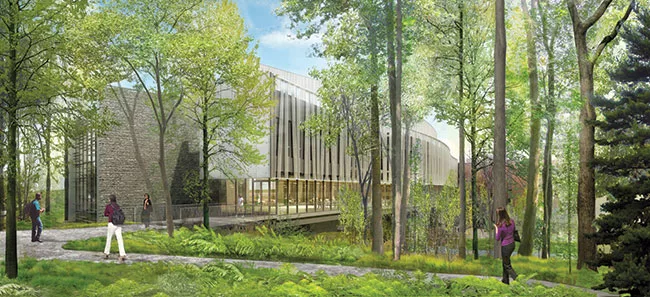
The ISC brings Vassar’s science departments together in a two-story structure that spans a small ravine and creek. The building, arched in plan, provides views into a wooded landscape and enables the students to use the surroundings as an outdoor lab.
From the perspective of bird safety, the arboretum setting means that any glass on the building’s facade will reflect attractive habitat and entice birds. To reduce the risk, the design team deployed bird-friendly strategies for each facade.
On the narrow southwest end of the building, a dense pattern of shading devices works to cut off the sky, providing elements that birds can see in front of the glass. On the convex southeast face of the building’s curved plan, a fully glazed corridor runs the length of the building at ground level. However, the overhang of the upper level recesses the glazing, limiting reflections of sky and narrowing the angle from which birds can see habitat reflections. On the upper levels, vertical shading fins similarly reduce reflections and birds’ angle of view to the glass.
“But that’s not enough,” says Maxwell. For the project’s southeast and north-facing glass, where views out to the landscape were especially desirable, the design team selected a glass treatment that takes advantage of birds’ ability to see ultraviolet (UV) light. The glazing includes a patterned 2-by-4-compliant UV-reflective coating on its number-two surface, so it’s visible to birds while remaining virtually invisible to humans.
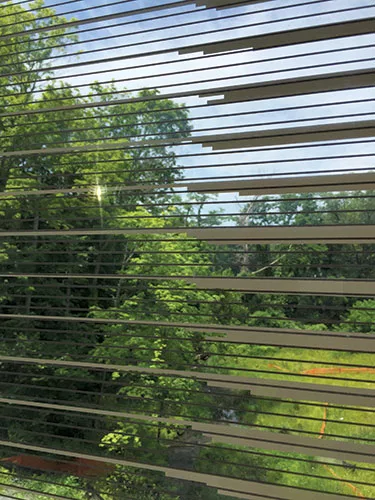
The concave northwest face of the building is composed of alternating vertical slices of cementitious panel-clad wall and glass. For this glazing, designers wanted a frit that would provide contrast no matter how the sunlight varied over the course of a day or a season. Their solution is an innovative dual frit: on the glazing unit’s number-two surface, light-gray broken horizontal lines at 2 inches on center; on the number-three surface (the cavity-facing side of the interior lite), dark-gray continuous horizontal lines at 5/8 of an inch on center. The two patterns, separated by the depth of the glazing-unit cavity, create an impression of movement, like a moiré. “Whatever the light,” says Maxwell, “at least one of these patterns will show up.”
The shared bird-safe priority of the ISC’s architects and clients affects more than the building’s facades: whether deliberately or not, the smooth arc of the building’s form, its slender hollow structural elements suspended from an overhead truss, and the lightness with which it touches the earth express an underlying affinity for the birds, who make their home in the site surrounding the ISC.
While daytime bird-friendly strategies offer scope for enriching a work of architecture, nighttime strategies are more simply a matter of preventing light pollution. At the ISC, for example, exterior uplighting is avoided altogether: shielded fixtures are used instead. LED downlights are embedded in entry-ramp handrails, safely lighting the path without spilling light into the environment. To minimize light trespass from the building’s windows, the main corridor will be illuminated at low levels, while occupancy sensors will shut off lighting in classrooms, labs, and offices when they’re not in use.
Light pollution’s greatest danger is to migrating birds, especially on overcast nights, when the birds descend to lower altitudes. The lights of tall buildings and brightly lit shorter buildings can draw birds in among the glass walls of a city, where trees and plants in illuminated interiors present a fatal attraction.
As awareness of this issue grows, jurisdictions across North America are increasingly adopting lights-out programs, design guidelines, and regulations to reduce bird strikes. LEED’s bird-strike deterrence pilot credit, rolled out in 2011, has proven to be the rating system’s most popular pilot ever.
These efforts acknowledge the tremendous value of birds. They pollinate plants, disperse seeds, and keep insects in check. They create flashes of experience for city dwellers that reconnect them to nature. They enliven the built environment with their flight, color, and song. And they’re entitled to life in their own right. Whatever goes into making a more bird-safe building, says Sheppard, they’re worth it.
Katharine Logan is an architectural designer and writer focusing on sustainability and wellbeing in the built environment.
|
Continuing Education
 To earn one AIA learning unit (LU), including one hour of health, safety, and welfare (HSW) credit, read “For the Birds,” review the supplemental material listed below, and complete the online test. Upon passing the test, you will receive a certificate of completion, and your credit will be automatically reported to the AIA. Additional information regarding credit reporting and continuing-education requirements can be found online at continuingeducation.bnpmedia.com. To earn one AIA learning unit (LU), including one hour of health, safety, and welfare (HSW) credit, read “For the Birds,” review the supplemental material listed below, and complete the online test. Upon passing the test, you will receive a certificate of completion, and your credit will be automatically reported to the AIA. Additional information regarding credit reporting and continuing-education requirements can be found online at continuingeducation.bnpmedia.com.
Supplemental Material
American Bird Conservancy LEED Pilot Credit 55: Bird Collision Deterrence U.S. Green Building Council Learning Objectives 1 Describe the factors that often make building glazing deadly for birds. 2 Outline some of the measures that can be implemented in new construction projects to prevent birds from colliding with buildings during daytime hours. 3 Describe bird-friendly measures that can be easily implemented on existing buildings. 4 Outline strategies for protecting migratory birds from nighttime building-related hazards AIA/CES Course #K1510A Take the Continuing Education Test |
Looking for a reprint of this article?
From high-res PDFs to custom plaques, order your copy today!