Architectural Record
search
cart
facebook twitter linkedin youtube
  • Sign In
  • Subscribe
  • Sign Out
  • My Account
Architectural Record
  • NEWS
    • Latest News
    • Awards
    • Interviews
    • Obituaries
    • Podcasts
      • Design:Ed Podcast
      • Sponsored Podcasts
  • OPINION
    • Book Reviews / Excerpts
    • Exhibition Reviews
    • Forum
  • EXCLUSIVES
    • Videos
    • Design Vanguard
    • Top 300 Firms
    • Sponsored Content
    • Sponsored eBooks
    • From the Archives
  • CONTINUING ED
    • Editorial Continuing Ed
    • CE Center
    • CE Academies
  • PROJECTS
    • Buildings By Type
    • Reuse & Renovation
    • Museums & Arts Centers
    • Colleges & Universities
    • Multifamily Housing
    • Interiors
    • Lighting
    • Kitchen & Bath
  • HOUSES
    • Record Houses
    • House of the Month
    • Featured Houses
  • PRODUCTS
    • Products by Category
    • Record Products of the Year
    • Latest Products
  • EVENTS
    • Dates & Events
    • Record on the Road
    • Innovation Conference
    • Sustainability in Practice
    • Women In Architecture
    • Webinars
    • Ad Excellence Awards
    • Submit an Event
  • CONNECT
    • Ask RECORD AI
    • Newsletters
    • Contact
    • Advertise
    • Editorial Calendar
    • Store
    • Customer Service
  • SUBMIT
    • Submission Guidelines
    • RECORD Competitions
  • MAGAZINE
    • Subscribe
    • My Account
    • Digital Edition
    • Current Issue
    • Firm Pass
    • Historic Archive

Modernism Endangered

Why are we so ambivalent about the architecture of the recent past?
By Edward Durell Stone
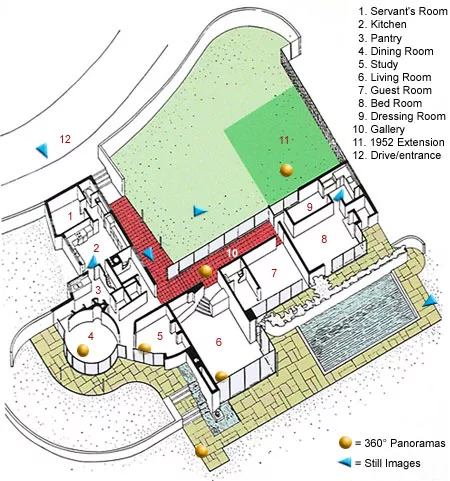
Goodyear house floor plan
Conger Goodyear House
Goodyear house floor plan
Conger Goodyear House
January 18, 2016

Robert A. M. Stern, an architect whose chameleon-like sense of style has brought him his own share of criticism, wrote a defense of Edward Durell Stone’s most controversial work, Two Columbus Circle. It is a building best referred to by its address, since its days as the Huntington Hartford gallery are long past, its more recent days as a home for a New York City cultural affairs department are also ended, and it now sits unoccupied and surrounded in chain link and bums, in the shadow of the nearly complete monolithic AOL Time Warner Center. Plans were released in the last several months to turn the bones of the building–but not its distinctive windowless shell–into a new home for the Museum of Arts and Design. So no one seems quite sure what to call it.

No one has ever seemed quite sure what to call it stylistically. Stone began his professional life as an International Style Modernist, as Stern points out in his brief essay, which is published on the homepage of Preserve & Protect. Stone’s design with Philip Goodwin for the Museum of Modern Art’s main building on 53rd St. is being preserved as part of a huge renovation project. But that building is a landmark, and happens to be owned by MoMA, an early proponent and usually staunch defender of Modernism.

Stone’s other work, including Two Columbus Circle with its cartoonish Venetian "lollipops," in Ada Louise Huxtable’s description, and its blank façade framed in portholes–this work is less well defended, and even, often, attacked. It is hard to deny that Two Columbus Circle is a unique building. One would imagine that this is reason enough for its preservation, but the design for the new Museum of Arts and Design, by Brad Cloepfil of Allied Works Architecture gives the building a new façade of glass. It is probably a more functional building the way Cloepfil envisions it. It may even be a better building. But it is not Stone’s building.

Cloepfil's design goes before the City Planning Commission on June 18th, 2003, in a hearing open to the public.

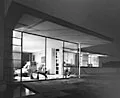
Two Columbus Circle, however, is squarely in the spotlight. Every New Yorker knows it. Every visitor who has taken a cab from Lincoln Center (another work of Modern architecture in danger of being lost) back to his hotel in Times Square can recognize it. Every conventioneer who went to an auto show at the old New York Coliseum knows it. But what about Stone’s other work? Who sees the Conger Goodyear House in Old Westbury, a suburb on Long Island? Only the neighbors, who look over its once-rural grounds from the windows of their McMansions. Robert Ivy, the editor in chief of Architectural Record, tells the story of the Conger Goodyear House in a recent editorial:

On Long Island, a coalition of forces has apparently saved the Conger Goodyear House, a 1938 gem by Edward Durell Stone for Goodyear, the first president of the Museum of Modern Art. In that more fortunate case, the World Monuments Fund, which had listed the Old Westbury, Long Island, house among its 2002 list of the "100 Most Endangered Sites," pulled together a funding group including the Barnett Newman Foundation, which purchased the house; the Monument Fund’s own capital, which will finance necessary repair work; and the Society for the Preservation of Long Island Antiquities of Cold Spring Harbor, which will hold title to the property until a permanent buyer can be found. International, national, and local resources–all three–were required.

In the summer of 2002, the World Monuments Fund opened the Conger Goodyear House to RECORD. In this feature, spectacular and fascinating three-dimensional walk-throughs allow anyone interested in the house can take a look around. In addition, in excerpts from his own writings, Edward Durell Stone discusses how the house came to be, and how its design took shape
 

Looking for quick answers on architecture and design topics?
Try Ask RECORD, our new smart AI search tool.
Ask RECORD →

KEYWORDS: modernism

Share This Story

Looking for a reprint of this article?
From high-res PDFs to custom plaques, order your copy today!

Edward Durell Stone (1902-1978). Born in Fayetteville, Arkansas, Stone studied art at the University of Arkansas, entered the School of Architecture at Harvard University, Cambridge, Massachusetts, and transferred to the Massachusetts Institute of Technology, Cambridge, to study modern design with Jacques Carlu. He toured Europe on a Rotch Traveling Fellowship and on returning to the United States assisted in the design of Radio City Music Hall in New York City.
Previous 1 2 3 4 Next

Post a comment to this article

Report Abusive Comment

Subscription Center
  • Create an Account
  • Start a Subscription
  • Manage My Account
  • Sign Up for Newsletters
  • Visit Customer Service
  • Update Preferences

More Videos

Sponsored Content

Sponsored Content is a special paid section where industry companies provide high quality, objective, non-commercial content around topics of interest to the Architectural Record audience. All Sponsored Content is supplied by the advertising company and any opinions expressed in this article are those of the author and not necessarily reflect the views of Architectural Record or its parent company, BNP Media. Interested in participating in our Sponsored Content section? Contact your local rep!

close
  • TAMLYN XtremeTrim Exterior Trim
    Sponsored byTamlyn

    Designing Cleaner Panel Facades: Why Exterior Trim Details Matter

  • Building with Vapor Barriers
    Sponsored byReef Industries, Inc.

    Vapor Barriers Help Control Moisture in Tighter Building Designs

  • Duct Interior with Prodeq System
    Sponsored byHenry, a Carlisle Company

    Designing Resilient Water Containment Systems

DESIGN:ED Podcast
Listen to Architectural Record’s DESIGN:ED Podcast

Events

June 10, 2026

Rethinking Stormwater – The Power of Porous Paving

Credits: 1 AIA LU/HSW; 1 AIBD P-CE; 0.1 ICC CEU

Learn how porous paving systems support stormwater management, reduce heat island effects, and enhance sustainable site design performance.

June 11, 2026

Very Early Warning Fire Detection for Mission-Critical Facilities

Credits: 1 AIA LU/HSW; 1 AIBD P-CE; 0.1 ICC CEU

Examine advanced fire detection strategies that support uptime and enhance safety in data centers and other mission-critical facilities.

View All Submit An Event

Products

2026 Architect's Square Foot Costbook

2026 Architect's Square Foot Costbook

See More Products

Popular Stories

Practice Matters illustration

What’s in a (Firm’s) Name? Thinking About Succession and Legacy

Practice Matters illustration

By the Numbers: Counting America's Architects

House on a Hill

Design Vanguard 2026: Forma

Crane Cove, ONO

Design Vanguard 2026 Winners

KRESA by DLR

In Kalamazoo, DLR Group Completes a Mass-Timber Hub for Career and Technical Education Programs

Broader Sustainability of CMU - Free Webinar - May 21, 2026

Related Articles

  • Selma Trail Campsite 1A

    America’s 11 Most Endangered Historic Places in 2021

    See More
  • National Trust Names 11 Most Endangered Sites

    See More
  • National Trust Announces 11 Most Endangered Sites

    See More
×

The latest news and information

#1 Source for Architectural Design, News and Products

SUBSCRIBE
  • RESOURCES
    • Advertise
    • Contact Us
    • Submit
    • Store
  • ACCOUNT CENTER
    • Create an Account
    • Start a Subscription
    • Manage My Account
    • Sign Up for Newsletters
    • Visit Customer Service
    • Update Preferences
  • PRIVACY
    • PRIVACY POLICY
    • TERMS & CONDITIONS
    • DO NOT SELL MY PERSONAL INFORMATION
    • PRIVACY REQUEST
    • ACCESSIBILITY
  • SERVICES
    • Marketing Services
    • Reprints
    • Market Research
    • List Rental
    • Survey/Respondent Access
  • STAY CONNECTED
    • Linkedin
    • Facebook
    • Instagram
    • YouTube
    • X (Twitter)

Copyright ©2026. All Rights Reserved BNP Media, Inc. and BNP Media II, LLC.

Design, CMS, Hosting & Web Development :: ePublishing