In the Cause of Architecture, VII: The Meaning of Materials—Concrete
An essay from August, 1928, by Frank Lloyd Wright.
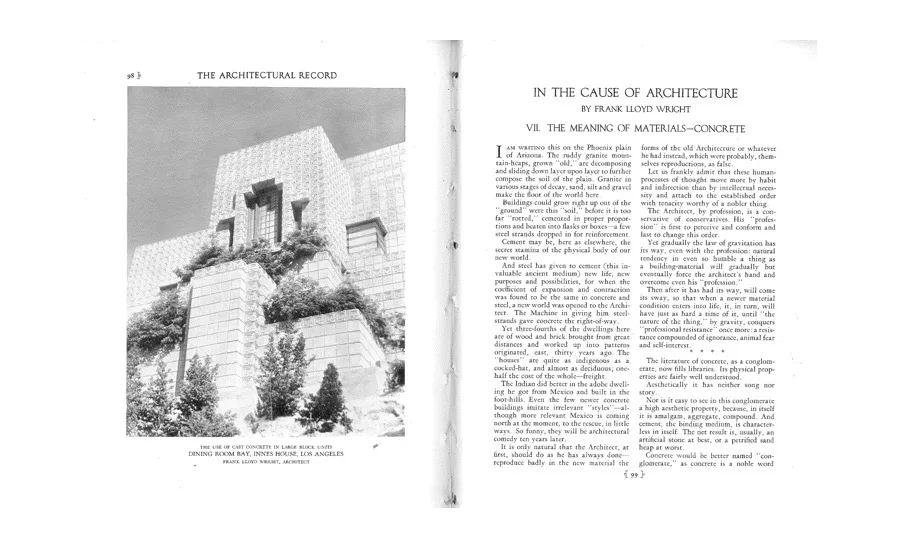
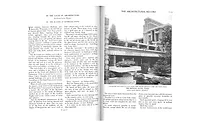
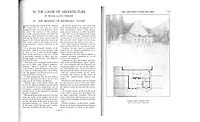
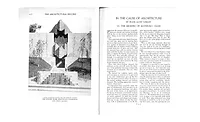
From Architectural Record, August, 1928. Read a PDF of the original article here.
I am writing this on the Phoenix plain of Arizona. The ruddy granite mountain-heaps, grown “old,” are decomposing and sliding down layer upon layer to further compose the soil of the plain. Granite in various stages of decay, sand, silt and gravel make the floor of the world here.
Buildings could grow right up out of the “ground” were this “soil,” before it is too far “rotted,” cemented in proper proportions and beaten into flasks or boxes – a few steel strands dropped in for reinforcement.
Cement may be, here as elsewhere, the secret stamina of the physical body of our new world.
And steel has given to cement (this invaluable ancient medium) new life, new purposes and possibilities, for when the coefficient of expansion and contraction was found to be the same in concrete and steel, a new world was opened to the Architect. The Machine in giving him steel-strands gave concrete the right-of-way.
Yet three-fourths of the dwellings here are of wood and brick brought from great distances and worked up into patterns originated, east, thirty years ago. The “houses” are quite as indigenous as a cocked-hat, and almost as deciduous; one-half the cost of the whole – freight.
The Indian did better in the adobe dwelling he got from Mexico and built in the foot-hills. Even the few newer concrete buildings imitate irrelevant “styles” – although more relevant Mexico is coming north at the moment, to the rescue, in little ways. So funny, they will be architectural comedy ten years later.
Looking for quick answers on architecture and design topics?
Try Ask RECORD, our new smart AI search tool.
Ask RECORD →
It is only natural that the Architect, at first, should do as he has always done – reproduce badly in the new material the forms of old Architecture or whatever he had instead, which were probably, themselves reproductions, as false.
Let us frankly admit that these human-processes of thought move more by habit and indirection than by intellectual necessity and attach to the established order with tenacity worthy of a nobler thing.
The Architect, by profession, is a conservative of conservatives. His “profession” is first to perceive and conform and last to change this order.
Yet gradually the law of gravitation has its way, even with the profession: natural tendency in even so humble a thing as building-material will gradually but eventually force the architect’s hand and overcome even his “profession.”
Then after it has had its way, will come its sway, so that when a newer material condition enters into life, it, in turn, will have just as hard a time of it, until “the nature of the thing,” by gravity, conquers “professional resistance” once more: a resistance compounded of ignorance, animal fear and self-interest.
* * * *
The literature of concrete, as a conglomerate, now fills libraries. Its physical properties are fairly well understood.
Aesthetically it has neither song nor story.
Nor is it easy to see in this conglomerate a high aesthetic property, because, in itself it is amalgam, aggregate, compound. And cement, the binding medium, is characterless in itself. The net result is usually an artificial stone at best, or a petrified sand heap at worst.
Concrete would be better named “conglomerate,” as concrete is a noble word which this material fails to live up to. It is a mixture that has little quality in itself.
If this material is to have either form, texture or color in itself, each must artificially be given to it, by human imagination.
This it is one of the insensate brute materials that is used to imitate others.
“Concrete” – so called – must submit to the “artistic” at the hands of any parlor-architect or interior desecrator and, consequently seldom have life of its own worthy a substance so obedient and useful.
As a material it is its misfortune to project as wooden beams, travel molded as cornices. Yet it will faithfully hang as a slab, stand delicately perforated like a Persian faience screen or lie low and heavily in mass upon the ground. Again, unluckily, it will stand up and take the form (and texture too) of wooden posts and planks. It is supine, and sets as the fool, whose matrix receives it, wills.
When, and as, he has made up his mind to his “taste,” it will set into whatever shape may be, and will then go to work with steel strands for sinews, and do mighty things. When aged it becomes so stubborn that it would cost more to remove the structure often, than the ground upon which it stands might be worth.
Surely, here, to the creative mind, is temptation. Temptation to rescue so honest a material from degradation. Because here in a conglomerate named “concrete” we find a plastic material, that as yet has found no medium of expression that will allow it to take plastic form. So far as it is now used it might be tallow, cast-iron or plaster, poured into molds and at the mercy of their shape.
Therefore its form is a matter of this process of casting rather than a matter of anything at all derived from its own nature. Because it is thus, universally, at the mercy of demoralizing extraneous influences, it is difficult to say what is “concrete” form and what is not.
But certain truths regarding the material are clear enough. First, it is a mass-material; second, an impressionable one as to surface; third, it is a material which may be continuous or monolithic within certain very wide limits; fourth, it is a material that may be chemicalized colored or rendered impervious to water: it may be dyed or textured in the stuff; fifth, it is a willing material while fresh, fragile when still young, stubborn when old, lacking always in tensile strength.
Looking for a reprint of this article?
From high-res PDFs to custom plaques, order your copy today!