Architectural Record
search
cart
facebook twitter linkedin youtube
  • Sign In
  • Subscribe
  • Sign Out
  • My Account
Architectural Record
  • NEWS
    • Latest News
    • Awards
    • Interviews
    • Obituaries
    • Podcasts
      • Design:Ed Podcast
      • Sponsored Podcasts
  • OPINION
    • Book Reviews / Excerpts
    • Exhibition Reviews
    • Forum
  • EXCLUSIVES
    • Videos
    • Design Vanguard
    • Top 300 Firms
    • Sponsored Content
    • Sponsored eBooks
    • From the Archives
  • CONTINUING ED
    • Editorial Continuing Ed
    • CE Center
    • CE Academies
  • PROJECTS
    • Buildings By Type
    • Reuse & Renovation
    • Museums & Arts Centers
    • Colleges & Universities
    • Multifamily Housing
    • Interiors
    • Lighting
    • Kitchen & Bath
  • HOUSES
    • Record Houses
    • House of the Month
    • Featured Houses
  • PRODUCTS
    • Products by Category
    • Record Products of the Year
    • Latest Products
  • EVENTS
    • Dates & Events
    • Record on the Road
    • Innovation Conference
    • Sustainability in Practice
    • Women In Architecture
    • Webinars
    • Ad Excellence Awards
    • AIA 2026 Videos
    • Submit an Event
  • CONNECT
    • Ask RECORD AI
    • Newsletters
    • Contact
    • Advertise
    • Editorial Calendar
    • Store
    • Customer Service
  • SUBMIT
    • Submission Guidelines
    • RECORD Competitions
  • MAGAZINE
    • Subscribe
    • My Account
    • Digital Edition
    • Current Issue
    • Firm Pass
    • Historic Archive
Record Interiors

Bape Shibuya

With movement, light, and sound, Wonderwall creates a sensory shopping environment for a bathing ape in Tokyo’s Shibuya district.
By Naomi Pollock, FAIA
Bape Shibuya

Photo © Kozo Takayama

Bape Shibuya

Photo © Kozo Takayama

Bape Shibuya

Photo © Kozo Takayama

Bape Shibuya

Photo © Kozo Takayama

Bape Shibuya

Photo © Kozo Takayama

Bape Shibuya

Photo © Kozo Takayama

Bape Shibuya

Photo © Kozo Takayama

Bape Shibuya
Bape Shibuya
Bape Shibuya
Bape Shibuya
Bape Shibuya
Bape Shibuya
Bape Shibuya
September 1, 2008

Architects & Firms

Wonderwall

Shibuya, Tokyo, Japan

People/Products

This is an excerpt of an article from the September 2008 edition of Architectural Record.


In 1993, when the hip-hop-inspired hoodies, sneakers, and T-shirts of A Bathing Ape (aka BAPE) first began appearing on the back streets of Tokyo’s edgy Urahara neighborhood, their designer never dreamed his clothes would be sold next door to The Gap, Uniqlo, and other mass-market retailers. But more than a decade and 40-plus BAPE outlets later, including stores in Hong Kong and New York City, the DJ-turned-fashionista known as “Nigo” decided it was time to take on Shibuya. Yet the move into this trendy but mainstream Tokyo shopping and entertainment district posed a conflict: While the central location offered increased exposure, it also threatened the brand’s exclusive aura. Fortunately, Nigo’s longtime interior design collaborator, Masamichi Katayama, of the Tokyo firm Wonderwall, had the solution.

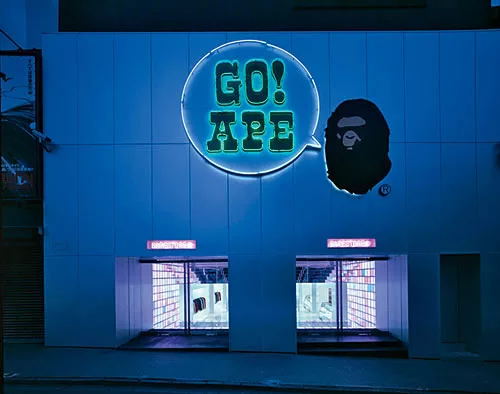
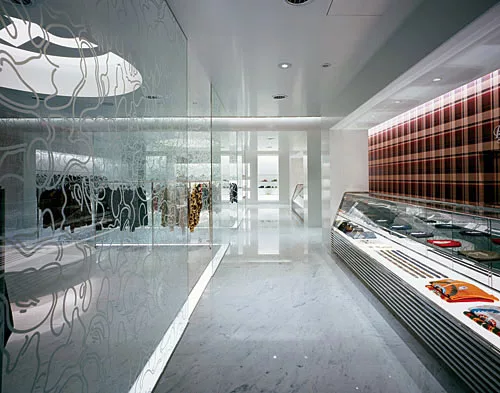
“Because BAPE is already an established brand with a loyal following, we thought we could do something extreme,” says Katayama. The Shibuya store, opened in late 2007, departs from the stark white and spaceshiplike BAPE boutiques that came before. Although the shop meets the street with a poker-faced wall devoid of identification aside from the brand’s simian mascot mouthing the words “Go Ape,” a dazzling light show visible through the glass doors pulls shoppers inside.

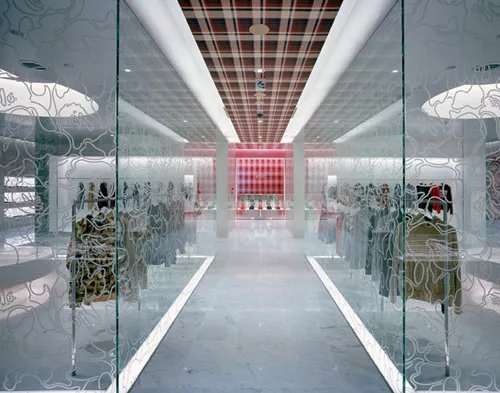
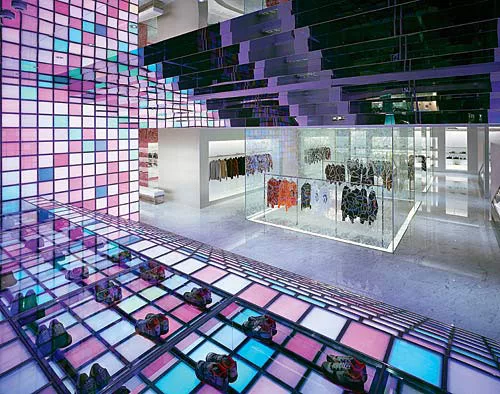
Like a giant Tetris game, a grid of flashing LED fixtures lines the walls and floor of the 26-foot-wide entrance. The glazed squares switch colors in time to a pulsating beat, while limited-edition sneakers roll by on a conveyor belt beneath a swath of clear glass in the middle of the foyer floor. A mirrored stainless-steel ceiling tops off the whole shebang, producing enough sensory overload to rival the game center that once occupied the store’s 4,200-square-foot space at the base of architect Atsushi Kitagawara’s Rise Building (1986). Though not a treatise on energy conservation or sustainability, Katayama’s scheme clearly distinguishes the BAPE shop from the conventional, casual-wear stores nearby.

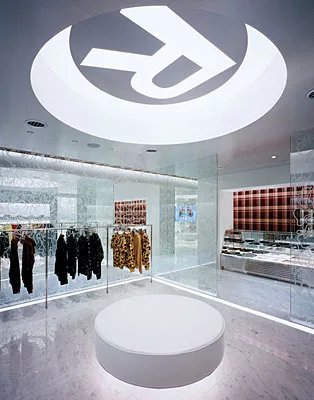
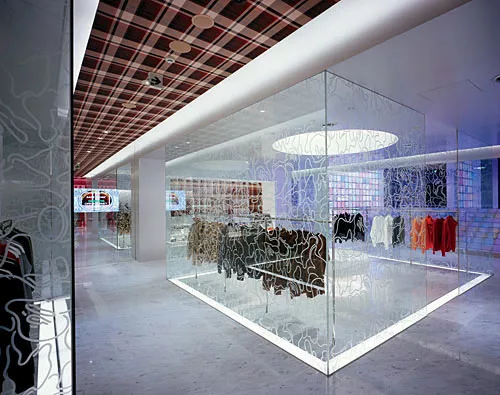
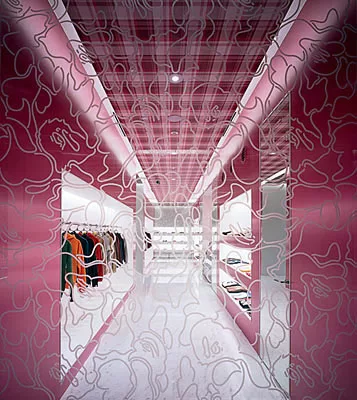
Beyond the threshold, the shopping floor unfolds a few steps below. Organized by a grid of internal “streets,” two glass-enclosed boxes dominate its core. These 13-by-17-foot rooms-within-a-room house the bulk of the menswear collection. Separated by walls of hanging racks and built-in shelves, back “alleys” contain women’s wear and service counters. Mirrored doors and partitions conceal the dressing rooms.

The shiny and reflective surfaces carry over into the boutique’s main body, where marble covers the floor, and silver and pink aluminum wall panels define the men’s and women’s areas, respectively. Other finishes incorporate graphics from the brand’s distinctive clothing, such as the signature camouflage pattern affixed to the glass boxes. Some motifs, like the plaid that covers ceiling panels and wall recesses, were created specifically for the project by BAPE’s graphic designers. The tartan pattern also adorns the boutique’s shopping bags.

Want the full story? Read the entire article in our September 2008 issue.

People

Designer

Wonderwall

Masamichi Katayama, founder


Interior designer

Masamichi Katayama/Wonderwall Inc.


Lighting

Masaki Yasuhara/Plus y


General contractor

D.BRAIN Co., Ltd.


Photographer

Kozo Takayama phone:81-3-6423-7830


Products

Façade:
Alminum alumite panel

Signage: neon, matte white melamin baking finish on steel(dialog baloon
base)

Entrances:
1)LED system stairs
*stainless steel hairline finish frame with tempered glass and white-translucent acrylic
* stair riser(to reflect the LED lighting system): stainless steel mirror finish
2)custom-made conveyer belt system under the tempered glass on the top   of stairs
3) ceiling: stainless steel mirror finish

Retail Area:
floor: white marble stone

wall1: aluminum alumite, wall paper( plaid pattern),clear glass, mirror

wall2: clear glass with custom made camouflage pattern with 3M film

ceiling: panting, wall paper(plaid pattern),aluminum alumite

Furniture(all custom designed by Wonderwall)

Rectangle bench- white enamel cover, stainless steel hairline finish

pedestal

Circle bench (within the glass box)- white enamel cover, stainless steel
mirror finish pedestal

Lighting:
Down light, indirect lighting, LED stairs

Materials(manufacturer= where they buy row materials and not the factory)

aluminum alumite(exterior, wall): CORONA KOGYO CO., LTD.
Glass(door, wall, glass for LED stairs etc): Nippon Sheet Glass Co., Ltd.

Hardware:
Locksets: MIWA LOCK Co.,Ltd.

Hinges: NEW STAR registered by NIPPON DOOR CHECK MFG. CO., LTD

Pulls: custom-made by D.Brain

Interior Finishes:
Audio: Lynn

Paints: KANSAI PAINT CO,.LTD.

Wallcoverings: original “Camo” pattern film: Sumitomo 3M Limited

wallpaper: Sumitomo 3M Limited

Floor and wall tile (white marble stone): ADVAN CO.,LTD.

Furnitures/Belt conveyer :
Custom made by D. Brain Co., Ltd.

 
KEYWORDS: Japan

Share This Story

Looking for a reprint of this article?
From high-res PDFs to custom plaques, order your copy today!
Contributing Editor Naomi Pollock, FAIA, is the author of Japanese Design Since 1945: A Complete Sourcebook and the forthcoming Vanishing Japan: Modern Architecture Gone But Not Forgotten,

Post a comment to this article

Report Abusive Comment

Subscription Center
  • Create an Account
  • Start a Subscription
  • Manage My Account
  • Sign Up for Newsletters
  • Visit Customer Service
  • Update Preferences

More Videos

Sponsored Content

Sponsored Content is a special paid section where industry companies provide high quality, objective, non-commercial content around topics of interest to the Architectural Record audience. All Sponsored Content is supplied by the advertising company and any opinions expressed in this article are those of the author and not necessarily reflect the views of Architectural Record or its parent company, BNP Media. Interested in participating in our Sponsored Content section? Contact your local rep!

close
  • 3D configurator
    Sponsored byDoorBird

    How DoorBird’s 3D Configurator Is Redefining Customization Across Residential and Commercial Design

  • interior of modern office
    Sponsored byCurrent

    The Downlight's Second Life: Why Below-Ceiling Serviceability Is the Specification Detail That Matters Most

  • cold storage facility
    Sponsored byCarlisle SynTec Systems

    How Architects Can Design More Continuous Cold Storage Envelopes

DESIGN:ED Podcast
Listen to Architectural Record’s DESIGN:ED Podcast

Events

July 22, 2026

Water Containment Waterproofing: Best Practices and System Selection

Credits: 1 AIA LU/HSW; 1 AIBD P-CE; 0.1 ICC CEU

Examine waterproofing strategies for water containment structures that enhance durability, prevent failures, and support long-term building performance.

July 29, 2026

Adaptive Reuse Reimagined: Designing Multifamily Housing from Existing Buildings

Credits: 1 AIA LU/HSW; 1 AIBD P-CE; 0.1 ICC CEU; 1 IIBEC CEH

Examine adaptive reuse envelope strategies that improve energy performance, preserve architectural character, and transform existing buildings into high-performing multifamily housing.

View All Submit An Event

Products

2026 Architect's Square Foot Costbook

2026 Architect's Square Foot Costbook

See More Products

Popular Stories

7480 N Delaware

A Portland Apartment Building by Daniel Toole Architecture Stands as a Study in Adaptation

Bergen complex frontage

Brooklyn’s Bergen Establishes Place with a Modulated Concrete Facade and an Idyllic Garden

Chacarita Alta Housing

In Paraguay’s Capital, MOS and Adamo-Faiden Rethink Public Housing for Residents of Informal Settlements

Kaya, San Diego

With San Diego’s Kaya, Jeff Svitak Melds Housing Density with Community

The Bend in Winnipeg, Canada

The Bend Wraps an Adapted Winnipeg Warehouse, Adding Apartments and Defining Public Space

Water Containment Waterproofing: Best Practices and System Selection - Free Webinar - July 22, 2026

Related Articles

  • Kyoto Hyoto

    An Elaborate Array of Wood and Aluminum-Mesh Panels Fills a Soaring Eatery in Osaka

    See More
  • Ando Museum

    See More
×

The latest news and information

#1 Source for Architectural Design, News and Products

SUBSCRIBE
  • RESOURCES
    • Advertise
    • Contact Us
    • Submit
    • Store
  • ACCOUNT CENTER
    • Create an Account
    • Start a Subscription
    • Manage My Account
    • Sign Up for Newsletters
    • Visit Customer Service
    • Update Preferences
  • PRIVACY
    • PRIVACY POLICY
    • TERMS & CONDITIONS
    • DO NOT SELL MY PERSONAL INFORMATION
    • PRIVACY REQUEST
    • ACCESSIBILITY
  • SERVICES
    • Marketing Services
    • Reprints
    • Market Research
    • List Rental
    • Survey/Respondent Access
  • STAY CONNECTED
    • Linkedin
    • Facebook
    • Instagram
    • YouTube
    • X (Twitter)

Copyright ©2026. All Rights Reserved BNP Media, Inc. and BNP Media II, LLC.

Design, CMS, Hosting & Web Development :: ePublishing