New Songdo City, South Korea
A Green City Rises: Inspired by precedents from around the world, New Songdo City emerges near Incheon International Airport as an up-and-coming bustling business hub primed to bring South Korea’s struggling economy back on track.
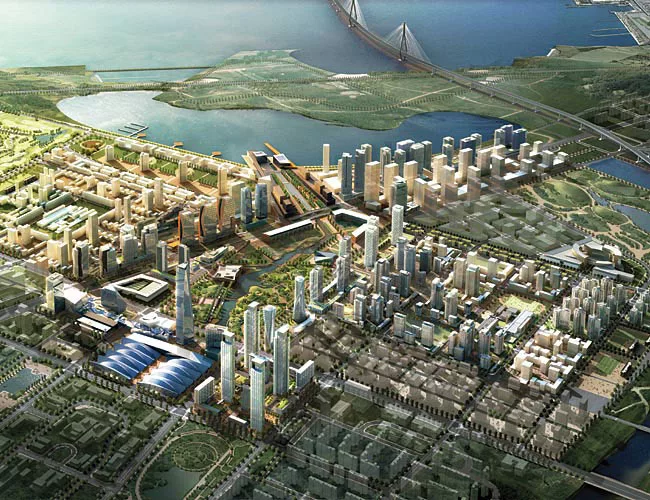
Strategically situated just a short distance from the airport across a suspension bridge, New Songdo City is intended to become an international business hub within easy access of neighboring Asian cities. Propagating outward from Central Park, the city consists of a patchwork of neighborhoods laced together with pedestrian-friendly, tree-lined avenues and broad boulevards created in response to South Korea’s enduring enthusiasm for car travel.
Rendering courtesy KPF
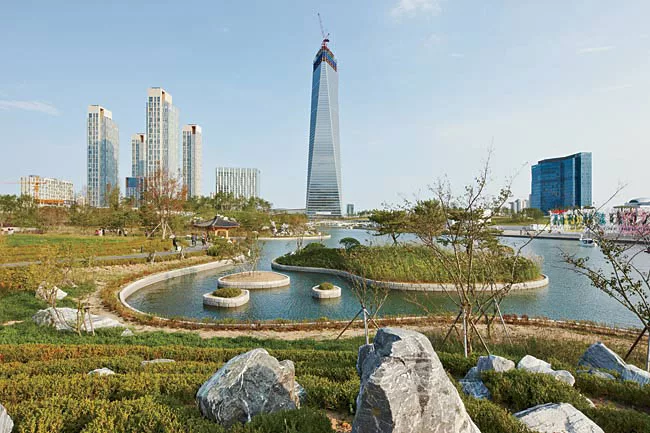
The tallest building in South Korea, the 68-story Northeast Asia Trade Tower stands out as a landmark on the New Songdo City skyline. Symbolizing the city’s mission to promote international trade, it occupies a key position next to the convention center at the end of the canal that runs through Central Park. Changing shape from a quadrilateral to a triangular plan as it ascends, the skyscraper contains offices below coupled with hotel and service apartments above, where the tower tapers. While the building’s striking form responds to the clients’ goal of architectural innovation for individual buildings, high-performance glazing and exterior shading devices help satisfy the request for lowered energy consumption by reducing solar heat gain and cooling loads. Heerim Architects was the associate architect.
Photo © H.G. Esch
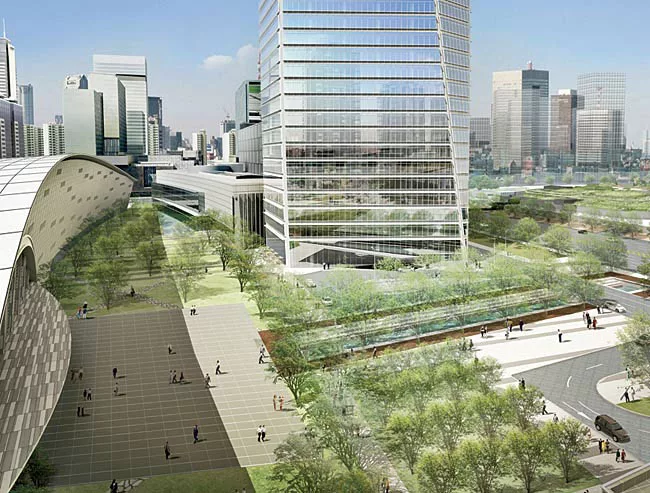
The tallest building in South Korea, the 68-story Northeast Asia Trade Tower stands out as a landmark on the New Songdo City skyline. Symbolizing the city’s mission to promote international trade, it occupies a key position next to the convention center at the end of the canal that runs through Central Park. Changing shape from a quadrilateral to a triangular plan as it ascends, the skyscraper contains offices below coupled with hotel and service apartments above, where the tower tapers. While the building’s striking form responds to the clients’ goal of architectural innovation for individual buildings, high-performance glazing and exterior shading devices help satisfy the request for lowered energy consumption by reducing solar heat gain and cooling loads. Heerim Architects was the associate architect.
Photo © KPF
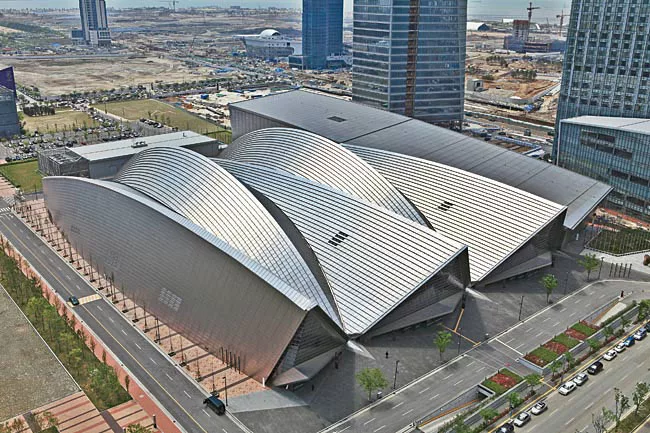
The defining elements of the Songdo Convention Center are folded, steel roofs that come to three prowlike points. In between the sharply angled planes, curved roofs reminiscent of boat hulls cap the major programmatic pieces: exhibition halls, preparation areas, and support spaces. Baum Architects and Heerim Architects were the associate architects.
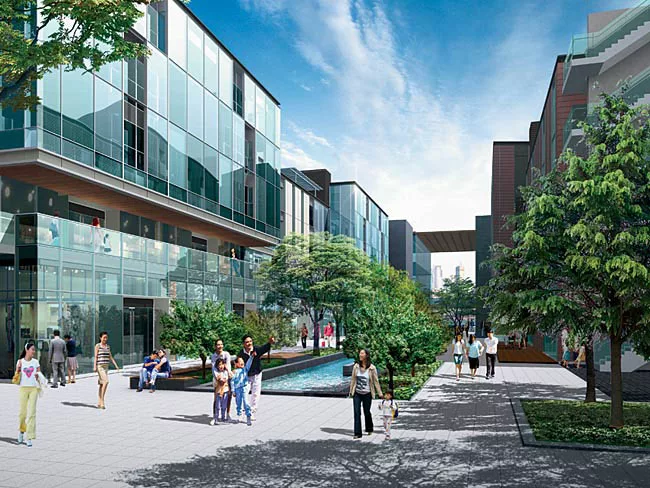
A pedestrian promenade alongside water, Songdo Canal Walk is a mixed-use development combining retail at grade with loftlike units for residences and offices above. JINA Architects was the associate architect.
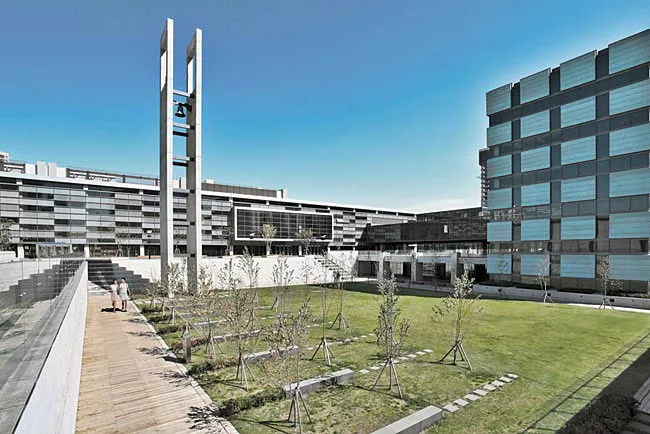
An international K–12 school, this project was inspired by traditional Korean palace and garden design. An elegant concrete bell tower stands in the sunken courtyard unifying the campus. Gansam Partners served as the associate architect.
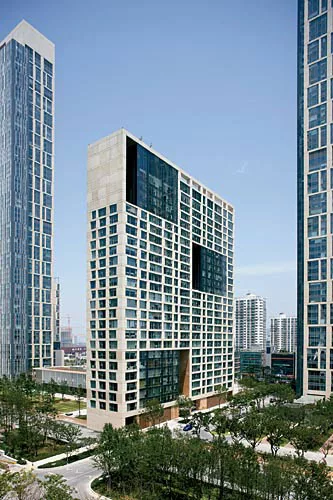
When realizing an entire city, it is hard to make progress by constructing one tiny building at a time, says KPF’s James von Klemperer — especially in South Korea, where superblocks abound. So, KPF and its associate architect Kunwon Architects created First World Towers, the city’s first completed residential project. While mixed building heights, exterior finishes, and permeability break down the overall volume, connected courtyards and water elements enrich the ground plane.
Photo © Jae Sung
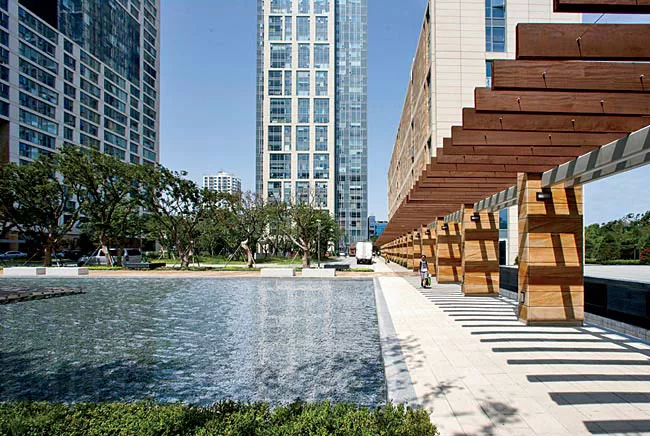
When realizing an entire city, it is hard to make progress by constructing one tiny building at a time, says KPF’s James von Klemperer — especially in South Korea, where superblocks abound. So, KPF and its associate architect Kunwon Architects created First World Towers, the city’s first completed residential project. While mixed building heights, exterior finishes, and permeability break down the overall volume, connected courtyards and water elements enrich the ground plane.
Photo © Jae Sung
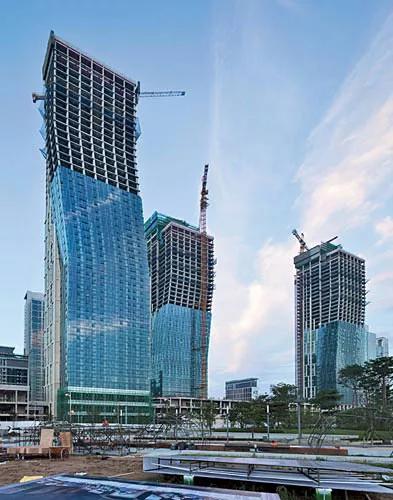
The second of three mixed-use projects designed by HOK, Central Park II consists of a commercial base with three residential towers above. The south-facing towers all front the park with shifting, sculptural glass volumes.
Photo © Yoon Joonhwan
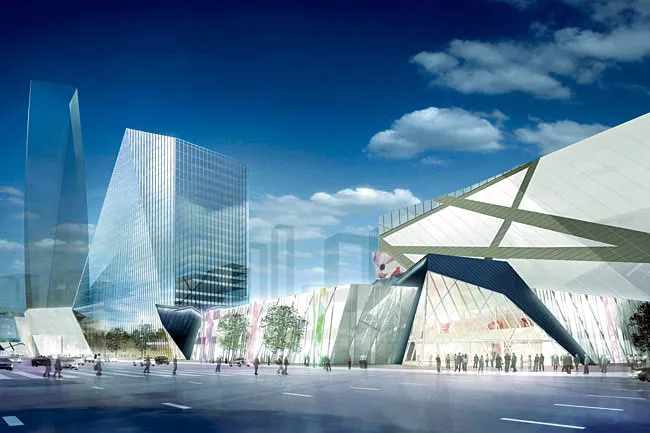
A retail and entertainment center designed by Studio Daniel Libeskind, Riverstone is next in the construction queue. Located amid the city’s commercial zone opposite Central Park, the complex includes a department store, cinema, ice-skating rink, and food court. Reminiscent of the dramatic South Korean landscape, it consists of jagged volumes that guide the flow of pedestrian traffic like rocks in a riverbed.
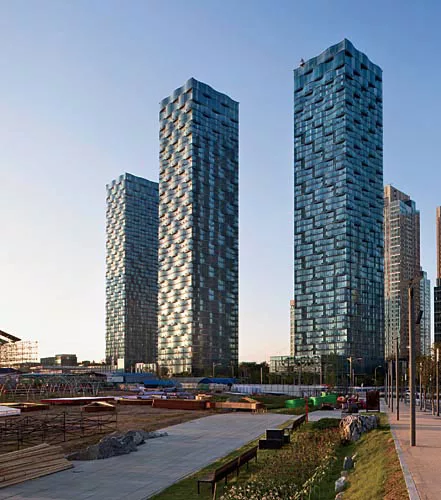
The first of several projects by HOK, Central Park I consists of three 50-story residential towers atop a three-story commercial/retail base that defines the street wall facing Central Park. Each tower is clad with a basket-weave facade composed of glass and aluminum.
Photo © Yoon Joonhwan
These days, plans for creating entire cities from the ground up do not surprise us, but South Korea’s New Songdo City (NSC) does. It has a clear purpose to attract foreign investment; it has an ideal geographic location near Seoul’s Incheon International Airport; and its design champions innovation and sustainability in accordance with LEED standards. The first foreign real estate acquisition in Korea, this massive project is a joint venture between POSCO E & C, the South Korean steel giant’s construction division, and the U.S. developer Gale International, which appointed the New York firm Kohn Pedersen Fox (KPF) to spearhead the design. With KPF’s master plan and many of its landmark components already in place, the project is off to a strong start. But the question remains how it will finish.
Approached from the 7 1⁄2-mile-long suspension bridge connecting to the airport, NSC emerges from the coastal fog like a mirage. The most striking feature is KPF’s 68-story Northeast Asia Trade Tower, South Korea’s tallest building to date. Multiblock housing by HOK and the tree-studded Central Park gradually come into focus as the air clears. But they vie for attention with vast stretches of still-empty land and the broad boulevards binding everything together. Already well trafficked, the roads are the most visibly populated part of town. Though NSC has yet to acquire the vibe of a bustling urban center, it is also hard to imagine that only a few years ago, the 1,500-acre reclaimed site did not exist.
While South Korea has been engaged in large-scale landfill construction since the 1970s, necessitated by a shortage of buildable area near the nation’s capital, the impetus for building NSC came after the South Korean economy hit the skids in 1997. At the urging of the International Monetary Fund, the South Korean government designated the site as a free economic zone with a full-fledged city to attract foreign investment. To jump-start the influx of money from abroad, the government made an unprecedented move by selling the land to this private, international joint venture and putting the new owners in charge of the city’s development. “Basically, it is a free-market experiment,” says KPF principal James von Klemperer, FAIA.
Given its lack of overseas experience, Gale was an unlikely partner for POSCO. But the challenge and opportunity to build a whole city from scratch — schools, museums, shopping, and entertainment, as well as housing and offices — was too good for the American developer to pass up.
The firm’s approach entailed synthesizing a number of complex conditions, such as building codes and infrastructure elements prescribed by local authorities; programmatic requirements stipulated by the client with guidance from the South Korean government; and common market practices, including the South Korean penchant for multilane roads and megablocks many times the size of their Manhattan counterparts. Not to mention an ambitious conceptual agenda that championed architectural innovation and sustainability. “Because NSC is a kind of entrance to South Korea and meant to showcase the free economic zone, we had high standards for building quality,” explains S.J. Lee, professor of architecture and engineering at Yonsei University and a former government design review board member.
KPF’s design process began with the development of a hypothetical master plan authored by a small team of architects, engineers, and client representatives. Ten new teams then produced 18-blocks worth of building prototypes to probe the scheme’s strengths and weaknesses. “We needed to test densities, scale, and the feeling of material,” explains von Klemperer. Based on the findings, KPF adjusted its model, discarded the temporary architecture, and, in 2004, got approval from South Korean authorities to proceed.
Inspired by precedents from around the globe, KPF’s cityscape brings to mind London’s garden squares, Paris’s tree-lined boulevards, and the canals that once riddled Seoul. As in New York, the heart of the city is Central Park. Adapting traditional South Korean landscaping, KPF’s 100-acre green space incorporates indigenous geographic features in miniature — craggy granite mounds, topiaries shaped like tea bushes, and a saltwater canal symbolizing the country’s extensive waterfront.
Looking for quick answers on architecture and design topics?
Try Ask RECORD, our new smart AI search tool.
Ask RECORD →
The city’s tent-shaped density distribution peaks near the park, which is ringed with NSC’s tallest buildings. “In every major city, the most expensive real estate surrounds a park,” comments Charles Reid, executive vice president of design and construction at Gale International. Here, too, high-end office and residential towers face its greenery but will taper off as the city propagates outward, ending in a golf course at one end and a hospital at the other.
While this formation will yield a coherent, Manhattan-style skyline, KPF’s “planned heterogeneity” forms the guiding principle at ground level. It consists of a patchwork of distinct neighborhoods, each one traversable on foot in under 15 minutes and linked by public transportation. Within each sector, KPF specified volume and mass restrictions plus street-wall requirements, but left architectural decisions largely up to the local and foreign firms in charge of individual buildings.
“For us, a pedestrian city is the first measure of sustainability,” says von Klemperer. Because green thinking is fairly new to South Korea, the team adopted the American LEED system as its ecological design standard. In addition to designating 40 percent of the land area as open green space, the central, saltwater canal neither utilizes potable water nor freezes in winter, enabling it to host water taxis year-round. And the reuse of gray water plus a citywide, pneumatic garbage collection system are just two ways that NSC will handle waste efficiently. “Sustainability is no longer a footnote,” says Daniel Libeskind, the architect of Riverstone, a 1 1⁄2-million-square-foot shopping center slated to begin soon.
But high-quality, environmentally sensitive architecture and urban planning alone do not a city make. A lot of square footage was built here in a short time, yet NSC still needs a viable downtown where people do business. Despite brisk sales of housing units, the townscape seems underinhabited. Although the international school is poised to open, the city is short on cultural, entertainment, and shopping facilities. And unless the tax code changes, NSC is not likely to become the next Singapore anytime soon. Unquestionably, the economic downturn has not helped the cause. Yet construction has slowed, not stopped. “Based on satellite cities around Seoul, I think it is almost inevitable that people will move here,” says Lee. That may be. But whether NSC will reach its ambitious goals remains to be seen.
Looking for a reprint of this article?
From high-res PDFs to custom plaques, order your copy today!