Continuing Education: Masonry Construction
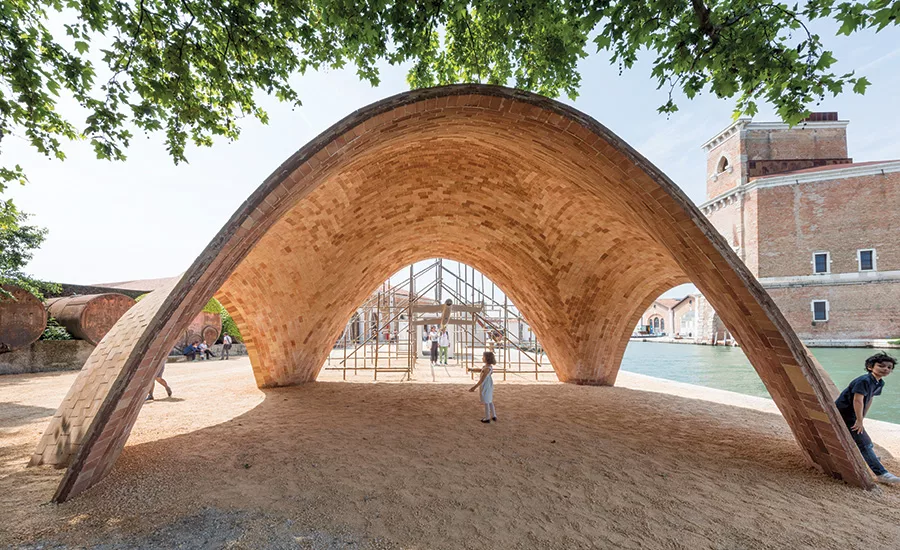
This past summer, a team of architects and engineers built an unusual brick vault at the Venice Biennale.
Photo © Nigel Young and The Norman Foster Foundation
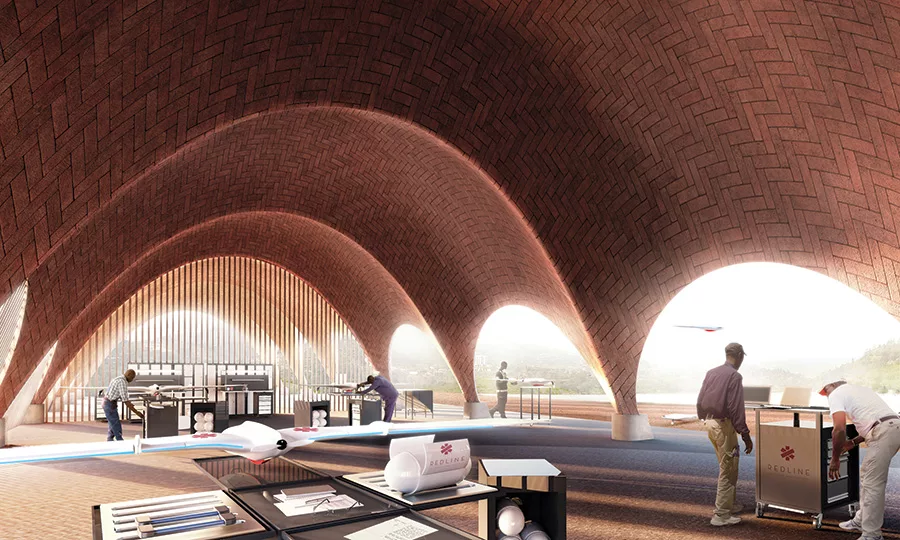
The structure was the first step in the creation of a network of cargo droneports for developing countries. The first facilities, planned for Rwanda, would be made of multiple vaults in a variety of configurations, depending on local needs.
Image courtesy Foster + Partners
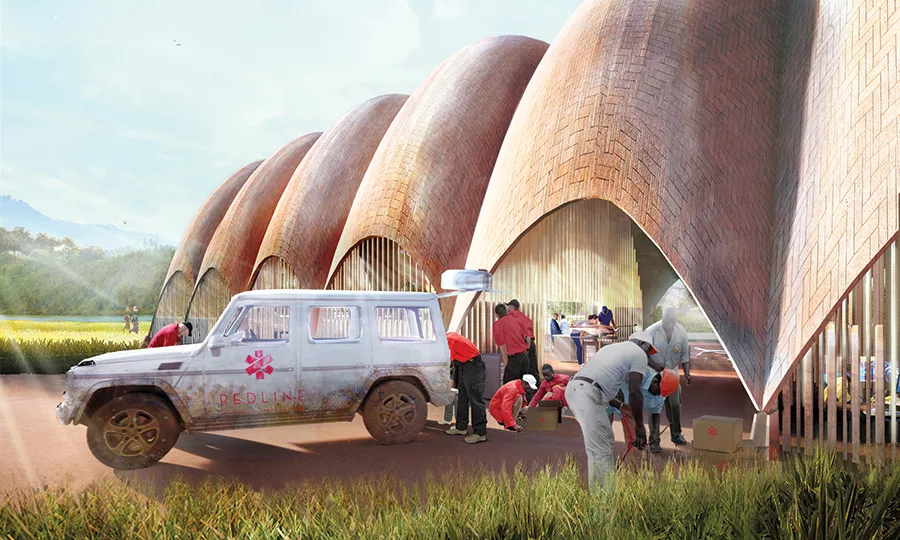
The structure was the first step in the creation of a network of cargo droneports for developing countries. The first facilities, planned for Rwanda, would be made of multiple vaults in a variety of configurations, depending on local needs.
Image courtesy Foster + Partners
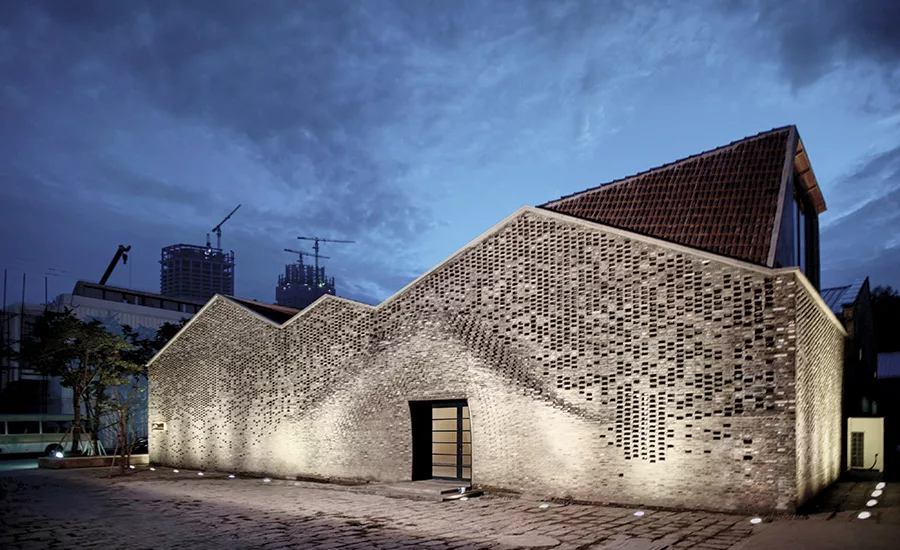
To convert an old industrial building in Shanghai into artists’ studios and a gallery, architects from Archi-Union salvaged the bricks from the original structure. They created the new undulating facade with the help of a bricklaying robot.
Photo © Brian Lin
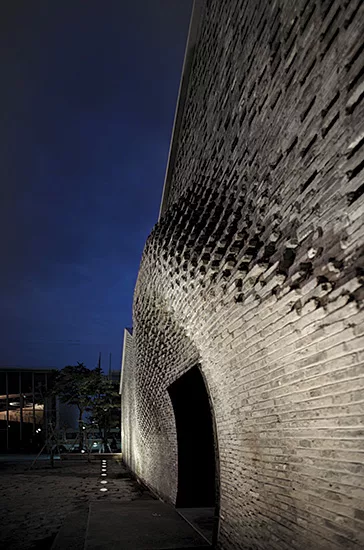
To convert an old industrial building in Shanghai into artists’ studios and a gallery, architects from Archi-Union salvaged the bricks from the original structure. They created the new undulating facade with the help of a bricklaying robot.
Photo © Brian Lin
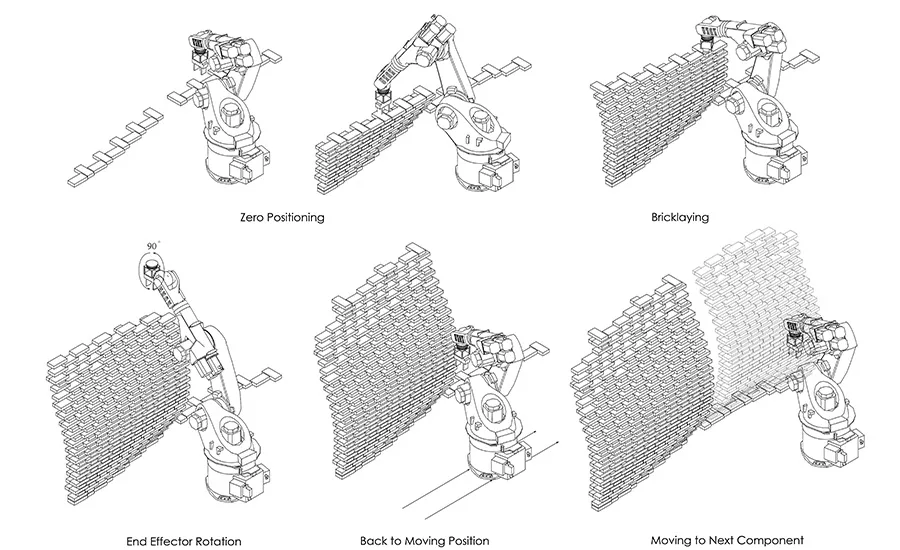
To convert an old industrial building in Shanghai into artists’ studios and a gallery, architects from Archi-Union salvaged the bricks from the original structure. They created the new undulating facade with the help of a bricklaying robot.
Image courtesy Archi-Union
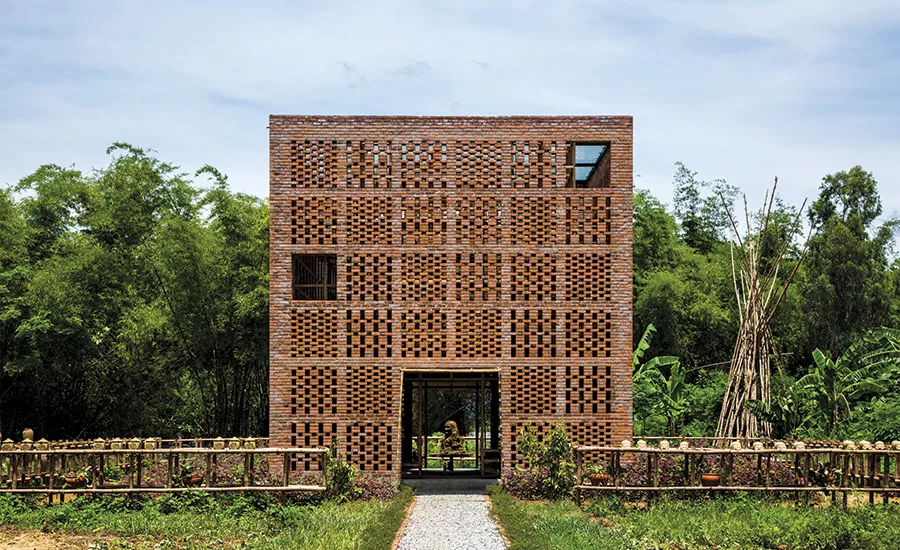
Tropical Studio organized the four walls enclosing a studio for a ceramist near Hoi An, Vietnam, so that they resemble a quilt, each with a grid of 36 squares. Within these squares, some bricks are omitted to create different patterns with various levels of transparency.
Photo © Oki Hiroyuki
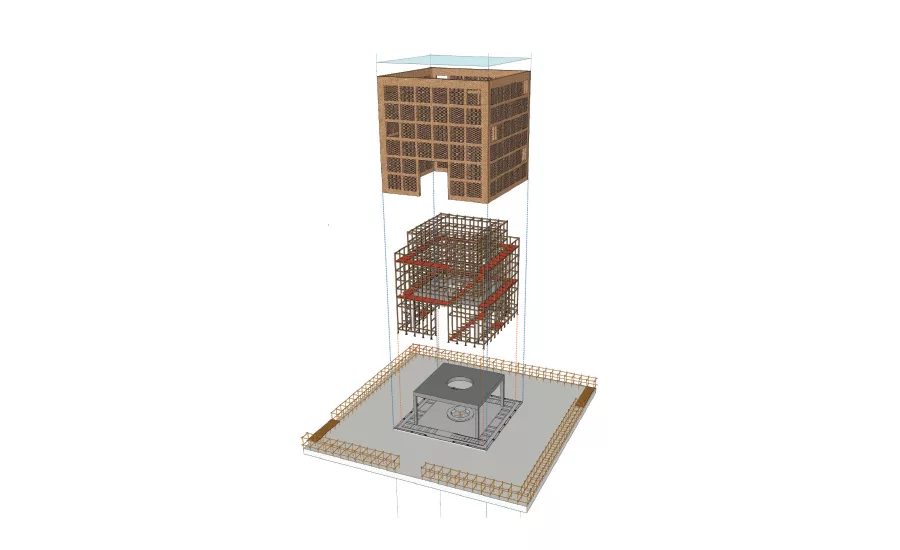
The cubic building’s layout recalls that of the region’s ancient Hindu temples.
Image courtesy Tropical Studio
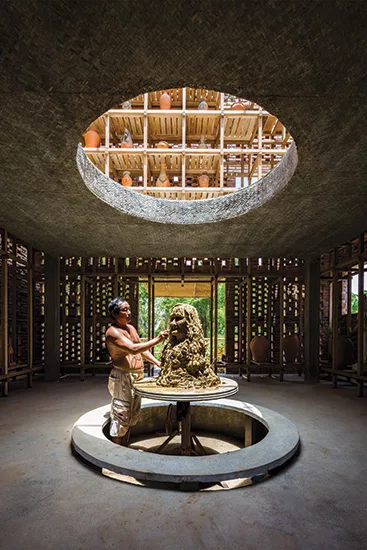
Inside the two-story ceramist’s studio, a stout 16-inch-thick slab is supported on four concrete columns.
Photo © Oki Hiroyuki
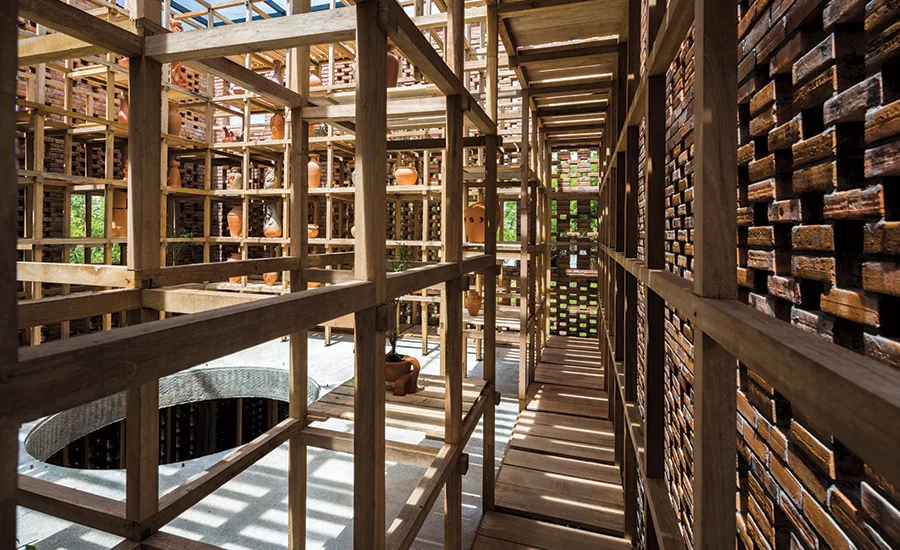
Between this slab and the exterior brick screen, a timber frame extends to a second level and to the building’s glass roof, housing stairs and shelves for display.
Photo © Oki Hiroyuki
Venice is a city built of bricks and one enriched by the wooden cargo ships that helped lift the former Venetian Republic to greatness. So it’s fitting that last May at the 2016 Venice Biennale, a handful of architecture and engineering students from the Massachusetts Institute of Technology and several European schools joined a team of professionals to build an experimental brick structure in the courtyard of the historic Arsenale, where naval and trading vessels were once constructed. Under the guidance of Foster + Partners architects, the team tested new approaches to traditional brick. Lord Norman Foster, known for his groundbreaking works in steel and glass, developed the design for the graceful, thin-shell masonry vault, demonstrating that common brick, with its durability, relatively low cost, and almost universal availability, continues to inspire form and innovation.
The vault built for the Biennale was a fullscale mockup of a cargo droneport and is an early step in the creation of a network of such facilities for developing countries. The concept is the brainchild of Jonathan Ledgard, director of the Ecole Polytechnique Federale de Lausanne’s Afrotech initiative and its offshoot Redline, a drone developer. The team is currently exploring sites for the first droneports in Rwanda, where, as in many emerging countries, roads are sparse and difficult to navigate. Cargo drones have the capacity to carry small freight such as medical supplies to remote places, and “leapfrog” over the lack of adequate infrastructure, says architect Narinder Sagoo, a partner at Foster + Partners.
Foster’s idea was to create a module that could be replicated and expanded by combining the units into different configurations, depending on local needs. In addition to housing drones and supplies, part of each facility could also serve community functions, such as a clinic or a post office.
The form of the droneport evolved from Foster’s revolutionary airport designs with their structurally expressive roofs. Similar to the firm’s upcoming airport for Mexico City, the droneport’s vaulted envelope “comes up from the ground and becomes the cladding and roof in one continuous system,” says Sagoo. “Instead of columns, slabs, and roofs, we wanted to create a model that is structurally efficient, maximizes spans, and is built with a single building system that is easy to construct.”
Following Foster’s mantra to “do more with less,” the architects worked with engineers from Cambridge, Massachusetts–based Ochsendorf DeJong and Block (ODB) early in the process to optimize the structure. Because the materials for making brick are readily available in Africa, the team decided to explore using an unreinforced masonry system.
The first step was a process that John Ochsendorf, an MIT professor of engineering and a partner in ODB, calls “form finding.” Because unreinforced masonry performs well in compression but not in tension, the engineers relied on digital models to find a geometry that works only in compression under all expected load conditions, Ochsendorf explains. The digital modeling tool they used is similar in concept to the famous experiments in which the Spanish architect Antonio Gaudí suspended chains to find the most efficient shape for arches and domes. When slung between two points, a string or chain will inflect to a curve, or catenary, that is uniformly loaded in tension. If that shape is inverted and constructed of a rigid material like masonry, it forms an efficient arch in compression.
The technique used to build the droneport is indebted to another Spaniard, Rafael Guastavino, who immigrated to the U.S. in the late 19th century. He developed a method of making thin-shelled masonry domes and vaults with little or no formwork. It relied on a quickdrying mortar to cantilever the tiles in place until the finished form was completed. Guastavino’s distinctive vaults were incorporated into many notable projects, including Grand Central Terminal in New York and the Boston Public Library.
Looking for quick answers on architecture and design topics?
Try Ask RECORD, our new smart AI search tool.
Ask RECORD →
To build the droneport mockup, Foster’s team erected scaffolding and light fiberglass poles sprung into arches every few feet in each direction. Over these temporary supports, they laid three layers of masonry, each at a different orientation, to increase strength.
The two outermost layers are made with an experimental 1½-inch-thick earthen brick, developed in collaboration with LafargeHolcim Foundation, a partner in the droneport project. Traditional air-cured earthen bricks, like adobe, typically consist of clay-based soil that contains sand or silt and organic material such as straw. Although easy to produce, these bricks are heavy and lack the strength, durability, and weather resistance of the kiln-fired variety. But those used for the Droneport include a small amount of Portland cement, which strengthens the bricks through a chemical curing process. The formula was conceived for situations where appropriate soils are plentiful but the resources for the energyintensive production and firing of traditional bricks are scarce.
Due to time and technical constraints on the Venice project, the designers specified a 1-inch-thick Spanish-fired brick for the prototype’s initial interior layer. Although the fiberglass poles and the steel for the scaffolding would be imported for the actual drone- ports, the idea is to rely on bricks made from raw materials found near the building site, Ochsendorf says.
Air-cured bricks that incorporate a small amount of cement have a significantly smaller carbon footprint than those that are fired. But researchers are studying ways to make modified earthen bricks even more green with additives that could replace the Portland cement, which has a high embodied energy due to a manufacturing process that includes heating limestone in a high-temperature kiln. MIT professor Elsa Olivetti, who teaches in the materials science department at MIT, is working with Ochsendorf to explore the potential of industrial by-products, such as boiler ash, which contains silicates and aluminates. These substances could chemically harden bricks in the same way that Portland cement does, but with fewer environmental consequences, she says.
One way to offset the negative impact of brick is to reuse it. That is what the architects, local firm Archi-Union, did for the Chi She Gallery in Shanghai. They repurposed much of a 70-year-old aircraft repair building, including the brick, and converted it into galleries and workspaces for several artists. Archi-Union stripped down the building to its concrete walls and floor slabs and raised the roof level to allow for a clerestory that lets daylight into an upper-level gallery. The ground level contains a multiuse space and studios.
The most distinctive feature of the project is the rippled brick facade. Made from the salvaged gray-green bricks of the original building, the non-load-bearing wall billows out over the entry. In addition to endowing the structure with a new sculptural presence, the designers made the facade appear lighter and screenlike near the top by omitting bricks in its Flemish bond (a pattern that alternates stretchers, or bricks laid flat with the long face exposed, with headers, or those turned so the short end is exposed).
To achieve the complex curvilinear geometry, the firm tapped into the new technology of robotic bricklaying, which is conceptually similar to CNC (computer numerical control) fabrication techniques. But instead of relying on machines for cutting, milling, or grinding, here a robotic arm was programmed to propel itself along a track while applying mortar to each brick and placing it with precision. Because the technology is not yet sufficiently developed to perform fine finishing tasks, masons followed behind the robot to strike, or shape, the mortar joints between the bricks.
For projects where crisp lines and uniformity are important, bricks that have a consistent hue and surface treatment are available and can be combined with robotic technology. But, like pottery, the elemental beauty of a hand-laid wall of bricks with subtle changes in color and texture is part of our 10,000-year love affair with the material. For a studio for ceramics artist Le Duc Ha near Hoi An, Vietnam, the architects at Ho Chi Minh City–based Tropical Studio show how simple forms can be enriched by taking advantage of variations in locally sourced brick as well as its potential for pattern-making and composition.
According to Tropical Studio principal Tran Thi Ngu Ngon, the firm envisioned the shape of the building as being as elemental and strong as the clay that forms the artwork. The cubic structure, 21 feet in all dimensions, contrasts with its pastoral setting, the edge of a field overlooking the Thu Bon River.
One goal was to relate the building to the historic brick construction of the region, says Nguyen Hai Long, a partner in the firm. Brick construction in central Vietnam dates to the 4th century, when the Champa culture began building Hindu temples in sacred complexes throughout the area, according to Nguyen. The site organization of the studio, with a path centered on the intricately detailed building, recalls the ceremonial layout of the Champa period.
The walls of the studio were constructed by first pouring a concrete frame for the exterior. To respond to the client’s desire that the studio provide shelter but be open to sunlight and cool river breezes, the architects devised a grid of openwork panels. Each wall is divided into 36 squares made up of several patterns of brick screens with various levels of transparency—created by leaving voids in the brickwork—fitted like patchwork pieces to make the larger square.
Masons laid the brick so that the concrete frame would be hidden both inside and out, with the brick sawed to fit around the concrete members. The resulting perforated walls are about 8 inches thick, the length of one brick.
Inside the two-story volume, four concrete columns support a stout 16-inch-thick concrete slab. Because the slab is separated from the brick walls by a 2-foot gap, it forms a tablelike pedestal between the lower and upper levels. A timber frame surrounds the workspace and passes up through the gap between the slab and the exterior wall to extend to a flat glass roof. This wooden matrix houses shelves for display and stairs to the upper level.
At the center of the ground floor, Le’s potter’s wheel sits directly below an oculus that penetrates the floor slab. Daylight fills the upper-level display space and focuses a Pantheon-like disk of light on the artist’s workspace below.
The elemental purity of the ceramist’s studio, along with the dynamic expression of the Shanghai gallery and the structural elegance of the droneport project, prove brick’s continued relevance. “Great buildings often go through considerable complexity to reach simplicity,” says Foster + Partners’ Sagoo. In selecting materials for these three projects, the designers found that simplicity in a humble and age-old material.
|
Continuing Education

To earn one AIA learning unit (LU), including one hour of health, safety, and welfare (HSW) credit, read “Brick by Brick,” review the supplemental material listed below, and complete the online test. Upon passing the test, you will receive a certificate of completion, and your credit will be automatically reported to the AIA. Additional information regarding credit-reporting and continuing-education requirements can be found online at continuingeducation.bnpmedia.com.
Supplemental Material Technical Notes on Brick Construction: Sustainability and Brick The Brick Industry Association
Learning Objectives 1 Describe different methods of building brick vaults. 2 Compare the environmental profile of air-cured, earthen brick with that of fired brick. 3 Describe efforts to enhance the durability and strength of air-cured, earthen brick. 4 Describe some of the limitations of robotic brick-laying technology.
AIA/CES Course #K1702A
For CEU credit, read "Brick by Brick" and take the quiz at continuingeducation.bnpmedia.com, or use our architectural record continuing-education app, available in the itunes store. structure, finishes, and other original fabric when
a building is moved.
significant buildings.
|
Looking for a reprint of this article?
From high-res PDFs to custom plaques, order your copy today!