Architectural Record
search
cart
facebook twitter linkedin youtube
  • Sign In
  • Subscribe
  • Sign Out
  • My Account
Architectural Record
  • NEWS
    • Latest News
    • Awards
    • Interviews
    • Obituaries
    • Podcasts
      • Design:Ed Podcast
      • Sponsored Podcasts
  • OPINION
    • Book Reviews / Excerpts
    • Exhibition Reviews
    • Forum
  • EXCLUSIVES
    • Videos
    • Design Vanguard
    • Top 300 Firms
    • Sponsored Content
    • Sponsored eBooks
    • From the Archives
  • CONTINUING ED
    • Editorial Continuing Ed
    • CE Center
    • CE Academies
  • PROJECTS
    • Buildings By Type
    • Reuse & Renovation
    • Museums & Arts Centers
    • Colleges & Universities
    • Multifamily Housing
    • Interiors
    • Lighting
    • Kitchen & Bath
  • HOUSES
    • Record Houses
    • House of the Month
    • Featured Houses
  • PRODUCTS
    • Products by Category
    • Record Products of the Year
    • Latest Products
  • EVENTS
    • Dates & Events
    • Record on the Road
    • Innovation Conference
    • Sustainability in Practice
    • Women In Architecture
    • Webinars
    • Ad Excellence Awards
    • Submit an Event
  • CONNECT
    • Ask RECORD AI
    • Newsletters
    • Contact
    • Advertise
    • Editorial Calendar
    • Store
    • Customer Service
  • SUBMIT
    • Submission Guidelines
    • RECORD Competitions
  • MAGAZINE
    • Subscribe
    • My Account
    • Digital Edition
    • Current Issue
    • Firm Pass
    • Historic Archive
Opinion

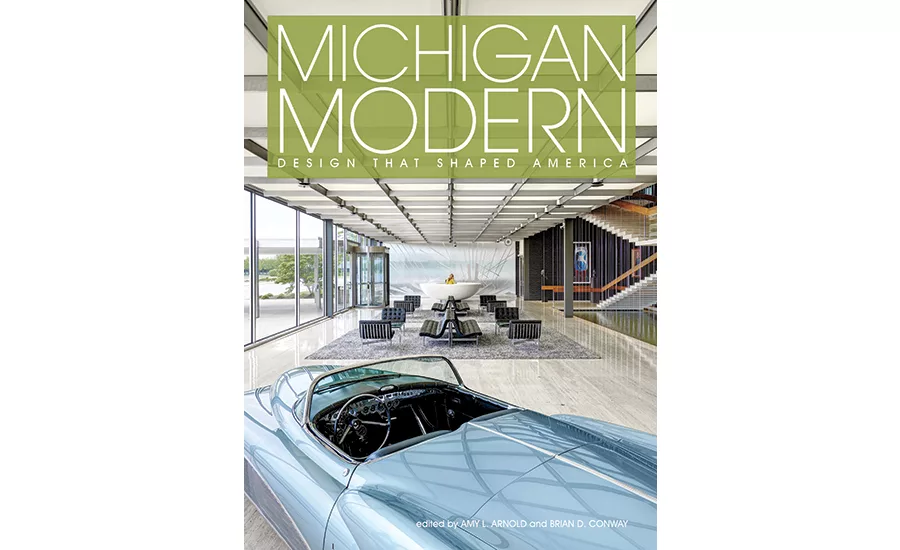
Michigan Modern: Designed That Shaped America

Edited by Amy L. Arnold and Brian D. Conway
By Wendy Moonan
Michigan Modern

Michigan Modern: Design That Shaped America, edited by Amy L. Arnold and Brian D. Conway. Gibbs Smith, 352 pages, $50.

March 1, 2017

This well-illustrated compendium is a detailed history—fascinating and, to some, unfamiliar—that makes the case that Modernist architecture and design was developed in Michigan, not imported from Europe between 1900 and 1970. As California critic Alan Hess says in the foreword, “Modernism grew directly from the state’s indigenous industries and the population they served.”

The case is built by the nearly 30 essays in the book, which grew out of a symposium at the Grand Rapids Art Museum in 2014. The editors—Amy L. Arnold, preservation planner for the State Historic Preservation Office, and architect Brian D. Conway, Michigan State’s Preservation Officer— had organized the three-day conference.

Much of the story, of course, has to do with the auto industry.

Prussian-born architect Albert Kahn came to America with his family in 1881, started working in a Detroit architecture firm as a teenager, and opened his own firm in 1895. His five younger brothers, obsessed with engineering, all worked with him; one of them, Julius, invented a “trussed-bar” system of steel-reinforced concrete construction that revolutionized modern factory design.

In 1905, when the Packard Motor Car Company hired Albert Kahn to build a new factory, he integrated these new systems. By using a steel-reinforced concrete structural frame, instead of walls of load-bearing masonry supporting wood floors, he could install huge windows, allowing natural light to flood the factory floors. He placed skylights in the concrete roofs and introduced industrial steel sash windows to America (they originated in England).

Henry Ford quickly adopted Kahn’s systems for the Highland Park Ford Plant (1908) and the Ford River Rouge Complex (1917), where each piece of the manufacturing process was housed in a separate building. As Arnold and Conway explain, the factories he designed for Henry Ford “became an inspiration for architects around the world who were looking for a ‘modern’ approach to design; most notably European architects Le Corbusier, Walter Gropius, and Ludwig Mies van der Rohe.”

At the same time, in 1906, the University of Michigan hired architect Emil Lorch to head its new architecture program, one of the first modern-oriented ones in America. Lorch, who followed the ideas of the Prairie school and eschewed traditional Beaux Arts training, invited Finnish architect Eliel Saarinen to be a visiting professor in 1923. There Saarinen met newspaper publisher George Booth (the father of a student), who enlisted Saarinen to help run the new Cranbrook Academy, which came to be known as architecture’s “cradle of Modernism.” Saarinen not only designed the campus but also created a program that incorporated philosophies of both the Arts and Crafts movement and the Bauhaus. The school attracted such students and teachers as Alvar and Aino Aalto, Harry Bertoia, Niels Diffrient, Charles and Ray Eames, Florence Knoll, Bill Moss, Harry Weese, and, of course, Eliel’s son Eero Saarinen—designers who would shape and define modern design in midcentury America.

The furniture companies in Grand Rapids took note. After Herman Miller lured George Nelson to its company in 1947, he brought in the Eameses, Alex Girard, and Isamu Noguchi. And Florence Knoll commissioned Eero Saarinen, Bertoia, and Mies to contribute pieces. The list goes on. The book demonstrates how Michigan’s industries, educational institutions, and businesses employed the most innovative architects and designers of the day, who in turn lured the best and brightest to come and work with them. In this way, Modernism and Michigan were inextricably tied

Looking for quick answers on architecture and design topics?
Try Ask RECORD, our new smart AI search tool.
Ask RECORD →

KEYWORDS: Detroit Michigan modernism

Share This Story

Looking for a reprint of this article?
From high-res PDFs to custom plaques, order your copy today!

Wendy Moonan, a New York–based architecture and design writer, is the author of New York Splendor: The City’s Most Memorable Rooms.

Post a comment to this article

Report Abusive Comment

Subscription Center
  • Create an Account
  • Start a Subscription
  • Manage My Account
  • Sign Up for Newsletters
  • Visit Customer Service
  • Update Preferences

More Videos

Sponsored Content

Sponsored Content is a special paid section where industry companies provide high quality, objective, non-commercial content around topics of interest to the Architectural Record audience. All Sponsored Content is supplied by the advertising company and any opinions expressed in this article are those of the author and not necessarily reflect the views of Architectural Record or its parent company, BNP Media. Interested in participating in our Sponsored Content section? Contact your local rep!

close
  • TAMLYN XtremeTrim Exterior Trim
    Sponsored byTamlyn

    Designing Cleaner Panel Facades: Why Exterior Trim Details Matter

  • Building with Vapor Barriers
    Sponsored byReef Industries, Inc.

    Vapor Barriers Help Control Moisture in Tighter Building Designs

  • Duct Interior with Prodeq System
    Sponsored byHenry, a Carlisle Company

    Designing Resilient Water Containment Systems

DESIGN:ED Podcast
Listen to Architectural Record’s DESIGN:ED Podcast

Events

June 16, 2026

Focus on the Façade: Exploring Steel, Timber & Fire-Rated Curtain Walls and Channel Glass Systems

Credits: 1 AIA LU/HSW; 1 AIBD P-CE; 0.1 ICC CEU

Explore modern façade and glazing systems that enhance daylighting, fire safety, and thermal performance while expanding architectural design possibilities.

June 18, 2026

Rebooting the Aging Office Building

Credits: 1 AIA LU/HSW; 1 AIBD P-CE; 0.1 ICC CEU; 1 PDH

Explore façade retrofit strategies and award-winning design concepts that can transform aging office buildings into healthier, higher-performing workplaces for today’s hybrid workforce.

View All Submit An Event

Products

2026 Architect's Square Foot Costbook

2026 Architect's Square Foot Costbook

See More Products

Popular Stories

Coronado Bridge

The Architect’s Guide to San Diego

SanDiegoAirport

Top 300 Architecture Firms of 2026

Crane Cove, ONO

Design Vanguard 2026 Winners

House on a Hill

Design Vanguard 2026: Forma

House A on a Hill

Design Vanguard 2026: Santiago Valdivieso

Focus on the Facade - Free Webinar - June 16, 2026

Related Articles

  • Vote: 10 Buildings That Changed America

    See More
  • Albert Kahn

    Review of 'Albert Kahn in Detroit: Building the Modern World'

    See More
  • Global Culture and Civic Competition

    How Global Culture and Civic Competition Have Shaped Modern Arts Institutions

    See More

Related Products

See More Products
  • Web-Modern-chinese-architecture18-1920x1125.jpg

    Modern Chinese Architecture: 180 Years

  • 0470126736.gif

    Modern Sustainable Residential Design: A Guide for Design Professionals

See More Products
×

The latest news and information

#1 Source for Architectural Design, News and Products

SUBSCRIBE
  • RESOURCES
    • Advertise
    • Contact Us
    • Submit
    • Store
  • ACCOUNT CENTER
    • Create an Account
    • Start a Subscription
    • Manage My Account
    • Sign Up for Newsletters
    • Visit Customer Service
    • Update Preferences
  • PRIVACY
    • PRIVACY POLICY
    • TERMS & CONDITIONS
    • DO NOT SELL MY PERSONAL INFORMATION
    • PRIVACY REQUEST
    • ACCESSIBILITY
  • SERVICES
    • Marketing Services
    • Reprints
    • Market Research
    • List Rental
    • Survey/Respondent Access
  • STAY CONNECTED
    • Linkedin
    • Facebook
    • Instagram
    • YouTube
    • X (Twitter)

Copyright ©2026. All Rights Reserved BNP Media, Inc. and BNP Media II, LLC.

Design, CMS, Hosting & Web Development :: ePublishing