Bar House by Audrey Matlock Architect
East Hampton, New York

The house’s two piloti-supported pavilions—one at grade and the other elevated—meet at 90 degrees to help define the surrounding landscape, including a pool area embraced in the arms of the resulting L shape.
Photo © Peter Aaron
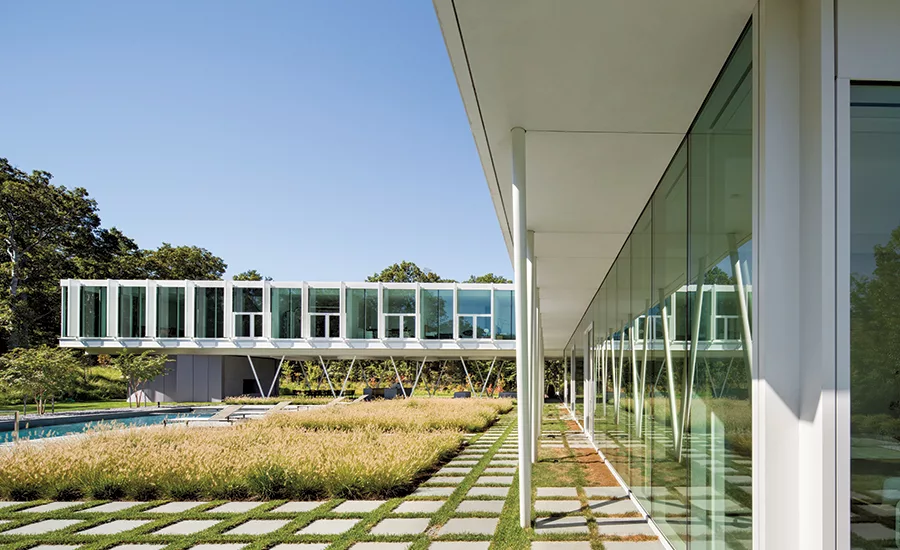
Tall fountain grasses in the pool area soften the architecture’s rectilinear edges.
Photo © Peter Aaron

A poolside terrace with seating area and open-air kitchen is tucked under the upper level.
Photo © Peter Aaron

The free-flowing main living space is divided by a double-sided heart and has a glazed south-facing wall.
Photo © Peter Aaron

The north wall in the main living space is largely opaque and was designed to showcase large-scale contemporary painting, including work by (left to right) Adam Henry, Joyce Pensato, and Heimo Zobernig.
Photo © Peter Aaron

A skylit and precisely detailed open-riser stair connects the lower and upper levels.
Photo © Peter Aaron

The stair treads, as well as the floors of the upper wing, including those of the master bedroom are made of walnut. This material choice continues the strategy used below, with a dark base to anchor the other mostly white, light-reflective surfaces.
Photo © Peter Aaron

Image courtesy Audrey Matlock Architect

Image courtesy Audrey Matlock Architect

Image courtesy Audrey Matlock Architect

Image courtesy Audrey Matlock Architect
Architects & Firms
Rigorous—that’s the adjective that comes to mind to describe a refined but relaxed weekend house by New York architect Audrey Matlock in East Hampton, Long Island. Matlock has designed the L-shaped modernist structure—with its two wings supported on slender V-shaped steel pilotis—down to the smallest of elements. It is so precisely designed that, despite its undeniably large size (10,200 square feet), it seems to barely touch its site.
This effect is achieved through the manipulation of any number of details, like tapering the overhanging roof structure so that it appears light and razor thin, or shielding the east-and west-facing glazing with perforated brise soleils, which lend the house a sense of permeability—or covering one roof with shaggy, tall grasses, to soften the edges of the architecture.
Even more striking than the precise assemblage of these elements are the relationship between the house and its surroundings and the treatment of exterior space as an extension of the architecture. The steel structure’s two single-story glass- and zinc-clad linear volumes—one at grade containing the main living spaces and the other elevated and enclosing the family’s bedrooms, among other spaces—intersect at 90 degrees. The composition defines a pair of outdoor rooms: a pool area embraced within the arms of the L and an adjacent sheltered terrace, slipped beneath the bedroom bar, that includes an open-air kitchen.
The emphasis on the outdoors reflects the priorities of the Brooklyn-based owners, a CEO in the education-technology sector and his wife, a former corporate communications executive. They had originally planned to buy a house on Long Island’s east end. During their search, they saw one for sale that Matlock had designed, which they liked, but found its site unappealing. So they decided to look for a property where she could build a structure that would have high ceilings, a sense of openness, and daylight. They also wanted a lap pool, a tennis court, plenty of open space for their two young children, and a workshop where the husband—an avid fisherman—could make his own flies. Her clients, says Matlock, were attracted to the Hamptons for its natural assets, not its much-publicized social scene.
The couple eventually purchased 13 acres in East Hampton’s Northwest Woods. Matlock positioned the house in the southeast corner of the property, a spot that was practically predetermined because of protected wetlands and a town-mandated location for the driveway. But, she says, the location was opportune, since this edge bordered a 500-acre public nature preserve encompassing hiking trails, a freshwater pond, and a forest of oak and pine. In addition it offered a significant slope and the opportunity to “engage the land” by partially hiding the garage below grade. Matlock took the same approach with the tennis court, tucking it behind an ivy-covered retaining wall, “so that it didn’t look as if an aircraft carrier had landed on the lawn,” she says.
Within the house, the two elongated wings have markedly different characters. The upper one has discrete rooms, including an office, a gym, and a den—in addition to bedrooms—lined up along a windowed corridor. Meanwhile, the interior of the lower volume, which contains a kitchen with bar-height seating at its light-gray marble counter top, a dining area with a custom oakwood table, and a living room, is primarily a freeflowing space, 28 feet wide and 64 feet long.
Though this main living zone does not have conventional partitioned rooms, it is highly articulated. Its most conspicuous space-defining element is a monumental and minimal fireplace with a black basalt base that faces both the living and dining areas. But there is also a subtler strategy at work: a 4-foot module that governs the entire house. The dimension is expressed in a number of ways, including the attenuated V-shaped steel pilotis placed every 12 feet on center and visible from the interior through a south-facing expanse of glass looking out onto the pool. The module is also manifest in the drywall ceiling, which consists of alternating 4-foot- and 8-foot-wide sections running between the steel beams of the roof. The narrower sections are flat, while the wider ones are gently canted like the underside of a shallow butterfly roof.
This A-B-A-B rhythm is reinforced by a secondary vertical structure of square pipe columns that sits just inside the glazed south wall and along the mostly opaque north wall. There, tall and narrow windows are spaced 12 feet apart. The approach yields surfaces suitable for showcasing art, specifically large paintings by contemporary artists, which the clients have recently begun collecting. But it also creates visual interest, even if nothing were to be displayed there, explains Matlock. “So often, the art is an afterthought,” she says.
The outcome is a living space with a sense of orderly calm. Daylight seems to fill the room—a feeling enhanced by its mostly white-painted interior, including the walls, the ceiling, and the structure. These elements are grounded by the dark bluestone floor—a material that continues outdoors (along with the 4-foot module) to the pool area and the adjacent terrace. Here Matlock has combined the stone with rectilinear planting beds of tall fountain grasses like those on the roof, while a grove of pear trees extends the formal order of the house toward the tennis courts.
Matlock’s landscape choices, like her many other carefully considered moves, help give the house a light and delicate presence on its site while making it a compelling object within nature. It all comes off as effortless, which of course it was not. “Building a minimal house is much more difficult,” says the architect. “But it’s the kind of fascinating puzzle I thrive on.”
CreditsArchitect: Audrey Matlock Architect 141 West Broadway New York, NY 10013 (212) 267-2378
Personnel in architect's firm who should receive special credit: Design Partner - Audrey Matlock, RA, FAIA Project Architect - Monica Franklin, RA. Design Team - Derek Metz, RA, Darshin Van Parjis, Rohan Cherayil
Engineer: Buro Happold (MEP, Structure, Curtain Wall)
Consultants: Interior: Elvan Arolat Landscape: Site Design Resources, The Laurel Group Lighting: Buro Happold Audio Visual: Barad Art Advisory Services: LINN | PRESS
General contractor: Lettieri Construction
Photographer: Peter Aaron - (917) 678-5900
|
SpecificationsStructural system Concrete & Steel
Metal Panels: Alpolic VM Zinc Composite Material
Metal/glass curtain wall: Efco 5600 SSG Curtain Wall Thermally Broken System
Moisture barrier: Grace Vycor Plus (over sheathing & under metal panel) Grace Ice & Water Shield (around openings)
Roofing Built-up roofing: Green Roof Media: Rooflite Intensive Waterproof Membrane: Aqua Seal Eco-Flex
Windows Metal frame: Efco S510 Series
Glazing Glass: 1 3/16” THK VNEI-63 INSULATED (1⁄4” CLEAR VNE-63 LOW E #2 SURFACE FULLY TEMPERED OUTBOARD LITE: 1⁄2” AIR SPACE, 7/16” CLEAR HEAT STRENGTHENED LAMINATED INBOARD LITE CONSISTING OF 2 LITES OF 3/16” CLEAR H.S. GLASS AND .090 PVB INTERLAYER)
Skylights: Solar Innovations SI5600
Metal and wood doors: Custom
Sliding doors: Arcadia Sliding ULT-5500 HPT Series
Garage Door: Renlita S-1000 Floataway
Hardware Locksets: Accurate Pocket Door Pull 2000, 2002
Pulls: Custom Accurate 24ST & 24SE Flush Pull
Other special hardware: Hafele Flattec II Pocket Door Tracks Rixson Pivot Set Model 117 (@ Front Door)
Interior finishes Cabinetwork and custom woodwork: MOB Furniture Interiors Inc. Istanbul, Turkey
Paints and stains: Benjamin Moore (GWB) Margolies Wood Flooring (Stain @ Wood Floor)
Floor and wall tile: Bluestone Honed (@ Level 1 Floor) Nano Glass Tile 002 Honed, Miller Druck (@Bathrooms) Olympic Stone Tile Honed (@ Master Bathroom)
Carpet: Kasthall, Stark
Lighting Interior ambient lighting: Feelux Dimslimline Cove Lighting Feelux Diva2 Cove Lighting KKDC KKSL Exterior Cove Lighting Hera KBS LED Millwork Lighting
Downlights: USAI 3430 Downlights USAI 3431 Wall Washers Erco Paratec I Wall Washers
Task lighting: Artemide Tolomeo with Shade Flos Kelvin LED Green Mode I
Exterior: BK Lighting DE-LED (Above Ground Landscape Lighting) BK Lighting HP2-LED (Below Ground Landscape Lighting)
Dimming System or other lighting controls: Lutron
Plumbing Blanco, Boffi, Duravit
Energy Geothermal heating & cooling, heated floors, sunshades, overhangs
Sunshades: Levolux |
Looking for a reprint of this article?
From high-res PDFs to custom plaques, order your copy today!