Names to Know at the 2017 Chicago Architecture Biennial: Ania Jaworska
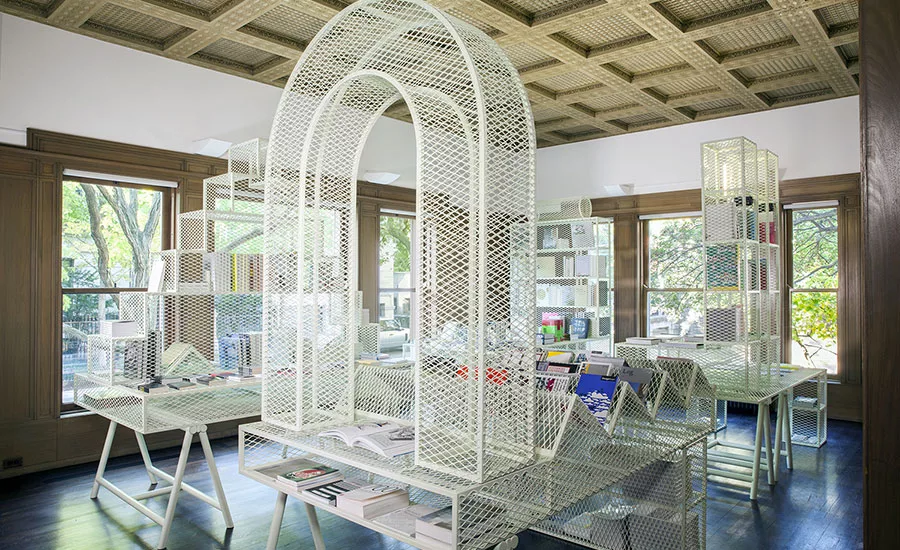
Graham Foundation Bookshop by Ania Jaworska
Chicago
This installation built in 2013 serves as a bookstore for art and architecture publications within the former dining room of Madlener House. Composed of four metal mesh structures that serve as shelves for book display while resembling structural elements like a gateway arch and staircase, the translucent structure allows the books to become integral part of its architecture.
Photo © Travis Roozée
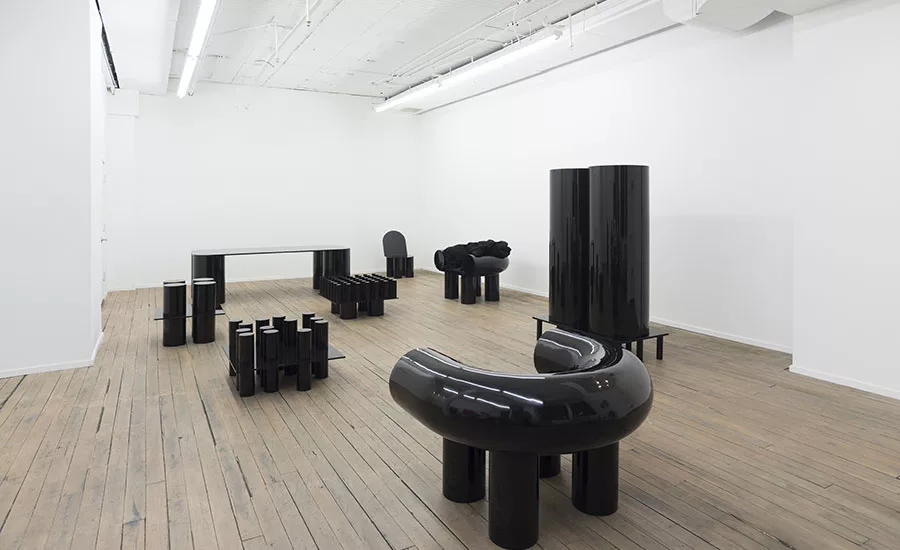
SET by Ania Jaworska
Chicago
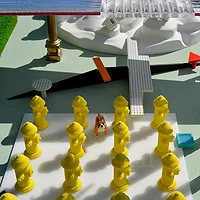
This furniture collection for a 2016 commission by Volume Gallery was designed to set the stage for specific actions, arranges behaviors and defines new attitudes. Reconfiguring well-recognized architectural elements, symbols, signs and geometric forms, the furniture aims to create a tension between known forms and the unknown.
Photo courtesy Volume Gallery
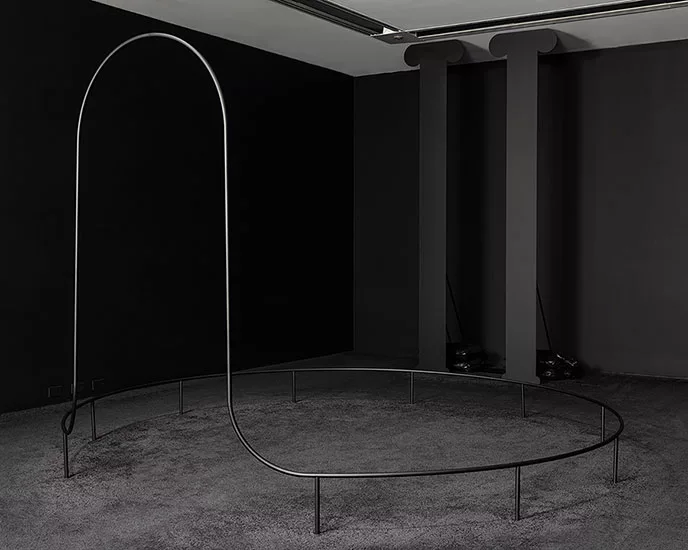
Cynic Architectures by Ania Jaworska
Chicago
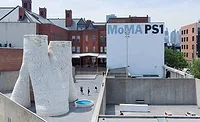
Part of a 2015 to 2016 solo exhibition at MCA Chicago Works, this series of six sculptures plays off familiar architectural elements of signage, gates and barriers, and the line between luxury and kitsch.
Photo © Travis Roozée
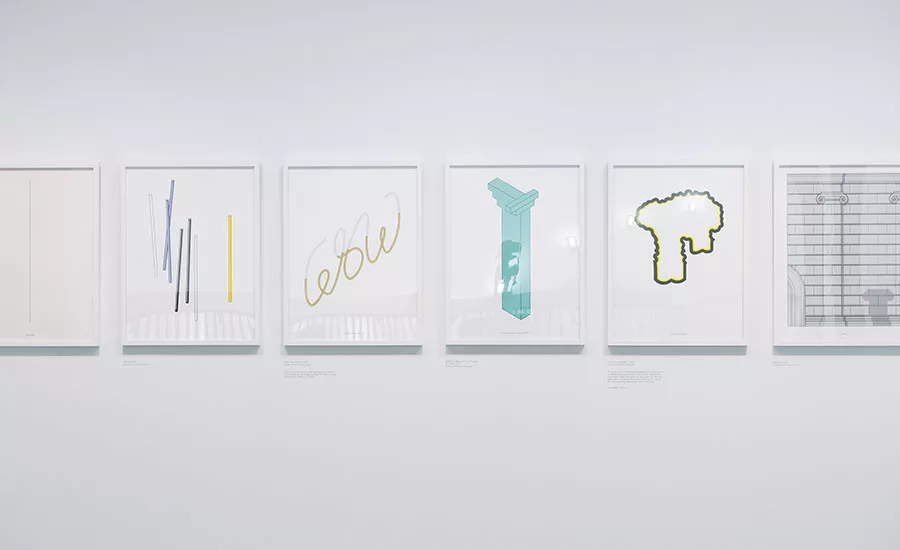
Subjective Catalog of Columns by Ania Jaworska
Chicago
Part of a 2015 to 2016 solo exhibition at MCA Chicago Works, this collection of 16 screen prints depicts one architectural element, the column, in isolation in order to expose the various references and narratives embedded within it.
Photo © Museum of Contemporary Art of Chicago

Architect and educator Ania Jaworska.
Photo courtesy Chicago Architecture Biennial
Architectural designer Ania Jaworska founded her Chicago-based practice in 2010. RECORD asked her five questions about her work at the Chicago Architecture Biennial. Scroll through the slideshow above to see some of her key projects.
Architectural Record: Tell us about your practice. What differentiates you from other firms?
My practice focuses on exploring the connection between art and architecture; my work explores bold simple forms, humor, commentary, and conceptual, historic, and cultural references. The work I produce functions as proposals or studies for larger works, but also stands independently as final works. I like to think that my work is simultaneously simple and complex, familiar and unfamiliar, funny and serious.
How do you get into the creative headspace?
I take my time…
Who are your design heroes?
I have been constantly returning to work of contemporary artists like Olaf Breuning or Beverly Fre$h, who explore cultural landscapes, humor and commentary, and, in turn, produce their own cultural entities. On the other hand, I have been investigating the minimal work of a designer Jonathan Muecke, whose seemingly simple objects have complex theoretical backgrounds and maximum spatial impact. I’ve been a fan of Ettore Sottsass, whose work spans scales and materials, and brings cultural references in order to communicate with the viewer.
Looking for quick answers on architecture and design topics?
Try Ask RECORD, our new smart AI search tool.
Ask RECORD →
I am also lucky to work with colleagues here in Chicago, whose work challenges and expands the understanding of an architectural form and architectural practice: CAMES/Gibson; Design With Company; Norman Kelley; Independent Architecture; and Paul Preissner Architects, among others.
What do you hope to contribute to the Chicago Biennial?
I was selected by the biennial’s curators to propose an entrance installation for Randolph Street Lobby. It is the first space visitors encounter while entering Chicago Cultural Center on the north side of the building. The current space contains a large, round concierge desk and accompanying furniture like benches, brochure stands etc., which function as an information center. The programmatic principals of the installation will remain unchanged—the desk is in fact a genesis of the project—however it will be consumed by a new structure and carefully arranged additional elements, which in turn will produce a cohesive environment—a space within a space. The installation will signal to the public that they are entering the Chicago Architecture Biennial.
The installation’s new structure uses familiar iconic forms such as the arch and column to call on architectural history and establish meaning, while simultaneously undermining it. The carefully-placed arch within the installation will both highlight and contradict the entrance; it will at once signify an entry point and create a physical boundary.
In a similar manner, the architectural column activates our collective memory and shared understanding of stability and tradition. Ancient Greek architecture, divided into three orders—Doric, Ionic, and Corinthian—explored the column as a simultaneously structural and decorative element. The classical forms of the columns persisted and are continuously reused in the Western architecture, making them the most recognizable and familiar symbols. Depending on the context, and which order is reused, they represent stability, tradition, authority, status, wealth, knowledge, and justice. Because of their use, overuse, and reinvention throughout history, these two architectural elements function as both structure and symbol. Their form no longer needs to rely on the material and structural properties, and we see this notion pushed further where the arch itself is filled in, and its grand presence is offset by its unusually thin profile in a process of establishing and questioning.
The entirety of the installation will be painted neon yellow, which will further flatten the structures and establish their relationship with popular culture.
Most importantly, when it comes to pizza, deep dish or thin crust?
Both.
The Chicago Architecture Biennial runs from September 19, 2017, to January 7, 2018. Read more of our coverage of the event here.
Looking for a reprint of this article?
From high-res PDFs to custom plaques, order your copy today!