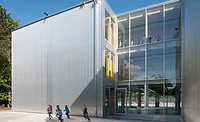
IGS Kalbach-Riedberg by NKBAK
Frankfurt, Germany

Rough-finished Douglas fir cladding helps the boxlike form of this temporary school harmonize with the landscaping of a new residential quarter to the north and an orchard to the south.
Photo © Thomas Mayer

A window-wall on the building’s northeast edge carries daylight into the entry and corridors.
Photo © Thomas Mayer

The units were delivered and installed over a three-week period.
Photo © Thomas Mayer

Factory-built stairs have the same lavender hue as the halls.
Photo © Thomas Mayer

Extensive glazing in classrooms and along the ends of corridors infuses the interiors with daylight and provides views of the neighborhood.
Photo © Thomas Mayer

Extensive glazing in classrooms and along the ends of corridors infuses the interiors with daylight and provides views of the neighborhood.
Photo © Thomas Mayer

The 9-foot-10-inch-wide hallways have colorful floors and are used as informal work areas.
Photo © Thomas Mayer

Image courtesy NKBAK
Architects & Firms
When the city of Frankfurt needed a temporary facility for a newly established middle school, the IGS Kalbach-Riedberg, they turned to NKBAK architects. The local firm had completed another provisional facility in 2015 for the pre-K-through-first-grade European School Frankfurt or ESF using prefabricated wood modules to meet a tight planning and construction schedule. The architects welcomed the chance to adapt this kind of construction to a different type of school, says firm coprincipal Andreas Krawczyk, “to test the possibilities of the modular wood system.” The brief here called for a cafeteria, offices, and 11 classrooms to accommodate 200 students, in grades five and six.
Additional Content:
Jump to credits & specifications
Situated on the city’s periphery, between a new residential district and an orchard, the 26,400-square-foot IGS will eventually serve 600 students in grades five to 10 at its permanent location, a few miles away. The first 100 fifth graders entered in September 2017, and the temporary school will be used for the next few years until the final building is completed. To bridge the gap, a similar provisional facility for grades seven and eight, adjacent to this one, is being planned.
IGS is the abbreviation for a hybrid facility known as an Integrated Comprehensive School (in translation). German middle schools are divided into three categories: general (Hauptschule) and enhanced-general (Realschule) programs, both going through grade 10, and a college-prep track (Gymnasium), which continues to the 12th grade. IGS pupils at the same grade level and from all three programs attend the same classes, but receive assignments appropriate to their ability.
Krawczyk’s partner, Nicole Kerstin Berganski, says the site was extremely narrow. To fulfill the program’s requirements, the architects devised a linear three-story structure using 90 prefabricated modules, which are stacked into two parallel forms connected by a long central hall on every level. They infused the resulting double-loaded corridors with a sense of spaciousness and light by pushing the forms in opposite directions, enough to create generous window walls that provide daylit entrances at grade and airy hangouts on the upper floors.
Developed in collaboration with Kaufmann Systems, the modules are made of spruce, and function as individual rooms or are combined to create larger spaces, such as the cafeteria. They measure 9 feet 10 inches wide and 23 feet long; each came from the factory with pre-installed ceiling heaters, and electrical and mechanical ducts. Delivery and assembly on a slab took three weeks.
While NKBAK opted for an aluminum-clad skin on their first modular school, which was in an urban context, the firm specified Douglas fir boards with a rough-sawn finish so that the IGS’s facade would blend with its greener surroundings. A dense surface protects against water penetration. The facade includes floor-to-ceiling double-glazed fenestration comprised of alternating transparent and translucent panels. The clear panes are fixed and shaded by interior blinds. The translucent ones are operable and protected by fixed, external wood panels, perforated with 4-inch-round holes that provide natural ventilation. The building does not have air-conditioning and lacks thermal mass which, combined with its extensive glazing, can cause overheating, a problem that arose at the ESF. The north and south facades have integrated sun shading.
Inside, the spaces are spare and basic, dominated by the raw wood of the modules and visible ceiling systems. But the whole place is enlivened by surprising colorful accents—lavender linoleum flooring in the corridors and stairways, canary yellow or moss green tiles and linoleum floors for the restrooms—thoughtfully selected to appeal to the students. On a recent visit, both school principal Susanne Goelitzer, and her deputy, Mareike Kauenfluegel, noted that parents were initially skeptical about the exposed construction. However, the good sound quality in the classrooms, largely the result of acoustic ceiling panels and “microholes” on the interior of the modular units, won them over.
The exposed wood has unexpected benefits. Affixing papers to walls in German schools is discouraged because tacks and tape deface painted surfaces, but “here it is easy to put up information for everyone to credits see,” says Kauenfluegel, effortlessly inserting a pushpin into the wood. Needless to say, artwork and flyers now adorn the hallways and classrooms.
The entire project—which took only 15 months to design, fabricate, and construct—was completed in May of 2017 and cost 20 percent less than a typical school. Though a temporary facility, the IGS Kalbach-Riedberg feels cozy and familiar, qualities that NKBAK achieved through simple means—color, material, light, air, and a straightforward plan. The staff reports that children not only feel comfortable, they have become curious about the building, and 80 percent have chosen “architecture” for their independent study project. “They want to know,” says Goelitzer, “if you build a round corner differently from a square one.”
CreditsArchitect: NKBAK Nicole Kerstin Berganski Andreas Krawczyk Baseler Platz 1, D – 60329 Frankfurt T +49 69 65609329 F +49 69 65609330
Personnel in architect's firm who should receive special credit: Nicole K. Berganski, Andreas Krawczyk, Johannes Lemke
Architect of record: NKBAK
Engineers Strucural Engineer: Merz Kley Partner ZT GmbH, Saegerstrasse 4, a – 6850 Dornbirn HVAC and Electrical: Ecotec GmbH, Wilhelm-Herbst-Strasse 7, D – 28359 Bremen Fire Protection: Wagner Zeitter Bauingenieure, Adolfsallee 27, D – 65185 Wiesbaden
General contractor: Kaufmann Bausysteme GmbH, Vorderreuthe 57, A – 6870 Reuthe
Photographer: Thomas Mayer |
SpecificationsStructural System Wood-Modules by Kaufmann Bausysteme CLT by Kaufmann Bausysteme, LVL Beachwood Beams by Pollmeier
Exterior Cladding Metal/glass curtain wall: Becker 360 Wood: carpenter: Oliver Beer
Roofing Built-up roofing: Dachland GmbH Elastomeric: Bauder
Windows Wood frame: Becker 360
Glazing Glass: Saint-Gobain
Doors Entrances: Becker 360 Wood doors: Becker 360
Hardware Closers: Dorma Pulls: FSB
Interior Finishes Acoustical ceilings: Heradesign Floor and wall tile: Villeroy & Boch Resilient flooring: Forbo (Linoleum) Special interior finishes unique to this project: Acoustic wall panels: Trikustik
Lighting Interior ambient lighting: Trilux |
Looking for a reprint of this article?
From high-res PDFs to custom plaques, order your copy today!