Fujisan World Heritage Center by Shigeru Ban Architects
Fujinomiya, Japan

The reflecting pool incorporates a red torii gate that marks the start of a processional route leading to a nearby shrine.
Photo © Hiroyuki Hirai

LEDs ringing the base of the cone send a spray of light upward, illuminating its outer surface from below.
Photo © Hiroyuki Hirai

Bridges connect the stair and elevator within the cone’s concrete core to the exhibit spaces and other functions housed in the building’s rectangular volumes.
Photo © Hiroyuki Hirai

Video displays line the curved walls of the main exhibition hall located inside the cone.
Photo © Hiroyuki Hirai

The culmination of the main exhibit sequence, the observation hall crowns the building. Sliding glass doors modeled after shoji screens open the room completely to a terrace and a spectacular view of Mount Fuji. In contrast to the cone’s dark interior, the hall is painted pure white.
Photo © Hiroyuki Hirai

Image courtesy Shigeru Ban Architects

Image courtesy Shigeru Ban Architects

Image courtesy Shigeru Ban Architects
Architects & Firms
Majestic and mythical, Japan’s snow-capped Mount Fuji has been an inspiration for artists, a destination for religious pilgrims, an ambition for hikers, and, since 2013, a UNESCO World Heritage Site. Commemorating this honor, the Fujisan World Heritage Center (FWHC) is a museum and resource center that celebrates the mountain itself. Designed by the Tokyo architect and Pritzker Prize winner Shigeru Ban, the building’s defining features are a monolithic wood lattice cone and its reflection in an expansive pool in front. While the cone points downward, its mirror image resembles the famous flat-topped peak.
Additional Content:
Jump to credits & specifications
This clever concept surfaced during the center’s competition, hosted by Shizuoka Prefecture for a site in Fujinomiya, a town of 131,000 situated 83 miles southwest of Tokyo. Though Mount Fuji is 11 miles away, the property has an unimpeded view and is adjacent to Fujisan Sengen Shrine, which administers Shinto activities held on the mountainside. “The client wanted to symbolize Mount Fuji, but I had never designed a symbolic building before,” says Ban. In his quest for an appropriate form, the architect recalled the rugby camp of his youth located by a lake near the mountain. Ban’s memory of the peak and its shimmery reflection were the genesis for the scheme.
Like Mount Fuji itself, the FWHC’s nearly symmetrical glazed facade rises up dramatically from level ground. The glass wall fronts a five-story atrium uniting the cone with two three-story rectangular volumes in back. To reach the main entrance of the $33 million center, visitors walk around the pool, viewing the cone and its double, before going inside. The first floor contains the information desk and a combined café and museum shop, plus the library, lecture hall, and administrative functions. Upstairs, the rectangular boxes hold exhibit spaces and a movie theater. The main exhibition hall occupies the entire cone, a cavernous, semidark space. While the cone’s concrete core holds stairs and an elevator, a ramp spirals around its interior perimeter, passing the displays and culminating in the rooftop observation hall that frames a postcard-perfect Mount Fuji view.
“Normally, buildings have no relationship to their exhibits, but I am very proud of how they harmonize here,” says Ban. Conceived by the architect during the competition phase, the exhibit program—recreating the climb up Mount Fuji—was inspired by the cone’s basic geometry. In turn, the cone’s shape was fine-tuned by the installation requirements and the 61-foot building height limit. A 39-foot-diameter circle at grade, the cone morphs into a 131-by-66-foot ellipse at the top, increasing the display space as it widens. Shown on the cone’s inner wall, the exhibit features videos depicting six different scenes from the actual ascent. “The technical challenges of projecting onto a curved surface approached by a ramp were really interesting,” remarks Edwin Schlossberg, president of ESI Design in New York, who was one of the project’s three exhibition consultants. Varying in slope, the 633-foot-long ramp evokes the unevenness of the trekker’s path but is not uniformly wheelchair-friendly, since accessibility was, surprisingly, not required by the prefecture.
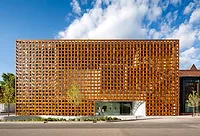
Concealing the cone interior, the lattice consists of 8,000 bars of local cypress linked with lapped joints and rounded on top, creating the illusion that they are woven. Small metal spacers affix the lattice to fiber–reinforced concrete wall panels behind, creating a slight shadow. “[The lattice] would look too flat if we attached it directly to the white wall,” explains Ban. Coated with textured white paint to hide their joints, the wall panels are attached to the underlying structural system. Its primary supports are 20 inclined H-shaped steel sections arranged radially around the cone’s circular base, complemented by the reinforced concrete core. A more conventional steel frame supports the rest of the building.
Though half of the cone stands inside the atrium, the other abuts the pool, which is just over 1 inch deep. “A thin layer of water reflects more sharply than a deep one,” explains a project architect, Wataru Sakaki. Covering more ground than the footprint of the 37,000-square-foot building, the water also provides all of its interior climate control through a heat-exchange system that circulates spring water supplied indirectly by Mount Fuji, fortifying the connection to the mountain.
While the FWHC is not a huge building, its reflection in the expansive, mirror-like pool gives it a monumentality worthy of a World Heritage Site. Indeed, it is hard not to be wowed by Ban’s achievement here. With one inspired move—turning the “mountain” upside down—he echoes its magnificence.
CreditsArchitect: Shigeru Ban Architects, 5-2-4 Matsubara, Setagaya-ku, Tokyo, Japan Telephone:+81-3-3324-6760, www.ShigeruBanArchitects.com
Personnel in architect's firm who should receive special credit: Shigeru Ban Nobutaka Hiraga Keita Sugai Wataru Sakaki Makoto Tadokoro
Engineers Structure: Arup MEP: Arup
Consultants Landscape: Studio Onsite Lighting Design: Lighting Planners Associates Fire: Akeno Facility Resilience Acoustic: Nagata Acoustics QS: Akane Architectural Consultants Graphic Design: Nippon Design Center
General contractor: Architecture: Sato Kogyo/Wakasugi-gumi Joint Venture Mechanical & Plumbing: Suga/Endo Joint Venture Electrical: Sumitomo/Sanwa Electrical Joint Venture Landscape: Sato Kogyo Exhibition: Tanseisha
Photographer: Hiroyuki Hirai |
SpecificationsExterior Cladding Metal sandwich panel (ISOBAND PRO): NISC Glass curtain wall: AGC Aluminum curtain wall: Fuji sash Wood lattice: Shelter
Roofing Membrane roofing built-up: Tajima roofing Asphalt waterproofing built-up: Tajima roofing
Windows Aluminum frame: Fuji sash
Hardware Oval series design by Shigeru Ban: Atelier Union
Interior Finishes Mineral wool sound absorbing panel Solaton: Yoshino Gypsum Library cabinetwork: Hiro and associate Atrium floor Granite stone bush hammered water jet: Hanakuni-giken Ramp floor rubber chip: ABC Trading
Conveyance Elevators/escalators: Elevators: Fujitec
Energy Add any additional building components or special equipment that made a significant contribution to this project:
|
Looking for a reprint of this article?
From high-res PDFs to custom plaques, order your copy today!