Architectural Record
search
cart
facebook twitter linkedin youtube
  • Sign In
  • Subscribe
  • Sign Out
  • My Account
Architectural Record
  • NEWS
    • Latest News
    • Awards
    • Interviews
    • Obituaries
    • Podcasts
      • Design:Ed Podcast
      • Sponsored Podcasts
  • OPINION
    • Book Reviews / Excerpts
    • Exhibition Reviews
    • Forum
  • EXCLUSIVES
    • Videos
    • Design Vanguard
    • Top 300 Firms
    • Sponsored Content
    • Sponsored eBooks
    • From the Archives
  • CONTINUING ED
    • Editorial Continuing Ed
    • CE Center
    • CE Academies
  • PROJECTS
    • Buildings By Type
    • Reuse & Renovation
    • Museums & Arts Centers
    • Colleges & Universities
    • Multifamily Housing
    • Interiors
    • Lighting
    • Kitchen & Bath
  • HOUSES
    • Record Houses
    • House of the Month
    • Featured Houses
  • PRODUCTS
    • Products by Category
    • Record Products of the Year
    • Latest Products
  • EVENTS
    • Dates & Events
    • Record on the Road
    • Innovation Conference
    • Sustainability in Practice
    • Women In Architecture
    • Webinars
    • Ad Excellence Awards
    • AIA 2026 Videos
    • Submit an Event
  • CONNECT
    • Ask RECORD AI
    • Newsletters
    • Contact
    • Advertise
    • Editorial Calendar
    • Store
    • Customer Service
  • SUBMIT
    • Submission Guidelines
    • RECORD Competitions
  • MAGAZINE
    • Subscribe
    • My Account
    • Digital Edition
    • Current Issue
    • Firm Pass
    • Historic Archive
Architecture News

Film Review: Face of a Nation
By Neel Patel
Film Review: Face of A Nation

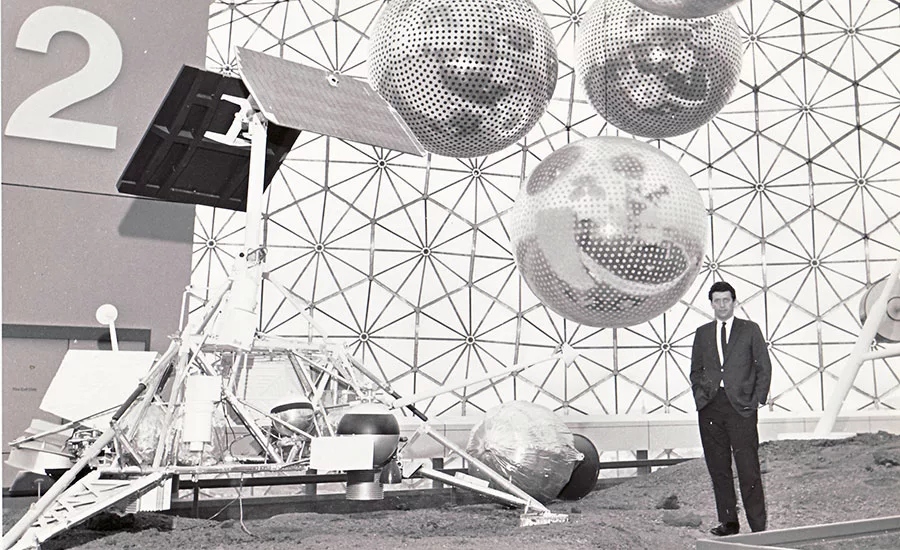
Jack Masey stands in front of the U.S. Pavilion’s space exhibit at the 1967 World Expo in Montreal.

Photo courtesy Mina Chow

February 21, 2018

“Architecture reflects who we are,” Mina Chow says in her new documentary, Face of a Nation, which premiers at Washington D.C.’s inaugural Architecture & Design Film Festival this week. The film, which makes connections between world fair architecture and national identity, examines the implications of the United States’ waning role in international expositions.

For Chow, who is an architect, the film is in many ways a personal investigation. Having been inspired to practice by photographs of her immigrant parents in front of the grand Unisphere at the 1964 New York World’s Fair, Chow posits that, historically, the United States has seized expos as opportunities to showcase technological prowess and artistic talent. She asserts that through these architectural displays, the international scene had come to view the U.S. as a land of hopeful opportunity.

Since the first world expo in 1851 in Hyde Park, London, universal expositions have become “runways of architecture,” serving as “battlefields for national pride,” says architect James Biber in the film. During the Cold War, the United States used its pavilions to outshine Communist enemies. Jack Masey’s model American kitchen at the expo in Moscow in 1959, Buckminster Fuller’s geodesic dome at the 1967 Montreal Expo, and the inflatable dome of the 1970 Osaka Expo, designed by architect Davis Brody and Chermayeff, Geismar & de Harak (and featuring a lunar rock brought back from the Apollo 12 mission), stand as powerful statements of American creativity and innovation.

But Chow, Biber, and other architects featured in the documentary, including Barton Myers and the late Masey (responsible for designing and organizing some of most memorable U.S. pavilions), argue that the United States’ diminishing effect at world fairs has weakened the image of American ingenuity and ambition. After the collapse of the Soviet Union, a misguided sense of victory had caused the U.S. to cease investing in its presence at expos, and the quality of its pavilions dwindled as funding and oversight became outsourced to private companies prioritizing corporate branding over technological innovation.

In the film, Chow visits the 2010 Expo in Shanghai, where it’s apparent that the United States’ influence at international fairs has been replaced by that of the rest of the world, particularly China, whose pavilion—a 200-foot high building inspired by the shape of an oriental crown, with features such as natural ventilation, a rooftop garden, and rainwater harvesting—was the largest ever built at an expo. France’s exhibition, home to six paintings and a sculpture on loan from the Musée d’Orsay, featured an ornate cross-patterned facade, while Latvia’s pavilion boasted a cylindrical exterior with an Aerodium wind tunnel centerpiece for visitors to enter. 

Chow’s thesis moves slowly, but crystallizes when we glimpse the U.S. pavilion, an unremarkable, 60,000-square-foot glass-and-steel structure designed by a Canadian architect, Clive Grout, and funded by private money collected from dozens of multinational corporations. The pavilion isn’t an expression of freedom, but, rather, of entrapped desperation, ingenuousness, and arrogance—perhaps an inadvertent metaphor for what the country currently represents. Through approaching the subject material as an architect investigating the death of the U.S. pavilion, Chow tells the story of a nation undergoing an identity crisis.

Looking for quick answers on architecture and design topics?
Try Ask RECORD, our new smart AI search tool.
Ask RECORD →

KEYWORDS: film review

Share This Story

Looking for a reprint of this article?
From high-res PDFs to custom plaques, order your copy today!
Post a comment to this article

Report Abusive Comment

Subscription Center
  • Create an Account
  • Start a Subscription
  • Manage My Account
  • Sign Up for Newsletters
  • Visit Customer Service
  • Update Preferences

More Videos

Sponsored Content

Sponsored Content is a special paid section where industry companies provide high quality, objective, non-commercial content around topics of interest to the Architectural Record audience. All Sponsored Content is supplied by the advertising company and any opinions expressed in this article are those of the author and not necessarily reflect the views of Architectural Record or its parent company, BNP Media. Interested in participating in our Sponsored Content section? Contact your local rep!

close
  • 3D configurator
    Sponsored byDoorBird

    How DoorBird’s 3D Configurator Is Redefining Customization Across Residential and Commercial Design

  • interior of modern office
    Sponsored byCurrent

    The Downlight's Second Life: Why Below-Ceiling Serviceability Is the Specification Detail That Matters Most

  • cold storage facility
    Sponsored byCarlisle SynTec Systems

    How Architects Can Design More Continuous Cold Storage Envelopes

DESIGN:ED Podcast
Listen to Architectural Record’s DESIGN:ED Podcast

Events

July 22, 2026

Water Containment Waterproofing: Best Practices and System Selection

Credits: 1 AIA LU/HSW; 1 AIBD P-CE; 0.1 ICC CEU

Examine waterproofing strategies for water containment structures that enhance durability, prevent failures, and support long-term building performance.

July 29, 2026

Adaptive Reuse Reimagined: Designing Multifamily Housing from Existing Buildings

Credits: 1 AIA LU/HSW; 1 AIBD P-CE; 0.1 ICC CEU; 1 IIBEC CEH

Examine adaptive reuse envelope strategies that improve energy performance, preserve architectural character, and transform existing buildings into high-performing multifamily housing.

View All Submit An Event

Products

Architectural Detailing: Function, Constructibility, Aesthetics, 4th Edition

Architectural Detailing: Function, Constructibility, Aesthetics, 4th Edition

See More Products

Popular Stories

7480 N Delaware

A Portland Apartment Building by Daniel Toole Architecture Stands as a Study in Adaptation

Goldring Woldenberg Park

Continuing Education: Postindustrial Waterfronts

Chacarita Alta Housing

In Paraguay’s Capital, MOS and Adamo-Faiden Rethink Public Housing for Residents of Informal Settlements

Kaya, San Diego

With San Diego’s Kaya, Jeff Svitak Melds Housing Density with Community

Tang Wing, NY Historical

RAMSA Completes an Inconspicuous Addition to the New York Historical

Water Containment Waterproofing: Best Practices and System Selection - Free Webinar - July 22, 2026

Related Articles

  • A Legacy of Mies and King

    Film Review: A Legacy of Mies and King

    See More
  • Film Review: A Master Builder

    See More
  • Film Review: Zipper: Coney Island's Last Wild Ride

    See More

Related Products

See More Products
  • book3.jpg

    If Architecture is a Language, Then a Building is a Story

  • image7.jpg

    Contemporary Architecture in China Towards A Critical Pragmatism

See More Products
×

The latest news and information

#1 Source for Architectural Design, News and Products

SUBSCRIBE
  • RESOURCES
    • Advertise
    • Contact Us
    • Submit
    • Store
  • ACCOUNT CENTER
    • Create an Account
    • Start a Subscription
    • Manage My Account
    • Sign Up for Newsletters
    • Visit Customer Service
    • Update Preferences
  • PRIVACY
    • PRIVACY POLICY
    • TERMS & CONDITIONS
    • DO NOT SELL MY PERSONAL INFORMATION
    • PRIVACY REQUEST
    • ACCESSIBILITY
  • SERVICES
    • Marketing Services
    • Reprints
    • Market Research
    • List Rental
    • Survey/Respondent Access
  • STAY CONNECTED
    • Linkedin
    • Facebook
    • Instagram
    • YouTube
    • X (Twitter)

Copyright ©2026. All Rights Reserved BNP Media, Inc. and BNP Media II, LLC.

Design, CMS, Hosting & Web Development :: ePublishing